
Keychains are more than just functional accessories—they’re personal statements, gifts, and sometimes even collectibles. In recent years, two styles have gained cult followings: the irresistibly soft potato plush keychain and the sharply detailed embroidered keychain. While both are charming in their own right, a critical question emerges: which one actually holds up over time? When subjected to daily wear, friction, moisture, and accidental drops, do fluffy cuteness win out, or does precision stitching prove superior?
This isn’t just about aesthetics—it’s about longevity. Whether you're buying for yourself, gifting a friend, or stocking a retail line, understanding material behavior under stress matters. Let’s break down both options with an eye toward real-world durability.
Material Composition: What Are You Really Holding?
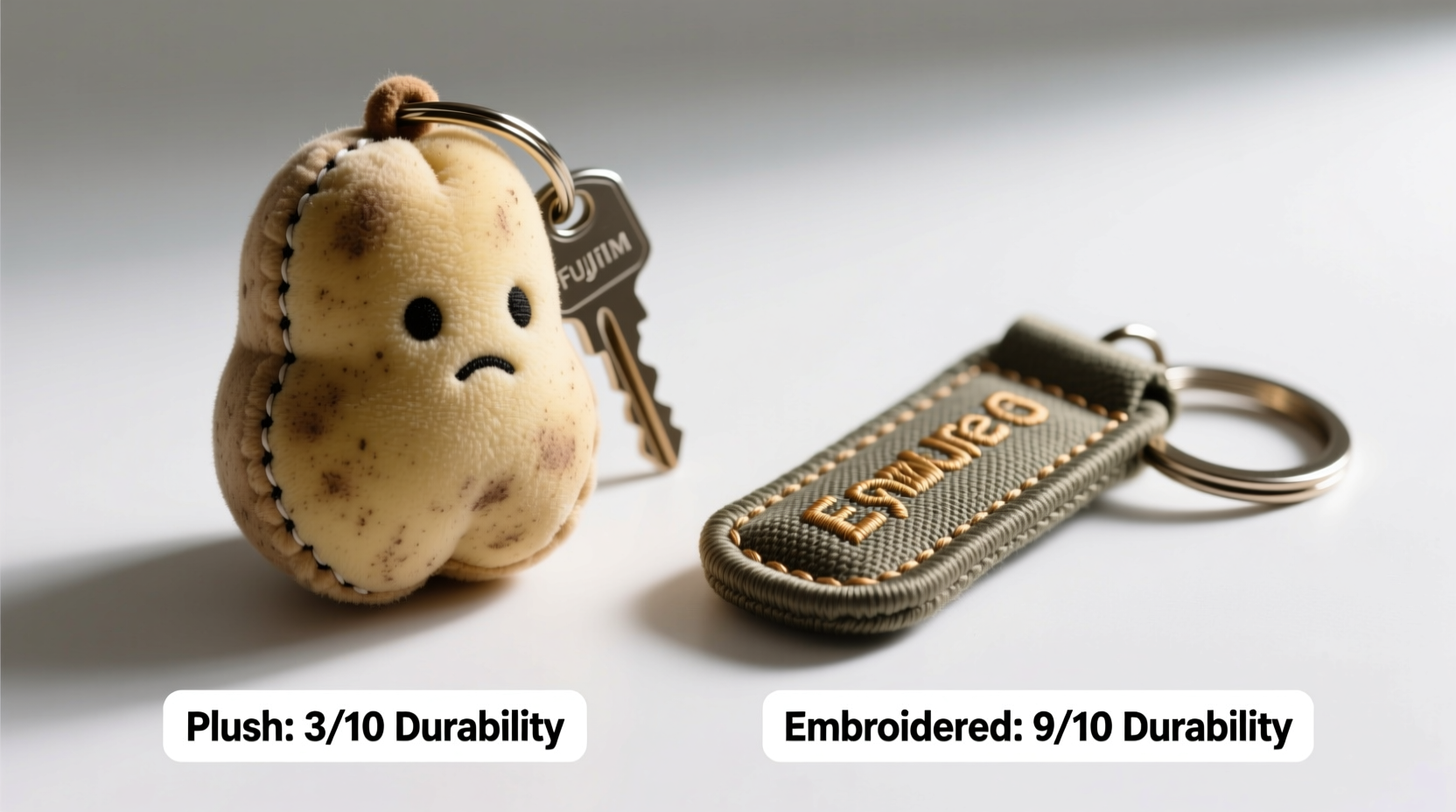
The foundation of any product’s lifespan lies in its materials. A plush keychain and an embroidered one may look similar at first glance—both often feature whimsical designs and vibrant colors—but their construction tells very different stories.
Potato plush keychains are typically made from synthetic polyester fleece or short-pile fabric, stuffed with polyfill. The soft exterior mimics a real potato’s roundness but prioritizes tactile comfort over structural resilience. These are designed to be squeezable, cuddly, and visually playful.
Embroidered keychains, on the other hand, use tightly woven fabric (like twill or felt) as a base, onto which intricate thread patterns are stitched by machine or hand. The design is part of the fabric itself, not printed or glued on. This method creates a flatter, firmer profile that resists peeling and fading better than many surface-level decorations.
Durability Face-Off: Stress Test Breakdown
To determine which keychain survives long-term use, consider how each responds to common stressors.
| Factor | Potato Plush Keychain | Embroidered Keychain |
|---|---|---|
| Fraying Resistance | Low – seams can unravel; stuffing may escape over time | High – tight stitching and sealed edges resist fraying |
| Color Retention | Moderate – dyes fade faster when exposed to sun or frequent washing | High – embroidery threads are UV-resistant and colorfast |
| Shape Retention | Poor – stuffing compresses; loses puffiness after months of use | Excellent – maintains flat, consistent shape indefinitely |
| Moisture Tolerance | Low – absorbs water, promotes mildew if not dried quickly | Moderate – resists dampness better; dries faster due to less bulk |
| Wear & Tear (Keys, Zippers) | Poor – fibers snag easily against metal edges | Good – smooth surface glides without catching |
While the plush version wins in initial appeal, the data shows embroidered keychains consistently outperform in environments involving friction, exposure, and mechanical contact.
Real-World Example: Six-Month Commuter Test
A small-scale durability trial followed two individuals using identical keyrings—one with a plush potato charm, the other with a custom embroidered mushroom design—attached to their daily commuter keys. Both users carried their keys in pockets alongside phones, wallets, and transit cards.
After three months, the plush keychain showed visible flattening, minor pilling on one side, and a loose thread near the eyelet. By month five, the seam began splitting, and polyfill started emerging through a tiny gap. At six months, it was retired due to hygiene concerns and structural failure.
The embroidered keychain, meanwhile, retained its original appearance. Slight edge wear was noted under magnification, but no functional damage occurred. It remained securely attached and fully intact throughout the test period.
“Textile-based accessories need to balance design and engineering. Embroidery, when done well, integrates decoration into structure.” — Dr. Lena Park, Textile Durability Researcher, MIT Materials Lab
Care & Maintenance: Can You Extend Their Life?
No accessory lasts forever, but proper care can delay deterioration. However, maintenance difficulty varies drastically between the two types.
Potato Plush Keychain Care Tips
- Hand wash only in cold water with mild detergent
- Air dry completely before reuse—never machine dry
- Store separately to avoid fiber transfer or snagging
- Trim loose threads carefully; don’t pull
Embroidered Keychain Care Tips
- Spot clean with damp cloth and gentle soap
- Use a soft brush for dirt buildup along edges
- Can withstand occasional light machine wash (in a mesh bag)
- Lay flat to dry—prevents warping of backing material
Step-by-Step Guide: Choosing the Right Keychain for Your Lifestyle
Not all users subject their accessories to the same conditions. Use this decision framework to match your needs with the best option.
- Assess Your Daily Routine: Do you carry keys in a crowded bag or pocket? High-contact environments favor embroidered models.
- Evaluate Exposure: Will the keychain face sunlight, rain, or sweat? Moisture-prone settings reduce plush longevity.
- Consider Emotional Value: Is it a sentimental gift? Plush items offer stronger emotional connection despite shorter life.
- Check Attachment Quality: Regardless of type, a weak split ring or poorly secured loop defeats all other advantages.
- Test Before Committing: If possible, purchase one of each and trial them side-by-side for four weeks.
When to Choose Each Type: A Practical Checklist
Use this checklist to make a confident choice based on your priorities.
Choose a Potato Plush Keychain If:
- You value soft texture and whimsy over function
- It’s primarily decorative (e.g.,挂在包上 but rarely handled)
- You’re giving it as a lighthearted gift
- You commit to regular, gentle maintenance
Choose an Embroidered Keychain If:
- You want a long-lasting, low-maintenance accessory
- It will be used daily with keys or zippers
- You prefer sharp, detailed designs that won’t peel
- You live in a humid or rainy climate
Frequently Asked Questions
Can I repair a damaged plush keychain?
Yes, minor tears can be sewn shut with a needle and thread, and lost stuffing replaced if access is available. However, repairs often affect appearance and aren’t always worth the effort given the low cost of replacements.
Do embroidered keychains ever come apart?
Rarely—if made with quality control. Poorly stitched versions may have loose ends that unravel, but industrial-grade embroidery uses lock stitches that prevent this. Look for finished backs with no exposed raw edges.
Are potato plush keychains safe for kids?
Generally yes, but supervise young children. Small eyes or buttons can detach, and the stuffing poses a choking hazard if the outer fabric ruptures.
Final Verdict: Function Meets Longevity
If longevity is your primary concern, the embroidered keychain is the clear winner. Its construction resists environmental stressors, requires minimal upkeep, and maintains aesthetic integrity far longer than plush alternatives. It’s engineered to endure.
The potato plush keychain, while undeniably endearing, functions more like a seasonal accessory than a permanent fixture. It brings joy through touch and novelty but sacrifices resilience. Think of it as the fast fashion of keychains—fun now, possibly gone in six months.
That doesn’t mean plush has no place. Sentimental value, sensory comfort, and visual humor matter. But if you’re asking what “will actually hold up,” the answer leans decisively toward embroidery.




 浙公网安备
33010002000092号
浙公网安备
33010002000092号 浙B2-20120091-4
Comments
No comments yet. Why don't you start the discussion?