
Temperature affects everything from weather forecasts to cooking times and scientific experiments. While many countries use the Celsius scale, others—like the United States—rely on Fahrenheit. Knowing how to convert between the two is essential for travelers, cooks, students, and professionals alike. The good news: it doesn’t require advanced math. With a few simple techniques, anyone can make accurate conversions quickly and confidently.
Understanding the Celsius and Fahrenheit Scales
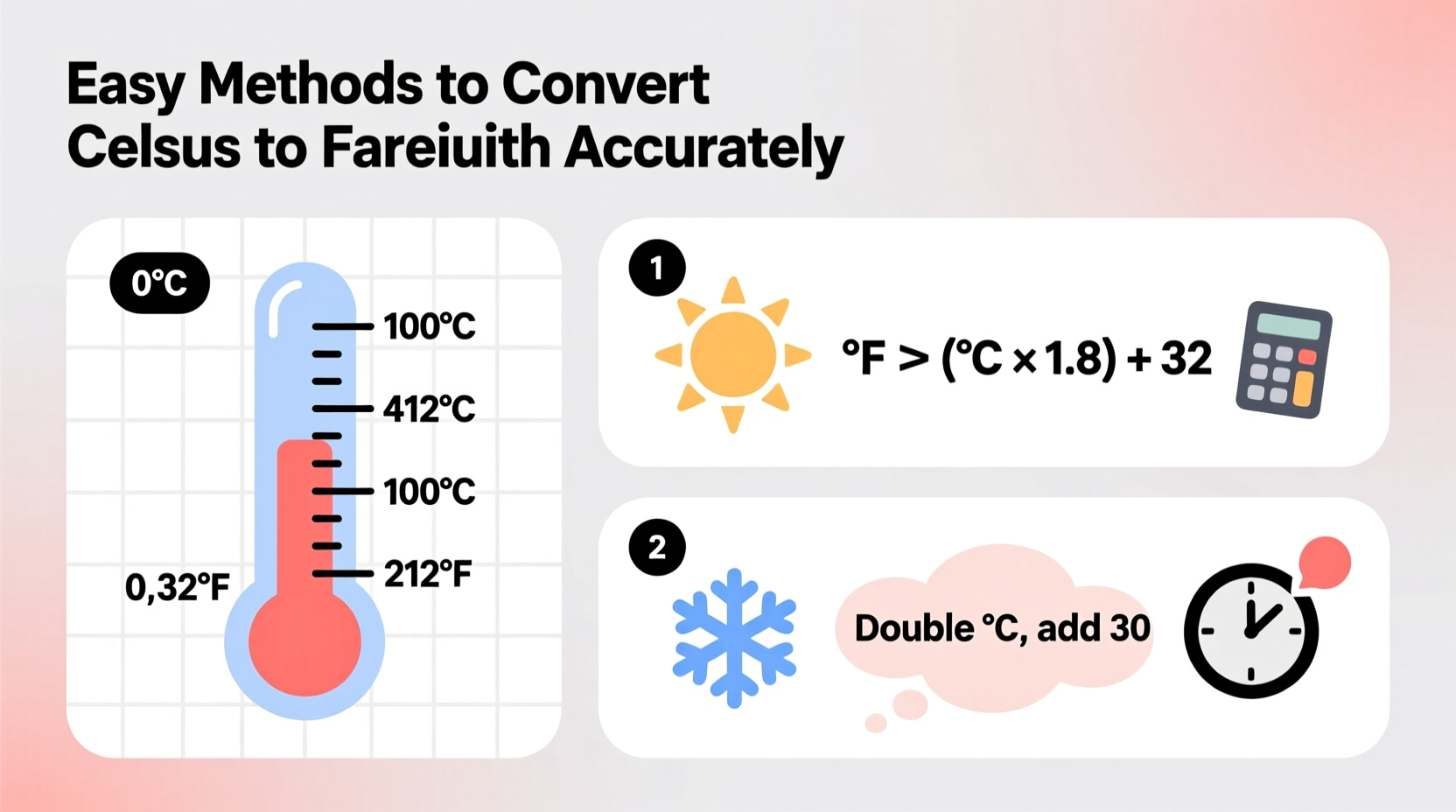
The Celsius (°C) scale is based on the freezing and boiling points of water: 0°C for freezing and 100°C for boiling at sea level. It’s part of the metric system and used globally in science and daily life. The Fahrenheit (°F) scale, developed earlier, sets the freezing point of water at 32°F and the boiling point at 212°F.
This difference in reference points means direct comparisons aren't intuitive. A warm day of 25°C feels pleasant, but that's 77°F—not immediately obvious without conversion. Grasping the logic behind each scale helps contextualize the numbers beyond mere calculation.
The Standard Conversion Formula (And How to Use It)
The most accurate way to convert Celsius to Fahrenheit is using the formula:
°F = (°C × 9/5) + 32
This equation scales the Celsius value to match Fahrenheit's larger degree intervals (since there are 180 degrees between freezing and boiling in Fahrenheit vs. 100 in Celsius), then adjusts for the 32-degree offset at freezing.
Example: Convert 20°C to Fahrenheit.
(20 × 9/5) = 36
36 + 32 = 68°F
This method works for any value and is ideal when precision matters—such as in lab reports, medical readings, or engineering calculations.
“Even small temperature errors can compound in scientific work. Always verify your conversions.” — Dr. Lena Patel, Climate Research Scientist
Quick Mental Shortcuts for Everyday Use
Not every situation calls for exact arithmetic. When you're checking the weather or adjusting an oven, speed often trumps precision. These simplified methods deliver close estimates with minimal effort.
Doubling and Adding 30 (Approximation Method)
A widely used shortcut: double the Celsius temperature and add 30.
Formula (approximate): °F ≈ (°C × 2) + 30
Example: 22°C → (22 × 2) + 30 = 44 + 30 = 74°F
Actual value: 71.6°F — only 2.4°F off.
This method is easiest to do mentally and gives results within 2–4 degrees of accuracy for typical weather temperatures (10°C to 30°C).
The “Add 40, Convert, Subtract 40” Trick
This clever technique leverages the fact that -40°C = -40°F. By shifting the scale temporarily, multiplication becomes reversible.
- Add 40 to the Celsius temperature.
- Multiply by 9/5 (or 1.8).
- Subtract 40.
Example: Convert 15°C.
15 + 40 = 55
55 × 1.8 = 99
99 - 40 = 59°F
Exact result: 59°F — perfect.
While slightly more steps, this method reduces cognitive load by unifying the logic between scales.
Step-by-Step Guide: Converting Any Temperature Accurately
Follow this sequence to ensure consistent, error-free results—especially important when teaching others or working under pressure.
- Identify the Celsius value you want to convert (e.g., 37°C).
- Multiply by 9: 37 × 9 = 333.
- Divide by 5: 333 ÷ 5 = 66.6.
- Add 32: 66.6 + 32 = 98.6°F.
This breakdown avoids decimal confusion early on. Alternatively, multiply by 1.8 directly if using a calculator: 37 × 1.8 = 66.6, then +32 = 98.6°F.
This process confirms normal human body temperature—long cited as 98.6°F, though recent studies suggest average may be closer to 97.9–98.2°F depending on individual and time of day.
Common Pitfalls and How to Avoid Them
Even simple conversions go wrong when assumptions creep in. Below are frequent mistakes and corrections.
| Mistake | Why It’s Wrong | Correct Approach |
|---|---|---|
| Forgetting to add 32 | Results in underestimating by over 30 degrees | Always include the +32 step after scaling |
| Using ×2 instead of ×1.8 | Introduces growing error at higher temps | Use ×1.8 or 9/5 for accuracy; reserve ×2 for rough estimates |
| Confusing C→F with F→C | Leads to wildly incorrect outputs | Reverse formula: °C = (°F – 32) × 5/9 |
| Rounding too early | Compromises final precision | Keep decimals until the last step |
Real-World Example: Cooking Across Borders
Sophie, a home baker in London, found a delicious American cookie recipe calling for baking at 350°F. Her oven uses Celsius, so she needed an accurate conversion.
Using the standard formula:
(350 – 32) = 318
318 × 5/9 = 176.66… ≈ 177°C
She set her oven to 180°C—the closest available setting—and adjusted baking time slightly downward. The cookies turned out perfectly golden. Later, she created a kitchen cheat sheet with common oven temperatures for future reference.
This example shows how accurate conversion prevents ruined dishes and builds confidence when adapting foreign recipes.
Checklist: Mastering Celsius to Fahrenheit Conversion
- ✅ Memorize the formula: °F = (°C × 9/5) + 32
- ✅ Practice with common values: room temp, body temp, freezing, boiling
- ✅ Use doubling + 30 for fast weather estimates
- ✅ Double-check critical conversions (medical, industrial, scientific)
- ✅ Keep a reference table handy for ovens or travel planning
- ✅ Verify direction: know whether you’re converting C→F or F→C
Frequently Asked Questions
Is there a temperature where Celsius and Fahrenheit are equal?
Yes. At -40 degrees, both scales read the same: -40°C = -40°F. This unique intersection occurs because the linear relationship between the scales crosses at that point.
Why does the U.S. still use Fahrenheit?
The U.S. retains Fahrenheit due to historical precedent and cultural inertia. Although the metric system is taught and used in science, everyday applications like weather, cooking, and signage remain in Fahrenheit. Transition costs and public familiarity have slowed full adoption of Celsius.
Can I rely on smartphone weather apps for accurate conversions?
Most reputable apps perform accurate conversions automatically. However, some third-party widgets or older devices may round aggressively or display outdated data. When precision matters, verify manually using the formula.
Final Thoughts: Build Confidence Through Practice
Converting Celsius to Fahrenheit doesn’t require special tools or advanced training. Whether you use the exact formula, a mental shortcut, or a combination of both, the key is consistency and awareness of context. In the kitchen, a few degrees might not matter. In a lab or hospital, they can be critical.
Start by practicing with daily temperatures. Notice how 10°C feels cool (50°F), 20°C is comfortable (68°F), and 30°C is hot (86°F). Over time, these associations build intuition. Pair that with occasional deliberate calculation, and conversion becomes second nature.




 浙公网安备
33010002000092号
浙公网安备
33010002000092号 浙B2-20120091-4
Comments
No comments yet. Why don't you start the discussion?