
Solving systems of two equations is a foundational skill in algebra, essential not only for academic success but also for real-world problem-solving in fields like engineering, economics, and data analysis. Whether you're dealing with linear equations or preparing for standardized tests, mastering step-by-step techniques ensures clarity and accuracy. This guide walks through proven methods, common pitfalls, and practical strategies that lead to reliable results every time.
Understanding the Goal: What Does Solving Two Equations Mean?
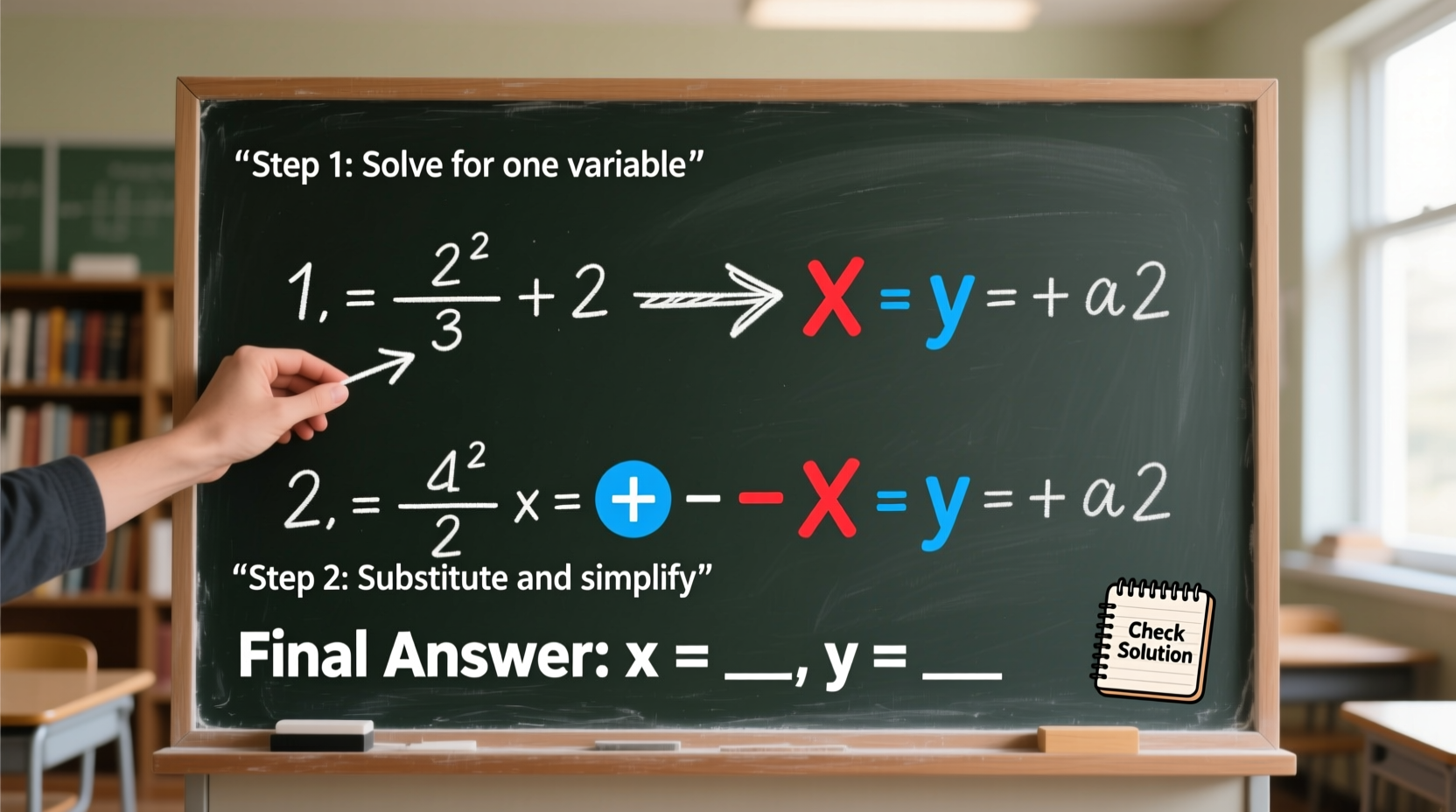
When presented with two equations—typically involving two variables (like x and y)—the objective is to find the values of those variables that satisfy both equations simultaneously. The solution represents the point where the graphs of the two equations intersect on a coordinate plane. Most commonly, these are linear equations forming straight lines, and their intersection is a single point—if it exists.
For example:
- Equation 1: \\( 2x + y = 7 \\)
- Equation 2: \\( x - y = 1 \\)
The goal is to determine the unique pair (x, y) that makes both equations true at once.
Core Methods for Solving Two Equations
There are three primary techniques used to solve systems of two equations: substitution, elimination, and graphing. Each has its strengths depending on the structure of the equations.
1. Substitution Method
This method works well when one equation can easily be solved for one variable.
- Solve one equation for one variable (e.g., solve for y in terms of x).
- Substitute this expression into the other equation.
- Solve the resulting single-variable equation.
- Plug the result back into one of the original equations to find the second variable.
Example:
Given:
\\( y = 3x - 5 \\) (already solved for y)
\\( 2x + y = 10 \\)
Substitute first into second:
\\( 2x + (3x - 5) = 10 \\)
\\( 5x - 5 = 10 \\)
\\( 5x = 15 \\Rightarrow x = 3 \\)
Now substitute back: \\( y = 3(3) - 5 = 4 \\)
Solution: \\( (3, 4) \\)
2. Elimination Method
Also known as the addition method, this technique combines equations to eliminate one variable.
- Align like terms vertically.
- Multiply one or both equations by constants so that coefficients of one variable are opposites.
- Add the equations to eliminate one variable.
- Solve for the remaining variable.
- Substitute back to find the other.
Example:
\\( 3x + 2y = 12 \\)
\\( 4x - 2y = 2 \\)
Add them directly:
\\( (3x + 4x) + (2y - 2y) = 12 + 2 \\)
\\( 7x = 14 \\Rightarrow x = 2 \\)
Substitute into first equation:
\\( 3(2) + 2y = 12 \\Rightarrow 6 + 2y = 12 \\Rightarrow 2y = 6 \\Rightarrow y = 3 \\)
Solution: \\( (2, 3) \\)
3. Graphical Method
This visual approach involves plotting both equations on the same coordinate grid and identifying the intersection point.
While intuitive, graphing is less precise unless done digitally. It’s best used for estimation or verification rather than exact solutions. However, it provides valuable insight into the nature of solutions:
- One solution: lines intersect at a single point.
- No solution: parallel lines (same slope, different intercepts).
- Infinite solutions: identical lines (same slope and intercept).
Step-by-Step Guide: A Reliable Process for Any Problem
To consistently solve systems of two equations, follow this structured timeline:
- Write both equations clearly. Ensure they’re in standard form (\\(Ax + By = C\\)) or slope-intercept form (\\(y = mx + b\\)).
- Choose the most efficient method:
- Use substitution if one variable is isolated.
- Use elimination if coefficients align or can be easily matched.
- Perform algebraic operations carefully. Track signs and distribute multiplication correctly.
- Solve for one variable. Simplify completely before moving on.
- Back-substitute to find the other variable.
- Verify your solution. Plug both values into the original equations to confirm they work.
Common Pitfalls and How to Avoid Them
Even experienced students make mistakes when solving systems. Here's a breakdown of frequent errors and how to prevent them:
| Pitfall | Why It Happens | How to Fix It |
|---|---|---|
| Incorrect sign during substitution | Forgetting to apply negative signs when substituting expressions | Use parentheses around substituted expressions: e.g., \\(2x + (-3x + 4)\\) |
| Unequal coefficient mismatch in elimination | Failing to multiply all terms in an equation | Multiply every term, including constants, when scaling equations |
| Arithmetic errors | Rushing through basic math steps | Double-check each line; write out all steps clearly |
| Forgetting to verify the solution | Assuming correctness after solving | Always plug the solution back into both equations |
Real-World Application: A Mini Case Study
Consider a small business owner who sells handmade candles and soaps at a local market. She knows that:
- She sold a total of 50 items last weekend.
- She earned $370, with candles priced at $9 each and soaps at $6 each.
She wants to know how many of each item she sold. This scenario translates into a system of two equations:
- \\( c + s = 50 \\) (total items)
- \\( 9c + 6s = 370 \\) (total revenue)
Using elimination:
Multiply first equation by 6:
\\( 6c + 6s = 300 \\)
Subtract from second equation:
\\( (9c + 6s) - (6c + 6s) = 370 - 300 \\)
\\( 3c = 70 \\Rightarrow c = 23.\\overline{3} \\)
Wait—that’s not a whole number. Something’s wrong.
Rechecking the math reveals no error in process, which suggests either incorrect data or non-integer solution. But since she can’t sell a third of a candle, she reviews her records and realizes she actually made $360, not $370.
Corrected: \\( 9c + 6s = 360 \\)
Now: \\( 9c + 6s - (6c + 6s) = 360 - 300 \\Rightarrow 3c = 60 \\Rightarrow c = 20 \\)
Then \\( s = 50 - 20 = 30 \\)
Verification: \\( 9(20) + 6(30) = 180 + 180 = 360 \\)
Conclusion: She sold 20 candles and 30 soaps. Accurate setup and verification prevented a misleading conclusion.
Expert Insight: Why Clarity Matters in Equation Solving
“Students often focus only on getting *an* answer, but the real skill lies in developing a logical, transparent process. When each step is clear and justified, errors become easier to spot and correct.” — Dr. Alan Reyes, Mathematics Education Specialist
Essential Checklist for Solving Two Equations
Before finalizing your solution, run through this checklist:
- ✅ Are both equations written clearly and aligned properly?
- ✅ Have I chosen the most efficient method (substitution or elimination)?
- ✅ Did I distribute multiplication across all terms when needed?
- ✅ Did I keep track of positive and negative signs?
- ✅ Did I solve fully for one variable before substituting?
- ✅ Did I verify the solution in both original equations?
- ✅ Is my final answer presented as an ordered pair (x, y)?
Frequently Asked Questions
What if the system has no solution?
This occurs when the lines are parallel—same slope, different y-intercepts. Algebraically, you’ll end up with a contradiction like \\( 0 = 5 \\), indicating no solution exists.
Can a system have infinitely many solutions?
Yes. If both equations represent the same line (one is a multiple of the other), then every point on the line is a solution. You’ll see identities like \\( 0 = 0 \\) after simplification.
Which method is fastest?
It depends. Substitution is quick when one variable is isolated. Elimination is often faster when coefficients are simple or already opposites. Practice helps you judge the best path quickly.
Final Thoughts and Call to Action
Solving two equations doesn’t have to be intimidating. With consistent practice and a disciplined step-by-step approach, anyone can master this fundamental skill. The key is not just arriving at an answer, but understanding the logic behind each move. Whether you're studying for a test, analyzing data, or managing personal finances, these techniques build confidence and precision.




 浙公网安备
33010002000092号
浙公网安备
33010002000092号 浙B2-20120091-4
Comments
No comments yet. Why don't you start the discussion?