
Power is more than a physics concept—it’s embedded in daily life, from charging your phone to running household appliances and even measuring your physical effort during exercise. Understanding how to calculate and interpret power helps you make informed decisions about energy use, efficiency, and personal performance. This guide breaks down the fundamentals of power and offers actionable ways to apply them in real-world situations.
What Is Power? A Simple Definition
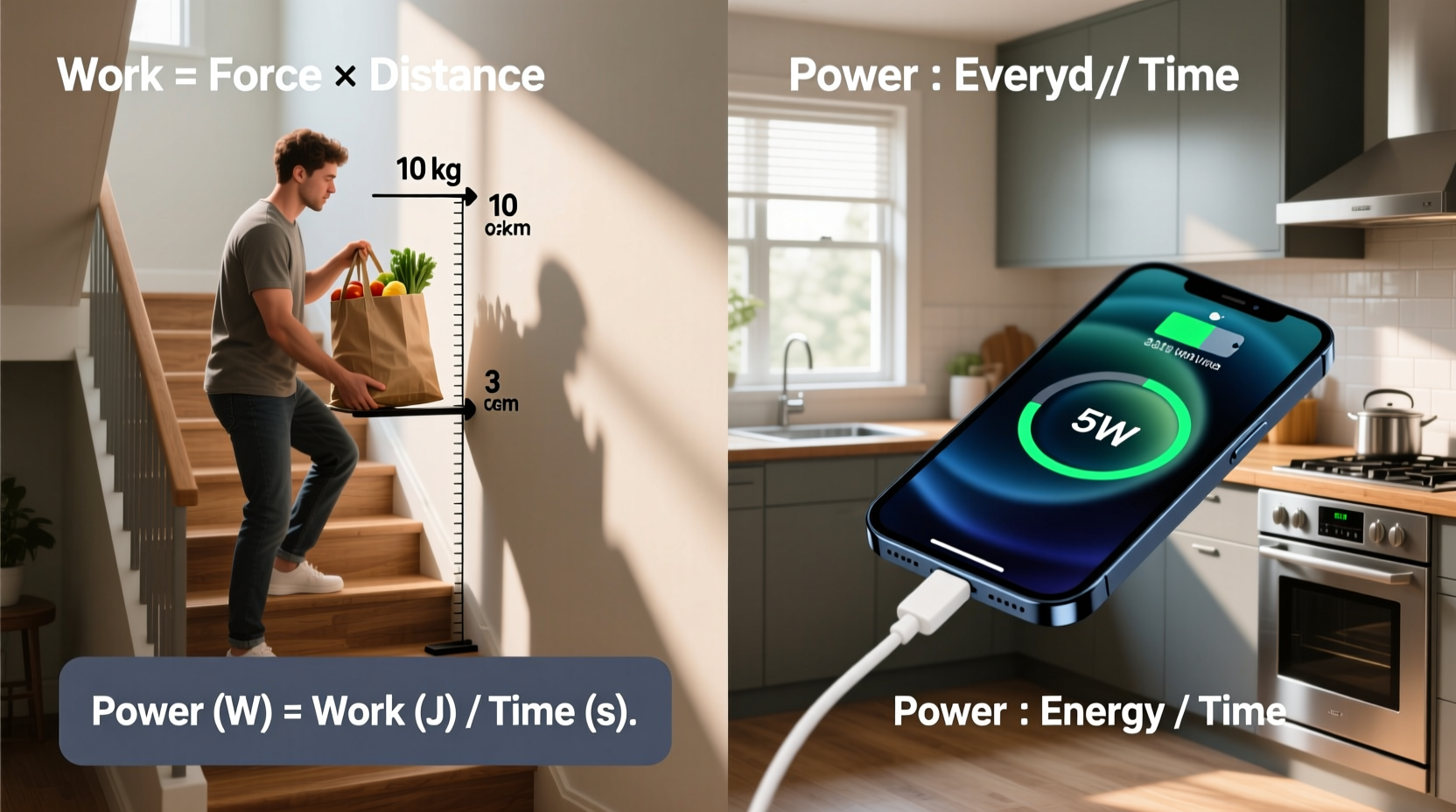
In physics, power measures how quickly work is done or energy is transferred. It’s expressed in watts (W), where one watt equals one joule per second. While that sounds technical, it translates simply: power tells you the rate at which something consumes or produces energy.
For example, a 60-watt light bulb uses 60 joules of electrical energy every second. A more powerful device, like a microwave rated at 1,000 watts, transfers energy ten times faster than a 100-watt incandescent bulb. Knowing this helps you estimate energy costs, compare appliance efficiency, and even gauge physical exertion.
“Power isn’t just about strength—it’s about how fast energy moves. That principle applies whether you’re climbing stairs or running a refrigerator.” — Dr. Lena Torres, Energy Systems Engineer
Calculating Electrical Power at Home
Most people interact with power through electricity bills and appliance labels. The formula for electrical power is straightforward:
Power (W) = Voltage (V) × Current (A)
In household circuits (typically 120V in North America), if a device draws 2 amps, its power consumption is 240 watts. Many devices list their wattage directly on labels or manuals, but when they don’t, using a multimeter or plug-in power meter can give you accurate readings.
Common Household Devices and Their Power Ratings
| Device | Average Power (Watts) | Typical Daily Use (Hours) | Daily Energy (Wh) |
|---|---|---|---|
| Led Light Bulb | 10 | 5 | 50 |
| Laptop | 50 | 6 | 300 |
| Refrigerator | 150 (cyclical) | 8 (active) | 1,200 |
| Microwave | 1,000 | 0.25 | 250 |
| Clothes Dryer | 3,000 | 0.5 | 1,500 |
To calculate total daily energy use, multiply each device’s power by its usage time. Summing these gives your approximate kilowatt-hour (kWh) consumption, which utilities use for billing. For instance, the above devices total about 3.3 kWh/day—just under 100 kWh/month, costing roughly $13 at $0.13/kWh.
Estimating Human Power Output
Humans also generate power—especially during physical activity. Whether cycling, climbing stairs, or lifting weights, your body converts chemical energy into mechanical work. You can estimate your mechanical power output using:
Power (W) = Work (J) / Time (s)
Where Work = Force × Distance
Step-by-Step Guide: Measuring Stair-Climbing Power
- Measure your body weight in kilograms (e.g., 70 kg).
- Convert to force: Multiply by gravity (9.8 m/s²). So 70 × 9.8 = 686 newtons.
- Measure vertical height climbed (e.g., 3 meters in a staircase).
- Calculate work: 686 N × 3 m = 2,058 joules.
- Time yourself ascending (e.g., 5 seconds).
- Divide work by time: 2,058 J ÷ 5 s ≈ 412 watts.
This means you generated over 400 watts of power briefly—comparable to a high-end blender. Sustained human power output is much lower; elite cyclists average 400–500 watts over an hour, while most adults sustain 100–150 watts during vigorous exercise.
Real-World Example: Solar Panel Sizing for a Small Cabin
Mark lives off-grid in a rural cabin. He wants to install solar panels but needs to know how much power he actually uses. Using plug meters, he logs his devices:
- LED lights: 20 W × 4 hours = 80 Wh
- Fridge: 100 W × 6 active hours = 600 Wh
- Laptop: 60 W × 3 hours = 180 Wh
- Phone charger: 10 W × 2 hours = 20 Wh
Total daily energy need: ~880 watt-hours. To supply this, Mark needs solar panels that produce at least 880 Wh per day. Assuming 4 peak sunlight hours, he divides total energy by sun hours: 880 ÷ 4 = 220 watts. Accounting for inefficiencies (dirt, angle, battery loss), he installs a 300-watt solar array with a charge controller and 12V battery bank.
This practical calculation ensures reliability without overspending—a direct application of power understanding.
Energy Efficiency and Power: Making Smarter Choices
High power doesn’t always mean better performance. Efficiency matters. A 1,500-watt heater may warm a room faster than a 1,000-watt model, but if both achieve the same result, the lower-wattage unit saves energy. Similarly, LED bulbs use 80% less power than incandescent ones for the same brightness.
Do’s and Don’ts of Power Management
| Do | Don't |
|---|---|
| Compare wattage when buying appliances | Assume higher wattage means better quality |
| Use power strips to cut phantom load | Leave chargers plugged in indefinitely |
| Check ENERGY STAR ratings for efficiency | Run half-empty dishwashers or washing machines |
| Track usage with smart plugs | Ignore cumulative small loads (e.g., multiple low-power devices) |
“Efficiency starts with awareness. Once you see how much power things really use, you start making smarter choices.” — Raj Patel, Sustainable Living Consultant
FAQ
What’s the difference between power and energy?
Power is the rate at which energy is used (measured in watts), while energy is the total amount consumed over time (measured in watt-hours or kilowatt-hours). Think of power as speed and energy as distance traveled.
Can I reduce my power bill without changing appliances?
Yes. Reduce usage time, unplug idle electronics, use natural lighting, and shift high-power tasks to off-peak hours. Behavioral changes alone can cut energy use by 10–20%.
Is human power a viable energy source?
On a small scale—like pedal-powered phone chargers or emergency radios—yes. But human power output is too low (typically under 100 watts sustained) to replace grid electricity meaningfully.
Conclusion: Take Control of Your Power Knowledge
Understanding and calculating power isn’t reserved for engineers or scientists. It’s a practical skill that empowers smarter decisions—about energy bills, appliance purchases, fitness goals, and environmental impact. By applying simple formulas, observing real usage, and thinking critically about efficiency, you gain control over one of the most fundamental forces in modern life.




 浙公网安备
33010002000092号
浙公网安备
33010002000092号 浙B2-20120091-4
Comments
No comments yet. Why don't you start the discussion?