
Accurate measurement is essential in construction, science, engineering, and even everyday tasks like cooking or home improvement. The metric system, with the meter as its base unit of length, is used globally for consistency and precision. However, many people still encounter measurements in inches, feet, yards, or miles—especially in countries that use imperial units. Knowing how to convert these into meters efficiently ensures accuracy and avoids costly errors. This guide breaks down practical, reliable methods to convert any length measurement into meters, using tools, formulas, and smart habits anyone can adopt.
Understanding the Meter and Its Role in Measurement
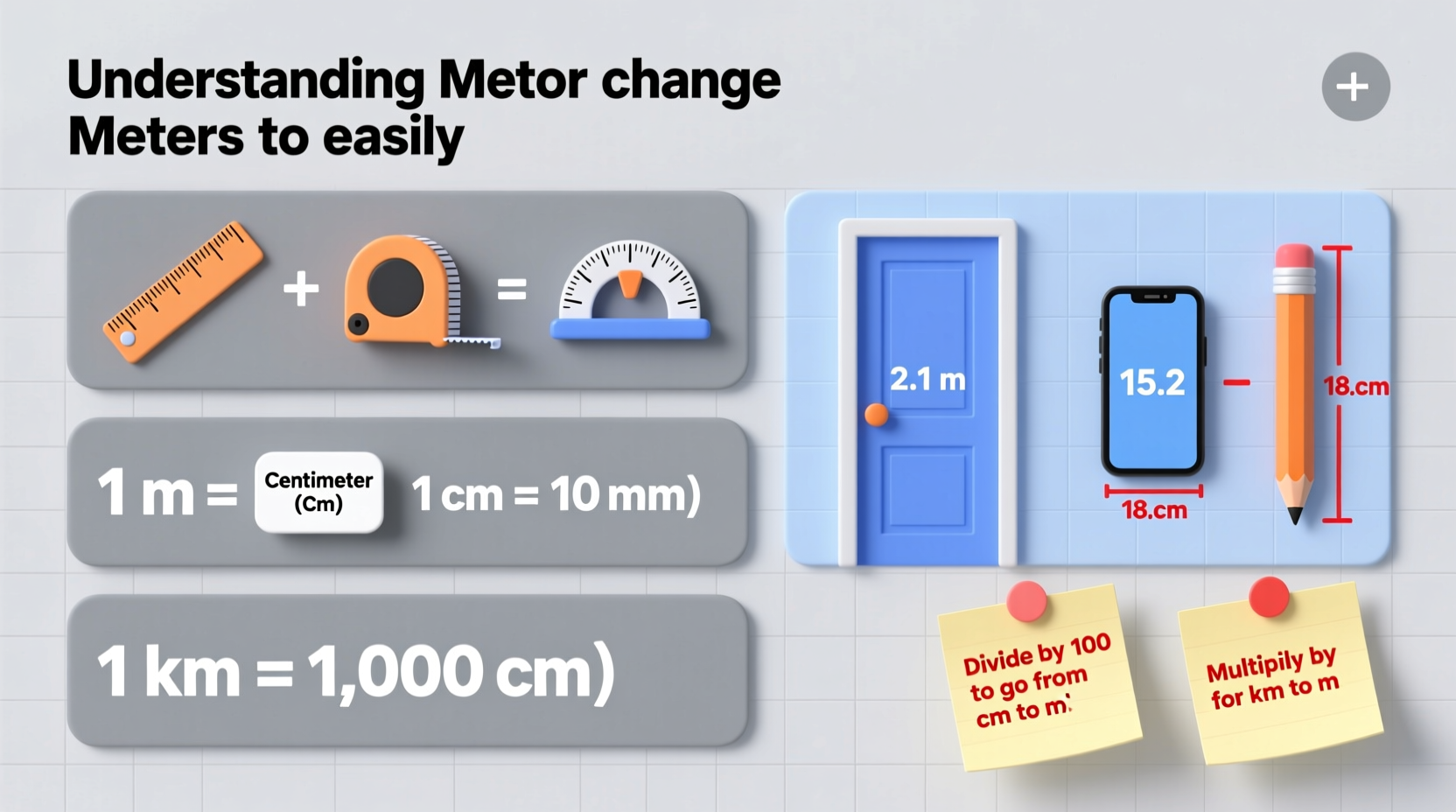
The meter is the fundamental unit of length in the International System of Units (SI). It was originally defined in the 18th century as one ten-millionth of the distance from the equator to the North Pole along a meridian. Today, it’s defined by the speed of light in a vacuum: exactly 299,792,458 meters per second. This universal standard makes the meter ideal for scientific work, international trade, and global communication.
Because the metric system is decimal-based, conversions within it—such as from centimeters to meters or kilometers to meters—are straightforward. But converting non-metric units requires specific multipliers. Understanding these relationships is the first step toward mastering conversions.
Common Conversion Factors for Length
To convert any measurement into meters, you need to know the correct conversion factor. Below is a reference table showing key equivalents:
| Unit | Equivalent in Meters | Multiplication Factor |
|---|---|---|
| 1 inch | 0.0254 m | Multiply inches by 0.0254 |
| 1 foot | 0.3048 m | Multiply feet by 0.3048 |
| 1 yard | 0.9144 m | Multiply yards by 0.9144 |
| 1 mile | 1,609.344 m | Multiply miles by 1,609.344 |
| 1 centimeter | 0.01 m | Divide cm by 100 |
| 1 kilometer | 1,000 m | Multiply km by 1,000 |
These values are standardized and recognized internationally. Memorizing the most common ones—like 1 foot = 0.3048 meters—can speed up mental calculations when working on projects without access to digital tools.
Step-by-Step Guide to Convert Any Measurement to Meters
Whether you’re measuring fabric, planning a garden layout, or reading blueprints, follow this logical sequence to ensure accurate conversions every time:
- Identify the original unit – Determine whether your measurement is in inches, feet, yards, miles, centimeters, or another unit.
- Choose the correct conversion factor – Refer to the table above or a trusted source for the precise multiplier.
- Perform the calculation – Multiply or divide the value using the appropriate factor.
- Round if necessary – For practical purposes, round to two or three decimal places unless high precision is required.
- Verify your result – Use an alternative method (e.g., online converter) to confirm accuracy.
For example, converting 75 inches to meters:
- 75 × 0.0254 = 1.905 meters
Or converting 15 feet:
- 15 × 0.3048 = 4.572 meters
“Precision in measurement starts with consistent unit conversion. A small error in translation can lead to structural flaws or safety risks.” — Dr. Lena Patel, Civil Engineering Consultant
Practical Tips for Everyday Use
You don’t need advanced math skills to convert measurements effectively. These actionable tips make the process faster and more reliable:
- Use mobile apps – Download unit converter apps that work offline and support multiple systems.
- Leverage search engines – Type “5 feet in meters” directly into Google for instant results.
- Memorize key benchmarks – Remember that 3 feet ≈ 0.9 m, 10 feet ≈ 3 m, and 1 inch ≈ 2.5 cm.
- Label mixed-unit plans clearly – When reviewing architectural drawings with both imperial and metric units, annotate converted values directly on the document.
- Teach kids early – Introduce children to dual-unit rulers to build familiarity with both systems.
Real-World Example: Renovating a Living Room
Sarah, a homeowner in Texas, decided to renovate her living room. She found beautiful European flooring sold in square meters, but her room dimensions were measured in feet. Her space was 12 feet wide by 18 feet long.
She followed these steps:
- Converted each dimension: 12 ft × 0.3048 = 3.6576 m; 18 ft × 0.3048 = 5.4864 m
- Calculated area: 3.6576 × 5.4864 ≈ 20.07 square meters
- Ordered 22 sq m of flooring to account for waste and cuts
By converting accurately, she avoided under-ordering and ensured a smooth installation. This scenario highlights how simple conversions empower better decision-making in real-life situations.
Do’s and Don’ts When Converting Measurements
| Do’s | Don’ts |
|---|---|
| Double-check conversion factors before calculating | Assume all inches-to-meters conversions are approximate without verifying |
| Use calculators or apps for complex numbers | Round too early in multi-step calculations |
| Write down intermediate steps to track progress | Convert without identifying the starting unit first |
| Store frequently used conversions in notes | Rely solely on memory for critical projects |
Frequently Asked Questions
How do I convert my height from feet and inches to meters?
First, convert your height entirely into inches. For example, 5 feet 10 inches equals 70 inches. Then multiply by 0.0254: 70 × 0.0254 = 1.778 meters. So, 5'10\" is approximately 1.78 meters tall.
Is there a quick way to estimate meters from feet?
Yes. Divide the number of feet by 3 for a rough approximation. For instance, 9 feet ÷ 3 = 3 meters (actual: 2.74 m). This gives a close-enough figure for casual use, though not suitable for technical work.
Can I convert meters back to imperial units?
Absolutely. To go from meters to feet, multiply by 3.28084. For example, 2 meters × 3.28084 = 6.56168 feet (about 6 feet 7 inches).
Final Checklist: Mastering Measurement Conversion
Before finalizing any project involving unit conversion, run through this checklist:
- ☑ Identified the original measurement unit correctly
- ☑ Selected the accurate conversion factor
- ☑ Performed the calculation carefully
- ☑ Rounded only after completing all steps
- ☑ Verified the result using a secondary method
- ☑ Documented the converted value clearly for future reference
Conclusion: Take Control of Your Measurements
Converting measurements to meters doesn’t require advanced training—just attention to detail and the right tools. Whether you're building furniture, traveling abroad, or interpreting scientific data, the ability to switch confidently between systems enhances your competence and reduces mistakes. Start practicing today: convert a few household items’ dimensions, check product specs in meters, or teach someone else the basics. Accuracy begins with awareness, and mastery comes with repetition.




 浙公网安备
33010002000092号
浙公网安备
33010002000092号 浙B2-20120091-4
Comments
No comments yet. Why don't you start the discussion?