
In environments where precision matters—such as crafting, DIY repairs, or fieldwork—having access to a ruler or caliper isn’t always possible. Yet, accurate measurement in millimeters can still be achieved with minimal resources. Whether you're assembling furniture in a remote cabin, sketching design concepts on the go, or troubleshooting mechanical parts without tools, knowing how to estimate millimeters reliably is a valuable skill. This guide outlines proven, real-world methods that leverage common items and human anatomy to deliver surprisingly accurate results.
Using Everyday Objects as Reference Points
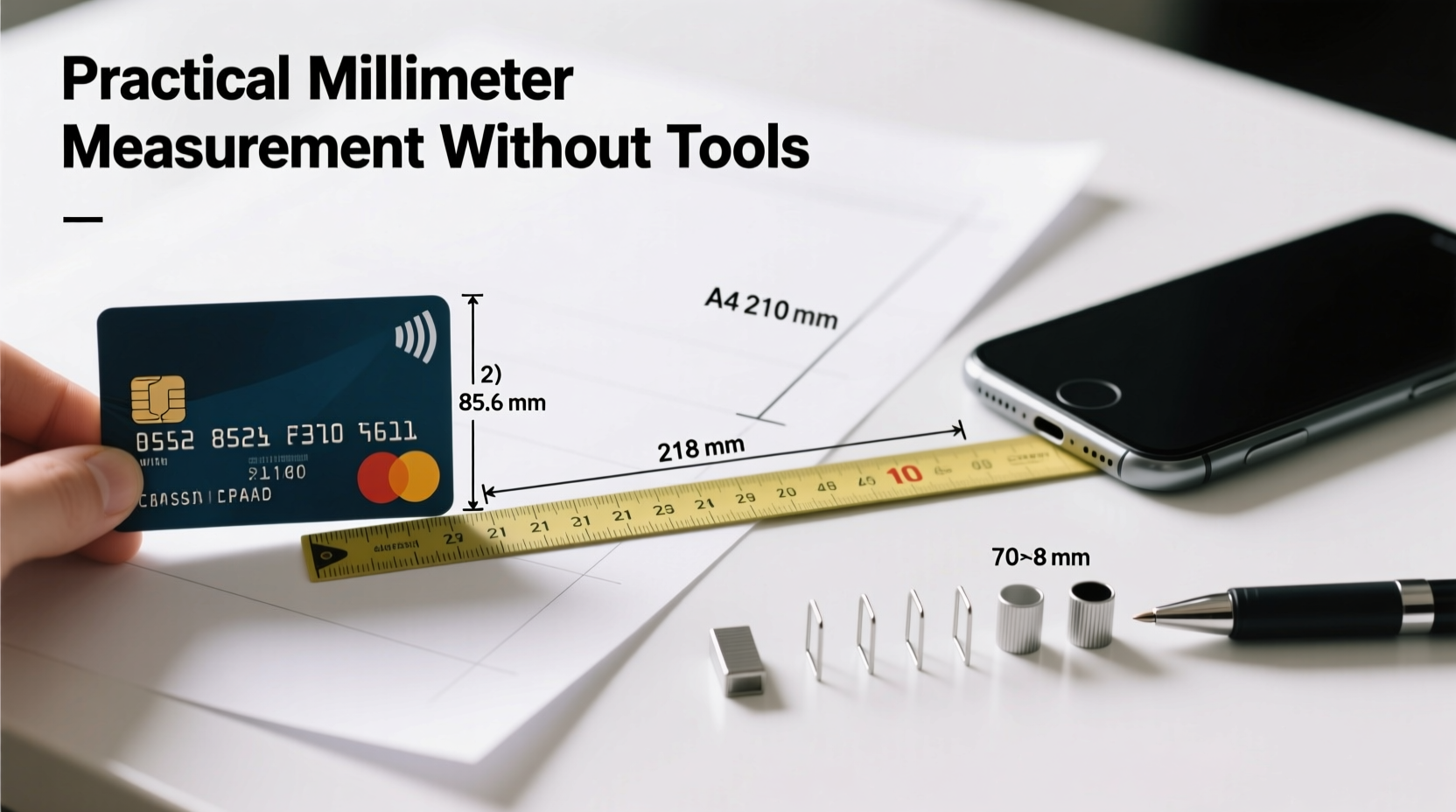
Many household and portable items have consistent dimensions that can serve as reliable references for measuring small distances. These objects are often manufactured to tight tolerances, making them surprisingly useful substitutes for rulers.
For example:
- A U.S. dime is approximately 1.35 mm thick and 17.91 mm in diameter—close enough to 18 mm for rough estimation.
- A standard credit card is exactly 0.76 mm thick. Stacking four gives about 3 mm; ten equals 7.6 mm.
- A sheet of printer paper averages 0.1 mm in thickness. While too thin alone, stacking ten sheets reaches 1 mm.
- The width of a standard ballpoint pen cap is typically between 8–10 mm, ideal for gauging small gaps.
Human Body as a Measurement Tool
The human body offers several repeatable benchmarks for estimating millimeters. While individual variation exists, average anatomical dimensions provide surprisingly consistent baselines when calibrated carefully.
The width of an adult’s index finger at the first joint is typically around 18–20 mm. The fingernail on the same finger often measures close to 10–12 mm wide. For finer estimates, the thickness of a fingertip pad ranges from 5 to 7 mm depending on pressure applied.
Another reliable method involves using the distance from the tip of the thumb to the first knuckle. On most adults, this spans roughly 25–30 mm—very close to one inch—and can be subdivided mentally into 5-mm increments.
“We train field engineers to use body-based measurements as a first-response technique when tools aren’t available. With practice, accuracy within ±1 mm is achievable.” — Dr. Lena Torres, Industrial Design Instructor, MIT
Step-by-Step Guide: Measuring Without Tools
Follow this sequence to achieve the most accurate estimation when no measuring device is available:
- Choose a stable reference object (e.g., coin, card, or known-width item).
- Align the object next to the edge of what you’re measuring, marking its endpoint with a pencil or scratch if possible.
- Repeat the placement end-to-end, counting how many times it fits along the length.
- Multiply by the known dimension (e.g., three dimes = 3 × 1.35 mm = 4.05 mm).
- Estimate the remainder using smaller references like paper thickness or visual division into tenths.
- Double-check with a second method, such as comparing to finger width or another object, to confirm consistency.
This process reduces error through cross-verification and repetition. Accuracy improves dramatically with practice and awareness of personal biases in perception.
Comparison Table: Common Objects and Their Millimeter Dimensions
| Object | Dimension | Millimeter Value | Best Used For |
|---|---|---|---|
| U.S. Dime (diameter) | Width | 17.9 mm | Measuring widths up to 2 cm |
| Credit Card (thickness) | Thickness | 0.76 mm | Stacked layers for sub-millimeter gaps |
| AA Battery (length) | Length | 50.5 mm | Medium-length linear estimates |
| Standard Paper (single sheet) | Thickness | ~0.1 mm | Estimating very thin materials |
| USB-A Port (width) | Width | 12 mm | Electronics-related spacing |
| Adult Index Fingernail | Width | 10–12 mm | Rough benchmark for centimeter-scale items |
Real-World Example: Fixing a Broken Shelf Bracket
Imagine you’re assembling a bookshelf in a rental apartment and discover one bracket screw hole is misaligned by a few millimeters. You don’t have a ruler, but you need to drill a new hole precisely. Using only what’s on hand, here’s how you might proceed:
You notice a loose SIM card in your phone case. Knowing it’s standardized at 25 mm × 15 mm, you align the 15 mm edge from the original hole to the desired location. The gap extends slightly beyond—about one-third of the card’s width. One-third of 15 mm is 5 mm, so you estimate the offset at 20 mm. To verify, you press your thumbnail against the mark: it covers about half the space, confirming ~10–12 mm per nail width. Satisfied, you drill confidently and secure the shelf flush.
This scenario demonstrates how combining standardized objects with anatomical feedback leads to functional precision—even under constraints.
Do’s and Don’ts of Non-Tool Measurement
| Do | Don't |
|---|---|
| Use multiple reference points to cross-check | Rely on a single estimation method |
| Stack thin items (like paper) for better resolution | Assume all coins or cards are identical across countries |
| Calibrate your finger widths in advance | Apply excessive pressure when touching surfaces |
| Mark progress with temporary notations | Guess large spans without breaking them down |
Frequently Asked Questions
Can I trust my smartphone screen size for measurement?
Not directly. While screen diagonals are advertised (e.g., 6.1 inches), bezels vary widely. However, some phones list exact body dimensions in settings or manuals. If you know your phone’s width—say, 71.5 mm—it becomes a viable straightedge. Just avoid relying on pixel density or display-only metrics.
How accurate are these methods compared to a digital caliper?
Under ideal conditions, experienced users can achieve ±0.5 to ±1 mm accuracy using combined techniques. A digital caliper offers ±0.01 mm precision, so non-tool methods won’t replace instruments in engineering. But for most everyday tasks—crafting, repairs, fitting components—they are sufficient and far better than guessing.
Is there a way to create a makeshift ruler from paper?
Yes. Fold a blank sheet repeatedly into eighths or sixteenths. Standard letter paper is 279.4 mm long. Dividing by 16 gives ~17.5 mm per segment. Alternatively, use known text sizes: 12-point type has a height of ~4.2 mm. Print a test page with labeled lines if preparing in advance.
Conclusion: Precision Is Accessible Anywhere
Accurate measurement doesn’t require specialized tools in every situation. By understanding the dimensions of everyday objects and training your observational skills, you can confidently estimate millimeters with surprising reliability. The key lies in preparation, consistency, and verification across multiple methods. Whether you're traveling, working off-grid, or simply caught without a ruler, these techniques empower you to maintain control over detail-oriented tasks.




 浙公网安备
33010002000092号
浙公网安备
33010002000092号 浙B2-20120091-4
Comments
No comments yet. Why don't you start the discussion?