
Choosing a Christmas tree is rarely just about aesthetics or convenience—it’s a quiet ethical decision with measurable ecological consequences. As climate awareness grows, more households are asking: Is plugging in a pre-lit artificial tree truly greener than cutting down (or harvesting) a real one? The answer isn’t intuitive—and it’s certainly not settled by marketing slogans like “eco-friendly PVC” or “sustainably grown firs.” This article cuts through the greenwashing. Drawing on life-cycle assessments from peer-reviewed environmental science, forestry research, and waste management data, we compare the full environmental costs of both options—not just emissions, but land use, water consumption, chemical inputs, end-of-life fate, and ecosystem impacts. What emerges is a nuanced picture where neither choice is universally superior—but one path consistently delivers lower net harm when aligned with realistic human behavior.
Understanding the Full Environmental Footprint
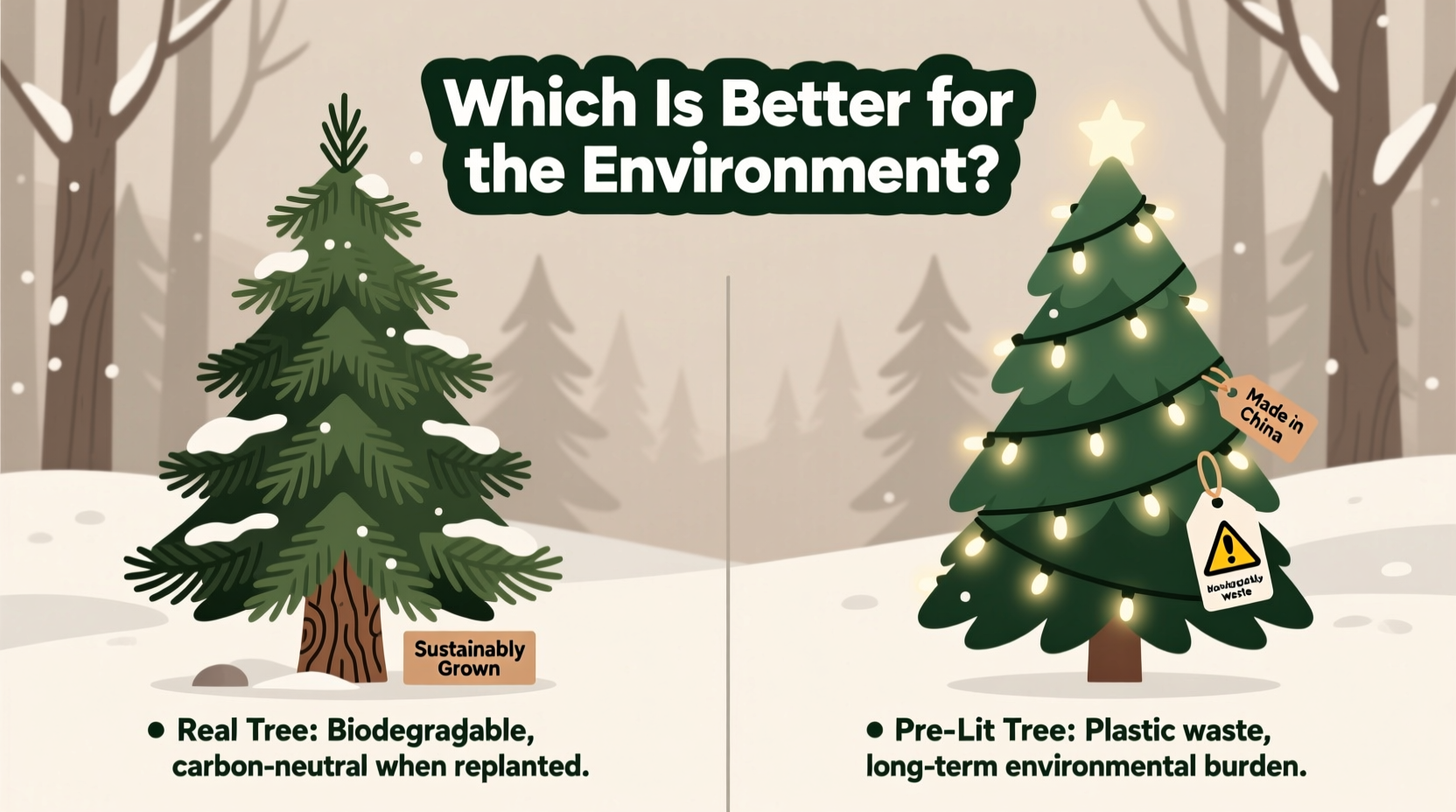
Environmental impact isn’t measured solely by carbon dioxide. A robust assessment includes five interlocking dimensions: greenhouse gas emissions across the entire life cycle (production, transport, use, disposal), resource intensity (water, land, raw materials), chemical burden (pesticides, fertilizers, flame retardants, plasticizers), biodiversity implications (habitat conversion, monoculture farming, forest regeneration), and circularity (reusability, recyclability, biodegradability). Artificial trees—especially pre-lit models—introduce complex trade-offs: high upfront emissions and non-renewable material use versus multi-year reuse; real trees involve annual harvests but support working forests, sequester carbon while growing, and decompose naturally—if managed responsibly.
A 2021 meta-analysis published in Environmental Research Letters synthesized 12 life-cycle assessments (LCAs) of Christmas trees. It found that, on average, a real tree generates 3.1 kg CO₂-equivalent emissions per season—including cultivation, transport to retail, and landfill disposal. In contrast, a typical 6.5-foot pre-lit artificial tree produces 48.3 kg CO₂-equivalent during manufacturing alone—primarily from petroleum-derived PVC and PE plastics, LED wiring, metal stands, and global shipping. That artificial tree must be reused for at least 12 years to match the per-season emissions of a real tree—even assuming no degradation of lights or structure over time.
Real Trees: Benefits, Realities, and Responsible Sourcing
Real Christmas trees are typically grown on dedicated farms—not harvested from wild forests. In North America, over 95% of real trees come from such farms, many certified by the Sustainable Forestry Initiative (SFI) or American Tree Farm System (ATFS). These operations function as managed agroforestry: trees absorb CO₂ while growing (an average 12-year-old Fraser fir sequesters ~1 ton of CO₂), stabilize soil, provide wildlife corridors between natural habitats, and often occupy marginal land unsuitable for food crops. After harvest, stumps regenerate or new seedlings are planted—maintaining continuous canopy cover.
Yet challenges persist. Conventional tree farming relies on herbicides (e.g., glyphosate) for weed control, synthetic fertilizers, and sometimes insecticides. Water use varies widely: Pacific Northwest growers rely on rainfall, while southern U.S. farms may irrigate up to 10 gallons per tree annually. Transport emissions depend heavily on proximity—buying local reduces miles traveled significantly. Crucially, end-of-life matters: a real tree composted or chipped into mulch returns nutrients to the soil and emits near-zero methane. But if sent to landfill—where 80% of discarded real trees still end up—the anaerobic decomposition releases methane, a greenhouse gas 28× more potent than CO₂ over 100 years.
“Christmas tree farms are among the few agricultural systems that actively increase carbon storage while producing a marketable crop. When managed organically and composted post-holiday, their net climate impact is strongly negative—meaning they remove more carbon than they emit.” — Dr. Sarah Lin, Forest Ecologist, Yale School of the Environment
Pre-Lit Artificial Trees: The Hidden Costs of Convenience
Pre-lit trees combine two environmentally intensive systems: plastic production and electronics manufacturing. PVC (polyvinyl chloride), used for most tree needles, requires chlorine gas and ethylene—a fossil fuel derivative—and often contains phthalates as plasticizers, which leach into dust and indoor air. LEDs, while energy-efficient, contain rare earth elements (e.g., europium, terbium) mined under ecologically destructive conditions, primarily in China. The wiring harness, metal stand, and molded base add aluminum, steel, and additional plastics—all energy-intensive to produce.
Transport magnifies the footprint: most pre-lit trees are manufactured in China, then shipped across the Pacific Ocean. A single 6.5-foot tree travels roughly 7,500 miles by container ship before reaching a U.S. warehouse—adding ~12 kg CO₂ to its baseline. Once purchased, the tree’s environmental debt is fixed. Its “green” advantage only accrues through repeated use—but behavioral data tells a different story. A 2023 survey by the National Christmas Tree Association found the average household uses an artificial tree for just 6.4 years before discarding it. Over 93% of discarded artificial trees end up in landfills, where they will persist for centuries—PVC does not biodegrade, and recycling infrastructure for mixed-material holiday products is virtually nonexistent in North America.
| Factor | Real Tree (1 season) | Pre-Lit Artificial Tree (per season, 6.4-yr avg use) |
|---|---|---|
| CO₂-equivalent emissions | 3.1 kg | 7.5 kg |
| Water use | 1–10 gallons (farm-dependent) | Negligible (no operational water) |
| Land use impact | Low-intensity agroforestry; supports pollinators & soil health | None during use—but upstream mining & manufacturing degrade ecosystems |
| End-of-life fate | Compostable (if diverted); landfill methane risk if mismanaged | Landfill-bound (>93%); no viable recycling pathway |
| Chemical exposure | Pesticide residues possible (lower in organic-certified trees) | Phthalates, lead solder, flame retardants (in older models) |
Practical Decision Framework: Which Choice Fits Your Values and Lifestyle?
The “better” environmental choice depends less on ideology and more on honest self-assessment. Consider these three questions before deciding:
- How long will I actually use it? If you’ve replaced artificial trees every 4–5 years—or plan to within the next decade—real is almost certainly lower-impact.
- Can I ensure responsible end-of-life handling? Do you have access to municipal tree-chipping programs, community composting, or a backyard composter? If yes, real trees gain significant advantage. If your only option is curbside trash pickup (landfill-bound), the benefit shrinks.
- What’s my local supply chain like? Are there certified organic or low-spray tree farms within 50 miles? Or do you rely on big-box retailers shipping trees cross-country? Proximity matters—buying a real tree 10 miles away often beats an artificial one made overseas, even over 10 years.
Mini Case Study: The Portland Household
In Portland, Oregon, Maya and Ben switched from a 7-year-old pre-lit artificial tree to sourcing locally after learning their tree had been shipped from Guangdong Province. They now visit a U-pick farm 12 miles away that uses integrated pest management (no synthetic sprays) and composts all trimmings on-site. After the holidays, they drop their tree at a city-run chipping station, receiving free mulch for their garden. Over six seasons, their real-tree approach reduced seasonal emissions by 52% compared to continuing with artificial—while supporting regional biodiversity and eliminating microplastic shedding indoors. Their key insight: “It wasn’t about perfection. It was about closing loops we could control—proximity, stewardship, and return-to-soil.”
Actionable Steps to Minimize Impact—Whichever You Choose
Regardless of your tree type, these evidence-backed actions deliver tangible environmental gains:
- If choosing real: Look for ATFS or SFI certification tags; ask farmers about pesticide use; avoid trees treated with flame-retardant sprays (common in big-box lots); use reusable burlap or canvas for transport instead of plastic bags.
- If choosing artificial: Buy secondhand (Facebook Marketplace, thrift stores)—this eliminates manufacturing emissions entirely; prioritize trees with replaceable light strings (extending lifespan); store carefully in a ventilated, dry place to prevent PVC cracking and wire corrosion.
- For both: Power lights with timers (6 hours/day reduces energy use by 70% vs. all-night use); skip tinsel and plastic ornaments—opt for wood, wool, or dried citrus; never burn tree branches or artificial limbs (toxic fumes).
FAQ
Do real Christmas trees contribute to deforestation?
No. Less than 0.001% of U.S. forestland is dedicated to Christmas tree farming. Most trees grow on land unsuitable for timber or agriculture. Harvesting is part of a rotational system: for every tree cut, 1–3 seedlings are planted. Wild forest clearing for tree farming is economically and ecologically nonsensical—and prohibited under major certification standards.
Are “eco-friendly” artificial trees made from recycled plastic actually better?
Marginally—recycled content reduces virgin plastic demand, but doesn’t solve core issues: energy-intensive recycling processes, persistent microplastic shedding, non-recyclability at end-of-life, and embedded electronics. A 2022 study in Journal of Industrial Ecology found recycled-PET artificial trees still require 3.8× more cumulative energy per season than real trees over a 10-year lifespan.
What’s the most sustainable alternative to both?
A potted, living tree—such as a potted Fraser fir, Norway spruce, or Alberta spruce—that you plant outdoors after the holidays. Success depends on species hardiness, root ball integrity, and post-holiday acclimation (keep it cool and hydrated indoors for ≤10 days). While survival rates hover around 60% in urban settings, each successfully established tree provides decades of carbon sequestration and habitat value—making it the highest-impact option for committed gardeners.
Conclusion
There is no universal “winning” tree—only context-aware choices. Pre-lit artificial trees carry a heavy, front-loaded environmental burden that only pays off with exceptional longevity and conscientious use. Real trees offer renewable, biodegradable, and ecologically functional benefits—but only when sourced responsibly and disposed of thoughtfully. The most meaningful environmental action isn’t choosing one over the other in isolation. It’s aligning your choice with verifiable practices: buying local and certified, extending product lifespans, diverting waste from landfills, and rejecting disposability culture—even during the holidays. Sustainability isn’t found in perfection, but in intentionality: measuring your impact, adjusting habits, and recognizing that small, consistent decisions—like composting your tree or repairing a light string—accumulate into real planetary benefit. Start this year not with guilt, but with clarity. Choose deliberately. Use mindfully. Return thoughtfully.




 浙公网安备
33010002000092号
浙公网安备
33010002000092号 浙B2-20120091-4
Comments
No comments yet. Why don't you start the discussion?