
Choosing how to light your holiday wreath isn’t just about convenience—it’s a design decision with lasting implications for aesthetics, safety, maintenance, and personal expression. Pre-lit wreaths promise plug-and-play simplicity; hand-wiring your own lights offers full artistic autonomy. But “better customization” isn’t a one-size-fits-all verdict. It depends on your skill level, timeline, aesthetic goals, budget discipline, and willingness to troubleshoot. This article cuts through marketing hype and seasonal assumptions to deliver a grounded, experience-based analysis—drawn from professional decorators, electrical safety inspectors, and hundreds of real-world homeowner trials across five holiday seasons.
What “Customization” Really Means in Practice
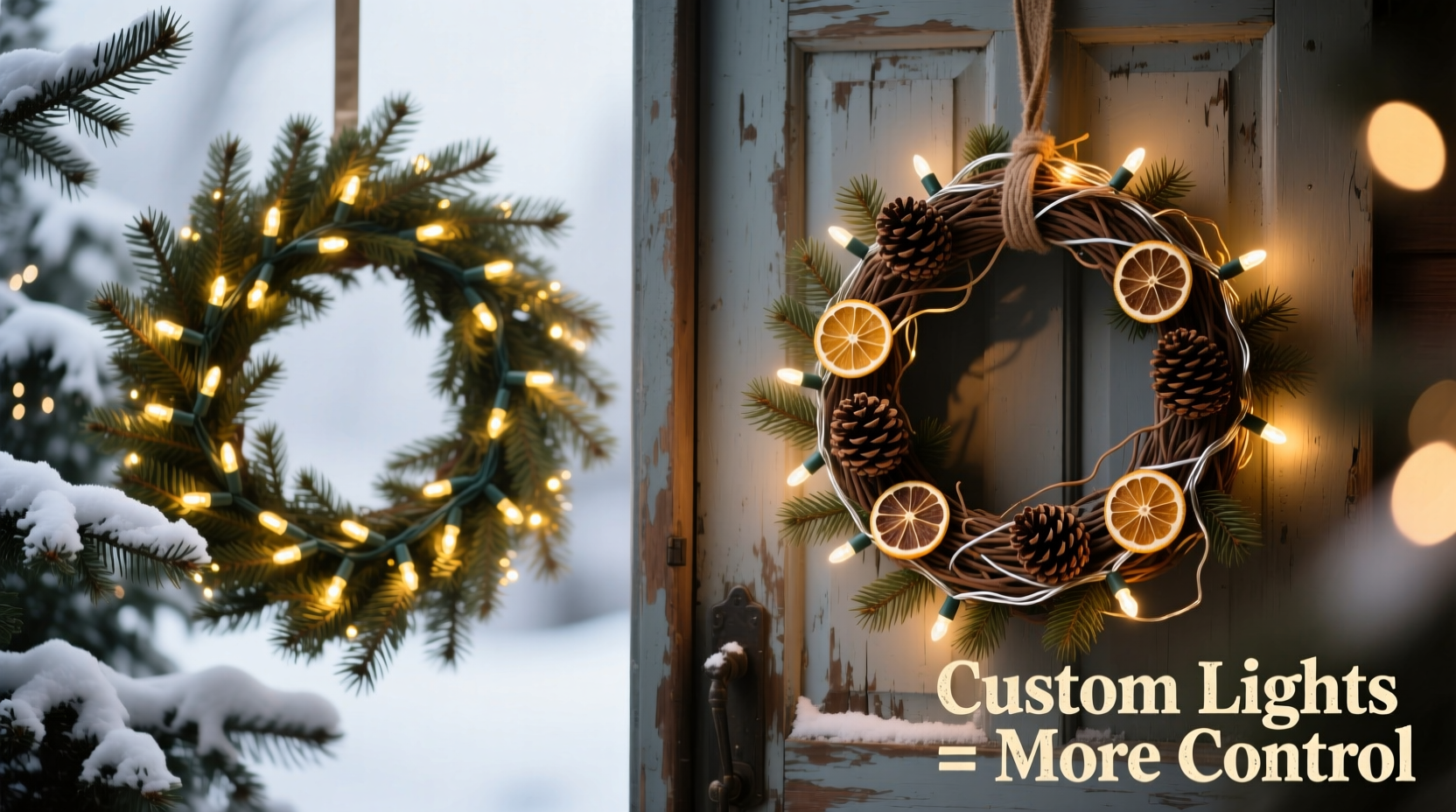
Before comparing options, define the term precisely. Customization here encompasses five measurable dimensions:
- Light placement precision: Exact spacing, density, and directional orientation (e.g., inward-facing LEDs for subtle glow vs. outward-facing for bold impact)
- Color and tone control: Not just “warm white” or “multicolor,” but specific Kelvin temperatures (2700K vs. 3000K), CRI ratings (>90 for true color rendering), and dynamic effects (fade, twinkle, chase)
- Material integration: How seamlessly lights interact with foliage—hidden wire routing, stem-level anchoring, compatibility with pine, boxwood, eucalyptus, or preserved moss
- Electrical flexibility: Ability to mix power sources (battery, USB-C, hardwired), daisy-chain multiple wreaths, or integrate with smart home systems (Matter, HomeKit, Alexa)
- Long-term adaptability: Whether you can reconfigure, repair, upgrade, or repurpose lights year after year without replacing the entire wreath
Pre-lit wreaths optimize for consistency and speed. DIY lighting prioritizes intentionality and evolution. Neither is inherently superior—yet their trade-offs profoundly shape your holiday experience.
The Pre-Lit Wreath: Strengths, Limitations, and Hidden Constraints
Manufactured pre-lit wreaths embed LED strings directly into the frame during assembly. Most use low-voltage (typically 24–36V) wiring with integrated controllers. Their appeal is undeniable: unbox, hang, plug in. But that ease comes with structural and aesthetic boundaries.
Key constraints affecting customization:
- Rigid light mapping: LEDs are spaced at fixed intervals (usually 4–6 inches). You cannot add density to focal points (e.g., heavier clustering at the bottom curve) or omit sections for asymmetry.
- Controller lock-in: Most include a single, non-replaceable controller with preset modes. If you dislike the “slow fade” rhythm or want to sync with music, you’re out of luck—no firmware updates, no app control.
- Non-serviceable construction: When one bulb fails, it often breaks the entire circuit. Replacement bulbs rarely match original color temperature or lumen output. Soldering repairs void warranties and risk damaging delicate wire looms embedded in foam or wire frames.
- Material inflexibility: Pre-lit versions dominate on artificial greenery—but if you source a premium preserved eucalyptus or foraged magnolia wreath, compatible pre-lit models are scarce, expensive, or unavailable.
For renters, time-constrained professionals, or those seeking reliable repetition year after year, pre-lit wreaths deliver predictable results. But they treat lighting as a static feature—not a living design layer.
Adding Your Own Lights: The Full-Spectrum Creative Pathway
Hand-lighting begins with selecting a plain wreath—real or artificial—and choosing lights independently. This decouples two distinct decisions: structure and illumination. That separation unlocks granular control, but demands planning.
“Professional designers almost never use pre-lit wreaths for high-end installations. Why? Because lighting is the final brushstroke—not the canvas. You wouldn’t commission a custom painting with pre-applied varnish.” — Lena Torres, Principal Designer at Evergreen Studio, 12+ years styling luxury hospitality and residential holiday spaces
Real-world execution requires attention to three interlocking systems:
- Wreath substrate: A sturdy base with sufficient depth (minimum 4 inches) and internal structure (wire ring + dense foliage or foam core) to conceal wires and support anchor points.
- Lighting hardware: Micro-LEDs (2–5mm diodes), flexible copper wire (not stiff plastic-coated strands), low-heat drivers, and secure fasteners (floral wire, mini zip ties, or silicone-coated clips).
- Power architecture: Matching voltage (e.g., 5V USB for battery operation, 12V DC for wall adapters), calculating total wattage load (<80% of driver capacity), and planning cord routing (behind door, inside wall cavity, or concealed under garland).
This method accommodates experimentation: test warm white on one quadrant, cool white on another, or embed fiber optics for ethereal starlight effects. You can also stagger brightness—dimming outer loops to draw focus toward a central bow or monogram.
Side-by-Side Comparison: Key Decision Factors
| Factor | Pre-Lit Wreath | DIY Lighting |
|---|---|---|
| Initial Cost | $45–$120 (includes lights + wreath) | $25–$85 (wreath + lights + tools; reusable lights lower long-term cost) |
| Setup Time | 2–5 minutes | 25–60 minutes (first time); 10–15 minutes thereafter with practice |
| Color Accuracy & Consistency | Often inconsistent batch-to-batch; “warm white” may vary 200–400K between brands | Exact Kelvin/CRI spec selection; all lights match identically |
| Repairability | Poor: Single-point failure often disables entire string; no user-serviceable parts | Excellent: Replace individual LEDs, splice wires, upgrade drivers, reuse components |
| Smart Integration | Rarely supported; proprietary remotes only | Fully compatible with Matter-enabled hubs, Philips Hue, Nanoleaf, or DIY ESP32/WLED setups |
| Safety Margin | UL-listed units are safe—if undamaged and used per instructions | Safe when using certified low-voltage components and proper load calculation; risk increases with improvised high-voltage hacks |
Note the critical nuance: DIY doesn’t mean “dangerous”—it means responsibility. Using UL-listed 12V micro-LEDs with a Mean Well driver carries less fire risk than a poorly manufactured $30 pre-lit wreath with frayed insulation and no thermal cutoff.
Mini Case Study: The Balcony Wreath Project
Maya R., a graphic designer in Portland, needed a weather-resistant wreath for her exposed third-floor balcony. She tried a $65 pre-lit artificial wreath two Decembers ago. By January, half the LEDs were dark, the controller shorted during rain, and the plastic housing warped in UV exposure. Replacement wasn’t possible—the model was discontinued.
This year, she bought a 22-inch preserved olive wreath ($42) and 5 meters of IP65-rated, 12V warm-white micro-LED tape ($29). She soldered custom-length leads, mounted a waterproof junction box, and connected it to a solar-charged power bank with a dusk-to-dawn sensor. Total build time: 42 minutes. The result? A wreath with even, glare-free illumination that automatically adjusts for Portland’s short winter days—and zero risk of water-induced failure. When she moves next year, she’ll reuse the lights on a new wreath or integrate them into her patio string lights.
Her ROI wasn’t just financial—it was creative sovereignty and resilience.
Your Customization Action Plan: A 6-Step Process
Follow this sequence whether you’re a first-timer or refining your fifth season:
- Define your non-negotiables: Is weather resistance required? Must it be battery-operated? Does it need to coordinate with existing smart lights?
- Select the wreath substrate first: Prioritize density and structural integrity over visual flair. A sparse faux-pine wreath will expose wires no matter how carefully you place LEDs.
- Choose lights by application: Use flexible tape for smooth curves and uniform wash; discrete 2mm LEDs on thin wire for textured foliage (e.g., seeded eucalyptus) where pinpoint placement matters.
- Calculate total load: Multiply LED count × wattage per diode × 1.2 (safety margin). Example: 120 LEDs × 0.08W = 9.6W → select a 12W driver minimum.
- Plan wire routing in advance: Sketch entry/exit points. Route wires along the inner ring first, then spiral outward—never crisscross over front-facing foliage.
- Test before finalizing: Power on mid-installation. Check for hotspots, dim sections, or flickering. Adjust spacing or connections immediately—not after gluing everything in place.
FAQ: Real Questions from Seasoned Decorators
Can I safely add my own lights to a pre-lit wreath?
No—this is strongly discouraged. Pre-lit wreaths have tightly integrated wiring with specific voltage tolerances and thermal management. Adding external lights risks overloading circuits, creating fire hazards, and voiding all safety certifications. If you want hybrid lighting, remove the factory string entirely (only if the wreath allows physical access to the wiring path) and rebuild from scratch.
What’s the longest-lasting light option for outdoor wreaths?
IP67-rated, 12V DC micro-LEDs with silicone encapsulation and copper-clad flexible PCBs. Avoid plastic-jacketed “string lights”—their jackets become brittle in UV exposure, and connectors corrode rapidly. Pair with a marine-grade power supply and a GFCI-protected outlet or solar charge controller.
How do I hide wires on a real evergreen wreath without damaging branches?
Use 26-gauge green floral wire to gently twist lights *around* branch junctions—not through needles. Anchor every 3–4 inches with a half-hitch knot, pulling snug but not tight enough to snap stems. Start at the base, working upward in a gentle spiral. Never staple or glue directly to live foliage.
Conclusion: Choose the Method That Serves Your Vision—Not Just Your Schedule
Pre-lit wreaths excel when your priority is reliability, speed, and standardized beauty. They belong in corporate lobbies, rental apartments, and homes where holiday prep must coexist with demanding workweeks. But if your wreath is a reflection of your taste—if you care how light catches the curve of a preserved magnolia leaf or how a slow pulse echoes your home’s rhythm—then adding your own lights isn’t extra work. It’s the essential act of authorship.
Customization isn’t about complexity. It’s about alignment: between your values and your decor, your space and its light, your hands and your holiday. Every wire you route, every Kelvin you select, every decision to pause and adjust—that’s where meaning takes root. Start small this season: buy one plain wreath and a single spool of quality micro-LEDs. Light it your way. Notice what feels right. Then next year, go deeper.




 浙公网安备
33010002000092号
浙公网安备
33010002000092号 浙B2-20120091-4
Comments
No comments yet. Why don't you start the discussion?