
Decorating a Christmas tree is rarely just about illumination—it’s about intention. The way light wraps around branches shapes the mood of a room, defines family traditions, and expresses personal style. Yet many shoppers face the same dilemma each November: buy a prelit tree and accept its built-in lighting scheme, or invest time (and patience) into stringing custom lights from scratch? While convenience often wins in marketing, true decorating freedom isn’t measured in minutes saved—it’s measured in creative control, adaptability across seasons, and the ability to evolve your aesthetic without replacing core elements. This isn’t a question of “better” or “worse,” but of alignment: does the solution serve your vision, your space, and your long-term habits—or merely simplify the first step?
What “Decorating Freedom” Really Means
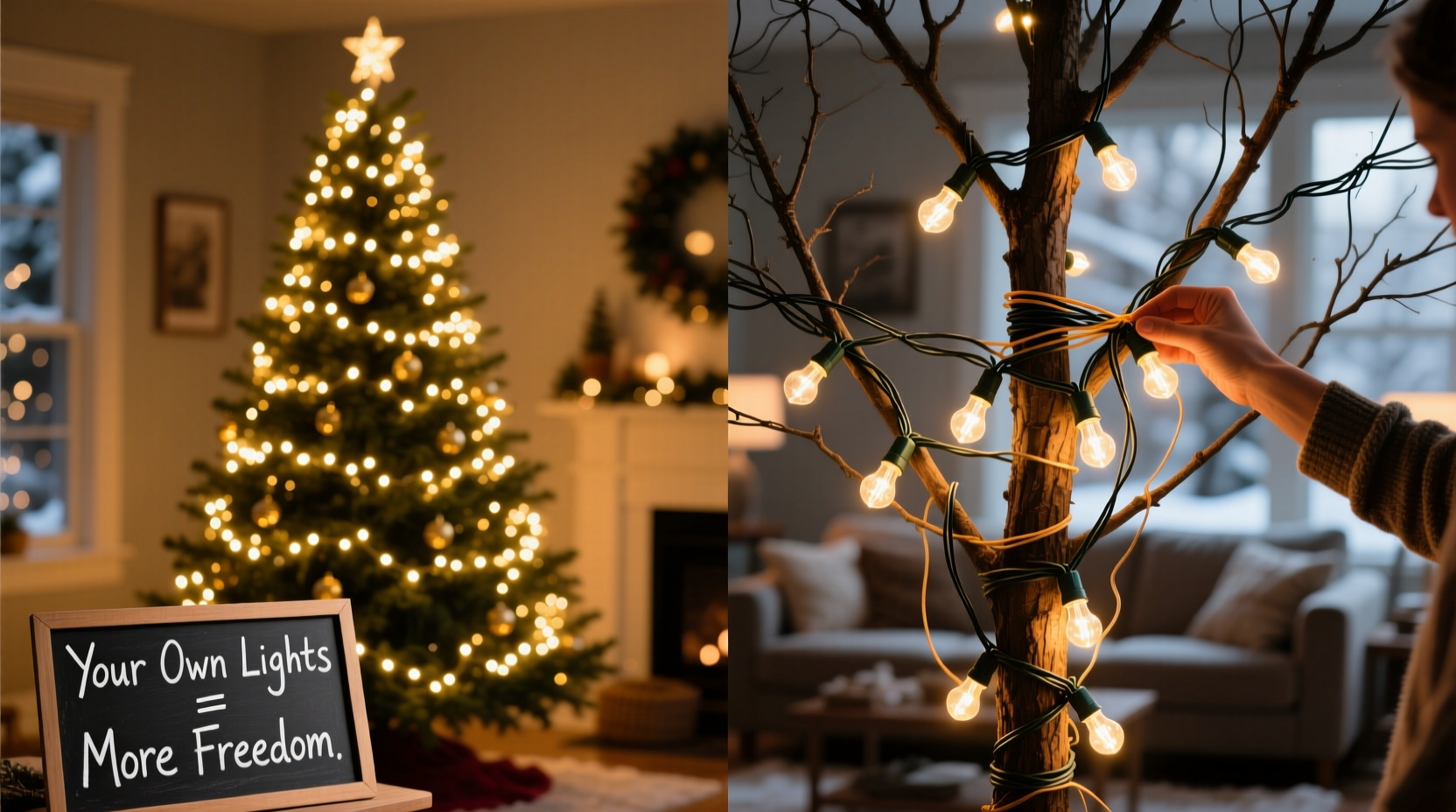
Before comparing options, clarify what freedom entails in practice. It’s not just about choosing colors—it’s the cumulative weight of decisions you retain or surrender:
- Placement precision: Can you spotlight specific ornaments, create gradients, or leave lower branches intentionally shadowed?
- Layering capacity: Can you add fiber-optic accents, net lights, or LED candles without overloading circuits or clashing with fixed wiring?
- Adaptability: If you switch from rustic farmhouse to modern minimalist next year, can your lighting evolve—or must you buy an entirely new tree?
- Troubleshooting autonomy: When one bulb fails, can you replace it individually—or do you need to diagnose a hidden circuit board or discard a full light strand?
- Longevity & modularity: Does the system allow incremental upgrades (e.g., swapping warm-white for tunable RGB), or lock you into a single generation of technology?
Freedom here is less about ease and more about agency—the right to edit, refine, and reinterpret your display year after year.
Prelit Trees: Convenience Engineered, Control Compromised
Prelit trees dominate retail shelves for good reason: they eliminate the most time-intensive part of setup. Most feature 500–750 lights wired directly into branch tips or internal sleeves, often with built-in timers, dimmers, or even remote controls. But their engineering prioritizes uniformity—not individuality.
Manufacturers design prelit trees for mass appeal: consistent spacing (typically 4–6 inches between bulbs), standardized color temperatures (usually 2700K–3000K warm white), and non-negotiable layouts (e.g., all tips lit, no gaps, no emphasis on trunk or base). While newer models offer multi-color LEDs or app-controlled zones, these features remain constrained by factory programming—no manual repositioning, no rewiring, no mixing of bulb types or voltages.
Safety is a notable advantage: UL-listed prelit trees undergo rigorous testing for heat dissipation, insulation integrity, and current load. However, that same safety rigor limits user modification. Cutting or splicing factory wires voids certifications and risks fire hazards—a hard boundary on “freedom.”
Stringing Your Own Lights: Labor-Intensive, Limitlessly Flexible
Stringing lights manually demands time—often 45–90 minutes for a 7.5-foot tree—but trades effort for total command. You select every variable: bulb size (micro, C6, C9), shape (round, conical, vintage filament), color (pure white, amber, blush pink), brightness (lumens), and even voltage (low-voltage 12V for safety near children or pets vs. standard 120V).
More importantly, you dictate placement logic. A professional decorator might use the “spiral wrap” method—starting at the base and winding upward with deliberate spacing—to create depth. Others layer: white micro-lights deep in the branches for ambient glow, then bold C9s on outer tips for punctuation. You can leave the trunk bare for a natural look, drape lights vertically like rain, or cluster them densely in upper tiers to draw the eye upward.
“Clients who string their own lights rarely change trees—they change *lighting narratives*. One year it’s monochrome elegance; the next, it’s bioluminescent blue with copper wire accents. That evolution is impossible with integrated systems.” — Lena Torres, Interior Stylist & Holiday Design Consultant, 12+ years serving residential clients
This flexibility extends to problem-solving. Burnt-out bulbs are replaced in seconds. Flickering strands are isolated and swapped. Voltage drops across large trees? Add a second power source mid-height. Want motion effects? Integrate a programmable controller—no proprietary app required.
Side-by-Side Decision Framework
The choice isn’t binary—it’s contextual. Below is a practical comparison focused on real-world decorating priorities, not just specs:
| Factor | Prelit Tree | Stringing Your Own |
|---|---|---|
| Customization Speed | ✅ Setup in under 15 minutes | ❌ 45–90+ minutes initial setup; 10–20 min annual refresh |
| Bulb-Level Control | ❌ Fixed positions; no repositioning possible | ✅ Full placement autonomy—every bulb placed intentionally |
| Color & Tone Flexibility | ⚠️ Limited to factory options (often warm white only) | ✅ Unlimited palette—mix warm/cool whites, pastels, saturated hues |
| Repair & Maintenance | ⚠️ Requires manufacturer support; entire section may fail | ✅ Individual bulb/strand replacement; modular troubleshooting |
| Future-Proofing | ❌ Technology locked at purchase (no firmware updates, no new modes) | ✅ Swap to smart LEDs, addressable strips, or battery-operated options anytime |
| Safety Oversight | ✅ Pre-certified; consistent load management | ⚠️ User responsibility: must calculate total wattage, avoid daisy-chaining beyond outlet rating |
Real-World Scenario: The Evolving Family Tradition
Consider the Chen family in Portland, Oregon. For eight years, they used a 7.5-foot prelit tree with warm-white LEDs. Their tradition centered on speed—decorating together on the first Saturday of December while baking cookies. But when their daughter began art school, she started experimenting with texture and contrast. She wanted matte black ornaments against cool-blue light, then later, amber-gold accents with flickering candle-effect bulbs. The prelit tree couldn’t accommodate either shift. Replacing it annually wasn’t sustainable financially or environmentally.
In year nine, they switched to a high-quality unlit Fraser fir (real) and invested in premium, dimmable warm-white micro-lights plus a separate set of programmable RGB mini-lights. They now spend 60 minutes stringing—but that time has become collaborative: Dad handles the structural spiral, Mom adds rhythm with alternating warm/cool layers, and their daughter programs subtle pulse effects in the top third. The tree isn’t just lit; it’s *composed*. “It stopped being decoration and became dialogue,” says Sarah Chen. “We’re not just putting up lights—we’re editing our story.”
Actionable Preparation Checklist
If you’re leaning toward stringing your own lights—or want to maximize flexibility within a prelit system—follow this field-tested checklist:
- Measure your tree’s height, width, and branch density—this determines optimal strand length (rule of thumb: 100 lights per vertical foot for dense coverage)
- Calculate total wattage—add all strand labels (e.g., 4.8W × 5 strands = 24W), ensuring you stay under 80% of your outlet’s capacity (1,440W max for a standard 15A circuit)
- Choose a consistent base bulb type—mixing incandescent and LED on one circuit causes voltage imbalance and premature failure
- Label every strand with masking tape: “Top Tier – Warm White,” “Mid – Cool White,” etc.—saves 15+ minutes during setup
- Invest in a dedicated surge-protected power strip with spaced outlets (not clustered) to prevent cord tangling and overheating
- Store lights on flat reels or cardboard spools—never in loose balls—to prevent kinks, broken filaments, and insulation damage
FAQ: Addressing Common Concerns
Can I add extra lights to a prelit tree without overloading it?
No—prelit trees have fixed internal wiring rated for their included lights only. Adding external strands to the same circuit risks tripping breakers, damaging controllers, or creating hot spots. If you need more light, use battery-operated accent lights (e.g., puck lights on the stand or garland-wrapped LEDs) that draw zero power from the tree’s system.
Won’t stringing my own lights look uneven or “amateur”?
Professional results come from technique—not automation. Use the “back-to-front” method: start at the trunk and work outward, hiding cords beneath branches. Keep tension gentle (no pulling), and step back every 3–4 rows to assess balance. Most perceived “unevenness” comes from inconsistent spacing—use a clothespin as a spacer guide (clip it to the branch tip, wrap once, move pin). With practice, your placement becomes more intentional than any factory pattern.
Are prelit trees really less expensive long-term?
Short-term, yes—no annual light purchases. Long-term, often no. High-end prelit trees ($300–$600) depreciate rapidly; if the lighting fails after 3–4 years, replacement costs exceed buying a quality unlit tree ($150–$250) plus $80–$120 in versatile, reusable LED strands. Plus, you lose resale value: prelit trees sell for 30–50% less used than unlit counterparts due to obsolescence risk.
Conclusion: Freedom Is a Practice, Not a Product
Decorating freedom isn’t granted by a shopping cart—it’s cultivated through intention, knowledge, and willingness to engage with the process. Prelit trees offer a valuable service: eliminating friction for those whose joy lives in the ornament-hanging, not the wiring. But if your vision shifts with the seasons—if you crave nuance in tone, drama in contrast, or the quiet satisfaction of crafting light like a painter mixes pigment—then stringing your own lights isn’t a chore. It’s the essential act of authorship.
You don’t need perfection to begin. Start small: use one custom-strung strand on an otherwise prelit tree. Swap a single warm-white section for cool-white next year. Learn how to calculate safe loads. These aren’t technical hurdles—they’re invitations to deepen your relationship with your space and your traditions. The most memorable trees aren’t the brightest or the fastest to assemble. They’re the ones that feel unmistakably, undeniably yours—because every decision, from bulb hue to branch-level placement, was made by hand and heart.




 浙公网安备
33010002000092号
浙公网安备
33010002000092号 浙B2-20120091-4
Comments
No comments yet. Why don't you start the discussion?