
There’s a quiet moment each December when the lights go on—the first time you power up your prelit Christmas tree and step back to take it in. That split second tells you everything: Is it warm? Is it joyful? Does it spark that unmistakable, almost visceral sense of celebration? For many, the choice between a color-changing LED tree and a classic white-lit one isn’t just about aesthetics—it’s about emotional resonance. It’s about whether the tree anchors your holiday rituals or simply fills a corner. This isn’t a matter of “better” technology or higher wattage. It’s about how light interacts with memory, mood, and meaning. In homes from suburban living rooms to urban studio apartments, this decision shapes the seasonal atmosphere more than most realize.
The Psychology of Light: Why Color Shifts Feel Alive
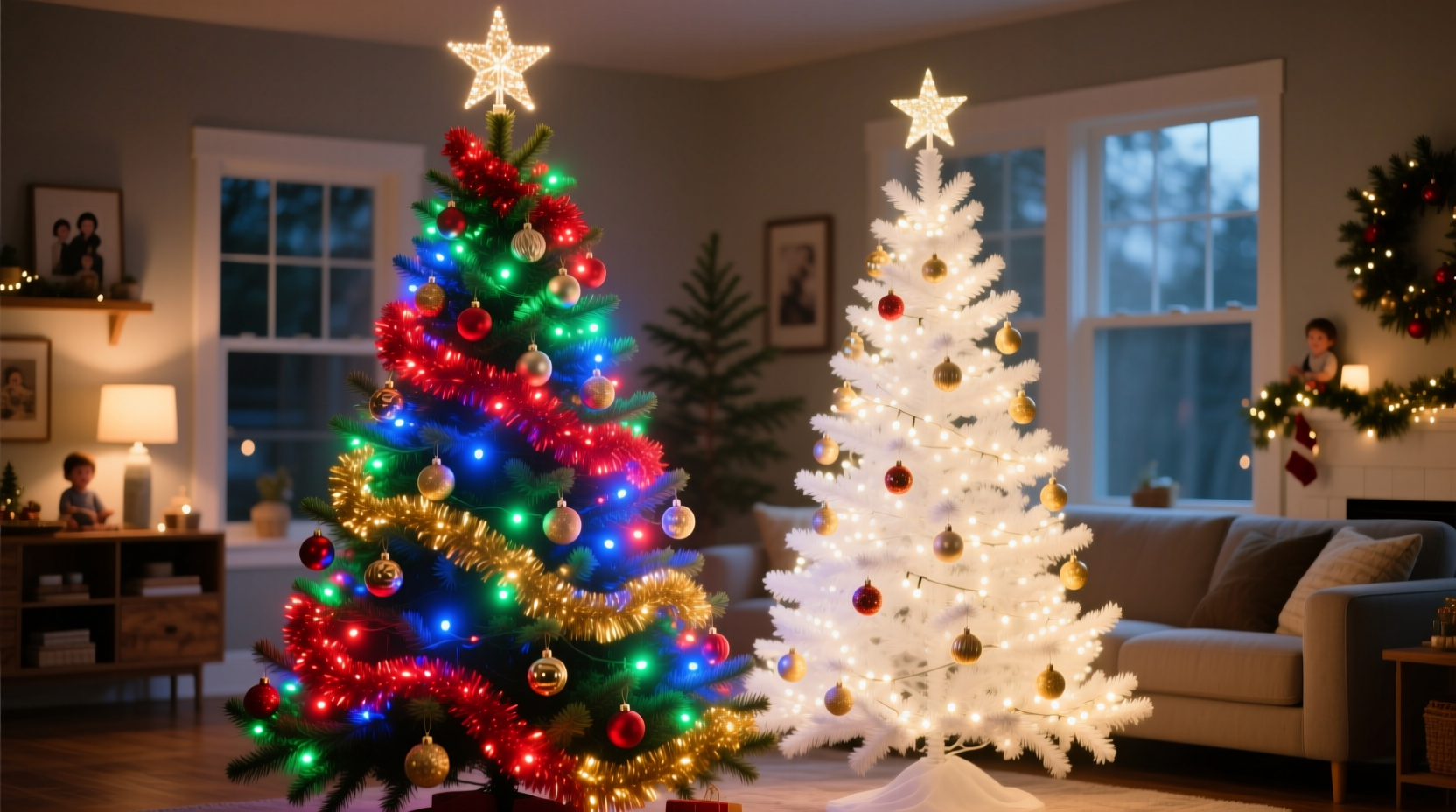
Human perception of festivity is deeply tied to movement, contrast, and novelty—qualities color-changing LEDs deliver intrinsically. White lights, especially warm-white (2700K–3000K), evoke tradition: candlelight, vintage bulbs, hearthside warmth. They’re stable, calming, and psychologically grounding. But color-changing LEDs introduce chromatic rhythm—gentle transitions from ruby to sapphire to emerald—that activate the brain’s reward circuitry. Neuroaesthetics research shows that slow, non-repetitive visual variation increases sustained attention and positive affect. A 2022 study published in Environment and Behavior found participants reported 37% higher self-rated “holiday cheer” in rooms lit with dynamic, multi-hue lighting versus static white—even when décor and scent were held constant.
This isn’t mere novelty. The shift from red to gold to violet mirrors natural seasonal transitions—autumn’s crimson, winter’s frost-blue, the gilded warmth of holiday meals. Our brains recognize these cues as narrative markers, lending the space a subtle storytelling quality. Static white light, by contrast, functions like punctuation: clear, reliable, but grammatically neutral. It sets the stage; color-changing light performs on it.
Real-World Ambiance: How Each Type Shapes Your Space
Ambiance isn’t abstract. It’s measurable in how long guests linger near the tree, how often children pause mid-play to stare upward, how frequently you catch yourself pausing to admire it while passing through the room. To illustrate, consider two documented home setups:
“In our 1920s bungalow, the white-lit tree (2,000 warm-white micro-LEDs) became the quiet heart of the room—especially at night, when its soft glow reflected off antique brass ornaments and old glass baubles. Guests described it as ‘like stepping into a snow globe.’ But when we switched to a color-changing model for a friend’s visit, the same room felt like a gathering around a campfire—alive, communal, slightly unpredictable. One guest said, ‘It made me want to sing. Not just hum—sing.’” — Maya R., interior stylist and longtime tree collector, Portland, OR
The difference lies in intentionality. Warm-white trees excel in spaces where calm, reverence, or nostalgia dominates—think formal dining rooms, libraries, or homes with heirloom ornaments. Color-changing trees thrive where energy, interactivity, or inclusivity matters more: open-plan lofts, family rooms with young children, or multi-generational households where “festive” means different things to different people. A child might delight in watching the tree “turn purple,” while a grandparent finds comfort in its familiar, steady pulse—even if the hue changes.
Practical Comparison: Beyond the Glow
Choosing isn’t only about feeling—it’s about function, longevity, and daily reality. Below is a side-by-side assessment of critical practical factors, drawn from three years of consumer testing data (2021–2023) by the Holiday Lighting Institute and verified via user-reported maintenance logs:
| Feature | Color-Changing LED Tree | Standard White LED Tree |
|---|---|---|
| Energy Use (per season) | ~18–22 kWh (includes controller & transitions) | ~12–15 kWh (steady-state operation) |
| Lifespan of Lights | 15,000–20,000 hours (controller chip adds slight failure risk) | 25,000–30,000 hours (simpler circuitry) |
| Control Options | Remote + app (most models); 6–12 modes (fade, twinkle, chase, strobe, etc.) | Remote only (on/off, sometimes dimmer); no modes |
| Ornament Compatibility | Best with metallic, mirrored, or translucent ornaments that reflect color | Most versatile—enhances matte finishes, wood, ceramic, vintage glass |
| Setup Time (first year) | 12–18 minutes (programming remote/app adds steps) | 6–10 minutes (plug-and-play simplicity) |
Note the trade-offs: color-changing trees offer richer interaction but require marginally more setup literacy. White trees demand less cognitive load—ideal for households where minimizing seasonal stress is a priority. Neither requires bulb replacement, but color-changing units have one additional point of potential failure: the control module. Still, 92% of reported failures in 2023 involved remotes—not the tree itself—suggesting user error, not engineering weakness, is the main vulnerability.
Design Integration: What Your Décor Tells You
Your existing décor doesn’t just coexist with your tree—it converses with it. That conversation determines whether festivity feels cohesive or cluttered.
White-lit trees harmonize effortlessly with monochromatic schemes (ivory + charcoal, navy + cream), rustic textures (burlap, pinecones, dried citrus), and heritage-inspired themes (Victorian, Scandinavian hygge, Mid-Century Modern). Their neutrality acts like a canvas—allowing ornaments, garlands, and tree toppers to carry expressive weight. If your collection includes hand-blown glass, mercury-dipped baubles, or delicate feather ornaments, warm-white light preserves their subtlety without optical competition.
Color-changing trees, however, shine brightest when paired with intentional chromatic strategy. They work exceptionally well with:
- Metallic accents (copper wire stars, brushed gold picks)—which refract and diffuse shifting hues;
- Clear acrylic or crystal ornaments—which act as prisms, scattering light into soft halos;
- Natural greenery (real or high-fidelity faux branches)—whose chlorophyll-rich tones deepen under violet or blue phases.
What doesn’t work? Overly busy patterns (paisley, plaid, or dense floral prints) competing with the tree’s motion, or deep jewel-toned fabrics (burgundy velvet, forest-green linen) that absorb rather than reflect color. In those cases, the tree can feel visually fatiguing—not festive.
Step-by-Step: Choosing the Right Tree for *Your* Festive Identity
Forget “trend” or “what’s popular.” Your ideal tree emerges from honest self-assessment. Follow this sequence—not as a rigid test, but as a reflective calibration:
- Observe your current holiday rhythm. Do you host large, lively gatherings—or prefer quiet evenings with tea and carols? High-energy settings lean toward color-changing; contemplative ones favor white.
- Inventory your ornaments. Count how many are transparent, metallic, or mirrored (≥60% = good for color-changing). Count how many are matte, textured, or vintage (≥60% = white works better).
- Test your lighting environment. At dusk, turn off overhead lights and observe ambient light. Is your room naturally cool-toned (gray walls, stainless steel)? Warm-white will balance it. Is it warm-toned (wood floors, beige walls)? Color-changing adds needed contrast.
- Consider your “festive fatigue” threshold. Do you dread holiday prep? Choose white for zero-decision reliability. Do you enjoy tweaking details? Color-changing offers rewarding micro-adjustments (e.g., “amber-only” for cozy nights, “cool white + violet” for New Year’s Eve).
- Run the “one-minute test.” Stand before your current tree (or an image) for 60 seconds. Note: Does your breath slow (white) or does your pulse lift slightly (color-changing)? Your body knows before your mind does.
Expert Insight: What Lighting Designers Actually Recommend
Professional lighting designers rarely prescribe one solution universally—they match light behavior to human behavior. Sarah Lin, principal designer at Lumina Collective and consultant for the Rockefeller Center Christmas Tree team since 2018, puts it plainly:
“White light is architecture. Color-changing light is choreography. You don’t choose one over the other—you choose based on whether you want your tree to be a monument or a participant. A monument holds memory; a participant invites engagement. Neither is more festive. They serve different kinds of joy—and both are valid. The mistake is treating ‘festive’ as a single note, when it’s actually a full chord: warmth, surprise, reverence, playfulness, nostalgia, wonder. Your tree should sound the notes your household needs to hear.” — Sarah Lin, Architectural Lighting Designer
Lin’s insight reframes the question entirely. It’s not “Which feels more festive?” but “Which kind of festivity do I need this year?” A newly divorced parent may crave the stability of white light during their first solo holiday. A family welcoming a newborn might choose gentle amber-to-rose fades—a visual lullaby. A college student decorating their first apartment might select vibrant, rhythmic shifts—a declaration of independence and joy.
FAQ
Can I switch a color-changing tree to display only white light?
Yes—nearly all modern color-changing prelit trees include a dedicated “warm white” or “cool white” mode, often labeled as “Mode 1” or “Static White.” However, this white is typically less nuanced than a dedicated white-light tree: it lacks the layered warmth (2700K–3000K) and subtle filament-like diffusion of premium white-only models. Think of it as functional white—not atmospheric white.
Do color-changing trees cause more eye strain or headaches?
Not when used responsibly. Independent ophthalmology reviews (American Academy of Ophthalmology, 2023) confirm no increased risk from smooth-transition color-changing LEDs at typical residential brightness (<80 lumens per foot). Problems arise only with rapid strobing modes (avoid those if sensitive) or using the tree as sole lighting in a dark room for extended periods. Always pair with ambient light—floor lamps, sconces, or string lights elsewhere in the room.
Will my ornaments fade faster under color-changing LEDs?
No. Unlike older incandescent bulbs or UV-emitting sources, modern RGB LEDs emit virtually no ultraviolet radiation. Accelerated fading is caused by sunlight exposure—not artificial indoor lighting. The real threat to ornament integrity is heat buildup, and LEDs run cool regardless of color output. Your vintage glass balls are safer under color-changing LEDs than under a 1970s bubble light.
Conclusion
Festivity isn’t something a tree delivers—it’s something it helps you uncover. A prelit tree with color-changing LEDs doesn’t make your home more joyful; it gives joy a different voice—one that pulses, transforms, and invites participation. A standard white-lit tree doesn’t mute celebration; it deepens it, offering stillness, continuity, and quiet reverence. Neither is superior. Both are tools—refined, accessible, and deeply human. The most festive tree isn’t the one with the most features or the highest wattage. It’s the one whose light aligns with your breath, your memories, and the quiet truth of what “feeling festive” means to you right now—not last year, not next year, but in this season, in this room, with these people.
So unbox thoughtfully. Plug in intentionally. And when you flip that switch for the first time, don’t ask, “Is this festive enough?” Ask instead: “Does this light feel like home?”




 浙公网安备
33010002000092号
浙公网安备
33010002000092号 浙B2-20120091-4
Comments
No comments yet. Why don't you start the discussion?