
When it comes to holiday decorating, few elements are as iconic as a beautifully lit wreath gracing a front door or mantle. As LED technology advances and customization becomes more accessible, homeowners face a key decision: should they purchase a prelit wreath or build their own by adding lights to a plain base? While both options have merit, one critical factor often tips the balance—control over brightness. Whether you're aiming for a soft glow or a bold statement, understanding how each approach impacts light intensity, flexibility, and long-term usability is essential.
Understanding Brightness in Holiday Lighting
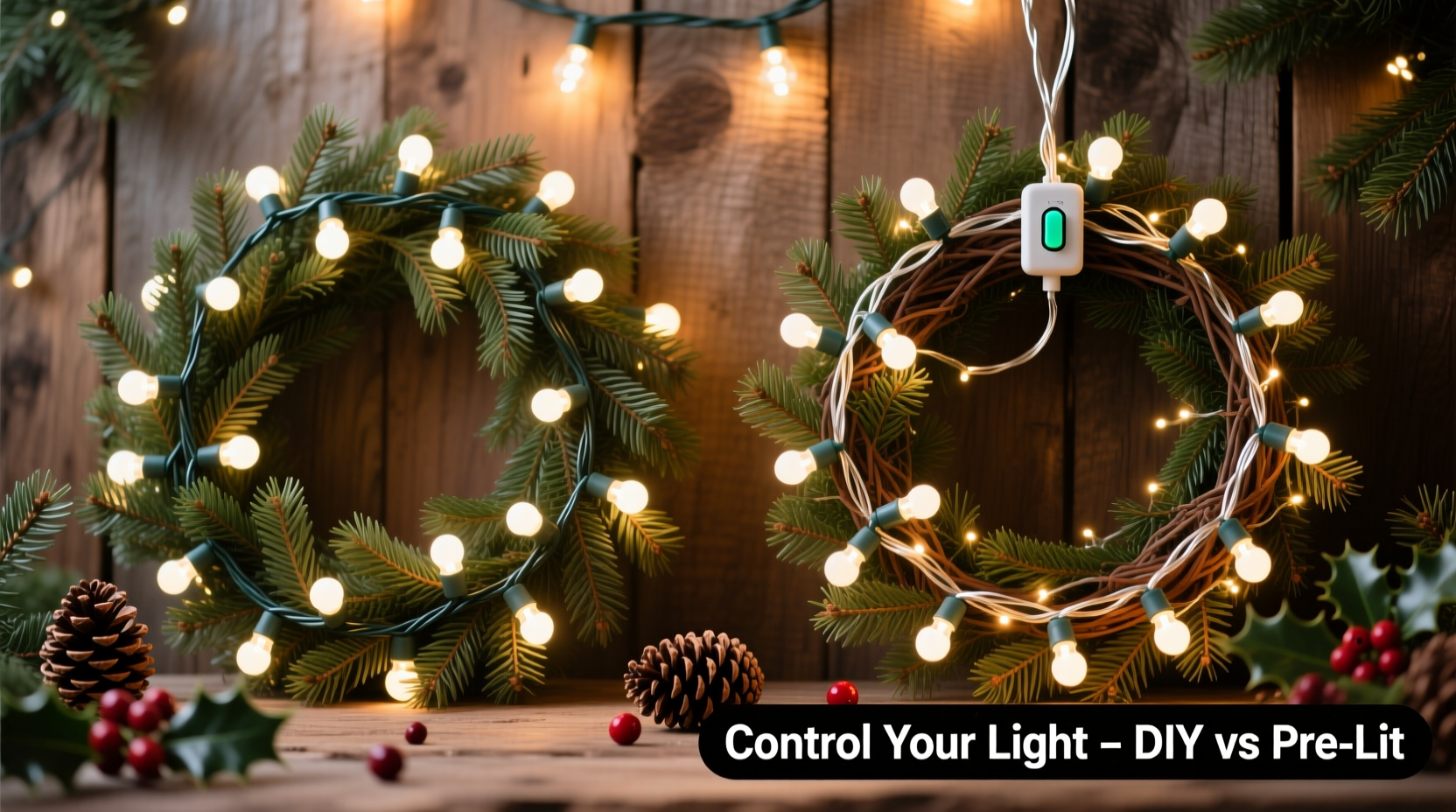
Brightness in decorative lighting isn't just about lumens; it's about ambiance, visibility, and personal preference. A dimly lit wreath may create a cozy atmosphere but could be lost against a dark exterior at night. Conversely, an overly bright display might overwhelm the space or disturb neighbors. The ability to adjust brightness allows decorators to fine-tune their look based on time of day, season, surroundings, and even mood.
Brightness is influenced by several factors:
- Lamp type: Incandescent vs. LED — LEDs offer greater efficiency and longer life.
- Lumen output: Higher lumens mean brighter lights.
- Number of bulbs: More bulbs generally increase total brightness.
- Wiring configuration: Series vs. parallel circuits affect consistency and dimming capability.
- Dimmability: Not all lights can be dimmed, and compatibility with controllers varies.
These variables come into play differently depending on whether you choose a prelit wreath or customize your own.
Prelit Wreaths: Convenience vs. Limitations
Prelit wreaths are factory-assembled decorations where lights are permanently wired into the greenery or frame. They’re marketed for convenience—plug and play, no setup required. Many come with built-in timers, remote controls, or preset modes like twinkle, fade, or steady-on.
However, when it comes to brightness control, prelit models often fall short. Most operate at a fixed brightness level determined during manufacturing. Even those labeled “adjustable” typically only switch between preset lighting effects rather than offering true dimming functionality.
Additionally, brightness uniformity can be an issue. Because manufacturers prioritize cost-efficiency, many prelit wreaths use lower-lumen LEDs spaced unevenly, leading to patchy illumination. Some sections may appear too bright while others remain underlit, especially on larger wreaths (24 inches or more).
“Most mass-market prelit wreaths are designed for visual appeal out of the box, not for nuanced lighting control. If you want subtle ambiance, you’ll likely need to supplement or replace them.” — Daniel Ruiz, Residential Lighting Designer
Pros and Cons of Prelit Wreaths
| Advantages | Disadvantages |
|---|---|
|
|
Custom-Lit Wreaths: Full Control Over Brightness
Building your own lit wreath from scratch offers unparalleled control over every aspect of the lighting experience—including brightness. By selecting individual string lights and applying them strategically, you can tailor the luminosity to match your environment and aesthetic goals.
Start with choosing high-quality, dimmable LED string lights. Look for specifications such as:
- Dimmable driver/chipset
- Lumens per bulb (e.g., 2–6 lumens for soft glow, 8–12 for vibrant)
- Color temperature (2700K warm white for traditional, 3000K–4000K for modern)
- Wire gauge and durability (especially for outdoor use)
You can then decide how densely to wrap the lights—tighter spacing increases perceived brightness. For example, using two strands instead of one doubles the light output. You also retain the ability to mix bulb types: combine steady warm-white LEDs with occasional cool-white accent bulbs for depth and contrast.
Step-by-Step: Building a Custom-Lit Wreath for Optimal Brightness
- Select a wreath form: Choose a foam, metal, or natural base that suits indoor or outdoor use.
- Choose dimmable LED strings: Ensure they’re compatible with your intended power source and controller.
- Determine bulb density: For moderate brightness, wrap lights every 2–3 inches; for high impact, go every inch.
- Test before securing: Plug in the lights and assess brightness in actual conditions (daylight and night).
- Secure with floral wire or clips: Avoid damaging wires; leave slack near plug ends for easy access.
- Add a smart dimmer or controller: Use a wall-mounted dimmer or Wi-Fi-enabled switch to adjust brightness remotely.
- Label and store carefully: Mark wires and keep spools intact for reuse next season.
Real-World Example: Sarah’s Front Door Transformation
Sarah, a homeowner in Portland, Oregon, initially bought a 28-inch prelit wreath for her entryway. While attractive during the day, she found it too dim at night, barely visible beyond her porch steps. After researching alternatives, she invested in a 24-inch premium evergreen wreath and added two strands of 100-count warm-white dimmable LEDs.
She wrapped the lights in concentric circles, overlapping slightly for even coverage. Then, she connected them to a Lutron smart dimmer switch inside her home. Now, she adjusts brightness based on occasion: 30% for quiet evenings, 100% for holiday parties, and uses a sunset-to-sunrise schedule via her home automation system.
“I didn’t realize how much difference manual control would make,” Sarah said. “Now my wreath feels intentional—not just another decoration.”
Expert Recommendations for Maximum Flexibility
Lighting professionals consistently recommend custom solutions when brightness control is a priority. Here’s why:
- Modular upgrades: Replace or add strands year after year without buying a whole new wreath.
- Energy efficiency: Only illuminate what you need; reduce wattage during off-peak hours.
- Seasonal adaptability: Reuse the same lights on trees, garlands, or window frames after the holidays.
- Smart integration: Sync with voice assistants or apps for dynamic scenes (e.g., gentle pulse on Christmas Eve).
“The real advantage of DIY lighting isn’t just brightness—it’s ownership of the entire experience. You become the designer, not just the buyer.” — Lena Torres, Interior Lighting Consultant
Checklist: Choosing the Right Approach for Your Needs
- You value speed and simplicity over customization.
- You decorate the same spot annually and don’t change themes.
- You lack tools or confidence to handle wiring.
- Your outlet access is limited and you prefer corded units.
- You want full control over brightness and color tone.
- You plan to reuse components across multiple displays.
- You’re using smart home systems and want scheduling/dimming.
- You have specific aesthetic goals (e.g., vintage Edison bulbs or colored gradients).
FAQ: Common Questions About Wreath Lighting and Brightness
Can I dim a prelit wreath?
Only if it explicitly states \"dimmable\" and uses compatible technology. Most prelit wreaths use non-dimmable LEDs or integrated drivers that don’t respond well to external dimmers. Attempting to dim them can cause flickering, reduced lifespan, or failure.
How many lights do I need for optimal brightness?
A general rule is 100 bulbs per foot of wreath diameter. So, a 24-inch (2-foot) wreath needs about 200 bulbs for balanced brightness. For higher impact, double that number. With custom setups, you can layer strands to achieve this incrementally.
Are warm white or cool white lights brighter?
Cool white (4000K–5000K) appears brighter to the human eye due to higher blue spectrum content, even at the same lumen output. However, warm white (2700K–3000K) creates a cozier feel and is less harsh at night. Choose based on desired mood, not just measured brightness.
Conclusion: Take Charge of Your Holiday Glow
The choice between a prelit wreath and adding your own lights ultimately hinges on how much control you want over the final result. If convenience is paramount and your expectations are modest, a prelit model may suffice. But if you care about ambiance, adaptability, and the ability to fine-tune brightness for different occasions, building your own lit wreath is the superior path.
Customization empowers you to create a display that reflects your taste and responds to your environment. From selecting exact lumen outputs to integrating smart dimming systems, the level of precision available far exceeds anything off-the-shelf. Plus, the initial effort pays dividends in reusability, sustainability, and seasonal joy.




 浙公网安备
33010002000092号
浙公网安备
33010002000092号 浙B2-20120091-4
Comments
No comments yet. Why don't you start the discussion?