
Every November, millions of households face the same quiet dilemma: do they settle for flicking a switch or pressing a button to cycle through three preset patterns—or do they invest in technology that transforms their home into a synchronized, story-driven light experience? The divide isn’t just about price. It’s about agency—how much creative authority you retain over timing, intensity, color, sequence, and responsiveness. Basic remotes have served well for decades, offering simplicity and reliability. But programmable controllers now deliver precision once reserved for professional installations. Understanding where each excels—and where one fundamentally outperforms the other—is essential before wiring your first strand or upgrading last year’s setup.
What “Control” Really Means in Holiday Lighting
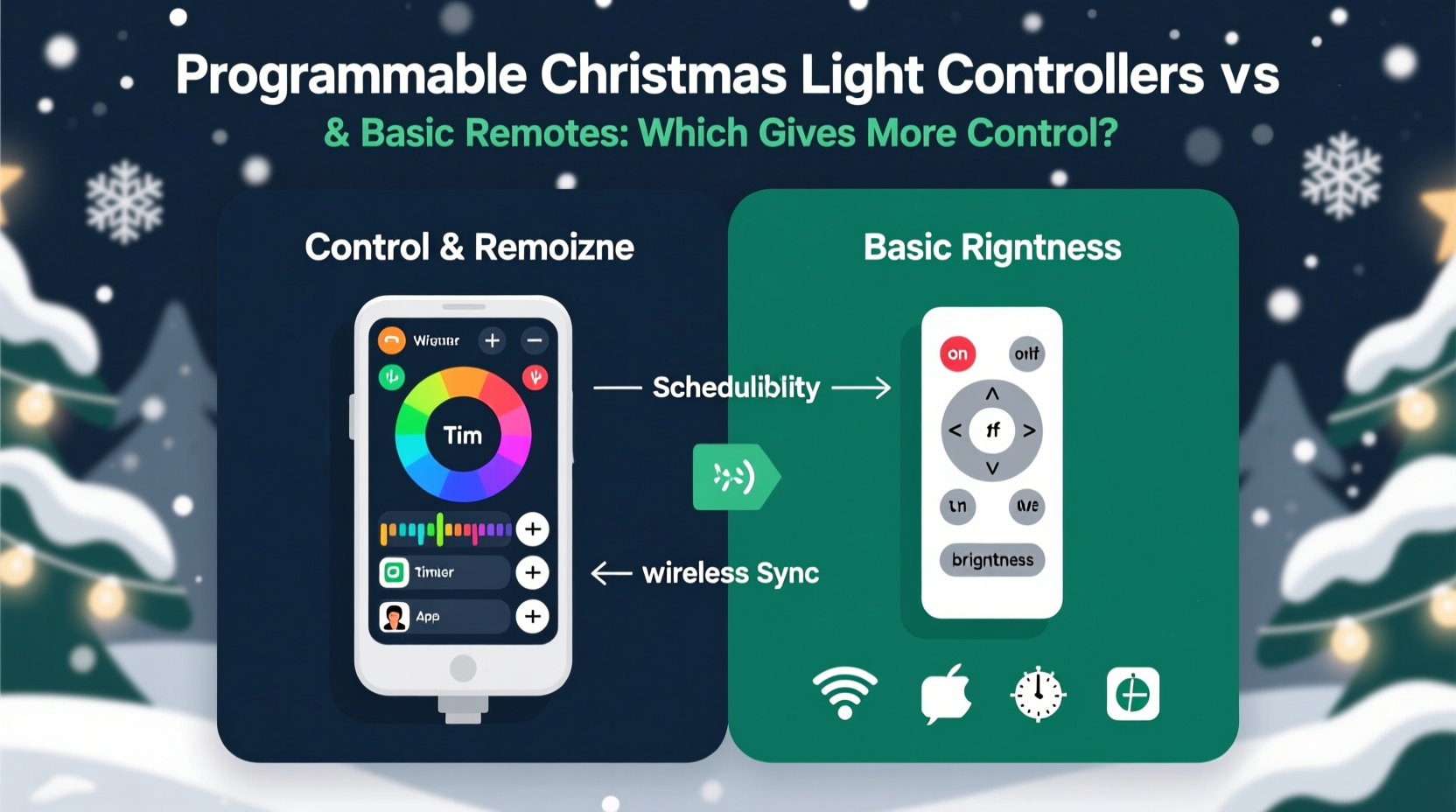
“Control” is often misused as shorthand for “on/off.” In practice, it encompasses five measurable dimensions: timing granularity (down to the millisecond), sequence complexity (layered animations across multiple channels), environmental responsiveness (motion, sound, or weather triggers), automation depth (scheduling with sunrise/sunset offsets and recurring exceptions), and scalability (managing dozens of independent zones without physical reconfiguration). A basic remote typically governs one or two functions: power toggle and pattern selection. A programmable controller treats lighting as data—assigning values to pixels, defining transitions, and executing logic. This distinction becomes critical when planning multi-facade displays, integrating with smart home ecosystems, or aiming for repeatable, shareable effects.
How Basic Remotes Work—and Where They Hit Limits
Basic infrared (IR) or short-range RF remotes communicate with a single receiver module wired inline with one or more light strings. Most operate on fixed-frequency protocols with no pairing or encryption. Their interface is intentionally minimal: a power button, mode button (cycling through 3–8 built-in patterns like “twinkle,” “chase,” or “fade”), speed toggle, and sometimes brightness. Internally, these remotes trigger preloaded firmware routines stored in the receiver’s microcontroller—no user modification possible.
Their strengths are undeniable: low cost ($5–$25), plug-and-play installation, zero learning curve, and high reliability in dry, line-of-sight conditions. However, limitations compound quickly. You cannot set lights to turn on at 4:58 p.m. on December 23rd and off at 11:02 p.m. You cannot make red lights pulse only when someone walks past the porch. You cannot assign different patterns to upper and lower windows simultaneously. And if you add a second light set, you’ll need a second remote—and likely a second receiver—unless both sets are explicitly designed for multi-unit IR daisy-chaining (a rare, undocumented feature).
How Programmable Controllers Enable True Creative Authority
Programmable controllers—whether standalone units like the Light-O-Rama CTB16PC or modern Wi-Fi-enabled hubs like the Falcon F16v3 or xLights-compatible ESP32-based boards—operate on a fundamentally different architecture. They run open-source or proprietary sequencing software (e.g., xLights, Vixen Lights, or LightShow Pro) on a computer or Raspberry Pi, then transmit precise frame-by-frame instructions to hardware outputs. Each output channel controls voltage delivery to a specific circuit, and sequences define exact RGB values, intensities, and durations for every millisecond of the show.
This model unlocks granular control previously impossible with remotes:
- Pixel-level precision: Individual LEDs in addressable strips (WS2811/WS2812B) can be programmed independently—creating flowing rainbows, text scrollers, or reactive audio waveforms.
- Time-based automation: Lights activate precisely at sunset (calculated daily via GPS coordinates), dim gradually over 30 minutes, pause during a neighborhood parade window, and resume—all without manual intervention.
- Multi-zone orchestration: Your roofline, driveway, and tree operate as separate timelines within one master sequence—synchronized to the same audio track with frame-accurate cue points.
- Real-time interactivity: Connect PIR motion sensors or microphone inputs to trigger custom animations—e.g., a snowflake burst when the front door opens, or bass-responsive strobes synced to backyard speakers.
- Version-controlled iteration: Save, compare, and revert sequences like code—tweaking a single channel’s fade curve without rebuilding the entire show.
“The shift from ‘remote’ to ‘programmable’ isn’t about adding features—it’s about shifting from consumer to creator. You stop selecting patterns; you author experiences.” — Derek Lin, Founder of HolidayLightingLab and 12-year display designer for municipal festivals
Side-by-Side Comparison: Capabilities That Matter
| Feature | Basic Remote System | Programmable Controller System |
|---|---|---|
| Scheduling Precision | None. Manual on/off or simple timer (±15 min accuracy) | Second-level accuracy. Sunset/sunrise triggers, recurring weekly calendars, holiday-specific overrides (e.g., “New Year’s Eve: extend show until 1:00 a.m.”) |
| Pattern Customization | Fixed library (3–12 patterns). No editing possible. | Unlimited sequences. Design custom fades, chases, ripples, text, or physics-based simulations (e.g., falling snow with variable wind drift). |
| Zones Managed | 1–2 zones max (requires duplicate hardware for expansion) | Dozens of independent zones (e.g., 16-channel controller manages 16 circuits; networked systems scale to hundreds) |
| Audio Sync | No support. Patterns run independently of music. | Frame-accurate lip-sync to MP3/WAV files. Visualize beat detection, assign channels to frequency bands, and manually place cues. |
| Troubleshooting & Diagnostics | None. If lights don’t respond, check batteries or line-of-sight. | Real-time channel monitoring, error logging (e.g., “Channel 7 voltage drop detected at 8:23 p.m.”), and visual waveform previews before deployment. |
| Long-Term Flexibility | Hardware locked to original firmware. No upgrades or community support. | Open-source tools, active forums, hardware modding (e.g., adding Ethernet or cellular failover), and annual software updates with new effects. |
Mini Case Study: The Thompson Family’s Two-Year Evolution
The Thompsons in Portland, Oregon began with a $12 remote-controlled garland and two pre-lit wreaths in 2022. By Thanksgiving, they’d added four more sets—but struggled with mismatched timers, inconsistent brightness, and frustration when the remote failed during a neighborhood tour. “We’d press ‘on’ and get ‘twinkle’ instead of ‘steady.’ Then the battery died mid-conversation with guests,” recalls Sarah Thompson.
In 2023, they invested $220 in a 16-channel Falcon controller, a Raspberry Pi, and xLights software. They mapped their house: 4 channels for eaves, 6 for the tree, 2 for path lights, and 4 for window outlines. Using free tutorials, they built a 4-minute synchronized show to “Carol of the Bells,” complete with timed spotlight sweeps and a finale snowfall effect triggered by a motion sensor near the driveway. Neighbors began texting requests for “the blue wave effect” and asking how to replicate it. For 2024, they’re adding voice control (“Alexa, start the winter wonderland sequence”) and planning a neighbor-coordinated block-wide light sync using timecode broadcasting.
Their ROI wasn’t just aesthetic. It was control regained—over timing, narrative, guest experience, and their own creative confidence.
Practical Implementation Checklist
Before committing to either path, verify these fundamentals:
- Confirm compatibility: Check if your lights use AC mains (120V), low-voltage DC (12V/24V), or digital addressable protocols (WS2811, SK6812). Remotes rarely support addressable LEDs; programmable controllers require them for pixel-level control.
- Calculate channel needs: One channel = one independent circuit. A simple roofline may need 1 channel; an RGB pixel strip wrapping a column needs 3 (R, G, B) or more if segmented.
- Assess your tech comfort: Remotes demand zero software. Programmable systems require installing sequencing software, calibrating timing, and troubleshooting network connections—though modern tools like xLights’ “Wizard Mode” reduce entry barriers significantly.
- Evaluate physical constraints: Will the controller be mounted outdoors? Does it need weatherproofing? Is there reliable Wi-Fi coverage at the mounting location? Basic remotes avoid all these concerns.
- Plan for growth: Choose a controller with 25–50% more channels than your current needs. Adding zones later is far easier than replacing core hardware.
FAQ
Can I mix programmable controllers and basic remotes in one display?
Yes—but not seamlessly. You can use a programmable controller for your main display (e.g., roofline and tree) while keeping porch lights on a basic remote. Just ensure they’re on separate circuits and power sources to avoid interference. Avoid connecting remote receivers to the same power supply feeding a programmable controller’s outputs, as voltage spikes may disrupt sequencing.
Do programmable controllers require constant computer connection?
No. Once sequences are compiled and uploaded, most modern controllers (e.g., ESP32-based or Raspberry Pi + SD card) run shows autonomously. The computer is only needed for design, editing, and initial upload—like loading a playlist onto a smart speaker.
Are programmable systems safe for beginners?
Yes—with caveats. Low-voltage (12V/24V) DC systems pose minimal shock risk and are ideal for learning. High-voltage AC controllers require adherence to NEC Article 411 standards and licensed electrician review for permanent outdoor installations. Always use GFCI-protected outlets and UL-listed power supplies. Start with a single 4-channel kit before scaling.
Conclusion: Control Is a Choice—Not a Feature
Choosing between a programmable controller and a basic remote isn’t about picking “better” technology. It’s about aligning your tool with your intention. If your goal is warmth, simplicity, and shared moments—not technical mastery—then a reliable remote remains elegant and appropriate. But if you envision lights that breathe with the season, respond to your presence, tell stories through color and motion, and evolve year after year with deeper personal meaning, then programmable control is the only path that honors that vision. It transforms decoration into expression, routine into ritual, and observation into participation. You’re not just illuminating your home—you’re composing light, conducting time, and inviting wonder on your own terms.




 浙公网安备
33010002000092号
浙公网安备
33010002000092号 浙B2-20120091-4
Comments
No comments yet. Why don't you start the discussion?