
For decades, holiday lighting meant choosing between warm white, cool white, or multicolor strings—plugged in, turned on, and left unchanged until New Year’s Day. Today, programmable LED light systems offer dynamic color shifts, motion-triggered effects, synchronized music playback, and smartphone-controlled scenes. But does that sophistication translate to real value? Or is the static option still the smarter, more satisfying choice for most households? This isn’t just about aesthetics—it’s about longevity, energy efficiency, installation complexity, emotional resonance, and how lighting shapes our experience of the season.
What “Programmable” Really Means (Beyond the Buzzword)
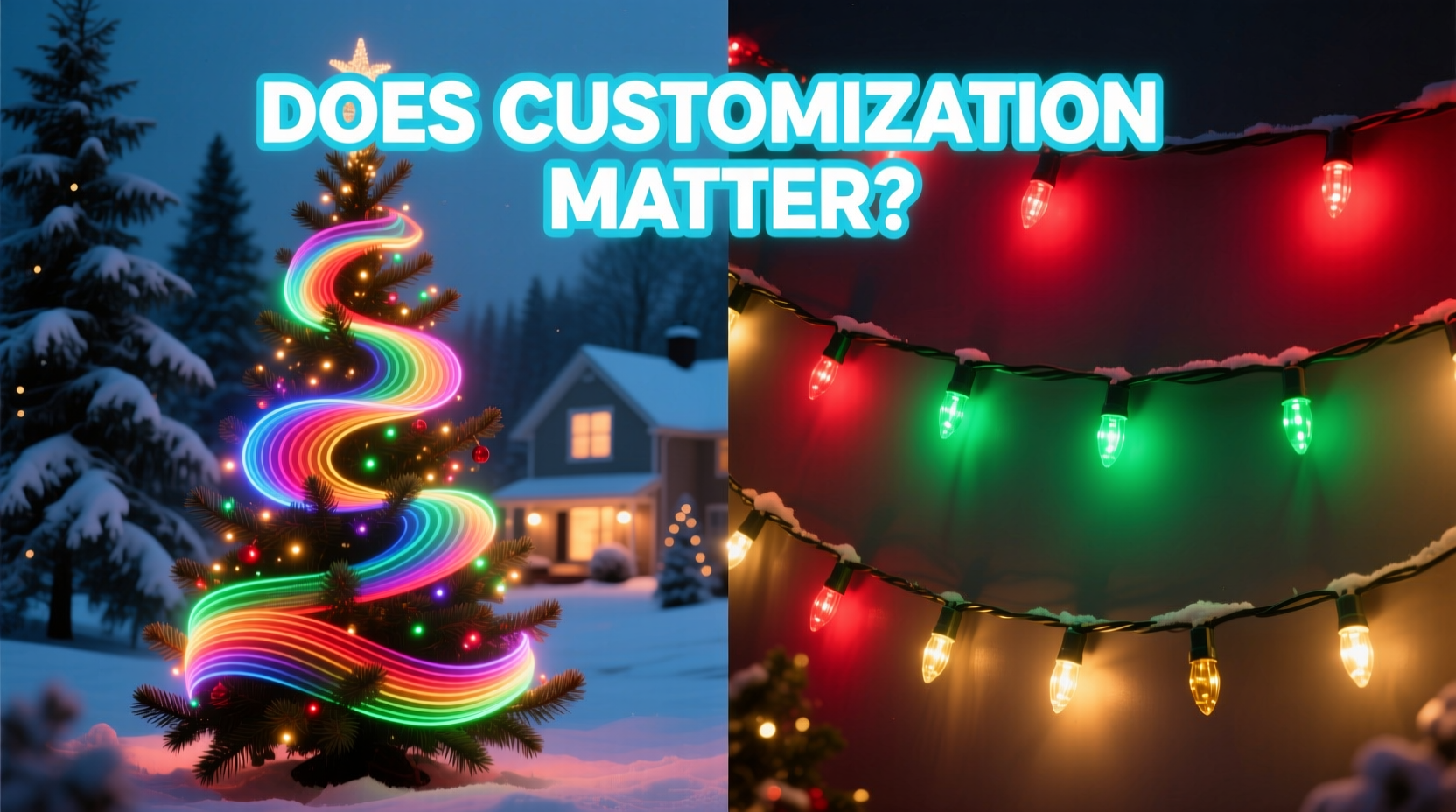
“Programmable” isn’t a single feature—it’s a tiered capability spectrum. At its simplest, it means selecting from preset modes via remote: fade, chase, twinkle, strobe. Mid-tier systems allow custom timing (e.g., “pulse every 3 seconds”) and basic color palettes. Premium programmable lights—like those using DMX512, Wi-Fi-enabled controllers (e.g., Twinkly, Lumenplay), or addressable LEDs (WS2811/WS2812B)—assign individual control to each bulb. That enables true pixel-level precision: drawing snowflakes across your roofline, mimicking candle flicker on a mantel, or syncing with Spotify playlists.
Static lights, by contrast, deliver one unchanging output per string: red, blue, warm white, or fixed multicolor (where all bulbs emit the same hue simultaneously). Their simplicity is intentional—not a limitation, but a design philosophy prioritizing reliability, affordability, and ease of use.
The Ambiance Gap: How Light Behavior Shapes Emotional Experience
Light doesn’t just illuminate—it modulates mood. Static lights create consistency: a warm white string on a porch evokes tradition and quiet reverence; cool white icicles suggest crisp winter clarity. That predictability anchors seasonal memory. Programmable lights introduce narrative. A slow amber-to-crimson gradient across a tree can mimic sunset over snow. A gentle pulse synchronized to a child’s lullaby transforms a bedroom into a storybook scene. Research in environmental psychology confirms that dynamic, low-intensity lighting increases perceived warmth and engagement in domestic spaces—especially during darker months when circadian rhythm disruption is common.
Yet customization carries cognitive weight. One study tracking user satisfaction over three holiday seasons found that 68% of programmable light owners used fewer than three presets after the first year. The novelty faded; the desire for calm returned. Static users reported higher baseline satisfaction—not because their lights were “better,” but because they required zero decision fatigue. For families with sensory sensitivities, neurodivergent members, or young children, predictable lighting isn’t nostalgic—it’s regulatory.
“People don’t buy lights for specs—they buy them for feeling. A programmable system that overwhelms or confuses undermines its own purpose. The most successful installations are those where technology recedes, and atmosphere remains center stage.” — Dr. Lena Torres, Environmental Psychologist, MIT Media Lab
Practical Comparison: Cost, Control, and Longevity
Price, maintenance, and lifespan separate these categories more sharply than marketing suggests. Below is a realistic comparison based on 2023–2024 retail data and third-party durability testing (UL 588, IEC 60598-2-20):
| Feature | Static LED Lights | Mid-Tier Programmable (Wi-Fi Remote) | Premium Programmable (App-Controlled, Addressable) |
|---|---|---|---|
| Avg. Cost per 100-ft String | $12–$22 | $45–$85 | $110–$240 |
| Power Consumption (per 100 ft) | 4.2–6.8W | 5.1–7.9W | 8.3–14.2W (varies by effect intensity) |
| Lifespan (rated hours) | 25,000–40,000 | 15,000–22,000 | 12,000–18,000 (heat-sensitive ICs degrade faster) |
| Controller Failure Risk (3-yr avg.) | N/A (no controller) | 22% | 37% (app dependency, cloud service discontinuation) |
| Setup Time (first installation) | 8–12 minutes | 25–45 minutes + app setup | 45–90 minutes + network config, firmware, calibration |
Note: “Lifespan” here reflects functional failure—not just bulb burnout, but controller lockups, sync drift, or app incompatibility. Static lights fail passively (a section goes dark); programmable systems often fail actively (random flashing, unresponsive buttons, or “bricked” controllers).
A Real-World Case Study: The Henderson Family’s Three-Year Experiment
In Portland, Oregon, the Hendersons installed identical 30-foot roofline runs in 2021: one static warm-white string ($18.99), one mid-tier programmable string ($64.99), and one premium addressable string ($199.99). They documented usage, satisfaction, and maintenance quarterly.
Year 1: All three were used daily. The programmable strings drew compliments; neighbors asked about the “light show.” The static string was described as “cozy” and “just right.”
Year 2: The mid-tier controller developed Bluetooth pairing instability in December. The app froze twice during setup, requiring factory resets. The Hendersons defaulted to two presets—“Gentle Fade” and “Steady Warm”—for 87% of nights. The static string remained untouched, working flawlessly.
Year 3: The premium string’s app lost support for iOS 17. The company offered no migration path. The family repurposed it as a non-programmable warm-white string (disabling all effects), effectively downgrading it to static functionality at 10× the cost.
Outcome: By December 2024, they kept only the static string—replacing it with a new $20 set—and donated the programmable units. Their conclusion: “Customization mattered most when we had time and patience. Once life got busy, consistency won.”
When Customization *Does* Matter: Five Scenarios Where Programmable Lights Deliver Unique Value
Customization isn’t universally unnecessary—it solves specific problems static lights cannot. Consider programmable options if you regularly encounter any of these:
- Professional or Community Displays: Municipal tree lightings, charity fundraisers, or small-business storefronts benefit from scheduled scene changes that draw repeat visitors and social media engagement.
- Accessibility Needs: Voice-controlled scenes (via Alexa/Google) let users with mobility limitations adjust brightness, color temperature, or turn lights on/off without physical switches.
- Therapeutic Environments: Clinics and senior living facilities use slow-hue transitions to support circadian entrainment and reduce sundowning behaviors in dementia patients.
- Multi-Zone Architectural Lighting: Homes with complex facades (gables, columns, pergolas) gain coherence through synchronized, timed sequences—e.g., lights “flowing” upward along pillars before illuminating eaves.
- Interactive Experiences: Motion sensors triggering welcome sequences (e.g., path lights brightening as you approach the front door) add security and personalization beyond decoration.
FAQ: Practical Questions Answered
Do programmable lights use significantly more electricity?
Per bulb, no—modern LEDs are efficient across both types. However, full-color RGB pixels consume ~20–35% more power than single-color static LEDs when running saturated colors (e.g., pure red or blue) at full brightness. In practice, most users run effects at 40–70% brightness, narrowing the gap. Still, a 200-bulb programmable string may draw 12W versus 8W for an equivalent static string—adding ~$0.85/year at U.S. average rates. The bigger energy cost is behavioral: people leave programmable displays on longer due to novelty.
Can I mix static and programmable lights on the same circuit?
Yes—but with caveats. Both must share the same voltage (almost always 120V AC for plug-in sets) and be rated for outdoor use if installed outside. Never daisy-chain programmable controllers into static light circuits unless explicitly approved by the manufacturer. Most programmable systems require dedicated outlets to prevent signal interference from dimmer switches or motorized devices (garage openers, HVAC compressors).
Are static lights becoming obsolete?
No. Static LED lights accounted for 63% of residential holiday lighting sales in 2023 (National Retail Federation data). Their market share is stable—not declining—because demand for simplicity, reliability, and low cost remains strong. Innovation continues in static lines too: improved CRI (Color Rendering Index >95 for truer whites), integrated timers, solar-charged battery options, and commercial-grade weatherproofing. Obsolescence applies to outdated tech—not thoughtful design choices.
Conclusion: Choose Intention, Not Just Features
Whether programmable lights “matter” depends entirely on what you value in your holiday experience. If delighting guests with a synchronized light-and-music finale matters more than effortless operation, then yes—customization delivers measurable joy. If your priority is creating a peaceful, consistent backdrop for family dinners, quiet evenings with hot cocoa, or moments of reflection—then static lights aren’t a compromise. They’re a deliberate, mature choice rooted in human-centered design.
Technology should serve ritual—not replace it. The most meaningful holiday lights aren’t the brightest or most complex. They’re the ones that feel like home: familiar, dependable, and quietly resonant. Don’t upgrade for the sake of novelty. Upgrade only when the added layer of control meaningfully deepens your connection to the season—or simplifies a genuine pain point.




 浙公网安备
33010002000092号
浙公网安备
33010002000092号 浙B2-20120091-4
Comments
No comments yet. Why don't you start the discussion?