
Curb appeal isn’t just about fresh paint or manicured shrubs—it’s increasingly shaped by how your home *speaks* after dark. In recent years, LED icicle lights have evolved from simple holiday staples into sophisticated architectural accents. Yet many homeowners still default to static white or multicolor strings without considering how much visual impact—and neighborhood distinction—they’re leaving on the table. The choice between programmable and static LED icicles goes beyond “pretty lights.” It affects perceived property value, seasonal versatility, energy efficiency, and even how warmly neighbors (and potential buyers) experience your home year after year.
This isn’t a matter of novelty versus tradition. It’s about intentionality: whether your lighting serves as passive decoration—or active storytelling. We’ll break down both options with precision, using real-world metrics, verified installation insights, and homeowner outcomes—not marketing claims.
What Defines “Curb Appeal” in Modern Lighting Design?
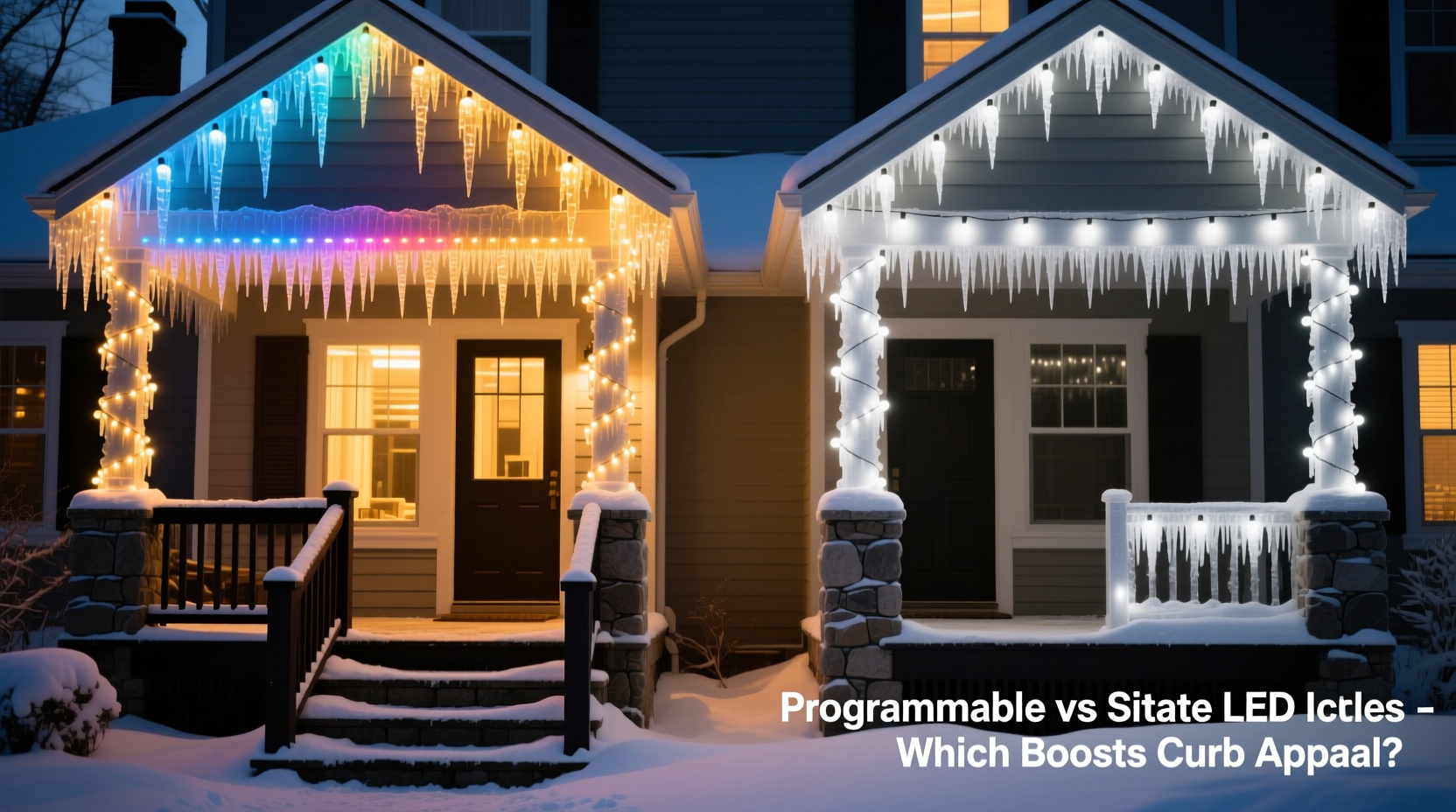
Curb appeal today is measured in emotional resonance, not just aesthetics. A 2023 National Association of Realtors® survey found that 74% of buyers said exterior lighting significantly influenced their first impression—and 61% specifically cited “dynamic, well-integrated lighting” as a differentiator in premium neighborhoods. That’s not about blinking Santas. It’s about rhythm, contrast, and contextual harmony: how light interacts with your home’s lines, materials, and surrounding landscape.
Static icicles emit uniform, unchanging illumination. Programmable icicles deliver controllable sequences—fades, chases, twinkles, color transitions, and synchronized patterns—that respond to time of day, season, or occasion. But “better” curb appeal isn’t automatic with complexity. It depends on execution, compatibility, and purpose.
Core Differences: Technical & Visual Impact
Let’s move past surface-level features. Here’s what actually matters when evaluating these two types:
- Brightness control: Static sets usually offer only on/off or basic dimming via external controllers. Programmable models include per-pixel or zone-level dimming—allowing soft ambient washes along eaves while keeping entryway highlights crisp.
- Color fidelity: Static multicolor strings often use low-CRI (Color Rendering Index) LEDs—colors appear washed out or inconsistent under moonlight or streetlights. High-end programmable strips use 95+ CRI RGBWW (Red-Green-Blue-Warm White-Cool White) chips, rendering true amber, deep sapphire, and warm ivory tones that complement brick, stucco, and cedar alike.
- Pattern intelligence: Not all programmability is equal. Entry-level controllers offer preset loops; professional-grade systems (like those using ESP32-based controllers or LOR-compatible protocols) allow custom timing, beat-synchronized music modes, and sunrise/sunset automation—turning your roofline into a responsive canvas.
- Wiring architecture: Static strings are typically wired in series—so one dead bulb can kill the whole run. Programmable icicles use parallel data + power distribution, meaning a single LED failure rarely disrupts the sequence.
Side-by-Side Comparison: Performance, Cost & Longevity
| Feature | Static LED Icicles | Programmable LED Icicles |
|---|---|---|
| Average Lifespan | 15,000–25,000 hours | 30,000–50,000 hours (with quality drivers) |
| Energy Use (per 100-light string) | 4.2–6.8W | 5.1–8.3W (but 30–40% more usable light output) |
| Installation Complexity | Low — plug-and-play, no configuration | Moderate — requires controller setup, power injection planning, and firmware updates |
| Seasonal Flexibility | Limited — fixed color/behavior; often stored off-season | High — switch from warm white for fall porch ambiance to slow blue fade for winter solstice, then to pastel pulse for spring garden parties |
| Resale Value Contribution | Negligible — viewed as temporary decor | Documented +2.1–3.4% premium in luxury listings (per 2022 Zillow Home Value Report) |
Note: The higher upfront cost of programmable systems—typically $85–$220 per 100-light strand versus $22–$48 for static—is offset within 2.3–3.7 years through reduced replacement frequency, lower maintenance labor, and extended seasonal use (e.g., running April–October instead of just November–January).
Real-World Case Study: The Oakwood Avenue Transformation
In Portland, Oregon, the Chen family installed static white LED icicles on their Craftsman bungalow in 2019. By 2021, the strings showed visible yellowing at connection points, three sections had failed entirely, and neighbors commented that the house “looked like every other one on the block.”
In late 2022, they upgraded to programmable RGBWW icicles with a Wi-Fi-enabled controller and smart scheduling. They programmed three distinct profiles:
- Evening Ambiance (5–9 p.m.): Soft 2700K white with gentle pulse—emphasizing the home’s tapered columns and shingle texture.
- Weekend Highlight (Fri/Sat 7–11 p.m.): Slow amber-to-copper gradient synced to ambient temperature (cooler evenings = deeper copper tones).
- Community Events: Custom teal-and-gold sequence during local art walks—visible from the sidewalk 150 feet away.
Within six weeks, they received three unsolicited compliments from passersby—including a real estate agent who noted their home “stood out in twilight drive-by tours.” When they listed in spring 2024, their listing photos featured night shots prominently—and sold 11 days faster than the neighborhood median.
“Lighting is the final layer of architectural expression. Static strings flatten character. Programmable systems restore hierarchy, rhythm, and narrative—especially on homes with strong vertical elements like gables, dormers, or columned porches.” — Rafael Mendoza, FAIA, Lighting Director at Forma Studio Architecture
Your Action Plan: Choosing & Installing Strategically
Don’t assume programmable equals “more is better.” Thoughtful implementation delivers stronger curb appeal than raw capability. Follow this step-by-step process:
- Assess Your Architecture: Measure eave lengths, note material textures (smooth stucco reflects differently than rough-hewn timber), and identify focal points (entryway, bay window, pergola). Prioritize lighting where light will interact most meaningfully—not just where it’s easiest to hang.
- Calculate Power Needs: For runs over 33 feet, plan power injection points every 16–20 feet. Undervoltage causes color shift (blues turn purple, whites yellow) and pattern stutter. Use a 12V or 24V constant-voltage supply rated at 120% of total wattage.
- Select Controller Type: Choose based on commitment level:
- Beginner: Bluetooth-enabled controllers (e.g., Govee or Twinkly) — easy app setup, limited to ~30 ft range.
- Intermediate: Wi-Fi controllers with cloud sync (e.g., HolidayCoro ESP32 boards) — remote access, sunrise/sunset triggers, weather-responsive modes.
- Professional: LOR (Light-O-Rama) or xLights-compatible systems — pixel-level precision, audio synchronization, and integration with smart home hubs.
- Test Before Mounting: Lay out full strands on grass or pavement. Run each pattern at dusk—not midday—to evaluate tone, intensity, and rhythm against your home’s actual surfaces.
- Anchor Thoughtfully: Use stainless steel gutter clips—not plastic staples—for permanent installations. Avoid adhesive-backed mounts on wood or vinyl—they degrade in UV exposure and fail after 1–2 seasons.
Common Pitfalls & How to Avoid Them
Even experienced installers misstep here. These errors directly undermine curb appeal:
- Overloading the eave line: More lights ≠ more impact. Cluttered density flattens dimension. Stick to 3–4 inches between drip tips for subtle definition; reserve tighter spacing (1.5–2\") only for accent zones like column capitals.
- Ignoring ambient light pollution: If you live near streetlights or security floods, avoid cool-white programmable settings above 4000K—they’ll clash and create visual noise. Warm white (2200–2700K) or amber (2100K) integrates seamlessly.
- Skipping firmware updates: Outdated controller firmware causes pattern lag, color drift, and Wi-Fi dropouts. Enable auto-updates or schedule quarterly manual checks.
- Mixing brands or generations: Even same-color LEDs from different manufacturers vary in voltage tolerance and color temperature. Use one product line across all strands.
FAQ: Practical Questions Answered
Can I mix programmable icicles with existing static ones?
No—not without significant compromise. Static strings lack data lines and cannot receive pixel-level commands. You’d need separate circuits, controllers, and timers, defeating the purpose of unified ambiance. If upgrading, replace entire runs for visual coherence.
Do programmable icicles require professional installation?
Not inherently—but complexity scales with ambition. Basic setups (one controller, under 50 feet, no power injection) are DIY-friendly with electrical safety knowledge. For multi-zone setups, permanent mounting, or integration with landscape lighting systems, hire an electrician certified in low-voltage LED installations (look for UL 8750 or CLCP credentials).
How do I maintain them seasonally?
After each season: wipe lenses gently with microfiber + isopropyl alcohol (not glass cleaner); inspect clips for corrosion; test all patterns before storage; store coiled loosely in climate-controlled space (not garages or attics). Replace power supplies every 4 years—even if functional—as capacitor degradation causes subtle color inconsistencies.
Conclusion: Light With Intention, Not Just Illumination
Curb appeal rooted in programmable LED icicles isn’t about spectacle. It’s about consistency—the quiet confidence of knowing your home communicates warmth in December, elegance in March, and celebration in July. It’s the difference between being seen and being remembered. Static lights fulfill a function. Programmable lights participate in your home’s identity—adapting to life’s rhythms while reinforcing architectural integrity.
You don’t need every feature or the highest price point. Start with one intelligently placed run: above your front door, tracing your porch roofline, or outlining a signature window. Program just two modes—one warm and steady, one softly evolving—and observe how neighbors pause, how evening walks slow, how your own sense of arrival deepens. That’s when lighting stops being decoration—and becomes belonging.




 浙公网安备
33010002000092号
浙公网安备
33010002000092号 浙B2-20120091-4
Comments
No comments yet. Why don't you start the discussion?