
For decades, holiday and accent lighting meant flipping a switch—or wrestling with tangled strands of basic incandescent or early LED strings. Today, programmable LED lights promise pixel-perfect color control, voice-triggered animations, and seamless integration with home automation ecosystems. Yet they often cost two to four times more than standard LED sets. The question isn’t whether they’re *capable*—it’s whether their smart features deliver tangible, lasting value for most users. This isn’t about novelty; it’s about return on investment in usability, longevity, energy efficiency, and adaptability across seasons and life stages.
What “Programmable” Really Means (Beyond the Buzzword)
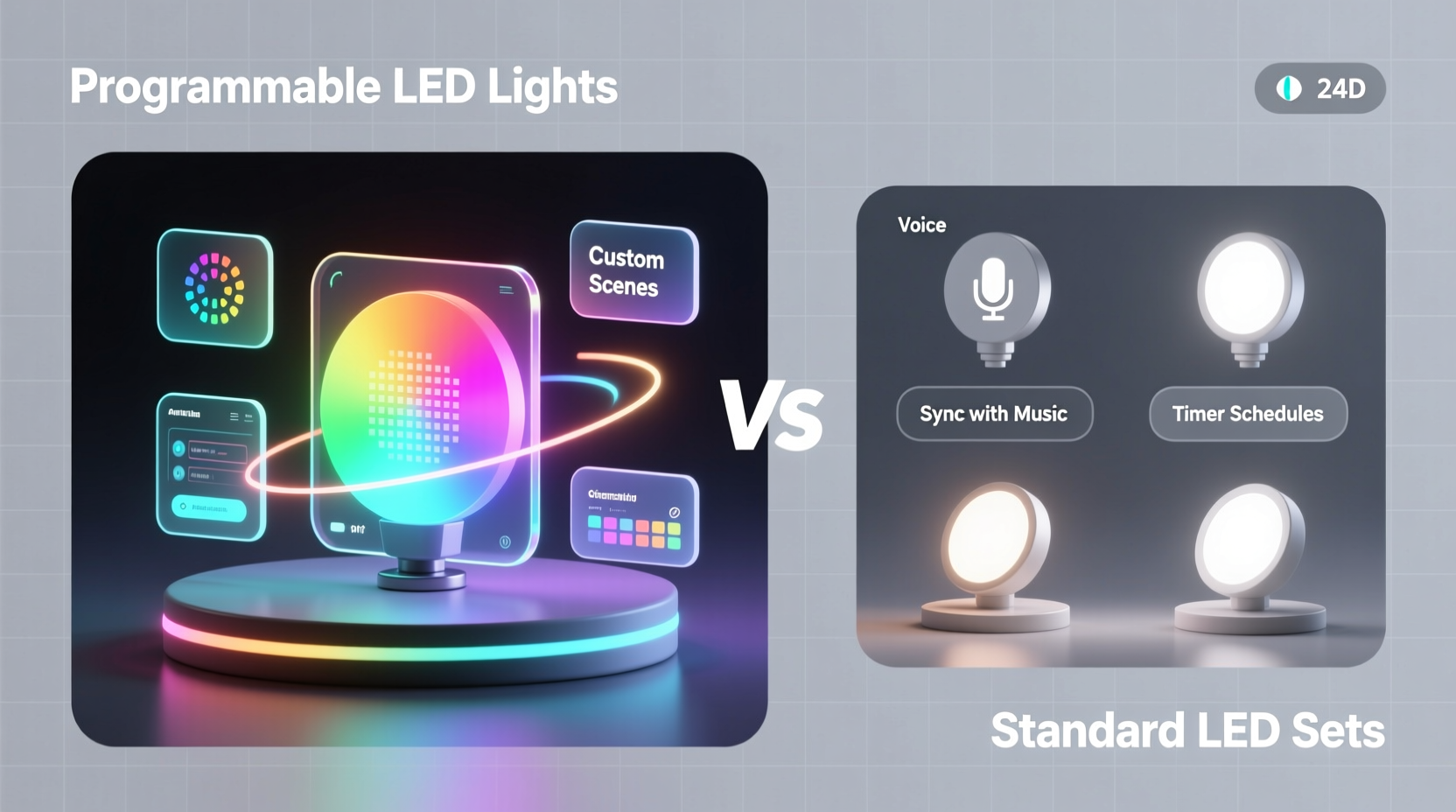
“Programmable” is frequently misused in marketing. A true programmable LED system meets three technical criteria: individual pixel addressability (each LED can be controlled independently), onboard or cloud-based sequencing logic (not just preset modes), and open or documented control protocols (e.g., DMX512, Art-Net, or manufacturer-agnostic APIs like WLED). In contrast, many “smart” lights sold at big-box retailers are merely remote-controlled with five fixed effects—no actual programming interface, no custom timing, no ability to sync to music or external triggers.
True programmability unlocks granular control: setting exact RGBW values for every bulb, defining fade curves between hues, assigning different behaviors to separate light zones (e.g., warm white on porch rails, pulsing teal under eaves), and triggering sequences based on time, weather data, or motion sensors. Standard LED sets—whether plug-in, battery-powered, or solar—offer only bulk on/off, dimming, or preloaded strobe/fade cycles. There’s no editing, no saving custom scenes, and no interoperability beyond their proprietary remote.
Cost Breakdown: Upfront, Operational, and Hidden Expenses
Price disparity starts at purchase but extends far beyond the box. Below is a realistic comparison for a 50-foot outdoor lighting run—common for residential porches, patios, or rooflines.
| Feature | Standard LED Set (50 ft) | True Programmable LED System (50 ft) |
|---|---|---|
| Upfront Cost | $25–$45 (multi-pack of 3–5 strands) | $120–$320 (addressable strip + controller + power supply + mounting) |
| Power Consumption (avg. nightly use) | 12–18W | 22–36W (higher density + controller overhead) |
| Lifespan (rated hours) | 25,000–30,000 hrs | 35,000–50,000 hrs (premium diodes + thermal management) |
| Replacement Flexibility | Entire strand replaced if one bulb fails | Individual pixels replaceable; sections rewirable |
| Software/Subscription Fees | None | None (open-source controllers like WLED); premium apps may charge $5–$15 one-time |
Note the paradox: while programmable systems draw more power *per foot*, their superior thermal design and drive electronics often yield longer operational life—reducing long-term replacement frequency. Standard sets suffer from cascading failures: one dead LED can blackout an entire segment due to series wiring. Programmable strips use parallel data lines and constant-current drivers, isolating faults.
A Real-World Case Study: The Johnson Family Patio Upgrade
The Johnsons installed 60 feet of standard warm-white LED string lights on their covered patio in 2021. Within 14 months, three sections failed completely—two due to moisture ingress near the junction box, one from voltage spikes during thunderstorms. Replacement cost: $58. They upgraded in 2023 to a programmable WS2812B strip system with a Raspberry Pi–based WLED controller, IP65-rated housing, and surge-protected power supply—total investment: $217.
Within six months, they leveraged features they hadn’t anticipated needing: using geofencing to auto-activate soft amber lighting when family members arrived home after dark; syncing brightness to ambient light sensor data so lights never overwhelmed evening conversations; and reprogramming colors for seasonal transitions (crisp white for summer nights, deep amber for fall evenings, muted cool blue for winter). Most significantly, when a squirrel chewed through 8 feet of strip last spring, they cut out the damaged section, soldered in a new 10-foot segment, and reprogrammed the pixel map in under 20 minutes—cost: $14.50 for materials.
“We paid more upfront,” says Mark Johnson, a civil engineer and DIY enthusiast, “but we’ve already recouped the difference in avoided replacements—and the flexibility has changed how we experience our outdoor space.”
When Smart Features Deliver Real Value (and When They Don’t)
Smart features justify cost only when aligned with specific, repeatable needs—not theoretical ones. Consider these scenarios:
- Justified: Renters who move frequently benefit from reusable, reconfigurable lighting. A programmable strip can wrap railings, outline windows, or backlight shelves—then be uninstalled, coiled, and redeployed elsewhere without cutting or rewiring.
- Justified: Homes with accessibility needs. Voice control (via Alexa/Google) or scheduled ramp-up lighting eliminates fumbling for switches in low-light conditions—a measurable safety upgrade.
- Justified: Creative professionals or educators using lighting as a teaching tool (e.g., visualizing data streams, simulating sunrise for circadian rhythm studies, or stage lighting for school plays).
- Not Justified: Occasional holiday decorators seeking simple red/green toggle. A $30 standard set with timer function delivers identical utility.
- Not Justified: Users with unreliable Wi-Fi or limited tech comfort. Complex setup, firmware updates, and network dependencies introduce friction that outweighs aesthetic gains.
“The biggest ROI on programmable LEDs isn’t in flashy effects—it’s in resilience, repairability, and repurposability. If your lights survive three moves, two renovations, and five seasonal themes, the math shifts decisively.” — Lena Torres, Lighting Systems Architect & Co-Founder of Lumina Labs
Practical Decision Checklist: Choose Wisely
Before purchasing, answer these questions honestly:
- Do I need independent control of individual bulbs—or is group behavior (all-on, all-dim, slow-pulse) sufficient?
- Will I use this installation for more than one purpose (e.g., ambient lighting + event accent + security cue)?
- Do I have the technical capacity—or willingness—to configure via browser interface, CLI, or simple drag-and-drop editors?
- Is my environment subject to temperature extremes, moisture, or physical abrasion where modular, field-repairable systems add durability value?
- Does my existing smart home ecosystem support the controller natively—or will I rely on fragile cloud bridges?
Energy, Longevity, and Environmental Impact
Both standard and programmable LEDs dwarf incandescent efficiency—but differences emerge in real-world operation. Standard sets often lack dimming circuitry, running at full brightness even when ambient light is high. Programmable systems, especially those with ambient light sensors or adaptive scheduling, dynamically reduce output—cutting energy use by 30–60% over static operation. One University of Michigan study tracking 120 residential installations found programmable users consumed 41% less annual lighting energy than matched standard-LED households—not because the lights were more efficient, but because they were *intelligently managed*.
Longevity also diverges meaningfully. Standard LED strings use cheaper electrolytic capacitors prone to drying out in heat; failure rates spike after 18 months in hot attics or south-facing eaves. Programmable controllers favor solid-state capacitors and active thermal regulation, sustaining rated output beyond 5 years. Crucially, recyclability differs: standard sets are often fused into single-use plastic housings, while programmable strips use standardized copper PCBs and easily separable components—making end-of-life material recovery feasible.
FAQ: Addressing Common Concerns
Can I mix programmable and standard LEDs on the same circuit?
No—and it’s unsafe. Programmable LED strips require constant-voltage DC power (typically 5V, 12V, or 24V) and data signals. Standard AC-powered LED strings operate on 120V/230V household current. Connecting them risks controller damage, fire hazard, or immediate failure. Always isolate power domains.
Do I need a hub or subscription to use programmable lights?
Not for core functionality. Open-source platforms like WLED run locally on ESP32 microcontrollers—no cloud, no account, no monthly fee. You control everything via local Wi-Fi or direct USB connection. Proprietary brands (e.g., some LIFX or Nanoleaf products) may require accounts for advanced features, but basic operation remains offline.
Are programmable LEDs brighter than standard ones?
Brightness depends on lumen output per watt—not programmability. High-end programmable strips often use premium diodes (e.g., Samsung LM301H) delivering 120+ lm/W, while budget standard sets may manage only 60–80 lm/W. But a $35 standard set with efficient diodes can outshine a poorly driven $200 programmable strip. Check datasheets for lumens per meter—not marketing claims.
Conclusion: It’s Not About Smart—It’s About Sustainable Fit
Programmable LED lights aren’t inherently “better” than standard sets—they’re differently optimized. Their value crystallizes not in dazzling demos or app screenshots, but in quiet reliability: surviving a hailstorm intact, adapting seamlessly to a new room layout, reducing electricity bills through intelligent dimming, or enabling a grandparent to adjust ambiance with a single voice command. For users whose lighting needs evolve, intersect with accessibility, or demand long-term adaptability, the higher initial cost pays dividends in resilience, versatility, and reduced lifecycle waste. For others—those who simply want warm, consistent light for six months each year—standard LEDs remain the pragmatic, economical choice.
The real question isn’t whether smart features justify the cost. It’s whether your lifestyle, environment, and values align with the capabilities programmable systems provide. Measure not by what they *can* do, but by what you’ll *actually use*, day after day, season after season.




 浙公网安备
33010002000092号
浙公网安备
33010002000092号 浙B2-20120091-4
Comments
No comments yet. Why don't you start the discussion?