
Ambiance isn’t decorative afterthought—it’s the silent architect of how we feel in a space. Whether it’s the warm hush of a reading nook at dusk, the energizing pulse of a home office at 9 a.m., or the soft, celebratory glow of a dinner party, lighting sets the emotional temperature of a room. For decades, static color string lights—those familiar red, green, blue, or warm-white strands—were the default choice for seasonal charm or basic accent lighting. Today, programmable LED systems offer dynamic color shifting, rhythm-responsive effects, app-based scheduling, and granular scene control. But does greater capability always translate to better ambiance control? Not inherently—and not without trade-offs that matter deeply to homeowners, designers, and everyday users.
This article cuts through marketing hype to examine what “better ambiance control” truly means: precision, adaptability, consistency, ease of use, and long-term value. We’ll compare both lighting types across five functional dimensions—color fidelity and range, temporal responsiveness, spatial integration, operational simplicity, and environmental and financial sustainability—and ground each insight in real usage patterns, not just spec sheets.
Color Range and Emotional Precision: Beyond “Warm White” and “Cool Blue”
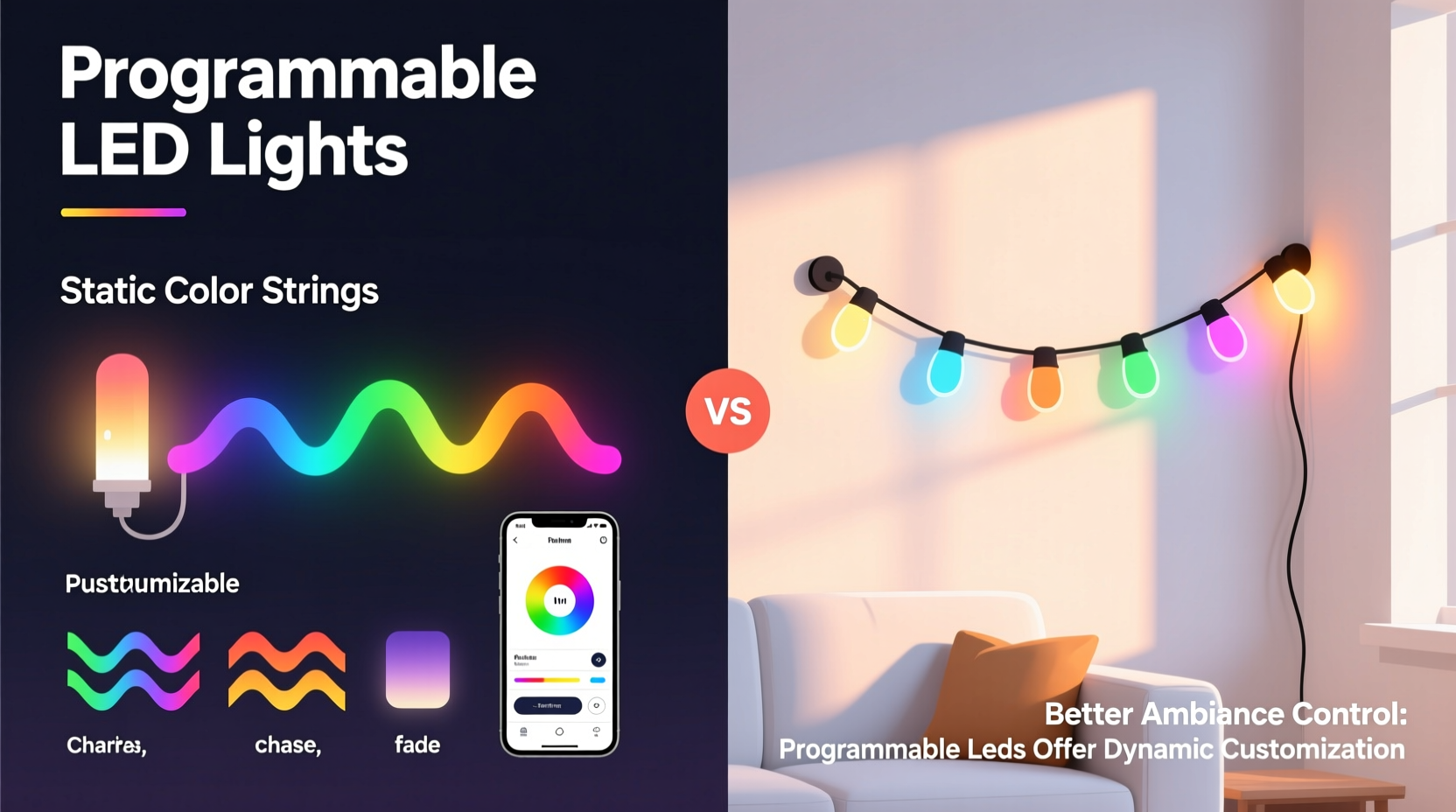
Static color strings deliver exactly what their name implies: one fixed chromatic output per strand. A “warm white” string emits light around 2700K–3000K—ideal for relaxation but incapable of shifting toward cooler tones that support alertness or focus. Similarly, a “blue” string emits a single narrow wavelength band (typically ~465nm), lacking saturation depth or hue variation. This limits emotional calibration: you can’t soften blue into teal for calm concentration, nor deepen red into burgundy for intimacy.
Programmable LEDs, by contrast, use RGB or RGBW (red-green-blue-white) chip configurations with 8-bit to 16-bit color depth. High-end models render over 16 million colors—including precise CIE 1931 coordinates—and maintain consistent color temperature across brightness levels. Crucially, they support tunable white (CCT) ranges from 1800K (candlelight) to 6500K (midday sun), enabling biologically informed lighting schedules. A 2023 study published in Lighting Research & Technology found users who adjusted CCT throughout the day reported 27% higher subjective alertness in morning hours and 34% deeper perceived relaxation in evening wind-down routines—results unattainable with static strings.
Temporal Responsiveness: How Lighting Adapts to Your Rhythm
Ambiance isn’t static; human physiology and activity shift hourly. Static strings ignore this entirely. Once hung, they remain unchanged—whether you’re hosting friends at 7 p.m., working late at 11 p.m., or waking up before sunrise. Their “control” is binary: on or off.
Programmable systems introduce time-aware lighting. With built-in schedulers or smart-home integrations (Apple HomeKit, Matter, Google Home), lights can automatically transition: dimming to 15% intensity and shifting to 2200K amber during bedtime routines; brightening to 85% and warming to 3200K for morning coffee; or pulsing gently at 60 BPM during yoga sessions. Some even sync to local sunrise/sunset data, ensuring circadian alignment regardless of season.
This responsiveness matters most where intentionality meets habit. Consider a home office: static warm-white strings may feel cozy at noon but visually flatten screen contrast and reduce visual acuity. Programmable lights can shift to 5000K cool white with higher intensity during work blocks, then ease back to 2700K at 5 p.m.—supporting natural cortisol decline without requiring manual intervention.
Spatial Integration and Layered Control
Effective ambiance relies on layered lighting: ambient (general illumination), task (focused function), and accent (highlighting texture or form). Static strings are almost exclusively ambient or decorative accents—and even then, only in linear arrangements. They lack zoning: you can’t dim the kitchen island lights while keeping the pantry strand at full brightness using a single controller.
Programmable systems excel in segmentation. Most support multi-zone configuration via physical zones (e.g., separate controllers per room), software-defined zones (grouping specific bulbs or strips in an app), or even pixel-level addressing (for addressable strips like WS2812B). This enables nuanced layering: soft, low-saturation lavender wash on walls (ambient), crisp 4000K white under-cabinet lighting (task), and slow-moving amber highlights along bookshelves (accent)—all coordinated within one scene.
| Feature | Static Color Strings | Programmable LED Systems |
|---|---|---|
| Zoning Capability | None — entire strand operates as one unit | Multi-zone: per-room, per-strip, or per-pixel control |
| Dimming Granularity | On/off or basic analog dimmer (often flickers below 30%) | 0–100% smooth digital dimming with memory retention |
| Scene Recall | Not supported | 5–50+ saved scenes (e.g., “Dinner,” “Movie Night,” “Focus Mode”) |
| Integration with Sensors | No native support | Compatible with motion, ambient light, and occupancy sensors |
| Uniformity Across Installations | High variance between batches (color temp drift ±200K) | Factory-calibrated batches; delta E <3 across units |
Operational Simplicity vs. Cognitive Load
Here’s where static strings hold undeniable advantage: near-zero learning curve. Plug in, switch on, enjoy. No apps, no firmware updates, no Wi-Fi pairing failures. For renters, elderly users, or those prioritizing reliability over novelty, this simplicity is a feature—not a limitation.
Programmable systems introduce complexity. Setup often requires downloading an app, creating accounts, granting location permissions, and troubleshooting Bluetooth range or 2.4GHz Wi-Fi congestion. Mid-tier products may lock features behind subscription services (e.g., advanced scheduling or cloud backups). And while high-end systems now support Matter/Thread for cross-platform stability, legacy Zigbee or proprietary hubs still suffer from latency and dropouts.
Yet, once configured, programmable systems reduce daily cognitive load. Instead of manually adjusting three different switches and a remote, one tap recalls a fully orchestrated ambiance. As interior designer Lena Torres explains:
“The real test of ambiance control isn’t how many colors a light can produce—it’s whether the system disappears into your routine. A well-set programmable system feels effortless after week two. A poorly integrated one becomes another device demanding attention.” — Lena Torres, Founder of Lumina Studio, specializing in human-centric residential lighting
Long-Term Value: Energy, Lifespan, and Upgrade Pathways
Both types use LED technology, so raw efficiency is comparable—typically 8–12W per 5-meter strip. However, programmable systems offer intelligent energy optimization static strings cannot match. Motion-triggered activation in hallways, adaptive dimming based on ambient daylight (via optional sensors), and automatic shut-off after inactivity cut real-world consumption by 30–50% versus always-on static strings used for similar durations.
Lifespan differs meaningfully. Quality static strings last 25,000–30,000 hours (≈3–4 years of continuous use). Programmable LEDs rated at 50,000 hours often achieve that only when operated at ≤70% brightness and with adequate thermal management—conditions rarely met in enclosed eaves or tightly coiled installations. Still, their modular design supports partial upgrades: replace a failing controller without rewiring the entire run, or add new zones without replacing legacy strips.
Crucially, programmable systems future-proof ambiance. Firmware updates regularly add new effects, integrations, or accessibility features (e.g., voice-controlled color temperature presets for visually impaired users). Static strings offer no such evolution—what you buy is what you get, forever.
Mini Case Study: The Urban Apartment Transformation
Maria, a graphic designer in Portland, lived with standard warm-white static strings in her studio apartment for three years. She loved their softness but felt “stuck”: the same glow for video calls, cooking, and winding down made evenings feel monotonous. After researching options, she installed a Matter-compatible programmable strip system along her ceiling cove, paired with a simple wall-mounted scene panel.
Within a week, she created four core scenes: “Clarity” (5000K, 75% brightness, subtle vertical gradient) for client Zooms; “Nourish” (2700K, 40%, warm amber accent on dining ledge) for meals; “Unwind” (2200K, 20%, slow amber-to-rose fade) post-work; and “Nightlight” (1800K, 5%, floor-level only). She enabled auto-scheduling synced to sunset and added motion sensing in the hallway. “It’s not about more light,” she notes. “It’s about light that knows when to recede—and when to hold space for me.”
Practical Implementation Checklist
- Evaluate your primary need: Is ambiance control about convenience (one-tap scenes), biology (circadian support), aesthetics (dynamic color), or practicality (zoned task lighting)?
- Assess your tech environment: Do you already use Apple Home, Google Home, or a Matter hub? Avoid proprietary ecosystems unless you’re committed to their long-term viability.
- Measure installation zones: Programmable strips require power access every 5–10 meters (depending on voltage drop). Static strings can run longer distances on a single plug—but with lower brightness at the far end.
- Verify dimming compatibility: If integrating with existing wall dimmers, confirm programmable controllers support leading-edge or trailing-edge inputs—or plan for smart switches instead.
- Start small: Begin with one high-impact zone (e.g., above the bed or behind the sofa) before scaling. Test color accuracy in your actual space—screens lie; your eyes don’t.
FAQ
Do programmable LEDs consume significantly more electricity than static strings?
No—when displaying equivalent color and brightness, power draw is nearly identical. The controller adds minimal overhead (<0.5W). Where savings emerge is behavioral: automated dimming, scheduling, and motion-based activation reduce total runtime, lowering net consumption by up to 45% in typical residential use.
Can I mix programmable and static strings in the same space?
Yes—but avoid visual competition. Use static strings for permanent, low-priority accents (e.g., inside glass cabinets) and programmable lights for active zones (walls, ceilings, task areas). Never place them side-by-side in the same fixture; inconsistent color rendering and dimming behavior will undermine ambiance cohesion.
Are programmable lights worth it if I don’t use smart home tech?
Yes—if the system includes a physical remote or wall panel with dedicated scene buttons. Many mid-tier brands (e.g., Govee, Philips Hue Tap) offer tactile controls that bypass apps entirely. Prioritize models with onboard memory (scenes saved locally on the controller) so functionality persists even during Wi-Fi outages.
Conclusion
Better ambiance control isn’t defined by the number of colors on a spec sheet—it’s measured in moments of resonance: the quiet certainty of a well-lit path to the kitchen at 2 a.m., the effortless shift from work mode to hospitality mode, the way light deepens a conversation rather than interrupting it. Static color strings serve reliably in contexts where ambiance is decorative, temporary, or secondary—holiday displays, rental-friendly dorm rooms, or simple shelf accents. But when lighting is asked to do emotional labor—to support health, reflect identity, or shape experience—programmable LEDs offer a level of responsive, adaptable, and intentional control that static strings fundamentally cannot replicate.
The decision isn’t about “better” in absolute terms. It’s about alignment: Does your lifestyle reward precision, or does it demand simplicity? Do your spaces evolve with your needs—or remain fixed in function? There’s no universal answer. But there is a clear path forward: start with your deepest lighting pain point—be it fatigue at midnight, glare during video calls, or the monotony of a single tone—and let that guide your choice. Because ambiance, at its best, isn’t something you set and forget. It’s something you live inside—and the right lights make that living feel like coming home.




 浙公网安备
33010002000092号
浙公网安备
33010002000092号 浙B2-20120091-4
Comments
No comments yet. Why don't you start the discussion?