
Lighting shapes mood. It defines space, influences emotion, and transforms the ordinary into something immersive. When it comes to ambient lighting, two popular options dominate homes, events, and creative setups: programmable LED strip lights and traditional static string lights. While both can enhance atmosphere, their capabilities in controlling ambiance differ significantly. Understanding these differences is essential for anyone aiming to craft intentional environments—whether for relaxation, entertainment, or aesthetic cohesion.
Static string lights have long been a go-to for soft glows and nostalgic charm. But with advancements in smart lighting technology, programmable LED strips now offer dynamic color shifts, motion effects, and scene automation. The question isn’t just about brightness or energy efficiency—it’s about control, precision, and adaptability. Which system truly empowers you to shape your environment with intention?
Understanding the Core Differences
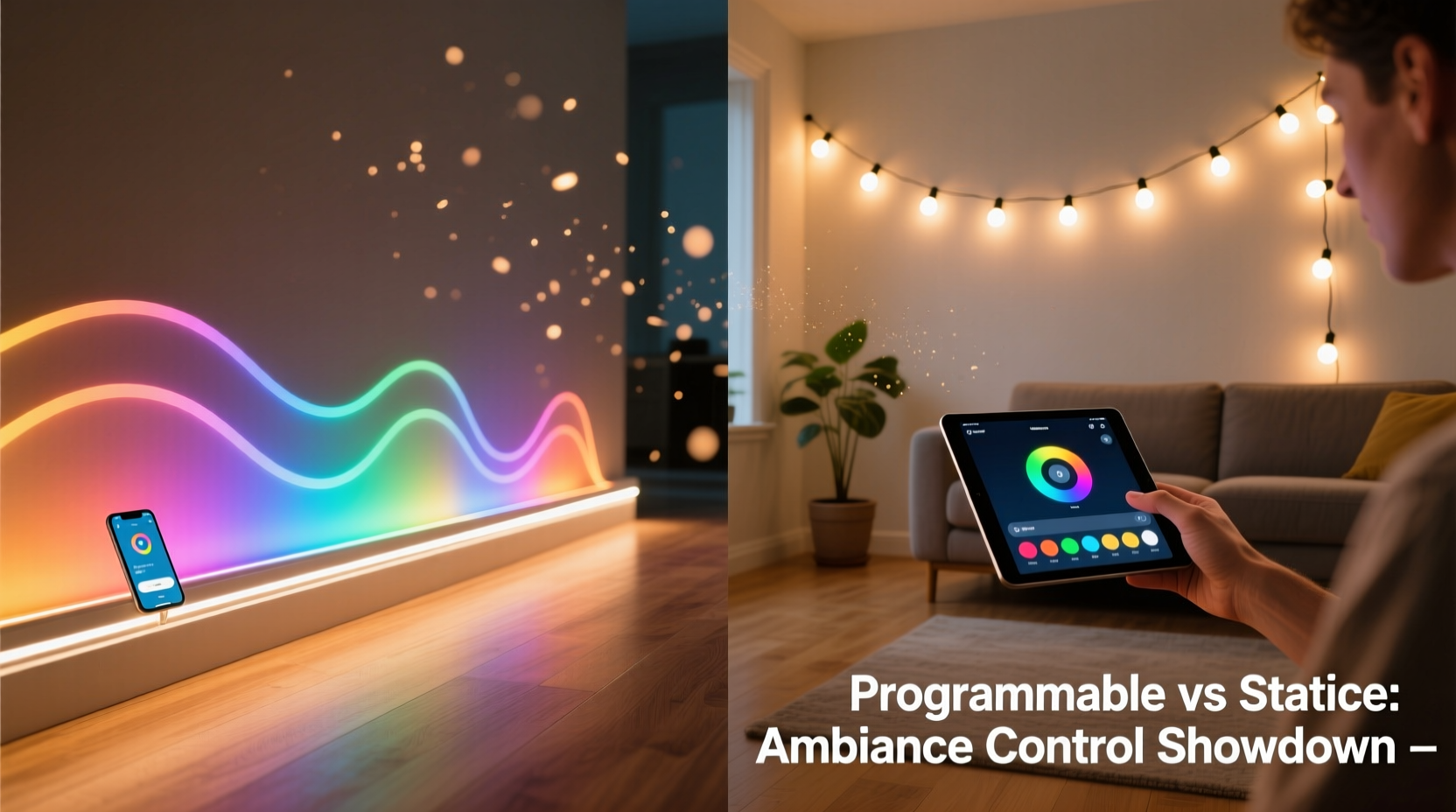
The fundamental distinction between programmable LED strip lights and static string lights lies in functionality and flexibility. Static string lights are typically composed of evenly spaced bulbs connected by a wire, offering a single fixed color (often warm white) and constant brightness. They’re simple, plug-and-play, and ideal for decorative use—think patio railings, holiday displays, or bedroom canopies.
In contrast, programmable LED strip lights consist of densely packed diodes mounted on a flexible circuit board. These LEDs are individually addressable, meaning each light can be controlled independently via software or a controller. This allows for complex color gradients, timed animations, music synchronization, and integration with smart home systems like Alexa or Google Home.
While static lights create a passive glow, programmable strips enable active lighting design. One offers consistency; the other offers transformation.
Control Capabilities: A Comparative Breakdown
Ambiance control depends on several factors: color range, brightness adjustment, timing, responsiveness, and integration. Let’s examine how each lighting type performs across these dimensions.
| Feature | Programmable LED Strips | Static String Lights |
|---|---|---|
| Color Options | 16 million+ colors via RGB/RGBW chips | Fixed (usually warm white or cool white) |
| Brightness Control | Fully dimmable with app or remote | Limited or none; some models support basic dimming |
| Dynamic Effects | Yes – waves, fades, strobes, chases | No – constant output only |
| Music Sync | Available via microphone or audio input | Not supported |
| Scheduling & Automation | Yes – sunrise/sunset, daily routines | No – manual on/off only |
| Smart Home Integration | Compatible with Alexa, Google Assistant, HomeKit | Rarely available |
| Installation Flexibility | High – cuttable, bendable, adhesive-backed | Low – rigid spacing, less adaptable to surfaces |
This comparison reveals a clear divergence in capability. Programmable LED strips aren’t just lights—they’re tools for environmental storytelling. Static string lights serve as background elements; LED strips become central to the experience.
Real-World Ambiance Scenarios
To appreciate the practical implications, consider how each lighting type performs in everyday settings.
Evening Relaxation Mode
In a living room designed for winding down, static string lights provide a gentle, unchanging glow. It’s pleasant but static. A programmable LED strip, however, can transition from bright white during reading hours to a deep amber at 8 PM, then slowly fade to near-darkness by 10 PM—mimicking natural circadian rhythms. Some systems even adjust based on sunset time, enhancing sleep readiness.
Entertainment & Social Gatherings
Hosting a dinner party? Static lights set a cozy tone but remain unchanged throughout the night. With programmable LEDs, the host can shift scenes: warm gold during appetizers, soft blue during mains, and pulsing purple when music starts. Apps allow guests to vote on lighting themes via smartphone, turning illumination into an interactive element.
“Lighting isn’t just functional—it’s emotional. The ability to modulate color temperature and intensity in real time allows people to curate not just spaces, but moods.” — Dr. Lena Torres, Environmental Psychologist
Home Office Focus Enhancement
Studies show that cooler color temperatures (5000K–6500K) improve alertness and concentration. A programmable LED strip under a desk can automatically switch to daylight white at 9 AM and revert to warmth at 6 PM. Static string lights lack this adaptability, potentially contributing to mental fatigue if used all day.
Step-by-Step Guide to Upgrading for Better Ambiance Control
If you're considering switching from static string lights to programmable LED strips—or integrating both—follow this sequence for optimal results:
- Assess Your Lighting Zones: Identify areas where ambiance matters most (bedroom, living room, kitchen island). Prioritize zones with high visual exposure.
- Choose the Right Strip Type: Decide between RGB (color-changing), RGBW (adds pure white), or tunable white (adjustable warmth). For ambiance control, RGBW offers the best balance of color and clarity.
- Select a Controller Platform: Options include IR remotes, Wi-Fi apps (like Govee or Lumenplay), or Bluetooth-enabled hubs. Wi-Fi provides remote access and automation.
- Plan Power & Length: Measure required lengths. Note that longer runs may need amplifiers. Most strips run on 12V or 24V DC power supplies.
- Install Strategically: Use aluminum channels for diffusion and durability. Apply to edges, undersides, or coves to create indirect, glare-free lighting.
- Set Scenes & Schedules: Program default modes (e.g., “Morning,” “Movie Night,” “Wind Down”). Enable geofencing so lights turn on as you approach home.
- Test & Refine: Observe how different colors affect mood and space. Adjust brightness levels—sometimes 30% glow feels cozier than 100%.
When Static String Lights Still Shine
Despite their limitations, static string lights have enduring appeal—and valid use cases.
- Nostalgic Aesthetic: Fairy lights in a child’s room or draped over a vintage mirror evoke warmth and simplicity that high-tech LEDs sometimes lack.
- Outdoor Decor: On porches or garden fences, static white strings offer consistent charm without complexity.
- Budget Constraints: High-quality programmable strips with controllers can cost $30–$80 per segment. Basic string lights start under $10.
- Minimalist Design: In Scandinavian or Japandi interiors, subtle, uniform lighting supports clean lines without drawing attention.
The key is intentionality. If the goal is tranquility through simplicity, static lights succeed. But if the aim is dynamic adaptation, they fall short.
Mini Case Study: Transforming a Shared Apartment Living Space
Carlos and Mina share a one-bedroom apartment in Seattle. The living area doubles as a workspace, gym, and entertainment zone. Initially, they used static string lights around the ceiling perimeter—a common rental-friendly choice. While attractive, the lighting failed to support different activities.
After researching ambiance control, they installed 24V RGBW LED strips along the base of floating shelves and behind the TV. Using the LIFX app, they created four scenes:
- \"Focus\": Cool white (6000K), 70% brightness, activated at 8 AM on weekdays.
- \"Unwind\": Soft pink gradient, slow pulse, triggered at 7 PM.
- \"Party Mode\": Music-synced rainbow chase, enabled manually during gatherings.
- \"Away\": Randomized low-light patterns simulating occupancy while traveling.
Within weeks, they reported improved focus during work hours and faster relaxation in evenings. Guests frequently commented on the “cinematic” feel of movie nights. The upgrade cost $120 but replaced three separate lighting products they previously relied on.
Checklist: Choosing the Right System for Your Needs
Use this checklist to determine whether programmable LED strips or static string lights suit your ambiance goals:
- ☐ Do I want to change colors based on time of day or activity? → Choose programmable LEDs
- ☐ Am I looking for a simple, decorative glow with no maintenance? → Choose static strings
- ☐ Do I use smart home devices (Alexa, HomeKit)? → LEDs integrate better
- ☐ Is budget under $20 for the project? → Static lights are more affordable
- ☐ Do I host frequent social events? → LEDs offer interactive potential
- ☐ Do I rent and cannot modify wiring? → Both work, but battery-powered LEDs offer more flexibility
- ☐ Am I sensitive to blue light at night? → Programmable LEDs can shift to red-heavy spectra
Frequently Asked Questions
Can I combine programmable LED strips with static string lights?
Yes, and it’s often effective. Use static lights for permanent ambient layers and LED strips for dynamic accents. For example, keep fairy lights on a bookshelf while adding color-shifting LEDs behind the TV for depth.
Are programmable LED strips difficult to install?
Most are designed for DIY use. They come with adhesive backing and connect via plug-and-play cables. However, longer installations may require soldering or signal boosters. Pre-assembled kits reduce complexity significantly.
Do LED strips consume more energy than string lights?
Per unit length, LED strips can use slightly more power due to higher diode density. However, because they’re more efficient at directing light and offer dimming, overall energy use is often lower. A 5-meter RGB strip uses about 24 watts at full brightness—comparable to a single incandescent bulb.
Conclusion: Ambiance as an Evolving Experience
The choice between programmable LED strip lights and static string lights ultimately hinges on your vision for space. If ambiance means a steady, comforting backdrop, static lights fulfill that role beautifully. But if you see lighting as an evolving part of daily life—one that adapts to mood, task, and time—then programmable LED strips offer unmatched control.
Modern living demands flexibility. Our environments should support focus, relaxation, celebration, and rest—not just look pretty. Programmable LEDs transform walls, ceilings, and furniture into responsive canvases, giving you agency over atmosphere in ways static lights simply cannot match.




 浙公网安备
33010002000092号
浙公网安备
33010002000092号 浙B2-20120091-4
Comments
No comments yet. Why don't you start the discussion?