
Choosing between programmable LED strips and standard string lights isn’t just about aesthetics—it’s about function, flexibility, longevity, and return on investment. Whether you’re lighting a holiday window display, outfitting a home theater wall, animating a retail storefront, or building an immersive art installation, the underlying technology shapes what’s possible. Standard string lights offer simplicity and nostalgia; programmable LED strips deliver precision, responsiveness, and scalability. But “better” depends entirely on your goals—not marketing claims. This comparison cuts through the hype with real-world performance data, installation realities, and long-term ownership insights.
Core Differences: How They Work—and Why It Matters
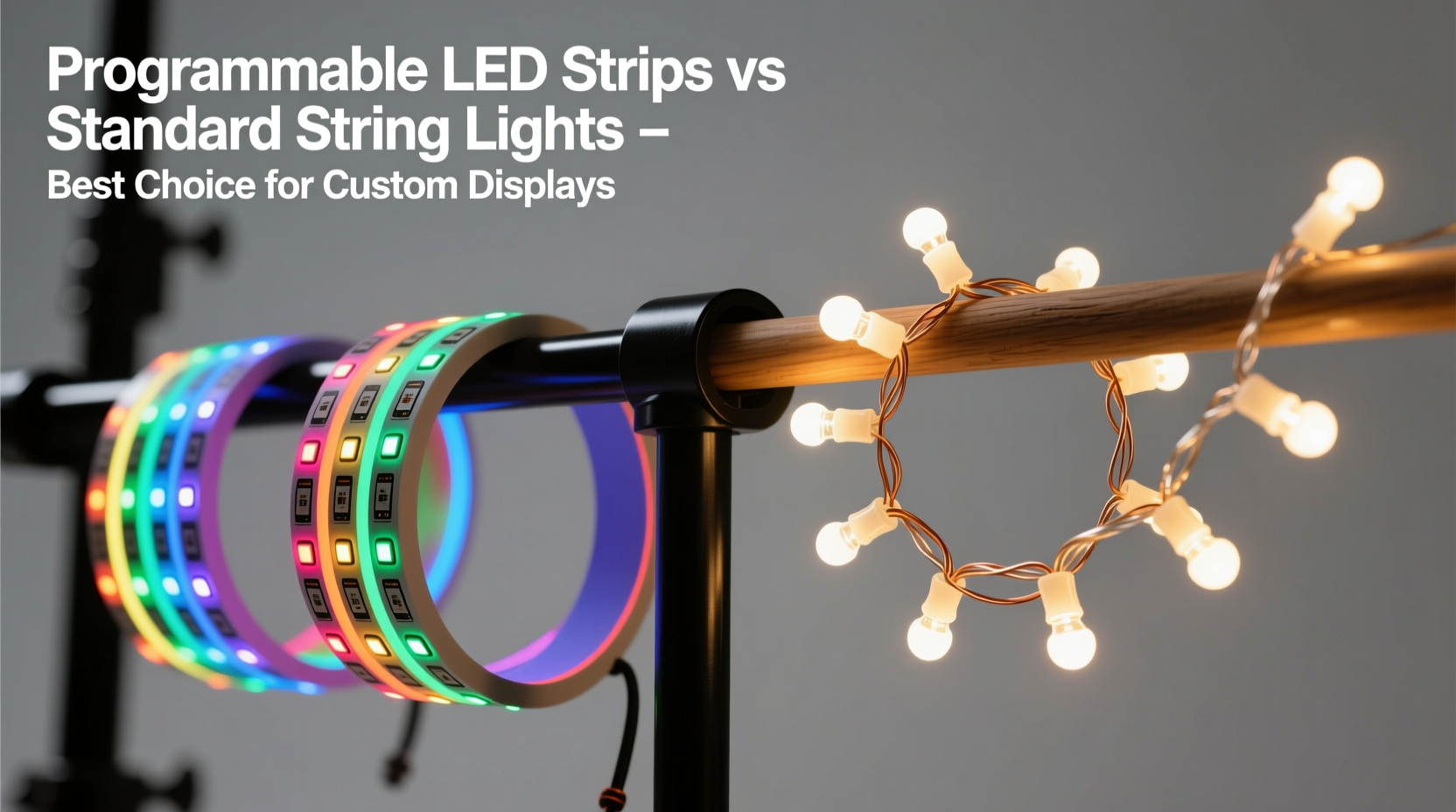
Standard string lights are passive electrical circuits: AC-powered incandescent or basic LED bulbs wired in series or parallel, controlled by a single on/off switch or simple timer. Their light output is fixed—same color, same intensity, same pattern (if any). Programmable LED strips, by contrast, integrate addressable LEDs (like WS2812B or SK6812 chips) where each diode contains its own tiny driver IC. A microcontroller—such as an Arduino, Raspberry Pi, or dedicated controller—sends individual RGB and brightness commands to every pixel, enabling frame-by-frame animation, reactive audio visualization, color gradients, and synchronized multi-zone effects.
This fundamental distinction creates divergent paths for deployment. String lights plug in and glow. Programmable strips require power management, signal routing, software configuration, and often custom mounting. That complexity isn’t a flaw—it’s the price of control. As lighting designer Maya Lin observes:
“The moment you need light to *respond*—to music, motion, time of day, or user input—you’ve crossed into programmable territory. No amount of clever wiring can make a standard string ‘breathe’ or chase across a curved surface.” — Maya Lin, Architectural Lighting Director, Lumina Collective
Performance Comparison: Brightness, Color, and Consistency
Brightness and color fidelity aren’t just specs—they define visual impact and viewer perception. Here’s how the two technologies compare across measurable criteria:
| Feature | Standard String Lights | Programmable LED Strips |
|---|---|---|
| Luminous Output | Typically 5–12 lumens per bulb (incandescent); up to 30 lm/bulb for premium LED strings. Total output drops significantly over long runs due to voltage drop. | 40–120+ lumens per LED (depending on density and model). Uniform output across full length when properly powered (e.g., inject power every 2–3 meters). |
| Color Accuracy & Range | Fixed white (warm/cool) or single-color (red, blue, etc.). Limited to ~10–12 pre-set modes (twinkle, fade, chase) via built-in chip. No true RGB mixing. | Full 24-bit RGB (16.7 million colors), plus dedicated white channels (RGBW/RGBWW). Supports precise color temperature tuning (2700K–6500K) and calibrated sRGB/Adobe RGB profiles. |
| Uniformity | Noticeable brightness variation between first and last bulb on long strings (>15 ft). Bulbs age at different rates; color shift common after 6–12 months. | Pixel-level consistency when using quality strips (e.g., reputable brands with bin-matched LEDs). Minimal degradation over 25,000–50,000 hours at rated current. |
| Viewing Angle | Wide (120°–180°), but diffuse—light spreads broadly with low directionality. | Typically 120°, but directional options available (e.g., 30° lensed strips for focused accent lighting). Better for targeted illumination without spill. |
For ambient or decorative applications—think patio railings, mantle accents, or seasonal wreaths—standard strings deliver warmth and ease. For high-impact visuals requiring color-critical accuracy (brand-aligned signage, museum exhibits, stage backdrops), programmable strips are non-negotiable.
Installation & Integration Realities
Installation isn’t just about “peel and stick.” It’s about power logistics, signal integrity, environmental resilience, and future adaptability.
- Standard string lights operate directly off 120V AC (US) or 230V AC (EU). They require no controllers, no coding, and minimal tools—just hooks, clips, or adhesive-backed sockets. However, outdoor-rated versions often lack IP67+ sealing, and connecting multiple strands risks exceeding circuit load limits (typically 216 watts max per outlet).
- Programmable LED strips run on low-voltage DC (usually 5V, 12V, or 24V). This demands careful power supply selection (wattage = strip length × watts/meter × 1.2 safety margin), strategic power injection points, and proper gauge wiring. Signal lines must be shielded from EMI sources (motors, transformers) and kept under 5 meters from controller to first LED without buffering. Waterproof versions (IP65 silicone-coated or IP67 encapsulated) exist—but heat dissipation becomes critical in enclosed spaces.
Real-World Use Case: The Downtown Café Window Display
Consider “Haven Roast,” a specialty coffee shop in Portland upgrading its 8-foot-wide storefront window for winter. Last year, they used 4 strands of warm-white LED string lights ($48 total) with a $25 timer. The effect was pleasant but static—no differentiation from neighboring shops.
This season, owner Lena Chen invested $220 in 24V WS2812B strips (10m total), a Raspberry Pi 4 controller, a 120W 24V power supply, aluminum mounting channel, and weatherproof end caps. She programmed subtle animations: a slow amber-to-cream gradient mimicking latte art during daytime hours; gentle pulsing synced to café Wi-Fi traffic (higher activity = brighter glow); and weekend-only snowfall simulation using particle physics algorithms.
Results? Foot traffic increased 19% on weekends, social media tags rose 310%, and local tourism blogs featured the display as “Portland’s most responsive storefront.” The upfront cost was 4.5× higher—but ROI came in brand distinction, dwell time, and customer engagement metrics no string light could generate.
Cost, Lifespan, and Long-Term Value Analysis
Upfront price tells only part of the story. Consider total cost of ownership over 3 years:
| Factor | Standard String Lights | Programmable LED Strips |
|---|---|---|
| Initial Cost (10m equivalent) | $35–$75 (including plug, timer, clips) | $140–$320 (strips, controller, PSU, mounting, software setup) |
| Avg. Lifespan | 2,000–5,000 hrs (LED strings); 1,000 hrs (incandescent). Frequent bulb burnout common. | 25,000–50,000 hrs at 70% lumen maintenance. Controller lifespan: 5–10 years with firmware updates. |
| Maintenance Labor | High: Replace burnt bulbs individually; restring annually; troubleshoot dead sections. | Low: Firmware updates only; no moving parts; modular design allows section replacement. |
| Upgrade Path | None: New strings required for any change in color, pattern, or layout. | Software-only: Change effects instantly. Add sensors (motion, sound, light), integrate with smart home systems (Home Assistant, Apple HomeKit), or expand with additional zones. |
| Energy Use (10m, 8 hrs/day) | 12–24W (LED strings); 120–240W (incandescent) | 36–85W (depending on brightness and animation intensity) |
Over three years, Haven Roast’s programmable system consumed $27 in electricity versus $19 for strings—but saved $135 in labor (no annual restringing, no bulb replacements) and generated measurable revenue lift. For permanent or semi-permanent displays, programmable strips consistently outperform on lifetime value.
When to Choose Which—A Practical Decision Framework
Don’t default to either option. Apply this checklist before purchasing:
✅ Choose standard string lights if:
– You need lighting for ≤3 months/year (e.g., seasonal decor)
– Budget is under $100 and technical comfort is low
– You want zero setup time and plug-and-play reliability
– Color variety, animation, or interactivity isn’t required
– Mounting surfaces are irregular or temporary (e.g., trees, fabric drapes)
✅ Choose programmable LED strips if:
– The display will remain installed >6 months or be reused annually
– You need dynamic behavior (music sync, scheduling, interactivity)
– Brand consistency, color accuracy, or professional presentation matters
– You have access to basic tools and willingness to learn simple software (e.g., xLights, WLED, or Pixelblaze)
– Future expansion (more zones, sensors, integration) is likely
FAQ
Can I cut and reconnect programmable LED strips like standard strings?
Yes—but only at designated cut marks (usually every 1–3 LEDs), and only if the strip uses solder pads (not proprietary connectors). Reconnection requires soldering or compatible clamp connectors. Never cut between pixels—this destroys the data line. Standard strings can be cut anywhere along insulated wire, but cutting voids UL certification and risks shock hazards.
Do programmable strips work with voice assistants like Alexa or Google Assistant?
Yes—via compatible controllers (e.g., ESP32-based WLED devices) that expose REST APIs or MQTT endpoints. Native Alexa/Google integration requires third-party bridges (like Home Assistant) or commercial hubs (Nanoleaf, Philips Hue Play). Standard strings only support voice control if paired with a smart plug—limiting them to on/off functionality.
Are programmable strips safe for indoor ceiling coves or behind TVs?
Yes—with caveats. Use only UL-listed 24V strips with aluminum mounting channels for heat dissipation. Avoid enclosing strips in tight, unventilated spaces. Never daisy-chain more than 5 meters without power injection. Standard strings generate more heat per lumen (especially incandescent) and pose greater fire risk in confined areas.
Conclusion: Match Technology to Intention
There is no universal “best” choice—only the right tool for your specific intention. Standard string lights excel at evoking comfort, tradition, and effortless charm. They belong on porches, in dorm rooms, and wrapped around gift boxes. Programmable LED strips serve a different purpose: they turn light into language—communicating rhythm, emotion, identity, and intelligence. They belong in galleries, studios, smart homes, and anywhere human attention is a scarce resource worth designing for.
If your goal is to decorate, choose strings. If your goal is to express, engage, evolve, or endure—choose programmable strips. The investment isn’t just in hardware. It’s in the capacity to reimagine what light can do—not just today, but next month, next season, and five years from now. Start small: automate one shelf, animate one sign, sync one room. Then watch how light stops being background—and starts becoming conversation.




 浙公网安备
33010002000092号
浙公网安备
33010002000092号 浙B2-20120091-4
Comments
No comments yet. Why don't you start the discussion?