
Customization in lighting isn’t just about aesthetics—it’s about intentionality. Whether you’re designing a home theater, upgrading a studio workspace, accenting architectural features, or building an immersive gaming setup, the choice between programmable LED strips and static color lights shapes how deeply you can express function, mood, and identity through light. Static lights offer simplicity and predictability; programmable strips deliver dynamic responsiveness and granular control. But “better” depends on context—not just technical capability, but on your goals, environment, technical comfort, and long-term vision. This comparison cuts past marketing hype to examine what each solution truly enables—and where each falls short—based on real-world implementation, scalability, and user agency.
Core Differences: Beyond “Color-Changing” Marketing
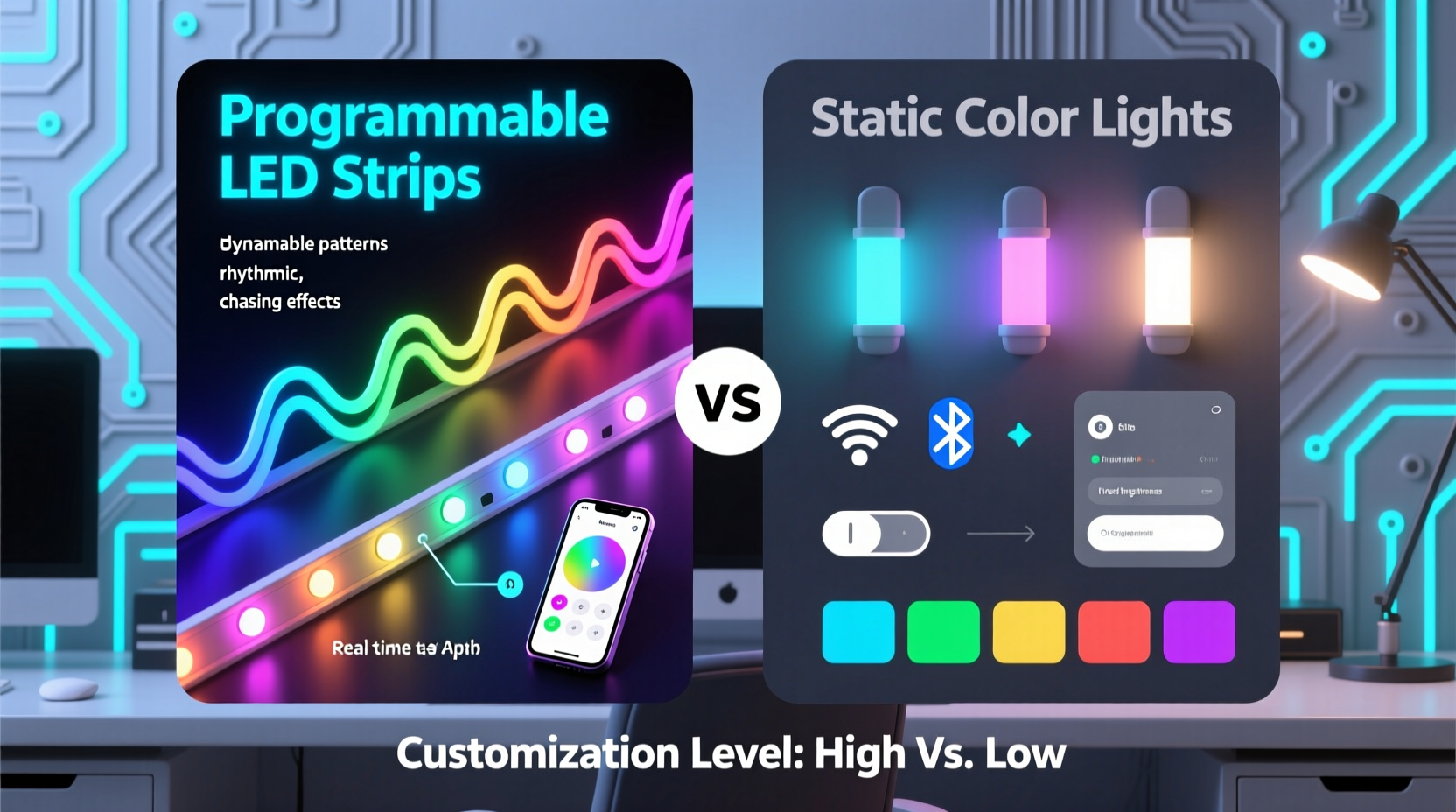
At first glance, both options emit light and can be installed along walls, under cabinets, or behind furniture. But their underlying architectures diverge fundamentally. Static color lights are fixed-output devices: a warm white strip emits only 2700K light, a blue strip only 465nm wavelength, and an RGB strip sold as “static” typically offers only three pre-set modes—red, green, blue—with no intermediate hues or transitions. There’s no microcontroller onboard, no addressable pixels, and no software interface. Programmable LED strips, by contrast, integrate individually controllable LEDs (commonly WS2812B, SK6812, or APA102 chips), each with independent red, green, and blue channels—and often white—driven by a microcontroller (like an ESP32 or Raspberry Pi) and managed via apps, voice assistants, or custom code.
This distinction creates two distinct user experiences: one of selection, the other of authorship. With static lights, you select a final state and install it. With programmable strips, you define behavior—timing, rhythm, response triggers, gradients, and interactions—and refine it over time. That difference becomes decisive when lighting must adapt: to time of day, occupancy, ambient sound, or seasonal shifts.
Customization Depth: What “Better” Actually Means
“Better customization” is multidimensional. It includes color precision, temporal control, environmental responsiveness, integration breadth, and creative scalability. A side-by-side evaluation reveals where each excels—and where compromises surface.
| Customization Dimension | Static Color Lights | Programmable LED Strips |
|---|---|---|
| Color Range & Accuracy | Limited to 1–3 fixed outputs (e.g., warm white only, or red/green/blue). No fine-tuning of saturation, hue, or CCT (correlated color temperature). | Full 24-bit RGB (16.7M colors) + optional dedicated white channels. Precise HSV/HSL control, tunable CCT (2000K–6500K), and calibrated color profiles possible. |
| Dynamic Behavior | No animation, fading, pulsing, or sequencing. On/off or basic dimming only. | Smooth fades, chases, ripples, audio-reactive patterns, sunrise/sunset simulations, and custom waveforms—all adjustable in speed, intensity, and direction. |
| Contextual Adaptation | None. Light remains unchanged regardless of time, motion, or external input. | Integrates with sensors (PIR, microphone, light), calendars, weather APIs, and smart home platforms (Home Assistant, Apple HomeKit, Matter) to shift behavior autonomously. |
| Zone Control | Entire run operates as one unit. No segmentation without multiple drivers or physical cuts. | Individual LED or grouped segment control—even down to single-pixel resolution on high-density strips. Enables multi-zone effects on one strip. |
| Software & Ecosystem | No software layer. Manual switch or basic wall dimmer only. | Open-source firmware (WLED, Hyperion), mobile apps, web UIs, CLI tools, and Python/JavaScript SDKs for bespoke automation. |
The table makes clear: programmable strips dominate in expressive depth. But that doesn’t mean static lights are obsolete. Their strength lies in reliability, consistency, and zero learning curve—critical in commercial signage, safety-critical task lighting, or hospitality settings where predictability outweighs novelty.
Real-World Implementation: A Studio Workspace Case Study
Consider Maya, a freelance motion designer who converted her garage into a hybrid editing suite and podcast studio. She needed lighting that supported both focused work (high-CCT, glare-free task illumination) and creative flow (low-CCT, gentle ambiance during brainstorming), plus visual feedback during recording (e.g., soft red glow when mic is live).
Her first attempt used static RGBWW strips: one warm white for desk lighting, one cool white for monitor backlighting, and a red-only strip for status cues. It worked—but rigidly. When she recorded, the red light stayed on even after pausing; during evening sessions, the cool white felt harsh, yet switching strips manually broke workflow. She upgraded to addressable SK6812 strips controlled via WLED on an ESP32, integrated with her Elgato Stream Deck and OBS.
Now, a single strip behind her monitor delivers three synchronized zones: top section adjusts CCT from 2700K to 5000K based on system clock; middle section pulses softly during audio peaks (via microphone FFT analysis); bottom section turns deep amber when OBS is recording and flashes crimson when mic is muted. She scripts transitions using cron-style schedules and shares presets with collaborators via QR codes. The static setup met baseline needs; the programmable one transformed lighting into an active, responsive layer of her creative infrastructure.
Practical Considerations: Cost, Complexity, and Longevity
Choosing isn’t just about features—it’s about sustainability of use. Programmable systems demand upfront investment in hardware (controllers, power supplies, signal amplifiers for long runs), software configuration, and ongoing maintenance (firmware updates, network troubleshooting). Static lights require only correct voltage matching and secure mounting.
- Upfront Cost: Static RGB strips start at $8–$12/meter; programmable equivalents begin at $15–$25/meter, plus $25–$60 for controllers and power gear.
- Installation Complexity: Static strips need only constant-voltage DC power. Programmable strips require data line routing, level-shifting for longer runs (>5m), grounding attention, and stable 5V logic signaling—mistakes cause flickering, color shifts, or dead segments.
- Long-Term Reliability: Static LEDs degrade uniformly; programmable strips risk firmware corruption, controller failure, or chip-level inconsistencies if low-tier components are used. Reputable brands (Philips Hue Lightstrip, Govee Glide, or DIY with APA102 + ESP32) mitigate this—but budget variants often sacrifice longevity for price.
- Scalability: Adding a second static strip means another driver and switch. Adding a second programmable strip often requires only extending the data line and adjusting pixel count in software—no new controller needed if within power/data limits.
“Addressable LEDs aren’t ‘smarter lights’—they’re programmable surfaces. Their value emerges not from blinking, but from behaving like part of your environment’s nervous system.” — Dr. Lena Torres, Human-Computer Interaction Lab, MIT Media Lab
Step-by-Step: Evaluating Which Solution Fits Your Project
Follow this decision sequence before purchasing any lighting:
- Define the primary intent: Is lighting functional (task visibility, safety, signage), atmospheric (mood, branding), or interactive (feedback, engagement)? If functional or atmospheric *without change*, static may suffice.
- Map required states: List all lighting conditions needed (e.g., “daytime focus mode,” “evening relaxation,” “guest arrival welcome,” “system error alert”). If more than three distinct, non-trivial states exist, programmability becomes necessary.
- Assess technical capacity: Can you configure Wi-Fi networks, flash firmware, or troubleshoot signal integrity? If not, prioritize plug-and-play programmable kits (e.g., Nanoleaf Essentials, Philips Hue) over raw DIY strips—or choose static for peace of mind.
- Calculate total cost of ownership: Include controller, power supply, mounting hardware, and potential labor. For installations >10 meters, factor in signal repeaters or distributed controllers—costs that scale linearly with length for static, but sub-linearly for well-designed programmable setups.
- Validate compatibility: Check if existing smart home ecosystem (Apple Home, Google Home, Matter) supports your chosen programmable platform. Some static “smart” strips (e.g., certain Govee models) offer limited app control but lack open APIs—blurring the line without delivering true customization.
FAQ
Can I upgrade static LED strips to be programmable later?
No—not without replacing them entirely. Static strips lack data lines and individual LED drivers. Retrofitting requires cutting, rewiring, and installing new addressable strips. Plan for future flexibility from the start if adaptability matters.
Do programmable strips consume more power than static ones?
Not inherently. Power draw depends on brightness, color (white uses more current than pure red), and number of lit LEDs—not programmability itself. However, poorly optimized animations (e.g., full-brightness rainbow chase) can draw up to 3× more peak current than static white at 50% brightness. Use current-limiting features in firmware and oversize power supplies by 20%.
Are there hybrid solutions that balance simplicity and flexibility?
Yes. Products like Philips Hue Lightstrip Plus offer app-based scene selection, scheduling, and voice control without requiring coding—but they lack low-level access to individual pixels or sensor integration. They sit between static and fully programmable: customizable, yet bounded by manufacturer-defined features.
Conclusion
Programmable LED strips provide objectively deeper customization: richer color, adaptive behavior, contextual awareness, and creative scalability. But “better” isn’t absolute—it’s contextual. If your priority is bulletproof reliability, minimal setup, or consistent color fidelity for retail displays, static lights remain the wiser, more economical choice. If your space evolves—whether through changing routines, expanding tech ecosystems, or growing creative demands—programmable strips become infrastructure, not decoration. They transform light from a passive backdrop into an active collaborator: responding, adapting, and reflecting your intentions in real time. The most thoughtful lighting decisions don’t ask “which is more advanced?” but “which empowers my next six months—and my next six years—without friction?” Start with that question. Then choose not the brightest light, but the most meaningful one.




 浙公网安备
33010002000092号
浙公网安备
33010002000092号 浙B2-20120091-4
Comments
No comments yet. Why don't you start the discussion?