
Lighting is the silent architect of atmosphere. It doesn’t just illuminate—it modulates mood, directs attention, and signals intention. Whether you’re winding down in a living room after work, hosting friends on a patio, or transforming a home office into a focused sanctuary, the quality and flexibility of your lighting directly shape how you feel and function. That’s why the choice between programmable LED strips and traditional static string lights isn’t merely about watts or wattage—it’s about agency. One option offers fixed, unchanging output; the other delivers dynamic, responsive, deeply personal control over light’s most expressive dimensions: color, intensity, timing, rhythm, and spatial behavior. This article cuts past marketing hype to examine exactly where that control lives—and where it falls short—in both technologies.
Core Differences: What “Control” Actually Means in Practice
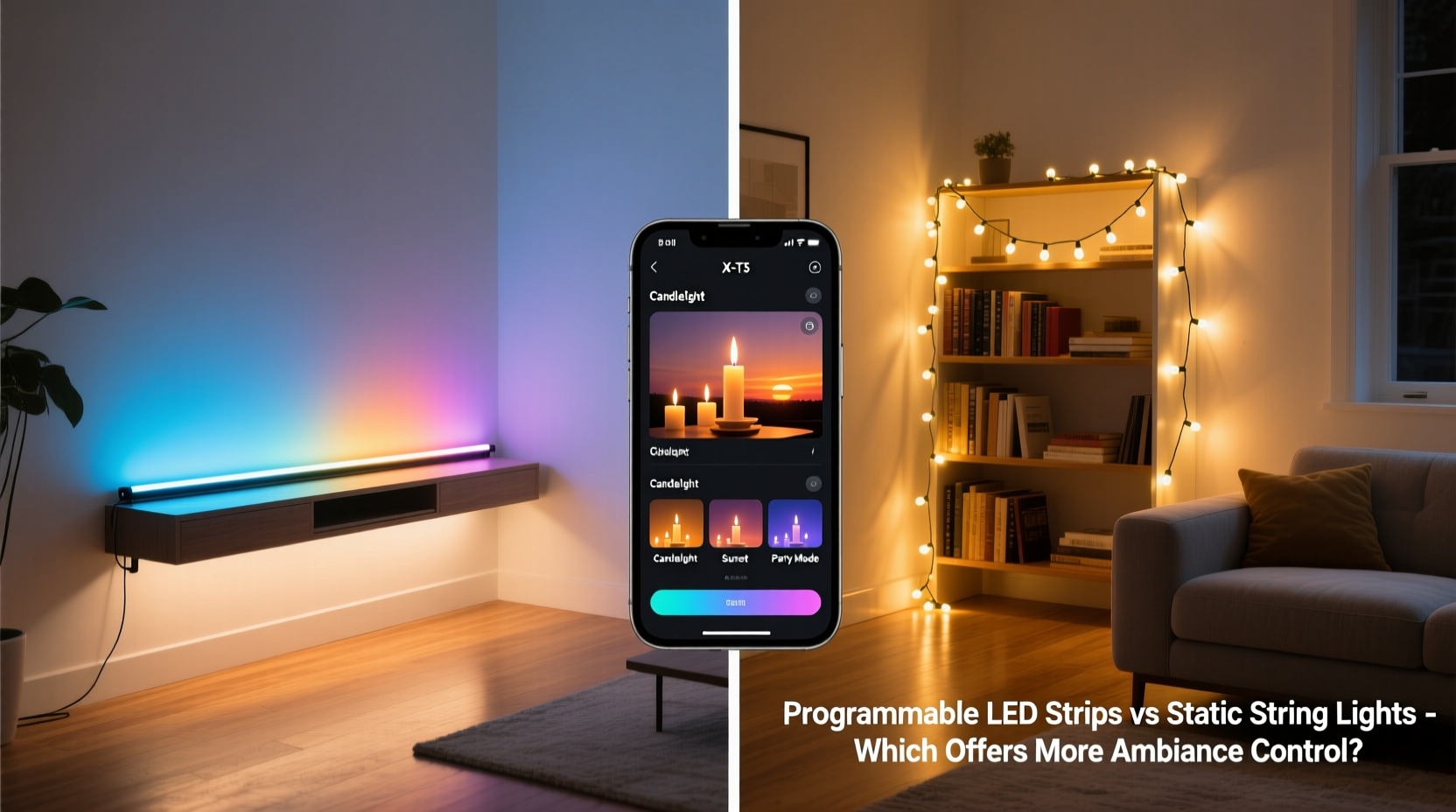
“Control over ambiance” isn’t abstract. It breaks down into five measurable, experiential layers: color temperature adjustment (warm white to cool daylight), full RGB or RGBW color selection, dimming precision (not just on/off, but smooth 0–100% transitions), dynamic effects (pulse, fade, chase, strobe), and temporal scheduling (automated changes based on time, sensor input, or routines). Static string lights—whether incandescent, warm-white LED, or multi-color pre-set strings—operate at the first layer only, if at all. Most offer no dimming, no color shift, and zero programmability. Programmable LED strips, by contrast, are built around microcontrollers (like WS2812B or SK6812 chips) that accept real-time data packets, enabling per-LED addressability. That means each diode can be independently commanded—lighting one section amber while another pulses soft violet, all synced to music or a sunrise simulation.
Granularity of Control: Addressable Pixels vs Fixed Outputs
Static string lights treat light as a monolithic unit. A 50-bulb string either glows uniformly or blinks in unison. Even “multi-color” versions typically cycle through three or four presets (red → green → blue → white) with no user input beyond pressing a button. There’s no way to hold a specific shade of coral, dim only the lower half of a mantel display, or create a slow gradient across a bookshelf. Programmable LED strips operate at the pixel level. A 2-meter strip with 60 LEDs contains 60 individually addressable points. Using software like WLED (open-source, widely supported), you can define zones, assign unique effects to each zone, set transition speeds, map brightness curves, and even integrate ambient light sensors to auto-adjust based on room luminance. This granularity transforms lighting from decoration into environmental intelligence.
Real-World Usability Comparison
| Feature | Programmable LED Strips | Static String Lights |
|---|---|---|
| Color Range | Full 16+ million RGB colors + tunable white (CCT 2700K–6500K) | Limited to 1–4 fixed colors (e.g., warm white only, or red/green/blue/white cycle) |
| Dimming | Smooth, flicker-free 0–100% dimming with memory retention | Often none; some have basic on/off or 3-step brightness (high/med/low) |
| Effects & Animation | Dozens of built-in effects (rainbow, fire, meteor, scan) + custom effect creation via JSON or UI | Typically 6–8 preset modes (steady, twinkle, chase, slow fade) — non-editable |
| Scheduling & Automation | Time-based triggers, sunrise/sunset sync, motion-activated scenes, voice-command integration | No scheduling capability; manual operation only |
| Zoning & Segmentation | Split into multiple independent segments on one strip (e.g., under-cabinet zone + toe-kick zone) | No segmentation—entire string behaves identically |
| Integration | Works with Home Assistant, Alexa, Google, Siri (via Matter), IFTTT, and MQTT | Rarely integrates beyond basic Bluetooth remotes; no smart home protocols |
Mini Case Study: The Apartment Renovation That Changed Everything
Alex, a UX designer in Portland, renovated a 650-square-foot apartment with floor-to-ceiling windows and exposed brick. Their goal was a space that felt energizing during weekday mornings but deeply restful by 9 p.m. With static string lights, they’d tried two sets: warm-white fairy lights along the window frame and a multi-color string behind the sofa. Both were frustrating. The fairy lights couldn’t dim below 70%, making evening reading harsh. The multi-color string cycled unpredictably—switching from calming lavender to jarring neon yellow mid-conversation. After switching to addressable LED strips with a WLED controller and a simple 12V power supply, Alex created four distinct scenes: “Focus Mode” (cool white, 90% brightness, no animation), “Dinner Mode” (amber, 40%, gentle pulse), “Wind Down” (soft pink, 20%, slow fade), and “Sunrise” (gradual 2700K→5000K ramp over 20 minutes). They tied “Wind Down” to their bedtime routine in Apple Shortcuts, triggering automatically when their sleep app launched. Within three weeks, Alex reported improved sleep onset and fewer evening screen cravings—proof that ambient control isn’t aesthetic indulgence; it’s neurophysiological design.
Installation, Maintenance, and Long-Term Flexibility
Installation complexity often deters people from programmable strips—but the barrier is narrower than assumed. Modern adhesive-backed strips install cleanly on dry, dust-free surfaces (use isopropyl alcohol to prep). Power injection every 5 meters prevents voltage drop. Controllers range from $15 ESP32-based boards (requiring basic soldering and Wi-Fi setup) to plug-and-play kits with touch remotes and mobile apps. Static strings win on plug-and-play simplicity: unwrap, plug in, enjoy. But that simplicity comes at a steep long-term cost. If you later want to dim them, add a timer, or change color, you’re out of luck—you’d need to replace the entire string. Programmable strips, once installed, are future-proofed. Firmware updates add new effects; new controllers can replace aging ones without rewiring; and expansion is trivial—just splice in another strip segment and reassign its address range. As lighting designer Lena Torres notes: “Static lights solve a momentary need. Programmable systems solve evolving human rhythms. The upfront learning curve pays back in adaptability—not just for years, but across life stages.”
“True ambiance control means lighting that breathes with you—not one that blinks at you. Programmable strips don’t just respond to commands; they anticipate context.” — Lena Torres, Lighting Designer & Co-Author of *Human-Centered Light*
Practical Decision Checklist
- ✅ Ask yourself: Do I want to adjust color or brightness without unplugging or swapping bulbs?
- ✅ Consider your routine: Would automated transitions (e.g., cooler light at noon, warmer at dusk) meaningfully improve your daily flow?
- ✅ Evaluate your space: Are there linear surfaces (shelves, cabinets, stairs, headboards) where precise, directional light would enhance function or aesthetics?
- ✅ Assess tech comfort: Are you willing to spend 20 minutes setting up a Wi-Fi controller—or do you prefer zero-config solutions?
- ✅ Think long-term: Will this lighting need to serve different purposes in 6 months? (e.g., a nursery → home office → guest room)
Step-by-Step: Getting Started with Programmable LED Strips (No Coding Required)
- Measure & Plan: Determine total length needed. Add 10% for bends and connections. Note where power will enter and whether zones require separate controllers.
- Select Strip Type: Choose RGBW (for richer whites) over RGB if color accuracy matters. Opt for 60 LEDs/meter for balance of resolution and cost.
- Pick a Controller: For beginners, choose a pre-flashed WLED controller (e.g., ESP32-WROVER with built-in antenna) that supports OTA updates and has a web UI.
- Power Supply: Use a regulated 12V DC supply rated for at least 1.5× your strip’s max wattage (e.g., 144W strip → 220W PSU).
- Install & Connect: Clean surface, peel backing, press firmly. Connect strip → controller → PSU → outlet. Secure wires with clips.
- Configure via Browser: Connect phone/laptop to controller’s Wi-Fi network, open http://x.x.x.x, use the intuitive interface to set colors, effects, and schedules.
- Integrate: In your smart home app (e.g., Home Assistant), add the WLED device via IP address—no hubs or bridges required.
FAQ
Do programmable LED strips consume more electricity than static strings?
No—power draw depends on brightness and active pixels, not programmability. At equivalent brightness and length, a well-configured programmable strip uses comparable or less energy than static LEDs because it avoids inefficient analog dimming circuits and allows selective illumination (e.g., lighting only 30% of the strip instead of the full length).
Can I cut and reconnect programmable LED strips like static ones?
Yes—but only at designated cut marks (usually every 1–3 LEDs). Reconnection requires soldering or specialized connectors. Unlike static strings, cutting mid-pixel destroys functionality. Always verify cut points before trimming.
Are programmable strips safe for outdoor or high-moisture areas?
Only if explicitly rated IP65 or higher. Standard strips are indoor-only. Look for silicone-coated, UV-stabilized models with sealed ends and waterproof controllers. Never assume “weather-resistant” labeling equals outdoor-rated.
Conclusion
Control over ambiance isn’t about having more buttons—it’s about having the right kind of responsiveness. Static string lights deliver charm, nostalgia, and simplicity. They’re perfect for seasonal decor, low-stakes patios, or spaces where lighting serves only as gentle background presence. But if your environment needs to evolve with your energy, your schedule, or your emotional state—if you’ve ever wished your lights could soften as your shoulders drop, brighten as your focus sharpens, or shift hue to match the season outside your window—then programmable LED strips aren’t an upgrade. They’re the baseline for intentional living. They turn passive illumination into active collaboration. You don’t just live under the light; you converse with it. Start small: a single 2-meter strip under your kitchen cabinets, configured with a sunset fade. Notice how the change in light alters your sense of time. Then ask yourself: what else could breathe with you?




 浙公网安备
33010002000092号
浙公网安备
33010002000092号 浙B2-20120091-4
Comments
No comments yet. Why don't you start the discussion?