
Lighting isn’t just about illumination—it’s a design language. Whether you’re transforming a backyard patio into an immersive lounge, staging a gallery installation, or tailoring ambient lighting for a home office, the choice between programmable LED strips and static string lights shapes what’s possible. Static strings—those familiar incandescent or warm-white LED bulbs strung along insulated wire—are beloved for their nostalgic charm and plug-and-play ease. Programmable LED strips, by contrast, are pixel-addressable, microcontroller-driven systems capable of displaying thousands of colors, dynamic animations, synchronized audio reactivity, and scene-based automation. But “more creative control” isn’t merely about technical capability—it’s about alignment with intent, environment, skill level, and longevity of vision. This article cuts through marketing hype to compare both options across real-world dimensions: precision, adaptability, integration depth, maintenance reality, and expressive range.
What “Creative Control” Really Means in Practice
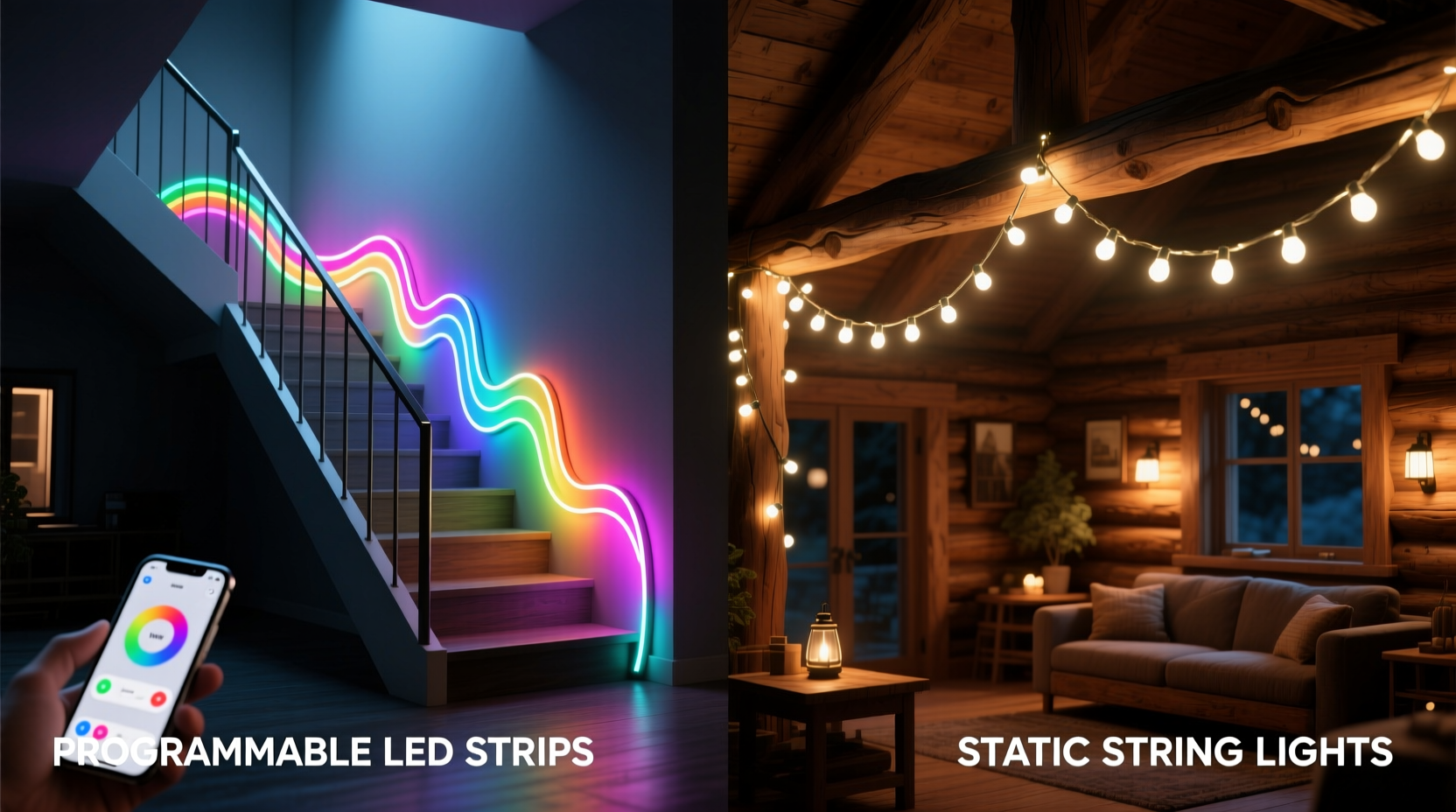
Creative control isn’t abstract—it’s measurable in degrees of freedom: the ability to change hue, saturation, brightness, timing, sequencing, spatial targeting, and responsiveness—all independently and in combination. A static string light offers one variable: on/off (and sometimes dimming). Even multi-color static sets limit you to preset modes—twinkle, chase, fade—hardwired at the controller level, with no ability to alter speed, direction, or segment behavior. Programmable LED strips, however, treat each LED (or group) as an individual canvas. With platforms like WLED, FastLED, or proprietary apps (Nanoleaf, Govee), you can define custom gradients across 300+ LEDs, trigger sunrise simulations that shift CCT from 1800K to 6500K over 45 minutes, map color zones to physical wall sections, or pulse lighting to live microphone input. That granularity enables intentionality—not just “lighting a space,” but choreographing light as narrative.
Feature-by-Feature Comparison: Where Control Diverges
| Feature | Programmable LED Strips | Static String Lights |
|---|---|---|
| Color Range | Full RGBWW (16.7M+ colors + tunable white); precise HSV/RGB values editable per pixel | Limited to fixed white temperatures (e.g., 2700K only) or 3–5 pre-mixed colors (red/blue/green/white/yellow) |
| Animation Control | Customizable speed, direction, easing, persistence, and layering (e.g., ripple over gradient background) | 3–8 factory presets; no parameter adjustment—speed and effect type are locked |
| Spatial Precision | Individual LED addressing (e.g., control only LEDs #42–#87 for accent lighting above artwork) | No segmentation—entire string behaves uniformly |
| Integration | Works with Home Assistant, Apple HomeKit (via bridges), IFTTT, MIDI, and custom Python/Arduino scripts | Basic smart plugs only; no native API or developer access |
| Adaptability Over Time | Firmware updates add new effects; user-created palettes and scenes persist across hardware generations | Functionality frozen at purchase; no firmware or software evolution |
A Real-World Creative Scenario: The Urban Apartment Gallery Wall
Maria, a mixed-media artist in Portland, uses her living room wall as a rotating exhibition space. She needed lighting that could shift character with each installation: cool, crisp white for monochrome photography; slow amber pulses for textile pieces evoking desert heat; and responsive blue-green ripples synced to ambient sound during video projections. Her first attempt used static warm-white strings—functional but emotionally flat. When she upgraded to addressable WS2812B strips mounted in recessed aluminum channels behind the frame, she gained transformative flexibility. Using WLED on a $6 ESP32 board, she created three named scenes: “Gallery Mode” (static 4000K), “Desert Pulse” (HSV-based sine wave at 0.3Hz), and “Resonance” (FFT-driven frequency bands mapped to LED zones). She triggers them via voice (“Hey Siri, activate Desert Pulse”) or automatically when her media player starts. Crucially, when she later added a motion sensor to dim lights when no one was present, the same strip handled it—no new hardware required. Static strings couldn’t accommodate any of this without replacing the entire system.
Practical Limitations You Can’t Ignore
Greater control demands greater responsibility. Programmable LED strips introduce complexity most static users never face: power supply sizing, data line integrity, firmware flashing, signal degradation over distance, and thermal management in enclosed channels. A poorly configured 5-meter strip can flicker, desync, or fail mid-animation—not from defect, but from insufficient amperage or ground-loop interference. Static strings avoid these pitfalls entirely: they’re AC-powered, require no controllers, and rarely fail outside of bulb burnout. Their simplicity is a feature for low-stakes applications—think porch railings, holiday mantels, or café patios where mood consistency matters more than variability. Also consider lifespan: quality static LEDs last 25,000–30,000 hours with zero configuration decay. Programmable strips match that rating *only* if driven within spec—overdriving pixels to “max brightness” accelerates lumen depreciation by 40%.
“Creative control without reliability is theatrical, not functional. The best lighting solution serves the experience—not the spec sheet.” — Rajiv Mehta, Lighting Designer & Co-Founder, Lumina Labs
Your Decision Framework: A 5-Step Evaluation Process
Don’t choose based on novelty. Use this sequence to determine which option serves your actual needs:
- Define your primary use case: Is it decorative ambiance (static excels) or expressive storytelling (programmable unlocks)? If >70% of your lighting need is “always-on warmth,” skip programmability.
- Map your control expectations: List desired changes—e.g., “adjust color temperature seasonally,” “highlight different artwork monthly,” “sync with music weekly.” If you need >2 variables changed independently, programmable is mandatory.
- Assess technical capacity: Can you safely wire a 12V DC supply? Are you comfortable using a web interface or basic YAML config? If not, static strings prevent frustration—and costly miswiring.
- Calculate total cost of ownership: Add controller ($15–$45), power supply ($20–$60), mounting hardware ($10–$30), and potential amplifiers ($12–$25). Static strings often cost less upfront *and* over 5 years due to zero upgrade path.
- Test scalability: Imagine adding 3 more lighting zones in 12 months. Programmable strips integrate natively; static strings require separate controllers, outlets, and visual discontinuity.
Common Misconceptions Debunked
- “More colors = more creativity.” Not true. A single, perfectly tuned 2200K amber can evoke deeper intimacy than chaotic rainbow cycling. Control matters most when aligned with purpose—not quantity.
- “Static lights are obsolete.” False. They dominate commercial hospitality (hotels, restaurants) where brand consistency, low maintenance, and UL certification outweigh dynamic needs.
- “All programmable strips are equal.” Critical distinction: Non-addressable RGB strips (common on Amazon) only allow whole-strip color changes—no pixel control. True programmability requires chips like WS2812B, SK6812, or APA102.
FAQ
Can I retrofit static string lights with programmable controllers?
No—static strings lack data lines and individually addressable drivers. Attempting to connect them to a microcontroller risks damage and voids safety certifications. Retrofitting requires full replacement with compatible LED strip and proper DC infrastructure.
Do programmable LED strips work outdoors?
Yes—but only with IP65-rated or higher enclosures, silicone coating, and weatherproof power supplies. Most off-the-shelf strips are indoor-rated. Static string lights often have superior outdoor readiness (IP44–IP67) out of the box, with sealed bulb housings and UV-resistant cords.
How much time does maintaining programmable lighting take?
Initial setup: 1–3 hours for wiring, flashing firmware, and calibration. Ongoing: under 5 minutes/month for firmware updates or scene tweaks. Static strings require zero maintenance beyond occasional bulb replacement every 2–5 years.
Conclusion: Choose the Tool That Serves Your Vision—Not the One That Impresses
Programmable LED strips offer unparalleled creative control—when your goals demand specificity, evolution, and integration. They turn light into a responsive medium: a tool for artists, educators, event designers, and technically curious homeowners who see illumination as an active participant in daily life. Static string lights, meanwhile, represent mastery of restraint: elegant, enduring, and effortlessly atmospheric. Their “limited” control is, in fact, profound discipline—removing decision fatigue so beauty emerges from consistency, not configuration. Neither is objectively superior. The right choice emerges from asking not “What can it do?” but “What must it do—and for how long?” If your vision evolves weekly, programmable strips are indispensable infrastructure. If your ideal light is the quiet glow of dusk, unchanged for years, static strings aren’t outdated—they’re resolved.




 浙公网安备
33010002000092号
浙公网安备
33010002000092号 浙B2-20120091-4
Comments
No comments yet. Why don't you start the discussion?