
Lighting transforms spaces—whether it’s a holiday display, retail window, landscape feature, or home ambiance. The method you use to control that lighting can dramatically affect both visual impact and operational efficiency. While basic mechanical or digital timers have long been the go-to for automated on/off cycles, programmable light controllers now offer advanced capabilities that redefine what’s possible. Choosing between them isn’t just about cost—it’s about precision, adaptability, and long-term performance.
Understanding the differences helps homeowners, event planners, and commercial property managers make informed decisions that elevate their displays while reducing maintenance and energy waste.
How Basic Timers Work—and Where They Fall Short
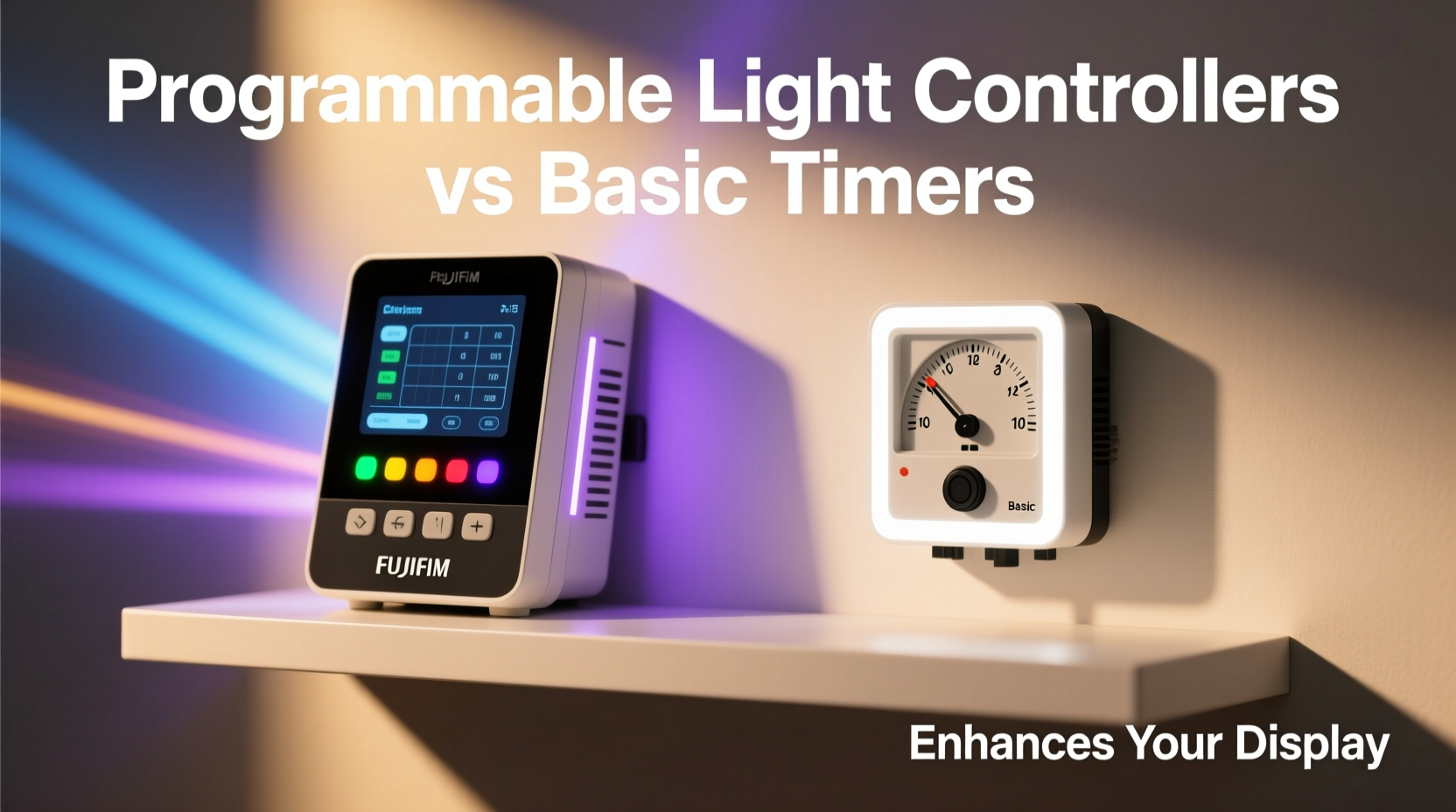
Basic light timers are simple devices designed to turn lights on and off at preset times. They come in two primary forms: mechanical (rotary dial) and digital (button-operated). Both allow users to set start and end times for lighting cycles, typically through a 24-hour format.
These timers are widely available, inexpensive, and easy to install. Plug-in versions work with standard outlets, making them ideal for temporary setups like seasonal decorations. However, their simplicity is also their limitation.
Most basic timers operate on fixed schedules. If sunrise shifts by even 15 minutes over the season, the lights won’t adjust unless manually reset. This leads to displays turning on during daylight or shutting off before full darkness—a subtle but noticeable flaw in professional or aesthetic applications.
Additionally, they lack support for multiple zones, dimming, or dynamic effects. Once programmed, they repeat the same pattern daily with no variation. For someone aiming to create rhythm, movement, or mood-based lighting, this rigidity becomes a constraint.
The Rise of Programmable Light Controllers
Programmable light controllers go beyond simple scheduling. These systems—ranging from standalone smart modules to full networked platforms—allow granular control over timing, brightness, color, sequence, and responsiveness to environmental conditions.
Modern programmable controllers often connect via Wi-Fi, Bluetooth, or wired protocols like DMX or DALI. They integrate with sensors (e.g., photocells, motion detectors), GPS-based astronomical clocks, or cloud services to automatically adjust lighting based on real-time data.
For example, a programmable controller can ensure holiday lights activate exactly at sunset, regardless of the time of year. It can gradually ramp up brightness to simulate dawn, fade colors in a wave across a building façade, or trigger animations only when motion is detected—all without manual intervention.
More advanced units support scene programming, letting users save multiple lighting “presets” for different occasions. A single system might switch from a vibrant festival mode to a subdued ambient glow with a tap on a smartphone app.
“With programmable controls, lighting becomes an expressive medium—not just illumination.” — Marcus Tran, Architectural Lighting Designer
Key Differences: A Comparative Overview
| Feature | Basic Timer | Programmable Controller |
|---|---|---|
| Scheduling Flexibility | Fixed daily cycle; must be manually adjusted | Dynamic scheduling with seasonal, solar, or sensor-based triggers |
| Number of Zones | Typically one circuit | Supports multiple independent zones or channels |
| Brightness Control | No dimming capability | Fully supports dimming and fade effects |
| Color Effects (RGB) | On/off only; no color control | Full color selection, transitions, and patterns |
| Remote Access | None (local only) | Wi-Fi/app/cloud access for remote management |
| Energy Efficiency | Moderate—lights run full duration | High—adaptive runtime and power modulation |
| Maintenance Needs | Regular manual adjustments required | Minimal; self-adjusting features reduce oversight |
| Initial Cost | $5–$20 | $30–$200+, depending on complexity |
The table illustrates that while programmable controllers carry a higher upfront cost, they deliver superior functionality and long-term savings through reduced labor, energy conservation, and extended bulb life due to intelligent cycling.
Real-World Application: A Holiday Display Transformation
Consider a suburban homeowner, Elena Reyes, who for years used a $12 plug-in timer to manage her front yard holiday lights. Each November, she’d program it to turn on at 5:30 PM and off at 11:00 PM. But as winter progressed, she noticed her display often lit up while it was still daylight—especially in early December—or turned off too early on longer nights in January.
She also wanted to add twinkling effects and synchronize her roofline LEDs with music, but the timer offered no such capability. After upgrading to a Wi-Fi-enabled programmable controller compatible with her RGB LED strips, everything changed.
The new system synced with local sunset times, adjusting nightly. She created custom scenes: a soft white glow on weekdays, a vibrant multicolor pulse on weekends, and a synchronized light show during weekend evenings. Using a mobile app, she could preview and tweak sequences remotely—even pausing the display during snowstorms to avoid glare.
Within three seasons, she estimated she saved nearly 40% in electricity costs due to optimized runtimes and dimming profiles. More importantly, her display became a neighborhood highlight, drawing visitors and praise on social media.
Elena’s experience reflects a broader trend: users who invest in programmable systems report higher satisfaction not just from better visuals, but from greater ease of use and reliability.
Step-by-Step: Upgrading from Timer to Programmable Control
Transitioning from a basic timer to a programmable light controller doesn’t require technical expertise. Follow this timeline to implement a smarter lighting setup:
- Assess Your Lighting Setup (Day 1)
Inventory all lights: note types (LED, incandescent), wattage, circuits, and locations. Identify whether they’re addressable (e.g., individually controllable) or grouped. - Determine Desired Features (Day 2)
Decide what you want: sunset-triggered operation? Color changes? Remote access? Music sync? This guides your choice of controller type. - Select the Right Controller (Day 3–5)
Choose based on scale. For small home displays, a Wi-Fi smart plug with app control (like those from LIFX or TP-Link Kasa) may suffice. For larger or multi-zone setups, consider dedicated controllers such as Light-O-Rama or Shelly Pro. - Install and Connect (Weekend Project)
Replace the old timer with the new controller. Follow manufacturer instructions for wiring or plug-in setup. Ensure outdoor units are properly sealed and grounded. - Configure Schedules and Scenes (1–2 Hours)
Use the companion app to set schedules based on sunset/sunrise, create lighting scenes, and test transitions. Save backups of your configurations. - Test and Optimize (Ongoing)
Run the system for several days under different conditions. Adjust brightness, timing, or effects as needed. Enable notifications if supported.
Checklist: Choosing the Right System for Your Needs
- ✅ Determine if you need simple on/off or dynamic effects (dimming, color, animation)
- ✅ Confirm compatibility with your existing bulbs and fixtures (e.g., dimmable LEDs)
- ✅ Check for weather resistance if installing outdoors
- ✅ Ensure the controller supports your desired number of zones or channels
- ✅ Verify connectivity options (Wi-Fi, Ethernet, Zigbee) and app usability
- ✅ Look for astronomical clock or geolocation features for automatic time adjustment
- ✅ Consider scalability—can you add more lights or controllers later?
Frequently Asked Questions
Can I use a programmable controller with non-smart lights?
Yes. Many programmable controllers work with standard LED or incandescent bulbs. The intelligence resides in the controller, not the bulb. As long as the fixture is connected to the controller, it can manage timing, dimming (if the bulb supports it), and switching.
Are programmable controllers difficult to set up?
Not necessarily. Entry-level models with app-based interfaces are designed for DIY users. Most take under an hour to install and configure. Advanced systems used in commercial projects may require professional setup, especially when integrating with building management systems.
Do programmable controllers save energy?
Yes. By enabling precise control over when and how brightly lights operate, these systems reduce unnecessary runtime and power consumption. Features like motion activation, adaptive dimming, and automatic shutoff contribute to measurable energy savings—often 20–50% compared to fixed-timer operation.
Conclusion: Elevate Your Display with Smarter Control
The choice between programmable light controllers and basic timers ultimately comes down to intent. If your goal is minimal effort for a simple on/off function, a basic timer may suffice—for now. But if you care about aesthetics, efficiency, and long-term convenience, programmable controllers offer unmatched advantages.
They transform static lighting into dynamic experiences, adapt seamlessly to changing conditions, and reduce the burden of manual maintenance. Whether illuminating a home, storefront, or public space, intelligent control ensures your display shines at the right moment, in the right way, every time.




 浙公网安备
33010002000092号
浙公网安备
33010002000092号 浙B2-20120091-4
Comments
No comments yet. Why don't you start the discussion?