
Lighting transforms spaces, especially during the holidays. Whether it’s a cozy winter evening or a festive Fourth of July celebration, ambient lighting can elevate the mood and bring seasonal joy into homes and businesses alike. Today, LED light strips have become one of the most popular ways to add dynamic color and rhythm to any environment. But when it comes to choosing between programmable light strips and those with preset modes—particularly for holiday customization—the decision isn’t always straightforward.
While both types offer benefits, understanding their differences in functionality, ease of use, and long-term value is essential. This article breaks down the strengths and limitations of each, helping you determine which solution aligns best with your lighting goals—especially if you love tailoring your ambiance for specific holidays throughout the year.
Understanding the Core Differences
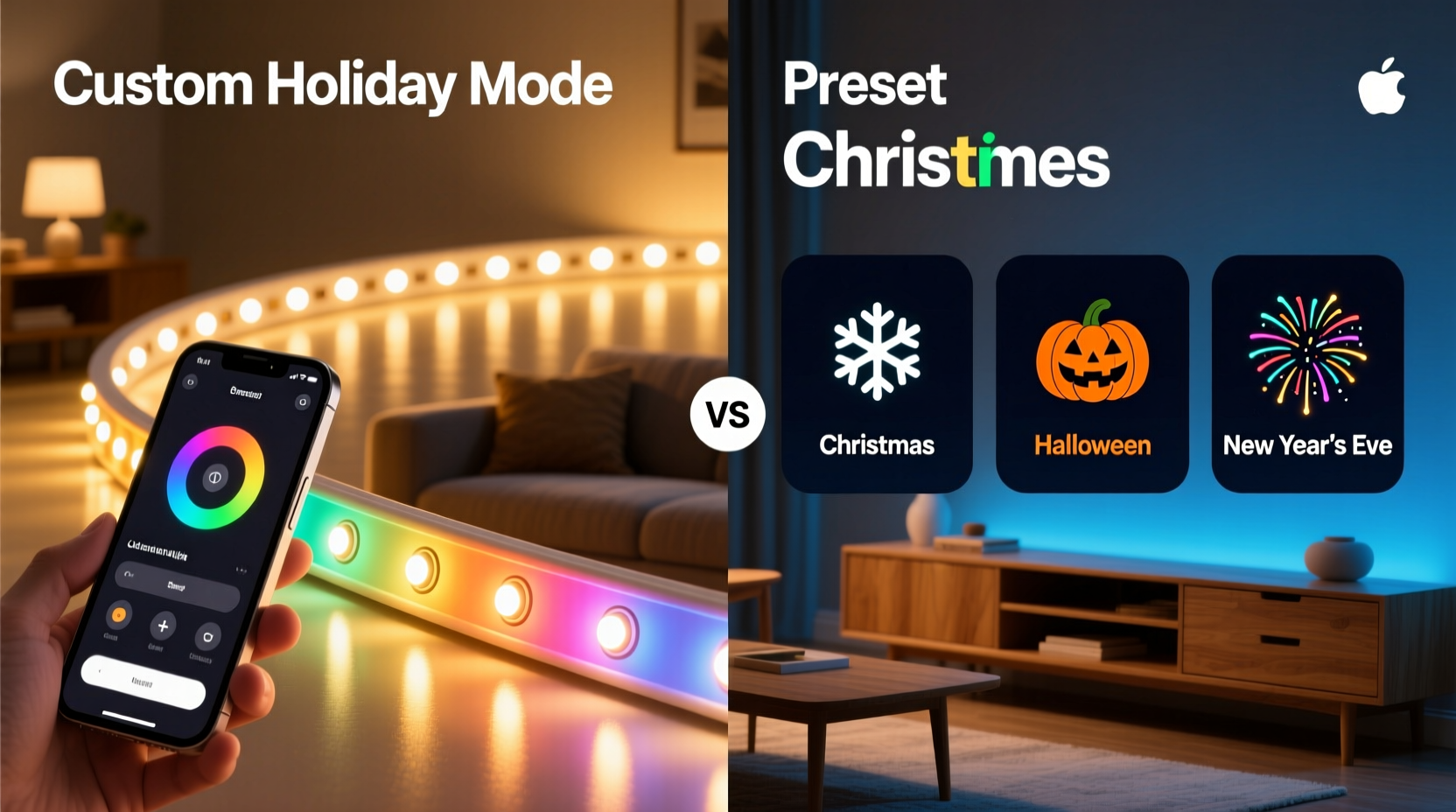
The primary distinction between programmable light strips and preset-mode strips lies in control and adaptability. Preset-mode strips come preloaded with a selection of effects—such as fading, flashing, or pulsing—and often allow users to cycle through them using a remote or app. These are designed for convenience and immediate impact, ideal for someone who wants festive lighting without technical involvement.
In contrast, programmable light strips—often powered by platforms like Arduino, ESP32, or proprietary smart ecosystems (e.g., Philips Hue, LIFX, or WLED)—allow full customization of colors, brightness, timing, transitions, and even synchronization with music or external triggers. This level of control enables precise holiday-specific animations, such as red-and-green waves for Christmas, pastel fades for Easter, or synchronized red-white-blue pulses for Independence Day.
Consider this: a preset strip might offer a “holiday” mode that cycles randomly through warm white and multicolor flashes. While festive, it lacks nuance. A programmable strip, however, could be set to slowly transition from deep red to forest green over 30 seconds, then pause briefly before repeating—a subtle, elegant effect tailored specifically to Christmas Eve.
Customization Capabilities for Holiday Themes
Holidays demand more than just bright lights—they require atmosphere. The ability to match lighting to cultural, emotional, and aesthetic expectations is where customization becomes critical.
Preset modes typically include generic themes like “warm white,” “party,” “romance,” or “dynamic.” Some higher-end models may label a setting as “Christmas” or “Halloween,” but these are still broad templates. You can’t adjust the speed of a fade, the order of colors, or how long a particular hue lingers. For users seeking authenticity—like mimicking candlelight flicker on Hanukkah or creating a slow gradient for Diwali’s luminous evenings—this lack of control is limiting.
Programmable systems, on the other hand, let you design lighting sequences frame by frame. Using apps like WLED or Govee Home, you can:
- Define exact RGB values for traditional holiday palettes
- Set duration, brightness curves, and transition smoothness
- Schedule automatic activation on specific dates (e.g., lights turn red/green every Dec 1)
- Sync with calendars, music, or motion sensors
Comparing Features: A Practical Breakdown
| Feature | Programmable Light Strips | Preset-Mode Strips |
|---|---|---|
| Color Control | Full RGB/W spectrum; individual LED addressability | Limited to predefined combinations |
| Animation Customization | Users can create, save, and edit sequences | Fixed effects only; no editing possible |
| Setup Complexity | Moderate to high (requires app or coding) | Low (plug-and-play) |
| Holiday Scheduling | Yes, via smart home integration | Rare; usually manual activation |
| Cost | Higher initial investment | Budget-friendly |
| Long-Term Flexibility | Highly adaptable across years and occasions | Static; limited evolution |
This comparison reveals a clear trade-off: convenience versus creative control. If your goal is to hang lights once and enjoy seasonal changes with minimal effort, preset models suffice. But if you value personal expression, precision, and evolving displays, programmable strips deliver unmatched versatility.
Real-World Example: The Holiday Enthusiast’s Journey
Meet Daniel, a homeowner in Denver who began decorating modestly for Christmas five years ago. He started with a single string of preset-mode LED strips around his porch. Each year, he grew more ambitious—adding more lights, experimenting with colors, and even incorporating outdoor speakers.
By year three, he was frustrated. The “festive” mode cycled too quickly, the colors didn’t match his décor, and there was no way to coordinate multiple strips beyond turning them all on simultaneously. He upgraded to a programmable WLED-based system connected to Wi-Fi.
That December, he programmed a sequence where lights gradually illuminated from the base of his tree upward, mimicking a rising glow. On Christmas Eve, the strip pulsed softly in time with carols playing inside. He scheduled Halloween animations to activate every Oct 1 at 6 PM—deep purples and eerie greens that faded unpredictably, like ghostly breath.
“It took me about two hours to set up the first custom scene,” Daniel said. “But now, every holiday feels unique. I even made a St. Patrick’s Day chase effect that runs down my staircase. It’s not just lighting—it’s storytelling.”
“We’re seeing a shift from passive illumination to expressive lighting narratives. Programmable LEDs let people embed meaning into their environments.” — Dr. Lena Torres, Smart Lighting Researcher at MIT Media Lab
Step-by-Step: Creating a Custom Holiday Scene
If you're ready to explore what programmable lighting can do, follow this practical guide to build your first holiday-specific animation:
- Choose Your Platform: Select a programmable system (e.g., WLED-compatible strip, Nanoleaf, or Philips Hue).
- Install & Connect: Mount the strip and connect it to power and Wi-Fi. Ensure firmware is updated.
- Open the App: Launch the corresponding software (WLED dashboard, Hue app, etc.).
- Select Holiday Palette: Define your color scheme (e.g., red #FF0000, green #006400 for Christmas).
- Create Animation: Choose an effect type (gradient, wipe, fade) and adjust speed, intensity, and direction.
- Test & Refine: Preview the sequence in real time. Tweak timing until it feels natural.
- Schedule Activation: Use automation tools (IFTTT, Google Calendar, or built-in scheduler) to run the scene annually on the correct date.
- Save & Share: Store the preset and consider sharing it in online communities for others to use.
This process may seem technical at first, but most modern platforms offer intuitive interfaces. Within a few tries, creating holiday scenes becomes second nature.
When Preset Modes Make Sense
Despite the advantages of programmable systems, preset-mode strips still hold value in certain contexts:
- Rental properties: Tenants may want temporary, non-invasive decor without installing complex setups.
- Occasional users: Those who decorate only once a year may prefer simplicity over customization.
- Budget constraints: Entry-level programmable kits start around $50–70, while preset strips can be found under $20.
- Kid-friendly environments: Easy remotes allow children to participate in selecting moods without risk of breaking configurations.
For families hosting annual gatherings where lighting is background ambiance rather than a focal point, preset options are perfectly adequate. The key is matching the technology to your actual usage patterns—not just aspirations.
Expert Tips for Maximizing Holiday Lighting
Frequently Asked Questions
Can I upgrade from preset to programmable later?
Yes, but it requires replacing the entire strip unless your current model supports firmware upgrades (rare). Most preset strips use non-addressable LEDs, which cannot support individual pixel control. Plan ahead if you anticipate wanting more customization in the future.
Do programmable lights consume more energy?
No. Both types use similar low-wattage LEDs. Power consumption depends more on length, brightness, and duration than programmability. In fact, programmable systems can be more efficient because they allow scheduling and dimming based on occupancy or time of day.
Are programmable strips harder to install?
Physically, installation is nearly identical—both require mounting and power connection. The difference lies in configuration. Programmable strips need app pairing and sometimes network setup, which may challenge less tech-savvy users. However, most brands now offer guided onboarding that simplifies the process significantly.
Checklist: Choosing the Right Option for You
Use this checklist to evaluate which type suits your needs:
- ☐ Do I celebrate multiple holidays with distinct aesthetics? → Favors programmable
- ☐ Am I comfortable using smartphone apps or basic tech tools? → Required for programmable
- ☐ Do I want lights to turn on automatically each holiday season? → Requires programmable + smart scheduling
- ☐ Is my budget under $30? → Likely limits to preset-mode
- ☐ Will I reuse these lights for years? → Higher ROI with programmable
- ☐ Do I enjoy DIY projects or tech tinkering? → Strong indicator for programmable
- ☐ Am I decorating temporarily or in a shared space? → May favor preset for simplicity
Final Thoughts: Lighting With Intention
The choice between programmable light strips and preset modes ultimately reflects your relationship with tradition, technology, and personal expression. Preset systems serve the need for instant cheer and hassle-free operation. They are the popcorn-string garlands of the digital age—simple, nostalgic, and effective.
But programmable lighting represents something deeper: the ability to craft experiences, evoke memories, and personalize spaces in ways that resonate emotionally. When your lights don’t just blink but breathe—with rhythm, color, and timing aligned to the spirit of the season—they become part of the celebration itself.
If you’ve ever wished your Halloween lights could mimic a jack-o’-lantern’s flicker or wanted your Valentine’s display to pulse like a heartbeat, then programmable strips aren’t just an upgrade—they’re an invitation to reimagine what lighting can do.




 浙公网安备
33010002000092号
浙公网安备
33010002000092号 浙B2-20120091-4
Comments
No comments yet. Why don't you start the discussion?