
Lighting automation has evolved from simple on/off switches to intelligent systems that adapt to daily routines, enhance ambiance, and save energy. Two popular options—programmable lights and timer plugs—offer ways to automate illumination without manual intervention. While both provide scheduling capabilities, their control over brightness and timing varies significantly. Understanding the strengths and limitations of each helps homeowners make informed decisions based on convenience, customization, and long-term value.
How Programmable Lights Work
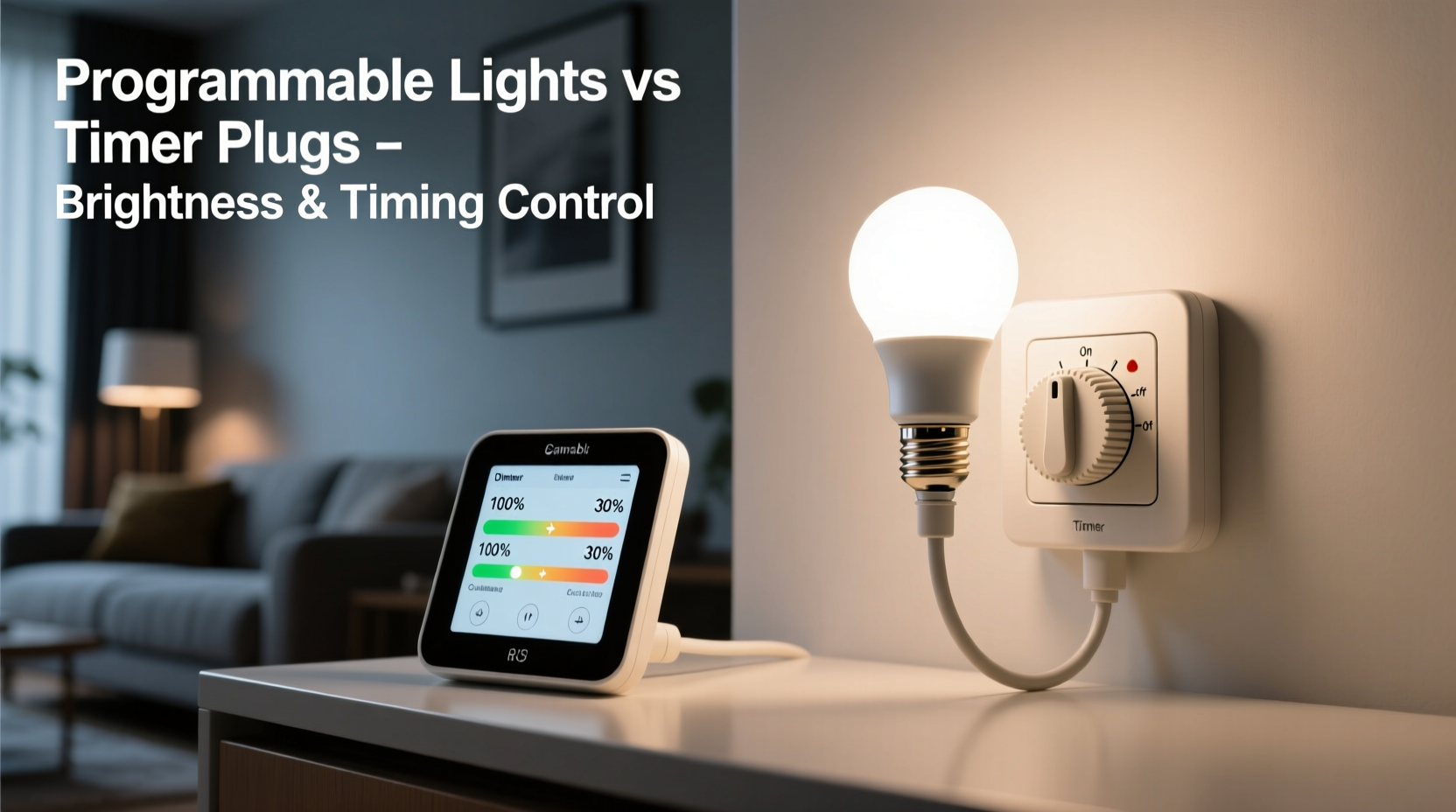
Programmable lights refer to smart bulbs or fixtures that connect to a network—usually via Wi-Fi or Bluetooth—and can be controlled through apps, voice assistants, or automation platforms. These lights allow users to adjust brightness, color temperature, and even hue remotely. Scheduling is built into most smart lighting ecosystems, enabling lights to turn on or off at specific times or under certain conditions.
Beyond basic timers, programmable lights support dynamic scenes, gradual dimming, sunrise/sunset syncing, and geofencing (activating when you arrive home). They integrate with broader smart home systems like Google Home, Amazon Alexa, or Apple HomeKit, allowing complex automations such as dimming at bedtime or brightening during morning routines.
The Role of Timer Plugs in Lighting Control
Timer plugs, also known as outlet timers or plug-in schedulers, are physical devices that fit between a lamp and wall socket. They allow users to set predefined on/off cycles for any connected device—including lamps, string lights, or fans. Mechanical models use rotating dials with 15- or 30-minute increments, while digital versions offer more precise programming through LCD screens and buttons.
These devices are typically standalone and do not require a smartphone or internet connection. Some advanced models support multiple daily events, randomization features (to simulate occupancy), and daylight saving adjustments. However, they only control power flow—they cannot modulate brightness or change light color unless the connected bulb has its own built-in controls.
Comparing Brightness Control: Smart Lights Win Hands Down
Brightness adjustment is where programmable lights clearly outperform timer plugs. Smart LED bulbs allow granular dimming—often from 1% to 100%—via app sliders, voice commands, or automated rules. This enables mood lighting, task-specific illumination, and smooth transitions throughout the day.
In contrast, timer plugs function as binary switches. Once triggered, they deliver full power to the connected device. If the lamp uses a traditional incandescent or non-dimmable LED bulb, there's no way to lower brightness through the plug itself. Even if the bulb supports dimming, the timer plug won’t influence it unless paired with an external dimmer switch or remote-controlled lamp base.
| Feature | Programmable Lights | Timer Plugs |
|---|---|---|
| Brightness Adjustment | Yes – full range dimming | No – on/off only |
| Color Tuning | Available (white spectrum or RGB) | Not supported |
| Scheduling Precision | Minute-level accuracy | 15–30 min increments (mechanical); minute-level (digital) |
| Remote Access | Yes – via app/voice | No – local control only |
| Integration with Smart Home | Full compatibility | Limited or none |
| Average Cost per Unit | $15–$50 per bulb | $10–$25 per plug |
“Smart lighting isn't just about turning lights on and off—it’s about creating environments that respond to human behavior.” — Dr. Linda Tran, Human-Centric Lighting Researcher, MIT Media Lab
Timing and Automation Capabilities
When it comes to timing, both solutions offer scheduling, but programmable lights provide far greater flexibility. Users can create recurring schedules down to the minute, set different routines for weekdays versus weekends, and layer triggers based on motion sensors, ambient light levels, or geolocation.
For example, a smart light can automatically dim to 30% at 9 PM, fade out by 10:30 PM, and gradually brighten at 6:45 AM to mimic sunrise. It can also activate when motion is detected in a hallway after dark. Timer plugs, even digital ones, usually support only fixed on/off times and lack conditional logic.
Digital timer plugs may allow up to 7–10 programmable events per day, which is sufficient for basic needs like turning on porch lights at dusk or powering a reading lamp in the evening. However, changing the schedule requires manual reprogramming at the device, unlike smart lights that can be updated instantly from a phone—even when away from home.
Real Example: Evening Routine in a Family Home
Consider a household with two working parents and school-aged children. The family wants living room lights to come on at 6 PM during winter months but prefers softer lighting after 8 PM to signal wind-down time.
With **timer plugs**, they could set the floor lamp to turn on at 6 PM and off at 10 PM. But all settings remain static—no dimming, no seasonal adjustments, and no ability to override remotely if dinner runs late.
Using **programmable lights**, the same setup includes a rule: “At 6 PM, set living room bulbs to 80% brightness, warm white. At 8 PM, dim to 40%. Turn off at 10 PM unless motion detected.” Parents can delay the schedule via app if guests stay late, or disable it entirely during vacations—all without touching a switch.
Installation and Compatibility Considerations
One advantage of timer plugs is ease of installation. Simply plug them into an outlet and screw a lamp into the top. No rewiring or technical knowledge required. They work with virtually any standard bulb, including halogen, CFL, and LED.
Programmable lights require compatible fixtures and often involve replacing existing bulbs. Some older dimmer switches interfere with smart bulb performance, especially those using phase-cut dimming. Additionally, homes with poor Wi-Fi coverage may experience lag or disconnections, affecting reliability.
It's also important to consider ecosystem lock-in. Many smart lights work best within proprietary platforms (e.g., Philips Hue, LIFX, or Nanoleaf), requiring bridges or hubs for full functionality. Cross-platform compatibility improves with Matter-enabled devices, but adoption is still growing.
Energy Efficiency and Long-Term Value
Both technologies contribute to energy savings by preventing lights from staying on unnecessarily. However, programmable lights go further by optimizing usage patterns and supporting energy-efficient LEDs natively.
Some smart lighting systems report energy consumption per bulb, helping identify high-usage areas. Features like auto-off after inactivity or adaptive brightness based on daylight reduce waste. Timer plugs eliminate forgetfulness-related waste but don’t adapt to changing conditions.
While timer plugs have a lower upfront cost, programmable lights offer higher long-term value through enhanced control, longevity (many rated for 15,000–25,000 hours), and multifunctionality. For renters or budget-conscious users, timer plugs remain a practical entry point.
Step-by-Step Guide to Choosing the Right Option
- Evaluate Your Lighting Needs: Determine whether you need dimming, color changes, or just scheduled on/off control.
- Assess Smart Home Readiness: Check if you already use voice assistants, hubs, or automation tools that support smart lighting.
- Check Network Stability: Ensure reliable Wi-Fi coverage in rooms where smart bulbs will be installed.
- Test One Device First: Buy a single programmable bulb or timer plug to trial functionality before scaling.
- Plan for Scalability: Choose products that allow future expansion—avoid obsolete protocols or discontinued brands.
- Set Up & Optimize: Program schedules, test remote access, and refine brightness levels for comfort and efficiency.
FAQ
Can I use a timer plug with a dimmable lamp?
Yes, but only if the lamp or bulb has its own dimming mechanism (like a rotary knob or remote). The timer plug itself cannot adjust brightness—it only controls when power is delivered.
Do programmable lights work during power outages?
After a power outage, most smart lights revert to default states once power resumes. Some models restore previous settings if the internal memory and hub are intact. Timer plugs with battery backup retain their schedule, though mechanical ones may lose time if unplugged.
Are timer plugs safe for long-term use?
Yes, certified timer plugs from reputable brands are safe for continuous use. Look for UL-listed or ETL-certified models and avoid overloading beyond the plug’s wattage rating (typically 1800W).
Checklist: Making the Right Choice
- ☐ Decide if brightness control is essential for your space
- ☐ Confirm compatibility with existing bulbs and fixtures
- ☐ Evaluate your Wi-Fi strength in key areas
- ☐ Determine whether remote access matters to you
- ☐ Consider integration with other smart devices
- ☐ Set a budget for initial purchase and potential upgrades
- ☐ Prioritize ease of use vs. advanced features
Conclusion: Which Offers Better Control?
When comparing programmable lights and timer plugs for brightness and timing control, the answer depends on user priorities. For basic automation—turning lamps on at sunset or simulating presence during travel—timer plugs are affordable, simple, and effective. They serve well in guest rooms, outdoor spaces, or secondary areas where fine-tuned lighting isn’t critical.
However, for superior brightness modulation, adaptive timing, and seamless integration into modern lifestyles, programmable lights are unmatched. Their ability to create personalized lighting experiences, respond to real-time inputs, and evolve with changing routines makes them the better choice for anyone seeking true control over their environment.




 浙公网安备
33010002000092号
浙公网安备
33010002000092号 浙B2-20120091-4
Comments
No comments yet. Why don't you start the discussion?