
When planning holiday lighting, the decision between programmable pixel Christmas lights and standard LED strips isn’t just about brightness or color—it’s about how much control you truly need over every element of your display. Standard LED strips deliver consistent illumination with broad, uniform effects. Programmable pixel lights—often called “addressable” LEDs—treat each bulb as an independent canvas: individually controllable in color, brightness, timing, and behavior. This distinction defines not only what you *can* build, but how deeply you can express intention, narrative, or interactivity in your lighting design. For homeowners, artists, educators, and makers alike, understanding the tangible differences in customization level is essential—not as a technical abstraction, but as a functional constraint or enabler for real projects.
What “Customization Level” Really Means in Practice
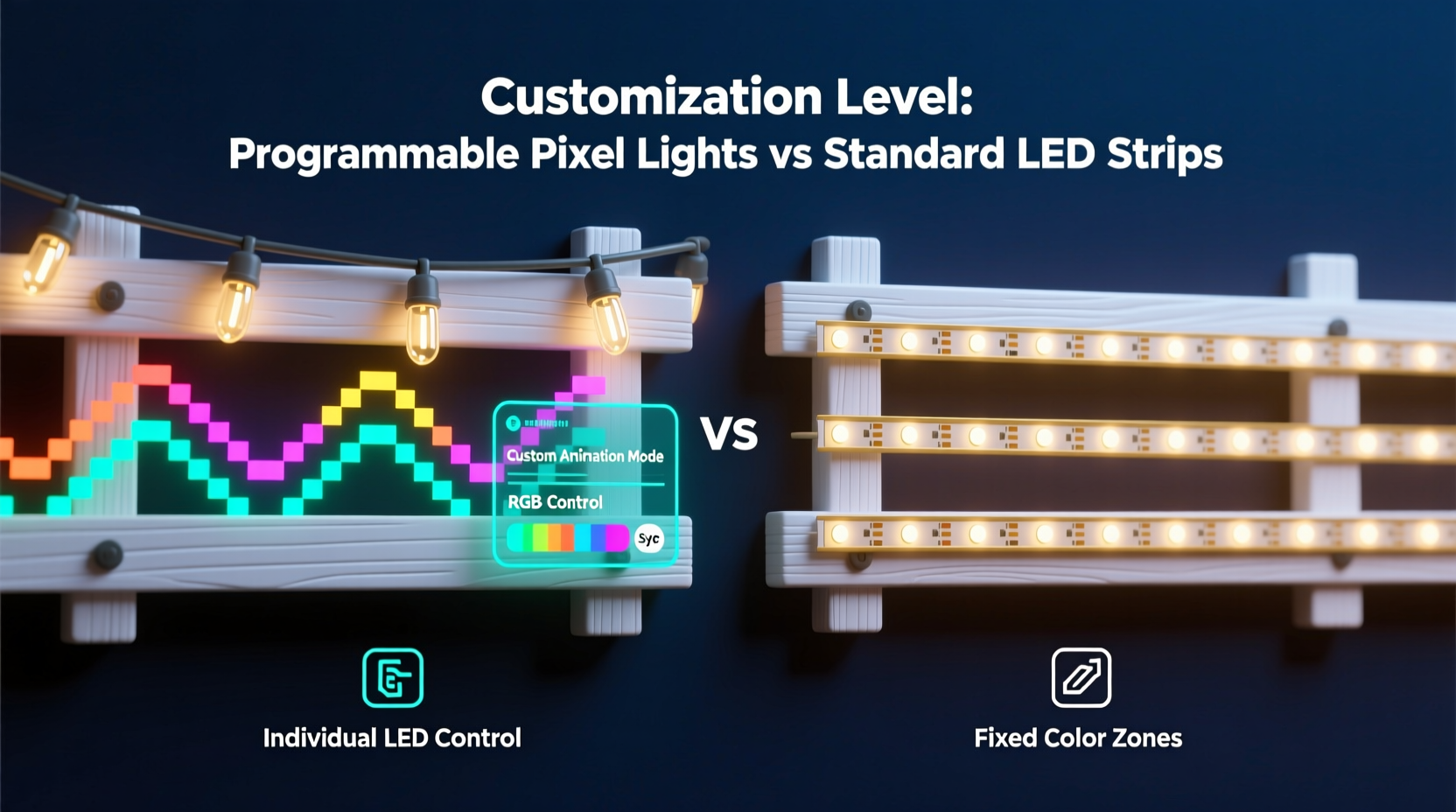
“Customization level” goes far beyond choosing red or blue. It encompasses four interdependent dimensions: spatial resolution (how finely you can control light across physical space), temporal precision (how accurately you can time changes down to the millisecond), behavioral complexity (whether lights respond to input, follow algorithms, or evolve autonomously), and creative accessibility (how much technical knowledge or specialized tools are required to achieve a given result). A standard LED strip may let you fade from warm white to cool white—but only across the entire length, simultaneously, using a single channel. A 300-pixel WS2812B strip lets you scroll a rainbow wave at 60 frames per second, freeze a gradient that mirrors your wall’s architectural lines, pulse individual pixels to the beat of audio captured from a microphone, or animate a scrolling message letter-by-letter—all while maintaining full RGB control at each point.
Core Technical Differences That Drive Customization Gaps
The divergence begins at the hardware layer. Standard LED strips use constant-voltage DC power and rely on analog dimming (PWM) applied uniformly across all LEDs via a controller with typically 3–5 channels (e.g., R, G, B, W, UV). Each channel controls groups of dozens or hundreds of LEDs identically. Programmable pixel lights embed a tiny integrated circuit (IC) into each LED package (e.g., WS2812B, SK6812, APA102). These ICs receive digital data packets specifying exact RGBW values—and sometimes brightness compensation—for that single pixel. The controller sends a serial stream; each pixel reads its assigned slot, applies the command, and forwards the rest downstream. This architecture enables true per-node control without additional wiring or hardware complexity.
This fundamental difference cascades into real-world implications:
- Color fidelity: Standard strips offer limited color mixing—typically 16–256 total colors depending on controller bit-depth. Pixel lights support 16.7 million colors (24-bit RGB) per pixel, with smooth gradients and precise pastels achievable across adjacent units.
- Effect granularity: With standard strips, “chasing” means shifting one color block across the whole run. With pixels, you can chase a single white dot across 150 nodes while the remaining 149 hold static amber—no hardware modification needed.
- Scalability limits: Standard strip controllers max out around 2–5 meters before voltage drop distorts color or causes flicker. Pixel strips require data buffering and power injection every 3–5 meters, but maintain full per-pixel control across installations spanning hundreds of meters when engineered correctly.
Customization Comparison: A Side-by-Side Breakdown
| Feature | Standard LED Strips | Programmable Pixel Lights |
|---|---|---|
| Per-LED Control | No — all LEDs act as one unit per channel | Yes — each LED independently addressable |
| Minimum Effect Unit | Entire strip or segmented zones (if multi-zone controller used) | Single LED (e.g., 1 of 300) |
| Animation Complexity | Preloaded patterns only: fade, strobe, jump, smooth (typically ≤10 options) | Unlimited: custom waveforms, physics-based simulations (fire, water), generative art, text scrollers, audio-reactive FFT analysis |
| Integration Capability | Basic IR remote or simple app; rarely supports external triggers | Full API access via Arduino, Raspberry Pi, ESP32; compatible with Home Assistant, MQTT, websockets, MIDI, sensors (motion, sound, temperature) |
| Setup Learning Curve | Plug-and-play: connect power + controller, select mode | Moderate: requires firmware flashing, data pin configuration, power management, and often basic coding (Python/Arduino) for advanced use |
| Cost per Meter (Typical) | $8–$15/meter (including controller) | $22–$45/meter (including controller + power supply + optional microcontroller) |
Real-World Example: Transforming a Front Porch Display
Consider Maya, a graphic designer in Portland who wanted her porch lights to reflect seasonal shifts—not just change color, but tell a story. In December 2022, she installed standard RGBW LED strips along her eaves and columns. She cycled through factory presets: “Warm Glow,” “Frosty Blue,” “Candy Cane.” It looked festive—but static. Neighbors complimented the brightness, not the imagination.
This year, Maya upgraded to 144-pixel SK6812 strips, mounted with custom 3D-printed diffusers shaped like pinecones and snowflakes. Using WLED firmware on an ESP32, she programmed three distinct zones: eaves (120 pixels), door frame (12), and wreath (12). Each zone runs independent animations synced to a central timeline. At dusk, the eaves begin a slow, upward-scrolling aurora borealis. When motion is detected near the walkway, the door frame pulses gently in gold—then transitions to a soft green if the front door opens. On Christmas Eve, the wreath displays a rotating “Merry” in crisp white letters, while the eaves simulate falling snow with randomized pixel dimming and drift velocity. Maya didn’t just add lights; she added choreography, responsiveness, and narrative texture—none of which would be possible without per-pixel control.
“Addressable LEDs have moved beyond novelty into expressive infrastructure. They’re no longer ‘smart lights’—they’re programmable surfaces. The limit isn’t the hardware anymore; it’s the designer’s fluency in light as a medium.” — Dr. Lena Torres, Director of Interactive Environments Lab, Carnegie Mellon University
Actionable Customization Roadmap: What to Do Next
Whether you’re evaluating your first purchase or upgrading an existing setup, follow this sequence to match capability with intent:
- Define your primary goal: Is it ambiance (standard strips suffice), storytelling (pixels required), interactivity (pixels + microcontroller), or integration into a smart home ecosystem (pixels with Matter/Thread support)?
- Map your physical layout: Measure linear feet and identify natural segmentation points (corners, windows, rooflines). Note where power outlets exist—and where you’ll need extension cables or secondary power injection.
- Assess your technical comfort: Can you safely wire 12V/5V circuits? Are you comfortable installing firmware via Arduino IDE or configuring Wi-Fi settings on an ESP32? If not, start with plug-and-play pixel kits like Nanoleaf Light Lines or Philips Hue Play Bars—they trade some flexibility for reliability and app simplicity.
- Calculate power requirements: Multiply total pixel count × 60mA (for white at full brightness) ÷ 1000 = amps needed. Then size your power supply at 20% above that figure. Underpowering causes flicker, color shift, and premature failure.
- Choose software wisely: For beginners: WLED (free, browser-based, massive community library of effects). For coders: FastLED (C++ library for Arduino) or rpi_ws281x (Python on Raspberry Pi). Avoid proprietary closed apps unless vendor support is exceptional and long-term updates guaranteed.
Frequently Asked Questions
Can I mix programmable pixels with standard LED strips in one display?
Technically yes—but not practically. They require separate power supplies, controllers, and control protocols. You’d manage them as two independent systems, losing synchronization and unified scheduling. If blending is essential, use a hub like Falcon Player (FPP) or xLights to coordinate multiple output types—but expect significant configuration overhead and latency mismatches.
Do programmable pixels burn out faster than standard LEDs?
No—pixel LEDs have identical semiconductor lifespans (typically 50,000 hours) when operated within spec. However, their integrated drivers are more sensitive to voltage spikes, reverse polarity, and overheating during soldering. Poor installation—not inherent fragility—is the leading cause of early failure. Always use anti-static precautions and verify polarity before powering on.
Is there a meaningful difference between WS2812B, SK6812, and APA102 pixels?
Yes. WS2812B uses a single-wire data protocol and is cost-effective but susceptible to timing errors on long runs. SK6812 adds built-in white LEDs (RGBW) and improved refresh rates. APA102 uses a two-wire (clock + data) protocol, enabling higher frame rates (>20 kHz), better dimming linearity, and immunity to signal degradation—ideal for professional installations. Choose based on your speed, color accuracy, and reliability needs—not just price.
Why Customization Depth Matters Beyond the Holidays
Thinking of programmable pixels solely as “Christmas lights” underestimates their role in modern ambient computing. Educators use them to visualize data streams in real time—temperature gradients across a classroom map, or live election results by state. Architects embed them in façade mockups to test circadian lighting schedules. Musicians mount them behind stages to generate synchronized visual scores. Even small businesses use pixel matrices as dynamic signage—displaying wait times, daily specials, or social media feeds—without replacing physical infrastructure. The customization level isn’t a feature; it’s the foundation for adaptive, responsive, and human-centered environments. Standard LED strips illuminate space. Programmable pixels interpret context, respond to presence, and translate information into light.




 浙公网安备
33010002000092号
浙公网安备
33010002000092号 浙B2-20120091-4
Comments
No comments yet. Why don't you start the discussion?