
Choosing the right Christmas lights isn’t just about brightness or bulb count—it’s about how much creative control you want over your display, how much time you’re willing to invest in setup and maintenance, and whether your vision evolves year after year or stays comfortably traditional. Static color sets—red, green, warm white, cool white, multicolor—have defined holiday lighting for decades. Programmable RGB lights, powered by addressable LEDs (like WS2812B or APA102), promise infinite palettes, dynamic effects, and smartphone-controlled choreography. But do they deliver on that promise for the average homeowner? Or do static sets still hold compelling advantages in reliability, simplicity, and value? This isn’t a theoretical debate. It’s a functional evaluation grounded in real installation experience, electrical constraints, software learning curves, and long-term ownership realities.
What “Programmable RGB” Actually Means (and What It Doesn’t)
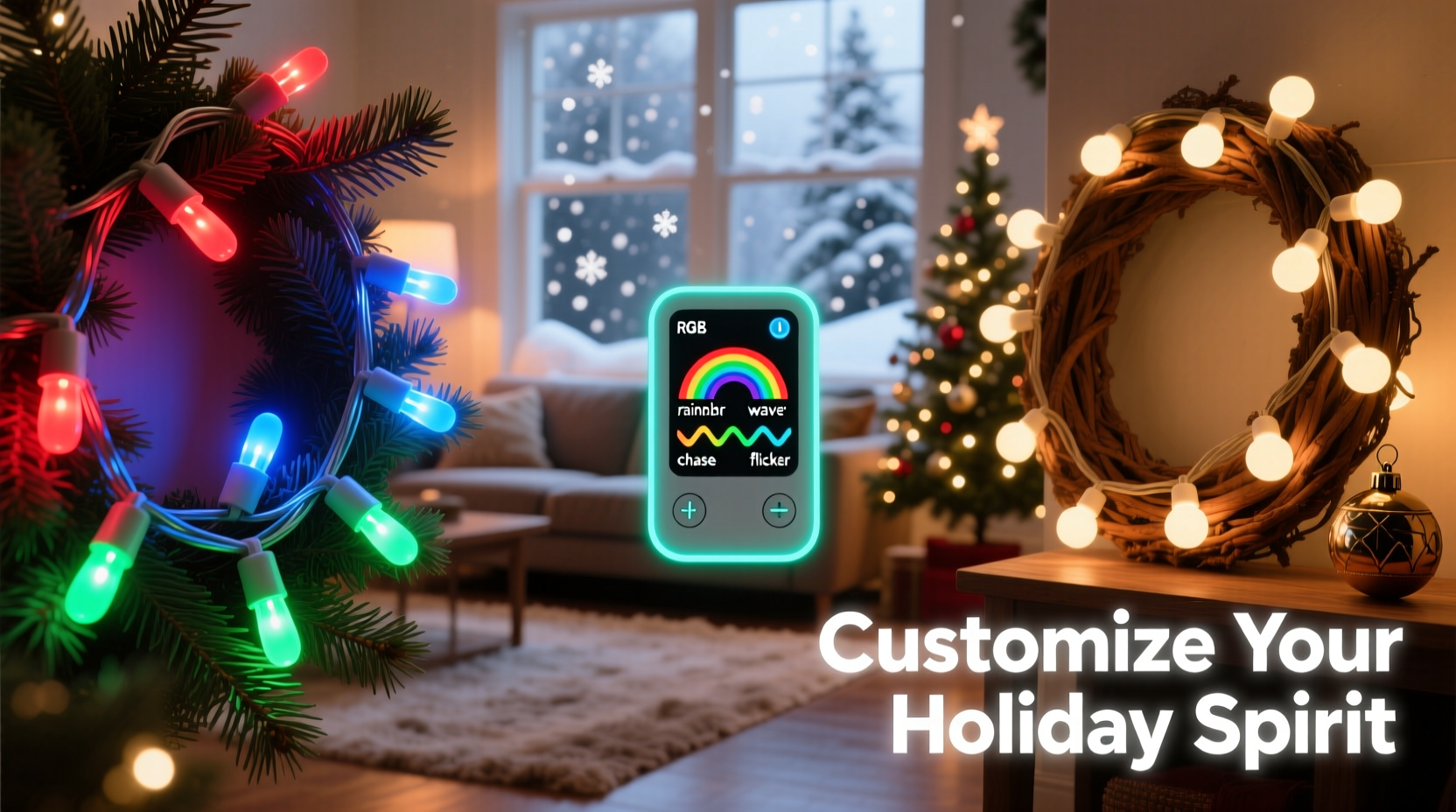
“Programmable RGB” refers to strings where each LED—or sometimes every three LEDs—is individually addressable via digital signal protocols. Unlike traditional incandescent or even basic LED sets with fixed color modes (twinkle, chase, fade), these lights accept precise commands: “Set pixel #47 to #FF6B6B (coral), pixel #48 to #4ECDC4 (turquoise), hold for 3 seconds, then transition to purple over 1.2 seconds.” That level of control enables synchronized light shows, music-reactive displays, custom animations, and seamless color blending across entire rooflines or trees.
But not all RGB is equal. Many budget “RGB” strings sold online are merely *switchable*—they offer 16 preset colors and 4–5 built-in modes controlled by a basic IR remote. These are not programmable. True programmability requires either a dedicated controller (like a Falcon F16v3, xLights-compatible ESP32 board, or Light-O-Rama device) or a smart hub (Philips Hue Play, Nanoleaf Shapes, or Lumenplay). The software layer matters just as much: platforms like xLights (free, open-source, steep learning curve) or Vixen Lights (legacy but stable) enable frame-by-frame sequencing, while consumer apps like Twinkly or Govee offer drag-and-drop simplicity at the cost of granular timing control.
Customization Depth: Control vs. Consistency
Static color sets excel in predictability. A 100-light warm white incandescent strand delivers the same soft, nostalgic glow year after year. There’s no firmware update to break, no Wi-Fi dropout during a neighborhood light walk, and no need to recalibrate timing when temperatures drop below freezing. Their customization is physical and permanent: you choose the hue at purchase, and that’s your palette. You can mix strands—pairing amber LEDs with deep reds and forest greens—but the combinations are finite and require manual planning.
Programmable RGB, by contrast, treats color as data. One string can emulate warm white at 2700K one evening, shift to a vibrant magenta gradient the next, then pulse in time with your holiday playlist—all without swapping a single bulb. Advanced users build seasonal themes: icy blues and silvers for December 1–15, rich burgundies and golds for Christmas Eve, then pastel pinks and lavenders for New Year’s. Customization extends beyond color: speed, direction, intensity, transition curves, and spatial mapping (e.g., “only the top 30% of the tree pulses”) become variables you adjust with precision.
The trade-off is cognitive load. Static sets demand zero configuration. RGB demands decisions: Do you want smooth HSL transitions or sharp RGB jumps? Should your eaves run a slow wave or a rapid strobe? Is your controller’s power supply rated for the full current draw at full white (the most demanding color)? Missteps here lead to flickering, color banding, or outright failure mid-display.
Real-World Performance Comparison
| Feature | Static Color Sets | Programmable RGB Lights |
|---|---|---|
| Initial Cost (per 100 lights) | $8–$22 (LED); $15–$40 (incandescent) | $25–$65 (basic addressable); $75–$180+ (premium, weatherproof, high-density) |
| Setup Time (first installation) | 15–45 minutes (plug-and-play) | 2–8 hours (wiring, controller config, software setup, testing) |
| Lifespan (rated hours) | 15,000–25,000 (LED); 1,000–3,000 (incandescent) | 30,000–50,000 (but highly dependent on thermal management & power stability) |
| Weather Resistance | IP44 standard for most outdoor-rated sets | IP65 common; IP67/68 available but premium-priced and less common in consumer lines |
| Failure Mode | Single bulb burnout (often non-cascading); fuse blow | Entire segment fails if one pixel shorts; voltage drop causes color shift at string end; controller overheating in attic enclosures |
| Expandability | Plug-and-play daisy-chaining (within manufacturer limits) | Requires careful power injection every 100–150 pixels; data line termination critical for long runs |
Note the lifespan advantage for RGB isn’t automatic—it assumes ideal conditions. Running a 5-meter WS2812B strip at full white brightness in direct summer sun without airflow will degrade LEDs faster than a static warm-white set running at half power. Likewise, cheap power supplies cause voltage sag, leading to inconsistent color rendering and premature controller failure.
A Mini Case Study: The Henderson Family’s Two-Year Evolution
The Hendersons in Portland, Oregon installed their first holiday lights in 2022: 12 strands of warm white LED mini-lights ($149 total), a simple timer, and hand-tied bows on the porch columns. Setup took 90 minutes. They loved the classic look but felt it lacked “personality.”
In 2023, they upgraded to a 300-pixel programmable system: two 150-pixel strips for the roofline, a 50-pixel tree wrap, and a Raspberry Pi 4 running xLights. They spent $387 on hardware, plus 14 hours over three weekends configuring sequences, calibrating audio input, and troubleshooting ground-loop interference from their garage door opener. Their display now features a 90-second synchronized show synced to “Carol of the Bells,” with snowfall effects on the eaves and gentle breathing pulses on the tree.
But they also learned hard lessons: one rainy November, a poorly sealed controller enclosure caused a short, taking out 40 pixels. They discovered their original 12V/10A power supply couldn’t handle the full white load—causing cyan tinting on the far end of the roofline until they added a second supply with power injection. And while neighbors praised the show, their 7-year-old daughter missed the “old twinkly lights” she could identify by color—“the red ones were happy, the blue ones were sleepy.”
By 2024, they adopted a hybrid approach: keeping the programmable roofline for spectacle, but reverting to static amber and sage green mini-lights for the porch railing and window boxes—lights their daughter helps hang and recognizes instantly. Their customization strategy matured: not more control, but *intentional* control.
Expert Insight: The Engineer’s Perspective
“The biggest misconception about programmable lights is that ‘more pixels’ equals ‘better display.’ In reality, resolution mismatch kills impact. A 50-pixel strip on a 30-foot eave gives you one controllable point every 7 inches—too coarse for smooth gradients. But 300 pixels on the same run yields rich detail. Yet those 300 pixels demand triple the power, double the data wiring complexity, and 10x the debugging time when one pixel fails. Simplicity isn’t lazy—it’s engineered resilience.” — Dr. Lena Torres, Embedded Systems Engineer & Holiday Lighting Consultant, co-author of *Practical LED Architectures for Outdoor Displays*
Your Action Plan: Choosing Based on Your Priorities
Follow this step-by-step framework to determine which path aligns with your goals, skills, and environment:
- Define your primary goal: Is it effortless charm (static), neighborhood attention (RGB), family engagement (both—kids love choosing presets), or technical growth (RGB)?
- Assess your infrastructure: Do you have accessible outdoor GFCI outlets within 25 feet of your display? Is there attic or covered porch space for a controller? Does your home Wi-Fi reliably reach the front yard?
- Calculate realistic time investment: Budget 3–5 hours for static setup (including ladder work). Budget 8–20 hours for RGB—including research, wiring, software install, sequence creation, and troubleshooting.
- Test one small zone first: Buy a single 50-pixel RGB string and controller. Run it on your patio for a week. If you enjoy tweaking timings and experimenting with effects, scale up. If you find yourself wishing for a simple on/off switch by day three, static is your answer.
- Plan for longevity: Choose static sets with replaceable fuses and shunted bulbs. For RGB, prioritize units with silicone-jacketed wires, metal heat sinks on controllers, and UL-listed power supplies—not generic “12V adapters.”
FAQ: Practical Questions Answered
Can I mix programmable RGB and static lights on the same display?
Yes—but not directly on the same circuit or controller. Static sets plug into standard outlets or timers. RGB strings require dedicated low-voltage DC power and data signals. You can coordinate them manually (e.g., static lights on at dusk, RGB show starts at 6 p.m.), or use a smart plug to trigger both simultaneously. True synchronization requires advanced integration (like Home Assistant automations), which adds complexity.
Do programmable RGB lights use significantly more electricity?
Surprisingly, no—when used thoughtfully. A full-brightness white RGB pixel draws ~0.3W. At 300 pixels, that’s 90W—comparable to three old incandescent strings. But most users run effects at 30–60% brightness, reducing draw to 27–54W. Static LED sets use ~0.04W per bulb (4W per 100), making them inherently more efficient—but the visual impact difference often justifies RGB’s modest draw increase.
Are static color sets becoming obsolete?
No—and they won’t for years. Retailers like Target, Home Depot, and Costco continue expanding static LED offerings with improved CRI (color rendering index), dimmable options, and smart-enabled versions (e.g., GE Enbrighten warm-dimmable whites). Their reliability, affordability, and zero-software barrier ensure enduring appeal, especially for renters, seniors, and those prioritizing ease over experimentation.
Conclusion: Customization Isn’t Just About Color—It’s About Confidence
The “vs.” in this showdown is misleading. This isn’t a winner-takes-all contest between technologies. It’s a calibration exercise between your values and your vision. Programmable RGB lights reward curiosity, patience, and a willingness to learn new tools. They transform lighting from decoration into expression—turning your home into a canvas that breathes, pulses, and responds. Static color sets reward intentionality, consistency, and respect for simplicity. They anchor tradition while quietly evolving through better materials, smarter dimming, and warmer, more natural color temperatures.
The most compelling displays today aren’t the flashiest or the most nostalgic—they’re the ones where technology serves emotion, not the other way around. Whether that means syncing 500 pixels to a choir recording or choosing the exact shade of forest green that reminds you of childhood Christmases, the right choice is the one that makes your holiday feel authentically yours—without draining your energy before the season even begins.




 浙公网安备
33010002000092号
浙公网安备
33010002000092号 浙B2-20120091-4
Comments
No comments yet. Why don't you start the discussion?