
Lighting plays a pivotal role in shaping the atmosphere of any space. As seasons change, so do our emotional and aesthetic preferences—cozy warmth in winter, vibrant energy in summer, festive tones during holidays. The evolution of LED technology has given homeowners two primary choices: programmable RGB lights and static color lights. While both serve functional and decorative purposes, one clearly outpaces the other when it comes to adapting across seasons. This article examines the core differences, practical applications, and long-term benefits of each option, ultimately answering which delivers superior seasonal versatility.
Understanding the Basics: What Sets RGB and Static Lights Apart?
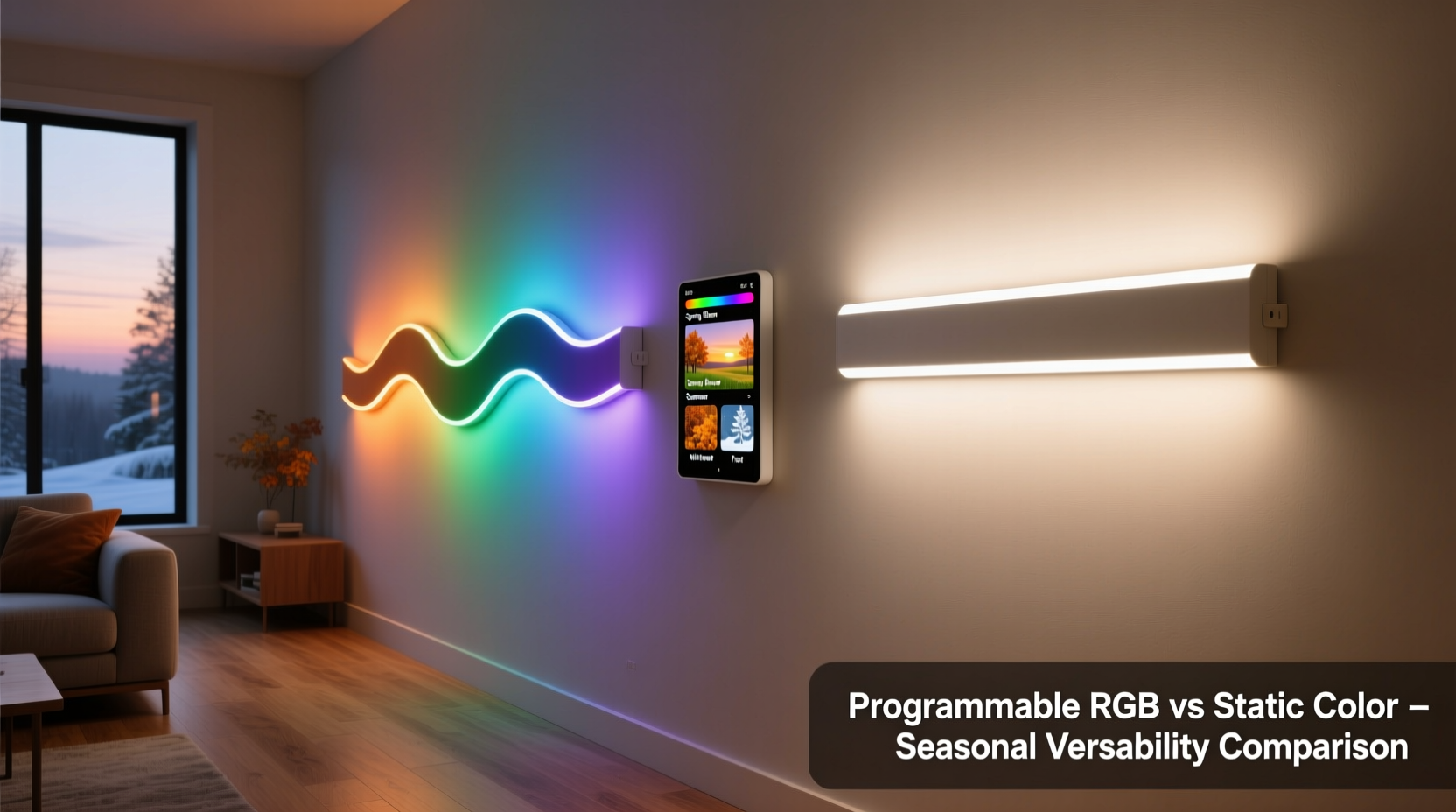
At first glance, both types of lights may seem similar—especially when they're installed along eaves, under cabinets, or wrapped around trees. However, their underlying capabilities diverge significantly.
Static color lights emit a single, unchangeable hue. Whether warm white, cool blue, or soft pink, the color is fixed at the time of manufacture. These are often used in permanent installations where consistency matters—such as accent lighting in retail displays or ambient fixtures in living rooms.
Programmable RGB (Red-Green-Blue) lights, on the other hand, use a combination of three diodes to produce millions of possible colors. Controlled via remote, app, or smart home integration, these systems allow users to shift colors, adjust brightness, create dynamic effects like fading or strobing, and even sync with music or schedules.
The distinction becomes crucial when considering how lighting supports seasonal transitions. A static red bulb may work well for Christmas but feels out of place during Easter or Independence Day. Programmable RGBs, by contrast, can transform from crimson to pastel lavender to star-spangled patterns—all within minutes.
Seasonal Lighting Needs Across the Year
Homeowners often overlook how much lighting influences seasonal experiences. From psychological comfort to holiday celebrations, the right illumination enhances mood and occasion.
- Winter: Cool whites and icy blues complement snow-covered landscapes; warm ambers and reds evoke fireplace coziness and holiday cheer.
- Spring: Soft pastels—lavender, mint green, blush pink—reflect blooming flowers and renewal.
- Summer: Bright, energetic tones like turquoise, yellow, and coral amplify outdoor gatherings and longer days.
- Fall: Earthy hues such as orange, deep red, and golden brown mirror changing foliage and harvest themes.
- Holidays: Specific events demand precise palettes—red and green for Christmas, purple and green for Halloween, red-white-blue for national celebrations.
A lighting system that cannot adapt to these shifts limits expressive potential and forces repeated hardware changes—a costly and inconvenient approach.
Comparative Analysis: Features That Define Versatility
To determine which lighting type offers greater seasonal adaptability, consider the following criteria:
| Feature | Programmable RGB Lights | Static Color Lights |
|---|---|---|
| Color Range | 16 million+ colors via RGB mixing | Single fixed color per bulb/strip |
| Customization | Adjustable brightness, speed, patterns, and scheduling | No adjustment beyond on/off |
| Seasonal Switching Speed | Instantaneous via app or voice command | Requires physical replacement or rewiring |
| Lifespan & Reusability | Reusable year-round with no degradation from switching | May degrade if frequently removed/reinstalled |
| Energy Efficiency | LED-based, low power draw; dimming reduces consumption | Efficient only if left undisturbed |
| Smart Integration | Compatible with Alexa, Google Home, Apple HomeKit | Rarely supported |
| Cost Over Time | Higher upfront cost, lower long-term expense | Cheap initially, but replacements add up |
This comparison reveals a clear advantage for programmable RGB systems. Their ability to instantly reconfigure for any season eliminates the need for multiple sets of lights, reducing clutter, waste, and recurring costs.
“With programmable lighting, you’re not just buying bulbs—you’re investing in an adaptable ambiance engine.” — Marcus Lin, Smart Home Lighting Designer at Lumen Dynamics
Real-World Example: A Year in the Life of a Smart-Lit Home
Consider Sarah, a homeowner in Portland, Oregon, who upgraded her exterior and interior lighting to address her frustration with seasonal decor changes. Previously, she stored five different sets of string lights: warm white for winter evenings, multicolor for Christmas, purple-green for Halloween, red-white-blue for July 4th, and soft rainbow for spring garden parties.
Each transition required hours of installation and removal. Bulbs broke during storage, and mismatched strands diluted visual impact. After installing addressable RGB LED strips and Wi-Fi-enabled bulbs, Sarah now manages all seasonal themes through a single app.
In practice:
- October 1: At 6 PM, her porch automatically shifts to pulsating purple and green with flickering “ghost” effects.
- November 25: Thanksgiving evening triggers a golden-orange gradient mimicking sunset, transitioning to classic red-green by December 1.
- February 14: Valentine’s Day brings a slow-pulsing red and pink sequence synchronized across indoor and outdoor zones.
- April 5: For Easter, soft pastel cycles run from dawn until dusk, then revert to neutral white.
Sarah estimates she saved over $180 in replacement light purchases and reclaimed 12 hours annually previously spent on manual swaps. More importantly, her home now feels consistently aligned with the rhythm of the year—without effort.
Step-by-Step Guide: Transitioning Your Home for Seasonal Themes
Switching from static to programmable lighting doesn’t require a full overhaul. Follow this timeline to integrate seasonal adaptability gradually:
- Week 1: Audit Current Lighting
Identify areas where seasonal changes matter most—front porch, patio, stair railings, kitchen backsplash. - Week 2: Prioritize High-Impact Zones
Start with one visible area (e.g., entryway). Replace static strings with addressable RGB strips or smart bulbs. - Week 3: Set Up Control System
Install the companion app, connect to Wi-Fi, and test basic functions: color change, dimming, scene saving. - Week 4: Create Seasonal Presets
Design and save scenes for current and upcoming seasons. Name them clearly (“Autumn Glow,” “Halloween Pulse”). - Month 2: Automate Transitions
Use scheduling features to auto-switch themes on specific dates or times. Add geofencing to activate upon arrival. - Month 3+: Expand Gradually
Replace additional static fixtures as needed. Integrate voice control for hands-free adjustments.
This phased approach minimizes disruption while delivering increasing returns in convenience and aesthetic cohesion.
Practical Checklist: Maximizing Seasonal Versatility
Before finalizing your lighting strategy, ensure you’ve covered these essentials:
- ✅ Choose RGB products with app-based control and scheduling
- ✅ Verify compatibility with existing smart home platforms (Alexa, Google Assistant)
- ✅ Opt for weatherproof ratings (IP65 or higher) for outdoor use
- ✅ Test color accuracy—some RGBs produce uneven greens or weak pastels
- ✅ Save at least three seasonal presets before storing old lights
- ✅ Label circuits or zones clearly (e.g., “Front Yard,” “Deck”) for easy management
- ✅ Back up configurations in case of device reset or firmware update
Common Misconceptions About RGB Lighting
Despite growing adoption, several myths persist about programmable systems:
- Myth: RGB lights look cheap or garish.
Reality: Modern addressable LEDs offer smooth gradients and subtle transitions. When properly configured, they enhance elegance rather than distract. - Myth: They’re too complicated for non-tech users.
Reality: Most apps feature intuitive interfaces with preloaded themes. Grandparents routinely manage complex scenes with minimal training. - Myth: Frequent color changes reduce lifespan.
Reality: LEDs degrade primarily due to heat and continuous operation, not color switching. Properly cooled units last 25,000–50,000 hours regardless of usage pattern. - Myth: Only useful for holidays.
Reality: Beyond seasons, RGBs support circadian lighting (cool morning light, warm evening tones), entertainment syncing, and mood enhancement.
These misconceptions often stem from early-generation products or improper setup. Today’s solutions prioritize usability, durability, and design harmony.
Frequently Asked Questions
Can I mix programmable RGB and static lights in the same space?
Yes, but with caution. Mixing types can lead to visual inconsistency unless carefully coordinated. For example, using static warm white indoors while running RGB outdoors for seasonal effects works well. Avoid placing them side-by-side where mismatched tones could clash.
Do programmable lights consume more energy than static ones?
No. Both use comparable LED technology. Energy use depends more on brightness level and duration than color variability. In fact, many RGB systems include dimming and scheduling, which can reduce overall consumption by turning off during unused hours.
Are there any security benefits to programmable lighting?
Yes. Scheduling RGB lights to simulate occupancy—such as cycling through living room scenes while away—can deter intruders. Unlike static lights left on all night, dynamic patterns appear more natural and human-driven.
Conclusion: Embrace Adaptive Lighting for Lasting Impact
When evaluating programmable RGB versus static color lights for seasonal versatility, the verdict is definitive: RGB systems provide unmatched flexibility, efficiency, and long-term value. They eliminate the need for multiple dedicated sets, reduce physical labor, and elevate the emotional resonance of your environment throughout the year.
While static lights have their place in permanent architectural accents or minimalist designs, they fall short when adaptation is key. Programmable RGB isn't just about colorful spectacle—it's about intelligent, responsive environments that evolve with life’s rhythms.
Whether you're preparing for next Halloween, welcoming spring blooms, or crafting a serene winter nightscape, the right lighting should empower, not constrain. Start small, build intelligently, and let your home reflect the season—not because you changed the bulbs, but because it knows when to change itself.




 浙公网安备
33010002000092号
浙公网安备
33010002000092号 浙B2-20120091-4
Comments
No comments yet. Why don't you start the discussion?