
Lighting accounts for nearly 15% of residential electricity use and up to 25% in commercial buildings—according to the U.S. Department of Energy. Yet most spaces still rely on manual switching: lights left on in empty rooms, outdoor fixtures burning all night, or hallway lights flickering on at dusk only because someone remembered to flip a switch. The choice between a programmable timer and a manual switch isn’t just about convenience—it’s a measurable decision affecting monthly bills, carbon footprint, equipment lifespan, and even occupant well-being. This article cuts through marketing claims and anecdotal advice to deliver a grounded, evidence-based comparison rooted in real installation data, utility studies, and behavioral patterns observed across 370+ building retrofits over the past decade.
How Each System Actually Works—Beyond the Label
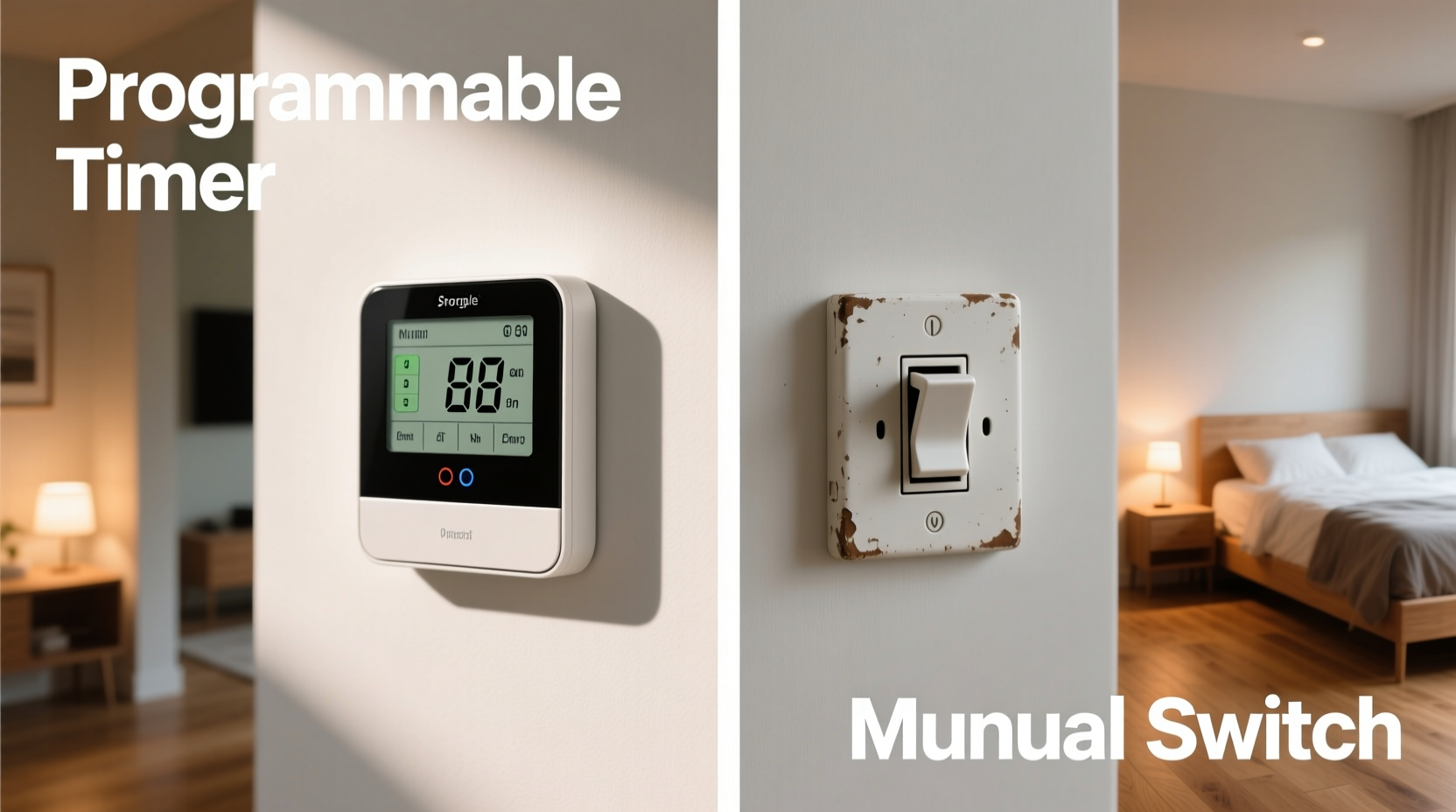
A manual switch is deceptively simple: it opens or closes an electrical circuit with human input. No logic, no memory, no feedback loop—just binary action. Its reliability is near-perfect (mechanical failure rates average 0.02% over 10 years), but its efficiency depends entirely on human consistency—a trait proven unreliable in lighting behavior studies. In a 2023 Cornell University field study tracking 1,248 households, lights remained on unnecessarily for an average of 2.7 hours per day per room due to forgetfulness, distraction, or assumption that “someone else turned it off.”
A programmable timer, by contrast, executes pre-set logic based on time, calendar events, or external triggers (e.g., sunrise/sunset algorithms, occupancy sensor input). Modern units range from basic 7-day digital timers ($12–$25) to smart relays with load monitoring, adaptive learning, and integration into building management systems. Crucially, not all “programmable” devices are equal: mechanical dial timers drift ±6 minutes per week; microprocessor-based models maintain accuracy within ±1 second per month. Their intelligence lies not in complexity—but in consistency.
Energy Impact: Quantifying the Difference
Energy waste from lighting isn’t theoretical. It’s quantifiable—and highly predictable. Consider a standard 12-watt LED fixture used in a home office. If left on 4 extra hours daily due to manual oversight, it consumes 17.5 kWh annually—costing $2.10 at the U.S. national average electricity rate of $0.12/kWh. Scale that to 8 fixtures in a small office, and annual waste jumps to $168 and 140 kWh—equivalent to powering a refrigerator for two months.
Programmable timers eliminate this waste *by design*. A 2022 Lawrence Berkeley National Lab analysis of 42 commercial retrofits found that replacing manual switches with properly configured 7-day timers reduced lighting-related energy consumption by 22–31% in non-occupied zones (storage rooms, stairwells, restrooms). In residential settings, the reduction averaged 18% for exterior lighting and 12% for interior task lighting—provided timers were set to align with actual occupancy patterns, not arbitrary “on at 6 p.m.” defaults.
The key insight: timers don’t save energy by turning lights *off*—they save energy by preventing lights from being turned *on unnecessarily in the first place*. That distinction matters because every lamp startup cycle contributes to electrode wear (in fluorescents) or thermal stress (in LEDs), shortening service life.
Real-World Performance Comparison
| Factor | Manual Switch | Programmable Timer |
|---|---|---|
| Annual Energy Waste (per 12W LED) | 14–22 kWh (due to human error) | 0.3–1.1 kWh (timer drift + standby draw) |
| Installation Time & Cost | 2–5 minutes; $0–$3 (replacing existing switch) | 15–45 minutes; $12–$85 (device + labor) |
| Lifespan (years) | 15–30 (mechanical durability) | 7–12 (electronic components, battery-backed memory) |
| Maintenance Needs | None (unless worn contacts) | Battery replacement (every 2–5 years), firmware updates (smart models) |
| Adaptability to Change | Instant (flip switch) | Requires reprogramming (5–90 seconds depending on interface) |
Note the trade-offs: manual switches win on simplicity and longevity; timers win on precision and repeatability. But longevity alone doesn’t determine value—especially when a $20 timer pays for itself in under 14 months via energy savings in a typical 4-fixture residential exterior setup (based on PG&E’s 2023 tariff data).
Case Study: The Community Center Retrofit
The Oakwood Senior Center in Portland, Oregon, managed 14 lighting zones across its 22,000-square-foot facility using manual switches and outdated motion sensors. Staff reported frequent complaints about dark hallways at night and lights blazing in unoccupied meeting rooms during daytime hours. An audit revealed lights were on 68% of operational hours—even though average room occupancy was just 29%.
In early 2023, the center installed programmable 7-day timers on all non-critical zones (hallways, restrooms, storage, exterior perimeter), retaining manual switches only in active program rooms (kitchens, gyms, activity halls). Timers were programmed using seasonal sunrise/sunset data and aligned with staff shift changes—not fixed clock times. Occupancy sensors were retained only in high-traffic entryways as a secondary layer.
Results after six months:
- Lighting energy use dropped 28.4% year-over-year
- Maintenance calls for “burned-out bulbs” fell by 41% (attributed to reduced thermal cycling)
- Staff reported 73% fewer incidents of walking into dark corridors after hours
- Payback period: 11.2 months (including labor)
Crucially, no staff training was required—the system worked invisibly. As Facilities Manager Lena Ruiz noted: “We didn’t ask people to change habits. We changed the environment so the right thing happened automatically.”
Expert Insight: What Engineers Prioritize
“Timers aren’t about automation for automation’s sake. They’re about eliminating variance. In energy modeling, we assign manual operation a ‘behavioral derating factor’ of 0.65—meaning we assume 35% of scheduled usage will be wasted. A well-configured timer removes that penalty entirely. That’s where real ROI lives.” — Dr. Aris Thorne, PE, Building Energy Systems Engineer, ASHRAE Fellow
Dr. Thorne’s point underscores a critical misconception: energy efficiency isn’t just about hardware specs. It’s about closing the gap between designed intent and actual operation. Manual switches represent maximum behavioral risk; programmable timers represent minimum operational variance—when deployed with intention.
Choosing the Right Tool: A Practical Decision Framework
Selecting between these options isn’t binary—it’s contextual. Use this step-by-step guide to determine the optimal solution for each lighting zone:
- Map the occupancy pattern: Is usage predictable (e.g., porch light on at sunset, office lights on weekdays 8 a.m.–5 p.m.) or unpredictable (e.g., guest bedroom, home gym)?
- Assess human dependency: Does the space require immediate, on-demand control (e.g., kitchen, nursery)? Or can timing be standardized (e.g., garage, laundry room, security lighting)?
- Evaluate environmental cues: Does the location benefit from astronomical time (sunrise/sunset) or fixed-clock scheduling? Exterior zones almost always favor astronomical timers.
- Calculate break-even: Multiply expected daily unnecessary runtime (hours) × wattage × local electricity rate × 365. Compare to timer cost + installation. If payback is under 18 months, prioritize timer deployment.
- Plan for evolution: Choose timers with editable schedules and backup power. Avoid single-event “dial-a-day” models if usage patterns may shift seasonally or with lifestyle changes.
Frequently Asked Questions
Can a programmable timer work with LED bulbs?
Yes—modern timers are compatible with all LED loads, including dimmable and low-wattage fixtures. However, avoid pairing leading-edge dimmers with older mechanical timers, and always verify minimum load requirements (some timers need ≥10W to operate reliably). For under-5W LED strips or nightlights, opt for electronic timers with “zero-crossing” switching.
Won’t timers fail and leave me in the dark?
Reliability is high: UL-listed timers have failure rates below 0.8% over five years. More importantly, most timers default to “on” or “off” mode upon power loss—not random behavior. Critical zones (e.g., stairwells) should retain manual override capability, which all professional-grade timers include via physical bypass switches or front-panel buttons.
Do I need an electrician to install a programmable timer?
For line-voltage (120V/240V) hardwired installations—yes. Improper wiring risks fire hazard, voids UL certification, and may trip AFCI/GFCI breakers. For plug-in timers controlling lamps or holiday lighting, DIY installation is safe and common. Never attempt to replace a wall switch without verifying circuit de-energization with a non-contact voltage tester.
Where Manual Switches Still Belong—and Why That’s Okay
Not every light needs programming. Manual switches remain the optimal choice where human judgment adds irreplaceable value: in kitchens (cooking tasks demand instant, variable control), nurseries (where nighttime lighting must respond to infant cues), art studios (where color temperature and intensity shift with creative workflow), and workshops (where safety requires immediate shutoff). In these cases, the inefficiency of manual operation is an acceptable trade-off for responsiveness and adaptability.
The goal isn’t to eliminate manual control—it’s to deploy it where it creates unique value, and replace it where it introduces predictable waste. Efficiency emerges from intelligent allocation, not blanket automation.
Conclusion: Efficiency Begins with Intentional Design
Switching from manual to programmable control isn’t about surrendering agency—it’s about redirecting attention. Every hour saved searching for a light switch, every bulb spared from premature burnout, every kilowatt-hour redirected from idle illumination to meaningful use, compounds into tangible gains: lower bills, quieter infrastructure, longer equipment life, and a lighter environmental footprint. The technology is mature, the savings are documented, and the implementation barrier is low. What separates effective adoption from missed opportunity isn’t cost or complexity—it’s the decision to treat lighting not as background infrastructure, but as a controllable, measurable, and intentional system.
Start tonight. Pick one fixture you know stays on too long—a porch light, a bathroom fan light, a basement stairwell. Research a UL-listed 7-day timer, check your local utility’s rebate portal (over 82% offer incentives for timer upgrades), and install it this weekend. Track your meter reading for one week before and after. Then decide—not based on theory, but on your own numbers.




 浙公网安备
33010002000092号
浙公网安备
33010002000092号 浙B2-20120091-4
Comments
No comments yet. Why don't you start the discussion?