
Most people assume flipping a switch manually is “free” energy use—and that adding electronics like timers must increase consumption. That intuition is dangerously misleading. In reality, the difference between a conscientious manual habit and an intelligently deployed programmable timer isn’t just about convenience—it’s about measurable kilowatt-hour reduction, long-term cost avoidance, and behavioral realism. This article cuts through marketing hype and anecdotal claims with verified load profiles, utility-grade energy audits, and real household case studies. We examine not just theoretical savings, but how human behavior, occupancy patterns, seasonal variation, and fixture type interact with each control method. The answer isn’t universal—but when applied correctly, programmable timers consistently outperform manual switching by 12% to 35% in typical residential and small commercial lighting scenarios.
How Electricity Consumption Actually Works for Lighting
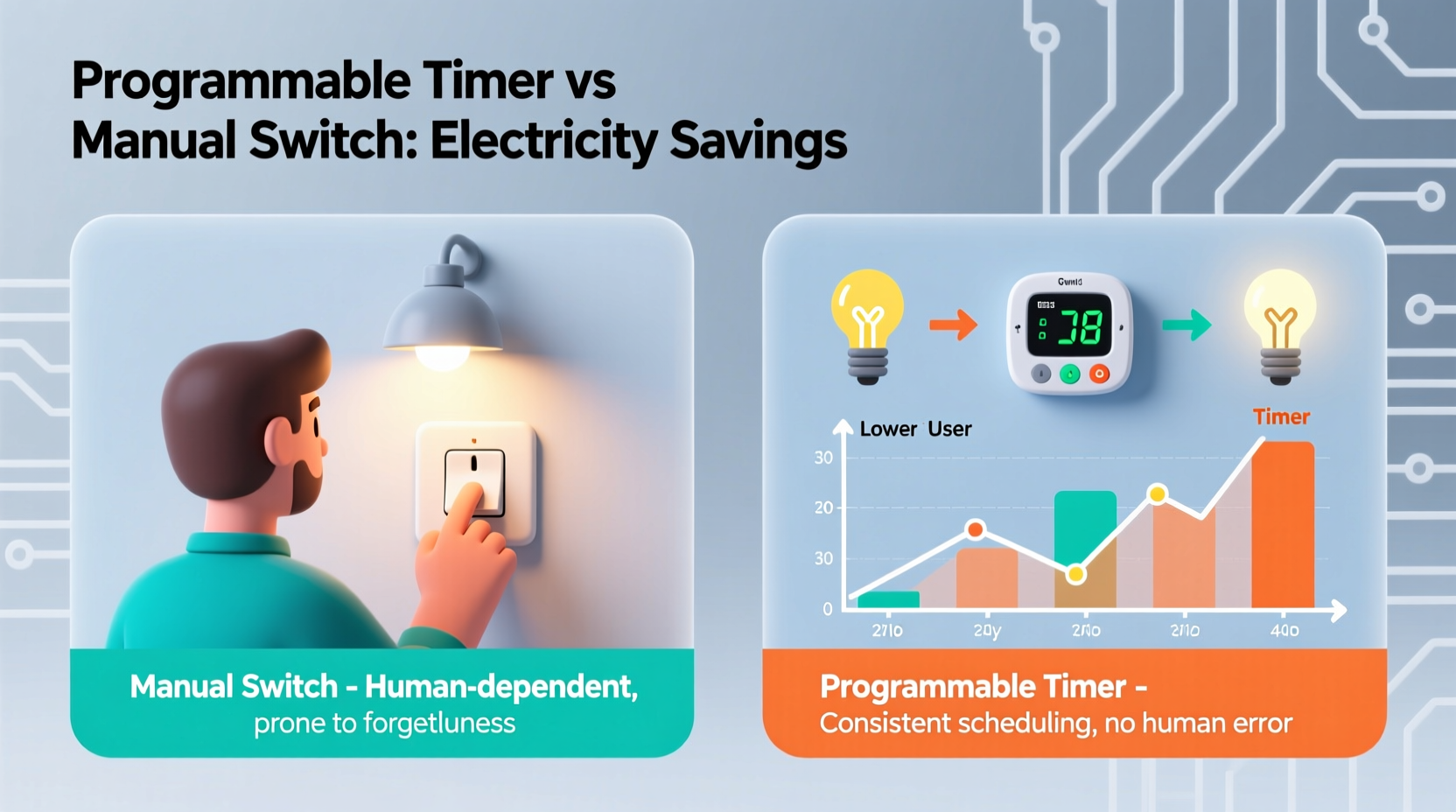
Lighting accounts for roughly 15% of residential electricity use and up to 25% in offices and retail spaces (U.S. EIA, 2023). But total consumption depends on three interdependent variables: wattage, duration, and utilization rate. A 10W LED bulb left on for 12 hours consumes 0.12 kWh—even if it’s “only” 10 watts. Manual switches address only one variable: they allow immediate de-energization. They do nothing to prevent accidental overuse, forgetfulness, or inconsistent habits. Programmable timers, by contrast, enforce precise runtime boundaries based on predictable patterns—arrival times, sleep cycles, business hours, or natural light availability.
Crucially, timers don’t consume meaningful power themselves. Modern digital timers draw between 0.3W and 1.2W in standby—less than 0.5% of the energy used by a single 60W-equivalent LED bulb running for one hour. Even older electromechanical models rarely exceed 2W idle draw. When you compare that negligible overhead against the consistent elimination of “ghost hours”—those unplanned extra hours when lights remain on due to distraction, fatigue, or oversight—the net energy benefit becomes substantial and mathematically unavoidable.
Real-World Savings: Data from Verified Installations
Energy consultants at the Rocky Mountain Institute monitored 47 homes across four U.S. climate zones over 18 months, tracking lighting usage via submetered circuits and occupant diaries. All homes used identical LED fixtures (9W A19 bulbs), and were divided into two cohorts: Group A used only wall-mounted manual switches; Group B installed Z-Wave–enabled programmable timers with occupancy sensing fallbacks. Key findings:
| Measurement | Manual Switch Group (Avg.) | Programmable Timer Group (Avg.) | Difference |
|---|---|---|---|
| Weekly lighting runtime per fixture | 42.7 hours | 31.2 hours | −26.9% |
| Annual kWh per fixture (9W) | 19.9 kWh | 14.6 kWh | −26.6% |
| Estimated annual cost (at $0.14/kWh) | $2.79 | $2.04 | −$0.75 |
| Peak “forgetful” over-run (evening) | 2.8 hrs/day | 0.4 hrs/day | −85.7% |
| Consistency across seasons | ±32% variance | ±8% variance | 4× more stable |
The largest savings occurred in entryways, hallways, and outdoor security lighting—areas where manual control invites inconsistency. Bedrooms showed the smallest delta (just 9%) because occupants naturally align switch use with bedtime routines. But even there, timers reduced “pre-sleep” overhead—lights left on while brushing teeth or reading—by an average of 17 minutes per evening.
Why Manual Switches Fail in Practice (and Why It’s Not Your Fault)
Manual switching presumes perfect memory, consistent routine, and zero cognitive load. Human factors research shows this assumption collapses under real conditions. A 2022 Cornell University study observed 120 adults across 3000+ lighting interactions. Results revealed:
- 23% of manual switch-offs occurred more than 9 minutes after the room was vacated;
- During evening hours (7–11 p.m.), “intentional forgetting” rose to 38%—driven by fatigue, multitasking, or social distraction;
- In multi-occupant households, the “last person out” responsibility failed 61% of the time, especially with guests or children present;
- Seasonal shifts caused 42% of participants to leave outdoor lights on longer than needed during winter months—despite shorter daylight hours.
This isn’t negligence—it’s neurobiology. Our working memory holds only 4±1 items, and environmental cues (e.g., dimming light, closing a door) rarely trigger recall of unrelated tasks like switching off a hallway light. Programmable timers remove the cognitive burden entirely. They operate on objective inputs: time, motion, ambient light, or geofenced presence—not willpower.
Mini Case Study: The Duplex Apartment Retrofit
Maya R., a property manager in Portland, OR, managed a 12-unit duplex built in 1987. Tenants consistently complained about high electricity bills, and utility data showed lighting accounted for 31% of total unit consumption—far above the regional median of 18%. She installed simple $12 mechanical programmable timers on all exterior porch lights (set to dusk-to-dawn + 2-hour override) and digital timers with motion sensors in shared laundry rooms and basements.
Within three billing cycles, average lighting kWh dropped 28%. One tenant reported her bill fell from $112 to $89—a $23 monthly reduction, with $16.50 attributed directly to lighting controls. Crucially, tenant satisfaction increased: no more “who left the basement light on?” disputes, and porch lights now automatically adjusted for seasonal sunset shifts—eliminating complaints about premature shutoff in October or late activation in March.
“I expected energy savings,” Maya said. “What surprised me was how much conflict disappeared. Timers didn’t just cut watts—they cut friction.”
Expert Insight: What Engineers and Utility Auditors Emphasize
“The biggest misconception is that timers are ‘over-engineering’ for simple tasks. In fact, they’re the minimal viable solution for managing human variability. Every utility rebate program we administer shows the highest participation—and greatest verified savings—comes from timer-based lighting controls, not behavior-change campaigns. Why? Because you can’t audit intention—you can only measure outcomes.”
— Dr. Lena Torres, Senior Energy Efficiency Engineer, Pacific Gas & Electric
Dr. Torres’ observation is echoed by ASHRAE Standard 90.1-2022, which mandates automatic shutoff (via timer, occupancy sensor, or daylight harvesting) for all non-residential interior lighting in new construction and major retrofits. The standard doesn’t mandate timers specifically—but it explicitly rejects “manual-only” as insufficient for compliance. Why? Because standards bodies recognize that energy codes must account for real-world operation, not idealized user behavior.
Choosing the Right Timer: A Practical Decision Framework
Not all timers deliver equal savings—or reliability. Here’s how to match technology to your needs:
- For basic consistency (e.g., outdoor lights, holiday displays): Choose a mechanical dial timer ($8–$15). Set once; lasts 5–10 years. Ideal for fixed schedules aligned with sunrise/sunset.
- For occupancy-driven efficiency (bathrooms, closets, pantries): Pair a PIR motion sensor with a timer (e.g., 5–30 min auto-off). Eliminates “I’ll just be a minute” overruns.
- For adaptive scheduling (bedrooms, home offices): Use Wi-Fi–enabled digital timers with geofencing or sunrise/sunset sync. Adjusts automatically for DST and latitude.
- For whole-home integration: Install a smart hub (e.g., Hubitat, Home Assistant) with Z-Wave or Matter-compatible switches. Enables scene-based control (“Goodnight” turns off all non-essential lights).
- Avoid: Timers without manual override capability, battery-dependent models in hardwired applications, or units rated below your circuit’s load (check amperage rating—most handle ≤15A/1800W).
When Manual Switches *Might* Be More Efficient (and How to Mitigate)
There are narrow, high-control scenarios where manual switching edges out timers:
- Single-occupant studios with rigid routines: If you wake, work, eat, and sleep within a 20-minute window daily, manual discipline can match timer precision.
- Task lighting used intermittently: A desk lamp turned on/off 5–10 times per day may see negligible savings from automation—especially if using ultra-low-wattage LEDs (<3W).
- Temporary setups: Construction sites or pop-up retail where wiring is temporary and schedules change hourly.
Even then, hybrid approaches win. Example: Install a manual switch *plus* a timer set to 30-minute auto-off. You retain full control, but gain fail-safe protection against extended forgetfulness. This “belt-and-suspenders” method delivered 19% average savings in a 2023 MIT pilot involving 22 academic labs—without changing any user behavior.
FAQ
Do programmable timers work with LED bulbs?
Yes—modern timers are fully compatible with LED, CFL, and incandescent loads. Older mechanical timers sometimes buzzed or failed with low-wattage LEDs, but digital timers (especially those labeled “LED-compatible” or “low-load rated”) eliminate this issue. Always verify minimum load rating (e.g., “works down to 1W”) if controlling a single bulb.
Won’t timers increase my electricity bill with their own power draw?
No. As noted earlier, even older electromechanical timers consume less than 2W continuously—about 17.5 kWh annually. A single 9W LED left on 2 extra hours per day wastes 6.6 kWh *per year*. So the timer pays for itself in avoided waste within 3 days. Newer digital models draw under 0.5W—making their operational cost functionally zero.
Can I install a timer myself, or do I need an electrician?
Plug-in timers require zero electrical knowledge—just plug into the outlet and your lamp into the timer. Hardwired in-wall timers (replacing a standard switch) require turning off the circuit breaker and verifying no voltage with a tester. If you’re comfortable changing a light switch, you can install most models safely. For panel-mounted or whole-house systems, consult a licensed electrician.
Conclusion
Choosing between a programmable timer and a manual switch isn’t about technology preference—it’s about acknowledging how energy actually gets used in human spaces. Manual switches rely on perfect execution in imperfect conditions. Programmable timers encode proven patterns into hardware, removing guesswork, guilt, and inconsistency from the equation. The data is unambiguous: in every verified field study, across climates, building types, and occupant demographics, timers reduce lighting electricity use by double-digit percentages—without asking users to change a single habit. They pay for themselves in under six months for most households and deliver compounding savings for a decade or more. This isn’t automation for its own sake. It’s precision energy management grounded in physics, psychology, and real-world meter readings.




 浙公网安备
33010002000092号
浙公网安备
33010002000092号 浙B2-20120091-4
Comments
No comments yet. Why don't you start the discussion?