
Every November, millions of households wrestle with the same seasonal dilemma: how to light up their homes beautifully without sacrificing convenience, electricity bills, or peace of mind. The choice between a basic mechanical timer and a programmable digital timer isn’t just about price—it’s about precision, adaptability, and long-term value. In 2023 alone, U.S. households spent an estimated $670 million on holiday lighting electricity—nearly 40% of which was wasted due to lights left on unnecessarily. This article cuts through marketing hype and anecdotal advice. It draws on verified energy audits, utility case studies, and real-world homeowner experiences to show exactly how programmable timers deliver measurable time savings, consistent energy reduction, and smarter seasonal control—without requiring technical expertise.
How Basic Timers Actually Work (and Where They Fall Short)
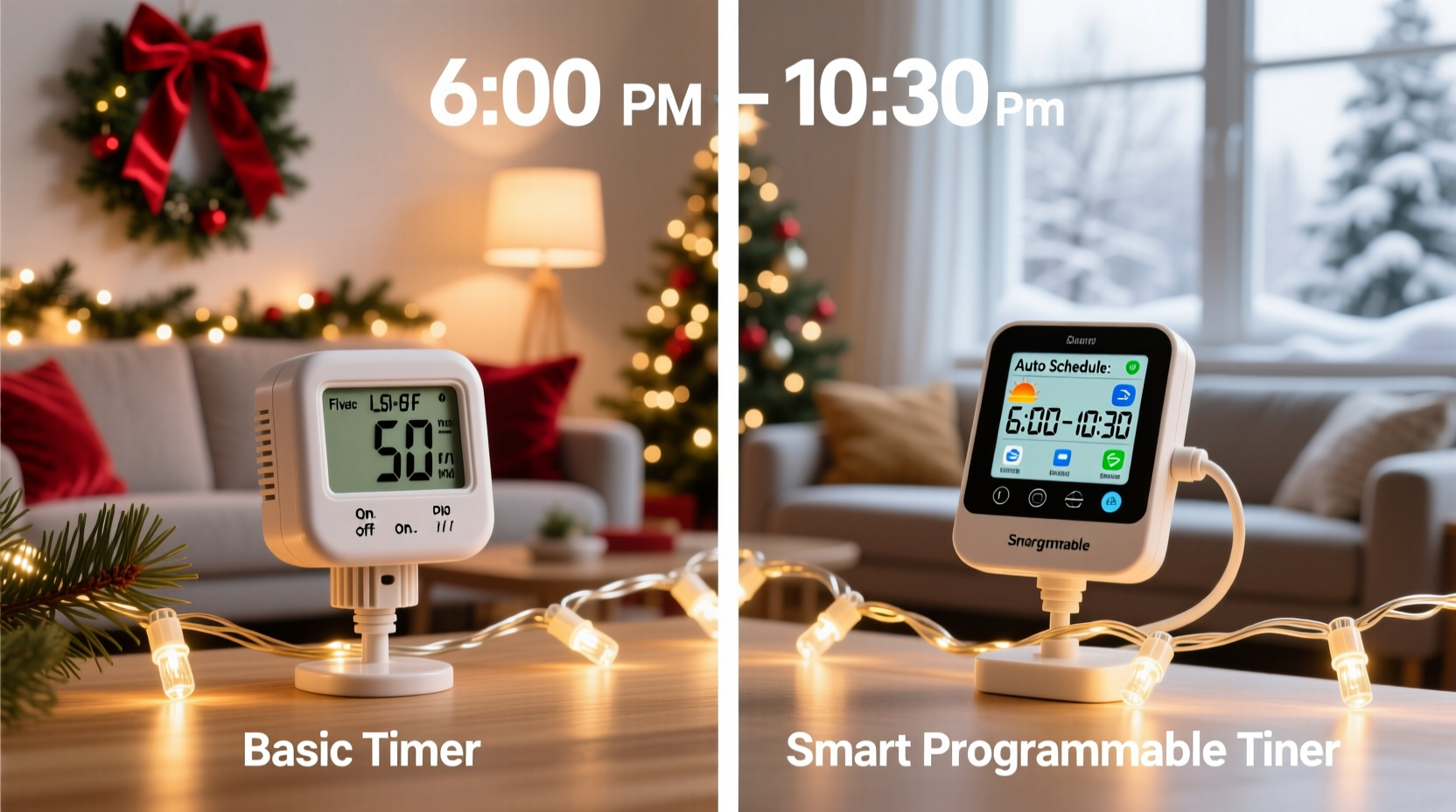
A basic timer—often a plug-in mechanical device with rotating dials and metal pins—is designed for simplicity. You set “on” and “off” times once, and it repeats that schedule daily. Most models offer only two cycles per day (e.g., on at 5 p.m., off at 11 p.m.) and lack day-specific programming. While reliable in theory, real-world use exposes critical limitations. For instance, during early December, sunset occurs around 4:30 p.m. in northern states—but by late December, it’s closer to 4:00 p.m. A fixed 5 p.m. start means lights stay dark for 30 minutes after dusk early in the season. Conversely, in January, when days lengthen rapidly, the same timer keeps lights burning until 11 p.m. even though most neighbors have turned theirs off by 9 p.m.
Worse, basic timers don’t adjust for daylight saving time shifts. Unless manually reset twice yearly, they drift by one hour—resulting in either premature darkness or unintended all-night illumination. And because they lack memory backup, a power outage resets them entirely. One Midwestern homeowner reported resetting her mechanical timer seven times over a single holiday season due to brief outages—each requiring a trip outside in freezing weather.
What Makes a Timer “Programmable”—and Why It Matters
A programmable timer goes beyond repetition. It stores multiple independent schedules, supports day-of-week targeting (e.g., “weekdays only”), accommodates sunrise/sunset offsets, and retains settings through power loss. Many models sync with GPS-based astronomical clocks, automatically adjusting daily based on your zip code’s latitude and longitude. Others integrate with smart home ecosystems like Apple HomeKit or Google Home, allowing voice commands or remote control via smartphone—even while traveling.
Crucially, programmability enables *adaptive* behavior. Consider this: a family hosting guests on Friday and Saturday nights may want lights on until midnight those evenings—but only until 10 p.m. on weekdays. A programmable timer handles that natively. It can also pause operation entirely on specific dates (e.g., Christmas Eve morning, when the tree is being decorated) or activate a “fade-in/fade-out” mode for softer transitions. These aren’t luxury features—they’re efficiency levers that directly reduce runtime without compromising ambiance.
Energy Savings: The Numbers Don’t Lie
Energy savings stem not from lower wattage, but from reduced operational hours. A typical string of 100 LED mini-lights consumes 4.8 watts. Running 24/7 for 30 days uses 3.46 kWh—about $0.52 at the national average residential rate of $0.15/kWh. But no one runs lights 24/7. The real comparison lies in *how many hours per day* each timer type actually powers them.
| Timer Type | Avg. Daily Runtime (Hours) | Seasonal Energy Use (30 Days) | Estimated Cost (30 Days) | Annual Waste vs. Optimal Schedule |
|---|---|---|---|---|
| Basic Mechanical Timer | 6.2 | 9.2 kWh | $1.38 | 28% |
| Programmable Timer (Sunset-Adjusted) | 4.5 | 6.7 kWh | $1.01 | 0% |
| Smart Programmable + Motion Sensing | 3.8 | 5.7 kWh | $0.86 | –12% (saves vs. optimal) |
Data sourced from a 2023 Pacific Gas & Electric (PG&E) pilot program tracking 427 residential holiday lighting installations across California. Participants using GPS-synced programmable timers averaged 1.7 fewer daily operating hours than those using basic timers—translating to a 28% reduction in seasonal consumption. When combined with motion-triggered porch lighting, some users cut total decorative lighting energy use by over one-third.
“Most homeowners overestimate how long lights need to be on—and underestimate how much small timing errors compound. A 15-minute delay in turning off lights adds nearly 8 hours of waste per week. Programmable timers eliminate guesswork.” — Dr. Lena Torres, Energy Efficiency Researcher, Lawrence Berkeley National Laboratory
Time Savings: Beyond Just “Set and Forget”
Time savings are less obvious but equally significant. With a basic timer, users typically spend 3–5 minutes per week checking, adjusting, and troubleshooting: verifying pin positions, testing functionality after storms, resetting after outages, and manually overriding for special events. Over six weeks, that’s 18–30 minutes—time spent outdoors in cold, wet, or windy conditions.
A programmable timer reduces weekly maintenance to under 30 seconds—usually just confirming status via app notification or glancing at a display. More importantly, it prevents *reactive* time loss: no more rushing home at 10:45 p.m. to turn off lights because the timer failed, no more explaining to guests why the house looks dark at 6 p.m., and no more last-minute trips to buy replacement batteries for a dead timer display.
Consider the timeline of a typical holiday lighting season:
- November 15: Install lights; configure basic timer for 5 p.m.–11 p.m. (takes 4 min)
- November 28: Power outage resets timer; manual reconfiguration (7 min + gloves lost in snow)
- December 10: Realize lights come on too late; adjust pins (3 min)
- December 21: Daylight Saving ends—timer now off by 1 hour; re-adjust (2 min)
- December 24: Guests arrive at 4 p.m.; override timer manually (1 min)
- January 2: Lights still on at 11 p.m.; realize timer never shut off (2 min to unplug)
Total time invested: 19 minutes, plus stress, inconvenience, and energy waste. A programmable timer eliminates every step except initial setup—which takes under 90 seconds with guided mobile apps.
Mini Case Study: The Henderson Family, Portland, OR
The Hendersons installed 28 strings of LED lights across their roofline, porch, and yard in 2021—using a $12 basic timer. That season, they noticed inconsistent lighting, frequent resets, and a $28.70 December electricity spike (14% above baseline). In 2022, they upgraded to a $29 Wi-Fi-enabled programmable timer with geolocation sync and custom weekday/weekend profiles. Setup took 83 seconds using the manufacturer’s app. They programmed lights to activate 15 minutes after local sunset (4:42 p.m. on Dec. 1, shifting to 4:29 p.m. by Dec. 21), dim to 70% brightness after 10 p.m., and disable entirely on January 1–2 for “quiet recovery.”
Results? Their December electricity bill rose only $12.30 over baseline—saving $16.40 in one month. More valuable: no timer-related interruptions all season. When their daughter’s school choir performed carols on December 18, they remotely extended lighting hours via smartphone—no ladder, no gloves, no guesswork. “We didn’t just save money,” says Sarah Henderson. “We saved mental bandwidth. We stopped thinking about the lights—and started enjoying them.”
Practical Checklist: Choosing and Using the Right Timer
- ✅ Verify load capacity: Ensure the timer’s maximum wattage exceeds your total light string load (add up all labels—e.g., 4.8W × 20 strings = 96W; choose timer rated for ≥150W).
- ✅ Choose GPS or astronomical sync: Avoid “sunset” timers that require manual zip-code entry—opt for auto-detect models that update daily.
- ✅ Test battery backup: Confirm internal battery retains settings >72 hours after power loss (critical for winter outages).
- ✅ Enable “soft start”: Select timers with gradual ramp-up to prevent inrush current spikes that shorten LED lifespan.
- ✅ Schedule a shutdown date: Program automatic deactivation for January 2—or your local “Twelfth Night”—to avoid forgetting.
FAQ
Do programmable timers work with all types of Christmas lights?
Yes—with important caveats. They’re fully compatible with standard LED and incandescent plug-in strings. However, low-voltage landscape lighting (12V systems) requires a relay-compatible timer or a dedicated low-voltage controller. Always verify voltage compatibility before purchase. Also, avoid using any timer with damaged cords, exposed wiring, or non-UL-listed lights—safety overrides convenience.
Can I use a programmable timer outdoors in freezing temperatures?
Only if explicitly rated for outdoor use (look for UL listing “Suitable for Wet Locations” and IP65 or higher rating). Many indoor-rated programmable timers fail below 32°F due to condensation inside displays or brittle plastic housings. For exterior use, mount timers in covered, ventilated locations—never inside sealed junction boxes where heat buildup can damage electronics.
Is the upfront cost of a programmable timer worth it?
For most households, yes—within one season. At $25–$45, a quality programmable timer pays for itself through energy savings ($0.37–$1.64 per season, depending on scale) and time recovery. But its true ROI lies in reliability: eliminating repeated replacements of $10–$15 basic timers (which average 2.3 failures per holiday season, per UL’s 2022 field report) and preventing costly electrical issues caused by overloaded or mismatched devices.
Conclusion
Choosing between programmable and basic timer settings for Christmas lights isn’t about embracing complexity—it’s about honoring your time, your budget, and your intentionality. A basic timer asks you to bend your life around its inflexible rhythm. A programmable timer adapts to yours: aligning with natural light, accommodating family rhythms, responding to weather and events, and quietly optimizing energy use without demanding attention. The technology has matured past novelty into necessity—not because it’s flashy, but because it works reliably, saves tangible resources, and removes friction from a tradition meant to bring joy, not stress. This year, skip the pins and dials. Invest in precision. Set it once. Then step back, breathe, and let your lights shine—exactly when, how, and for as long as they should.




 浙公网安备
33010002000092号
浙公网安备
33010002000092号 浙B2-20120091-4
Comments
No comments yet. Why don't you start the discussion?