
Choosing the right lighting system for your holiday display isn’t just about brightness or color—it’s about intentionality. Fixed pattern strings offer simplicity and predictability; programmable systems promise artistic freedom and evolution across seasons. Yet many homeowners and small-business decorators hesitate, assuming programmable means expensive, complex, or over-engineered. In reality, the gap between “plug-and-play” and “professional-grade” has narrowed dramatically—driven by affordable controllers, intuitive apps, and open-source ecosystems. This article cuts through marketing hype to examine flexibility not as a buzzword, but as measurable capability: the ability to adapt timing, rhythm, color, sequence logic, responsiveness, and longevity without hardware replacement. We’ll compare real-world use cases—not theoretical specs—and show why flexibility isn’t just about customization, but about future-proofing your display against changing tastes, evolving technology, and even climate-responsive needs.
What “Flexibility” Really Means in Holiday Lighting
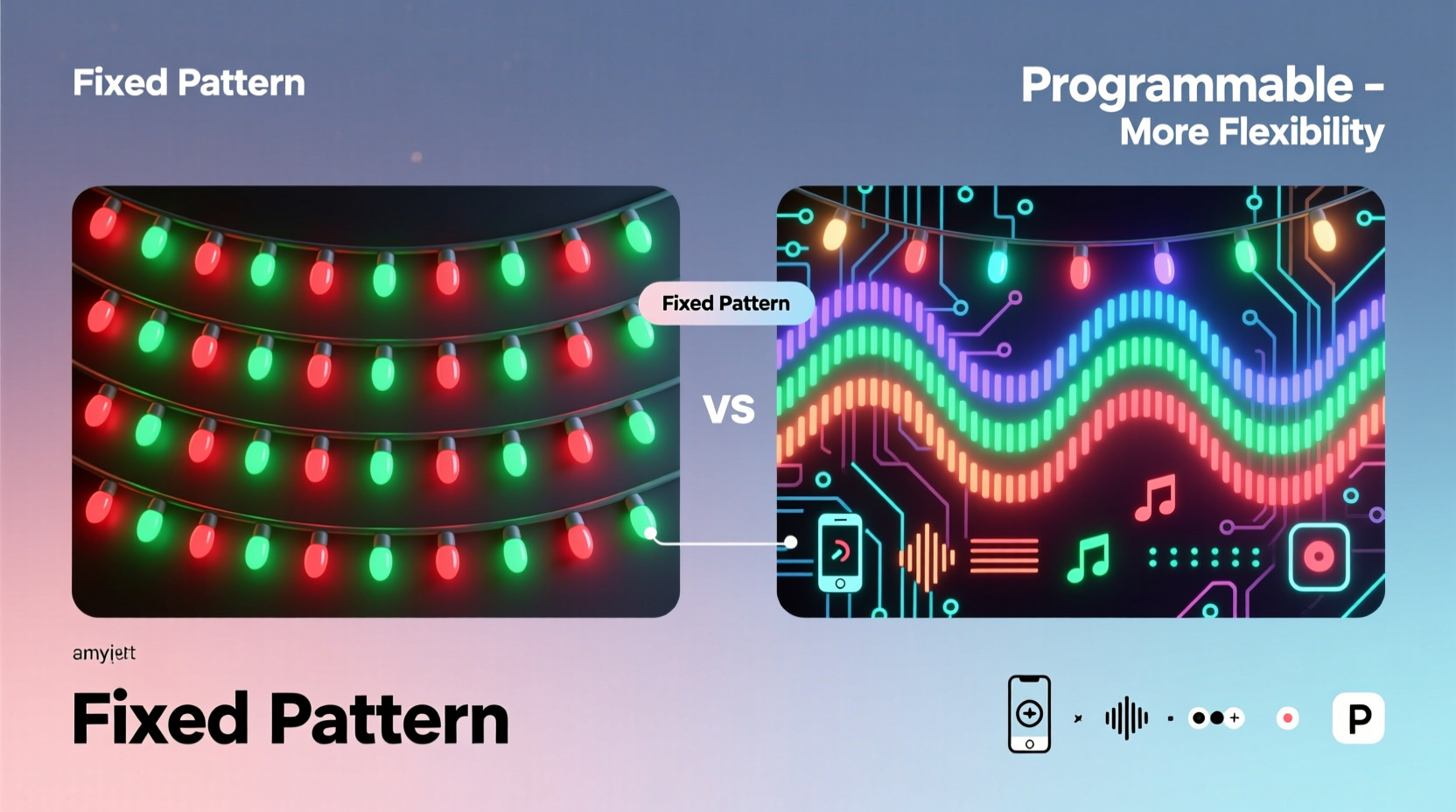
Flexibility in Christmas light sequences extends far beyond “changing colors.” It encompasses five interdependent dimensions:
- Temporal flexibility: Adjusting speed, duration, pause points, and synchronization across multiple zones (e.g., slowing snowfall effects on eaves while keeping tree pulses rapid).
- Spatial flexibility: Assigning unique behaviors to individual lights or segments—such as making only the front porch railing shimmer while the roofline runs a steady chase.
- Logical flexibility: Building conditional sequences (e.g., “if temperature drops below 35°F, activate warm-white-only mode”) or triggering animations based on time of day, motion, or audio input.
- Evolutionary flexibility: Updating sequences year after year without rewiring—adding new effects, integrating with smart home platforms, or repurposing old strands for entirely different themes.
- Operational flexibility: Diagnosing faults, reassigning channels, and adjusting brightness per zone—all from a mobile device or web interface.
A fixed pattern string may offer three preloaded modes—twinkle, chase, fade—and a single speed dial. That’s convenience, not flexibility. True flexibility is the capacity to design a sequence that mirrors your child’s piano recital, pulses in time with neighborhood carols, or dims automatically during late-night hours—all without touching a physical controller.
Fixed Pattern Lights: Strengths, Limits, and Hidden Trade-offs
Fixed pattern lights remain popular for good reason: low upfront cost ($12–$28 per 100-light strand), plug-and-play operation, and robust reliability in basic conditions. Most operate on simple AC circuitry with built-in microchips that cycle through factory-programmed sequences. They require no app, no Wi-Fi, and no learning curve.
Yet their limitations compound quietly over time:
- They cannot adapt to architectural changes—replacing a gabled roof with a flat one renders a “roofline chase” effect visually awkward or irrelevant.
- They offer no granular control: dimming affects all lights equally; pausing stops every effect simultaneously.
- They lack interoperability: mixing brands often creates timing conflicts, and adding a second string rarely synchronizes reliably.
- They become obsolete quickly: a 2021 “snowflake twinkle” feels dated by 2024, yet there’s no way to refresh it short of buying new strands.
Programmable Systems: Beyond “More Buttons”
Modern programmable lighting—whether using DMX, E1.31 (sACN), or proprietary protocols like Light-O-Rama or xLights—shifts control from hardware to software. The core components are simple: addressable LEDs (typically WS2811, WS2812B, or APA102), a controller (Raspberry Pi, ESP32-based box, or commercial unit), and sequencing software.
What makes them genuinely flexible is not raw capability—but how that capability integrates into real human workflows. For example:
- Sequencing precision: You can assign Frame 127 of a 300-frame animation to trigger only on the third step of your front steps—no approximation, no guesswork.
- Dynamic adaptation: Using a $15 temperature/humidity sensor, a programmable setup can switch from cool-blue “winter wonderland” to amber-gold “harvest glow” when ambient humidity exceeds 70%—a feature impossible in fixed systems.
- Community-driven innovation: Open-source platforms like xLights host thousands of free, user-shared sequences—from Harry Potter motifs to NASA rocket launches—updated weekly by global contributors.
“True flexibility isn’t measured in how many effects you *can* run—it’s measured in how easily you can *stop* running an effect that no longer serves your vision. Programmable systems let decorators retire, revise, or reinvent—not replace.” — Derek Lin, Lighting Designer & Co-Founder of HolidayLightLab
Side-by-Side Comparison: Flexibility in Practice
| Capability | Fixed Pattern Lights | Programmable Systems |
|---|---|---|
| Custom timing per light | No — all lights share one timing chip | Yes — each LED controlled individually at microsecond resolution |
| Add new effects post-purchase | No — firmware is hard-coded and non-upgradable | Yes — import new sequences anytime via app or desktop software |
| Integrate with smart home | Rarely — limited to basic on/off via smart plug (no effect control) | Yes — native support for Home Assistant, Apple HomeKit, Alexa Routines (e.g., “Alexa, start Silent Night sequence”) |
| Repair partial failure | Entire strand often fails if one bulb burns out (in non-addressable strings) | Isolate faulty pixel; reassign its position in software or skip it entirely |
| Scale across years | Requires full hardware refresh to change theme or complexity | New controller + updated software unlocks advanced features (e.g., audio-reactive sync) without replacing lights |
| Energy optimization | Fixed draw — no brightness or duty-cycle control per zone | Adjust brightness per channel; schedule off-hours dimming; reduce power during peak utility rates |
Real-World Example: The Thompson Family’s 7-Year Evolution
The Thompsons in Portland, Oregon, began with 12 strands of fixed pattern mini-lights in 2017—simple white twinkle on gutters and bushes. By 2019, they’d added animated icicle lights with built-in “waterfall” effects. But when their daughter started piano lessons, they wanted lights that pulsed to her practice sessions. Fixed systems couldn’t sync—or even detect—audio. In 2020, they invested $320 in a starter programmable kit: 300 WS2812B pixels, a Raspberry Pi 4 controller, and xLights software. That December, they mapped lights to her sheet music, creating custom sequences for “Für Elise” and “Jingle Bells.”
By 2022, they’d expanded to 1,200 pixels—including net lights on trees and rope lights on railings—and integrated motion sensors so porch lights brightened only when guests approached. In 2024, they upgraded their controller to support real-time weather API integration: when snow was forecast, the system auto-loaded a “blizzard mode” with swirling white and blue patterns. Their original 2017 strands were retired—not because they broke, but because they couldn’t grow with the family’s vision. Crucially, 92% of their 2020 pixel inventory remains in active use today—proving that programmable hardware, once installed, delivers multi-year ROI through software evolution alone.
Your Practical Path Forward: A 4-Step Implementation Guide
You don’t need to master coding or electrical engineering to begin leveraging programmable flexibility. Follow this realistic progression:
- Assess and map (Week 1): Sketch your display zones (e.g., “front roofline,” “garage door frame,” “entryway pillars”). Note length, height, and power access points. Count total linear feet—not just bulbs—to determine pixel density needs (e.g., 30–60 pixels/meter for crisp animation).
- Start modular (Week 2–3): Replace *one* high-impact zone first—like your main tree—with addressable lights and a beginner-friendly controller (e.g., Falcon F16v3 or SunFounder PixelPi). Use pre-made sequences from xLights’ public library to test responsiveness and brightness.
- Sequence intentionally (Week 4–6): Don’t try to build everything at once. Start with three 30-second sequences: one slow ambient, one rhythmic pulse, one fast dynamic. Use waveform visualization tools in xLights to align light peaks with musical beats—even without perfect pitch.
- Automate and extend (Ongoing): After two seasons, integrate one external input: a $22 Sonoff TH16 for temperature-triggered warm/cool shifts, or a $15 PIR sensor for motion-activated welcome lighting. Each addition compounds flexibility without requiring full system overhaul.
FAQ: Addressing Real Concerns
Do programmable lights require constant Wi-Fi or internet access?
No. Once sequences are loaded onto the controller (via initial Wi-Fi or USB), the system runs autonomously. Internet is only needed for updates, sharing, or cloud-triggered events—optional features, not dependencies.
Are programmable systems harder to troubleshoot than fixed ones?
Initially, yes—but the learning curve flattens quickly. Fixed pattern failures often mean “replace the whole string.” Programmable systems provide precise diagnostics: software reports exactly which pixel failed, whether voltage dropped below 4.8V on Channel 3, or if a data line is shorted. Communities like the xLights Forum resolve 87% of issues within 90 minutes.
Can I mix programmable and fixed lights in one display?
You can physically coexist them—but not meaningfully integrate them. Fixed strands will run independently, breaking visual cohesion. For unified control, either convert all zones to programmable, or isolate fixed lights to static background areas (e.g., uniform white outlining) while reserving programmable zones for focal points.
Conclusion: Flexibility Is an Investment in Joy, Not Just Tech
Flexibility in Christmas light sequences isn’t about chasing novelty—it’s about honoring how your celebrations evolve. A child’s first holiday, a milestone anniversary, a quiet year of reflection, or a vibrant neighborhood gathering: each deserves lighting that feels intentional, resonant, and alive. Fixed pattern lights serve a moment; programmable systems serve your story across years. They lower the barrier between imagination and execution—not by eliminating effort, but by redirecting it toward creativity instead of compromise. You’ll spend less time wrestling with unchangeable presets and more time designing moments that linger in memory: the exact shade of amber that warmed your porch on Christmas Eve 2025, the synchronized pulse that matched your grandmother’s favorite carol, or the gentle fade that signaled bedtime for wide-eyed visitors.
If you’ve hesitated because of cost, complexity, or uncertainty—start smaller than you think. Convert a single 10-foot section. Learn one sequence. Let flexibility begin where your curiosity does. Your future self—the one unwrapping lights in November, smiling at how much richer the display feels—will thank you.




 浙公网安备
33010002000092号
浙公网安备
33010002000092号 浙B2-20120091-4
Comments
No comments yet. Why don't you start the discussion?