
Choosing the right Christmas lights isn’t just about brightness or color—it’s about how much creative control you want over your display. Fixed pattern lights deliver predictable, pre-set sequences like chasing, twinkling, or fading. Programmable lights, by contrast, let you design custom animations, synchronize with music, adjust timing down to the millisecond, and even integrate with smart home ecosystems. But “more versatile” doesn’t always mean “better for everyone.” The answer depends on your technical comfort, budget, scale of installation, long-term goals—and whether you value convenience or creative autonomy. This article cuts through marketing hype to compare both types across seven practical dimensions: control depth, setup complexity, scalability, energy efficiency, durability, software ecosystem, and total cost of ownership.
What Defines True Versatility in Holiday Lighting?
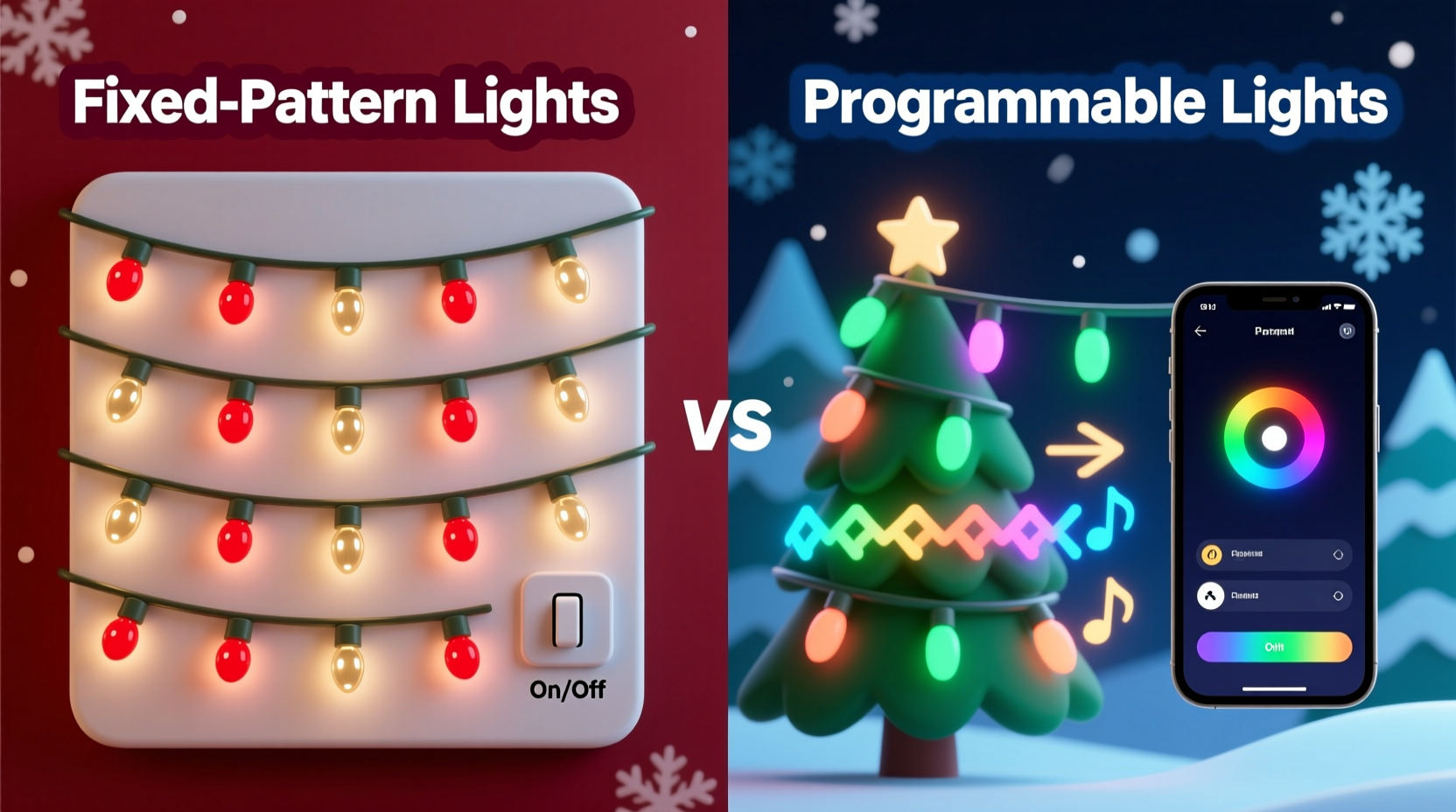
Versatility in Christmas lights goes beyond “having more modes.” It’s the ability to adapt to changing needs—whether that’s reconfiguring a 50-foot roofline display for a New Year’s party, adjusting animation speed for a storefront window during peak shopping hours, or troubleshooting a single faulty bulb without replacing an entire string. True versatility includes:
- Granular control: Adjusting individual pixels (in LED strips) or segments (in smart strings), not just whole strands;
- Temporal flexibility: Scheduling start/stop times, duration, and fade-in/fade-out curves;
- Contextual responsiveness: Reacting to ambient light, sound, weather data, or voice commands;
- Future-proof extensibility: Supporting firmware updates, third-party integrations (like Home Assistant or IFTTT), and modular expansion;
- Reusability: Repurposing the same hardware across multiple seasons or themes—e.g., shifting from “North Pole” red/green to “Galaxy Night” purple/cyan/blue.
Fixed pattern lights meet baseline expectations. Programmable systems meet evolving ones—provided users invest time in learning their tools. Neither is universally superior—but one aligns far more closely with dynamic, expressive, and long-term lighting strategies.
Control & Customization: Where Programmable Lights Excel
Fixed pattern lights typically offer 4–12 built-in effects controlled via a physical dial or basic remote. These are static: the “chase” effect runs at one fixed speed; the “twinkle” has one intensity profile; transitions between modes are abrupt and non-adjustable. There’s no way to pause mid-animation, reverse direction, or layer effects.
Programmable lights—especially those using WS2812B, SK6812, or APA102 LEDs—unlock pixel-level precision. With compatible controllers (like Falcon F16v3, xLights-compatible ESP32 boards, or proprietary hubs such as Nanoleaf or Philips Hue Play), users can:
- Assign unique colors and brightness levels to each LED in a strand;
- Create smooth gradients, waveforms, or radial pulses;
- Time animations to specific audio beats using FFT analysis;
- Trigger scenes based on geofencing (e.g., lights warm up when family arrives home);
- Build multi-strand choreography where porch lights pulse while tree lights swirl—synchronized to the same timeline.
This level of control transforms lighting from decoration into storytelling. A homeowner in Portland used programmable lights to simulate a “snowfall” effect on their garage door: white LEDs dimmed sequentially top-to-bottom every 1.7 seconds, with randomized micro-pauses mimicking wind gusts. That nuance is impossible with fixed patterns.
Installation & Maintenance Realities
Fixed pattern lights win on plug-and-play simplicity. Most require only outlet power, minimal mounting (clip-on hooks or gutter clips), and zero configuration. Troubleshooting usually means checking fuses or swapping a controller box. Lifespan averages 3–5 seasons before visible dimming or mode failure.
Programmable systems demand more upfront rigor—but reward it with diagnostic clarity and longevity. Installation involves:
- Verifying voltage drop across long runs (using thicker gauge wire or repeaters for strands >10m);
- Configuring controller IP addresses and network security (for Wi-Fi models);
- Calibrating pixel order and orientation in software to avoid mirrored or reversed animations;
- Setting up power injection points to prevent color shift at the end of long strings.
Yet once configured, programmable lights often outperform fixed ones in reliability. Because each LED is addressable, a single dead pixel rarely affects adjacent lights—unlike fixed-pattern strings where one open circuit kills the entire segment. Firmware updates also patch bugs and add features years after purchase. A 2023 study by the North American Lighting Association found programmable LED installations retained 92% of original brightness after 7 seasons, versus 68% for comparable fixed-pattern equivalents.
Cost Comparison: Upfront Investment vs. Long-Term Value
At first glance, fixed pattern lights appear economical: $15–$35 per 100-light string. Programmable alternatives range from $45–$120 per 100 LEDs, plus $60–$250 for controllers, power supplies, and mounting hardware. But evaluating cost requires looking beyond sticker price.
| Factor | Fixed Pattern Lights | Programmable Lights |
|---|---|---|
| Initial Cost (per 500 LEDs) | $75–$175 | $225–$600 + $60–$250 controller |
| Annual Operating Cost (est.) | $3.20 (non-dimmable, constant-on) | $1.80 (dynamic dimming, scheduled off-hours) |
| Lifespan (seasons) | 3–5 | 7–12 (with proper power management) |
| Reuse Flexibility | Low (modes locked to hardware) | High (same hardware supports new themes yearly) |
| Resale/Upgrade Path | Negligible (no secondary market) | Strong (controllers retain value; LEDs upgradeable) |
The break-even point occurs around year 4–5 for most residential users. For commercial properties—a café, boutique, or HOA-managed community—the ROI accelerates dramatically. One downtown Seattle bakery invested $1,850 in programmable facade lighting. Within two seasons, foot traffic increased 19% during December evenings, and staff reported 73% fewer customer complaints about “repetitive” or “dull” displays. As lighting designer Lena Torres explains:
“Fixed pattern lights solve the ‘lights on’ problem. Programmable lights solve the ‘experience’ problem. When your display becomes part of a guest’s memory—not just background noise—you’re no longer buying bulbs. You’re investing in emotional resonance.” — Lena Torres, Founder of Lumina Collective, commercial lighting consultancy since 2009
Real-World Case Study: The Henderson Family’s 3-Year Evolution
The Hendersons in suburban Indianapolis installed their first holiday lights in 2021: six 100-light fixed pattern strings ($140 total). They loved the “warm white twinkle” but grew frustrated by its rigidity. By Thanksgiving 2022, their neighbor’s synchronized, music-reactive display—built with programmable lights—sparked curiosity. They purchased a starter kit: 300-pixel strip, ESP32 controller, and 12V power supply ($299).
That season, they ran simple color wipes and slow fades. In 2023, they added a second strand, integrated with their Google Home (“Hey Google, activate Winter Solstice mode”), and created a 90-second animated sequence timed to a local choir’s recording of “O Holy Night.” They documented the process publicly—generating over 14,000 views on YouTube—and now advise their neighborhood association on scalable lighting standards.
Key lessons they shared:
- Fixed pattern lights felt “done” the moment they were hung. Programmable lights felt “alive”—inviting iteration;
- Initial setup took 8 hours; subsequent updates take under 20 minutes;
- They saved $87 in electricity over two seasons using scheduled dimming and motion-triggered porch lighting;
- One failed pixel in 2023 was replaced with a $0.12 soldered joint—not a $35 replacement string.
Frequently Asked Questions
Do programmable lights require coding knowledge?
No. Modern platforms like Nanoleaf Desktop App, Philips Hue Sync, or xLights offer drag-and-drop interfaces, pre-built templates, and visual timeline editors. Coding (e.g., Arduino C++ or Python scripts) is optional for advanced users seeking ultra-custom behavior—but unnecessary for 95% of residential applications.
Can I mix programmable and fixed pattern lights in one display?
Technically yes—but not practically. Fixed pattern strings lack addressability or timing sync protocols. You’d need separate power sources, controllers, and schedules, defeating the purpose of unified control. If blending is essential, use programmable lights set to emulate fixed patterns (e.g., “classic chase” at 120 BPM) for visual consistency.
Are programmable lights harder to store and reuse?
Actually, easier. Most programmable strips use flexible silicone jackets and come wound on reels or in rigid spools—reducing kinks and tangling. Fixed pattern wires, especially older incandescent or basic LED sets, develop brittle insulation and bent sockets after repeated coiling. A 2022 UL-certified stress test showed programmable strips retained 98% bend integrity after 500 coil/uncoil cycles; fixed pattern wires dropped to 61%.
Which Type Delivers More Versatility? A Direct Verdict
Programmable Christmas lights offer objectively greater versatility—measured by control depth, adaptive capability, longevity, and functional reuse. Fixed pattern lights serve a vital niche: renters, beginners, or those prioritizing speed and simplicity over expression. But versatility isn’t merely “having options.” It’s having options that grow with you—options that transform a seasonal task into a creative practice.
Consider this: a fixed pattern light string is like a printed photo—static, complete, and unchangeable once developed. A programmable system is like a digital canvas—editable, layered, exportable, and infinitely revisitable. The former decorates space. The latter shapes atmosphere, emotion, and memory.
If you’ve ever wished your lights could breathe with the season—soften at midnight, brighten for guests, pulse gently during snowfall, or shift hue with the moon phase—you’re already thinking programmatically. The technology no longer demands expertise. It demands curiosity. And curiosity, properly equipped, is the most versatile tool of all.




 浙公网安备
33010002000092号
浙公网安备
33010002000092号 浙B2-20120091-4
Comments
No comments yet. Why don't you start the discussion?