
Whimsy isn’t just a mood—it’s a design language. In holiday lighting, architectural accents, retail window displays, and even residential gardens, the goal is often to evoke delight, surprise, or gentle wonder. And while brightness, color temperature, and energy efficiency matter, it’s the *behavior* of light that delivers true whimsy: a slow pulse like fireflies at dusk, a cascade of stars tumbling down a porch railing, or a rhythmic shimmer mimicking rain on water. That behavior hinges on one fundamental choice—programmable or fixed pattern lights. Neither is inherently “better,” but their capacity to spark joy differs dramatically. This article cuts through marketing hype to examine how each type contributes to whimsy—not as a theoretical concept, but as a tangible, experiential quality shaped by control, timing, context, and human perception.
What “Whimsy” Really Means in Lighting Design
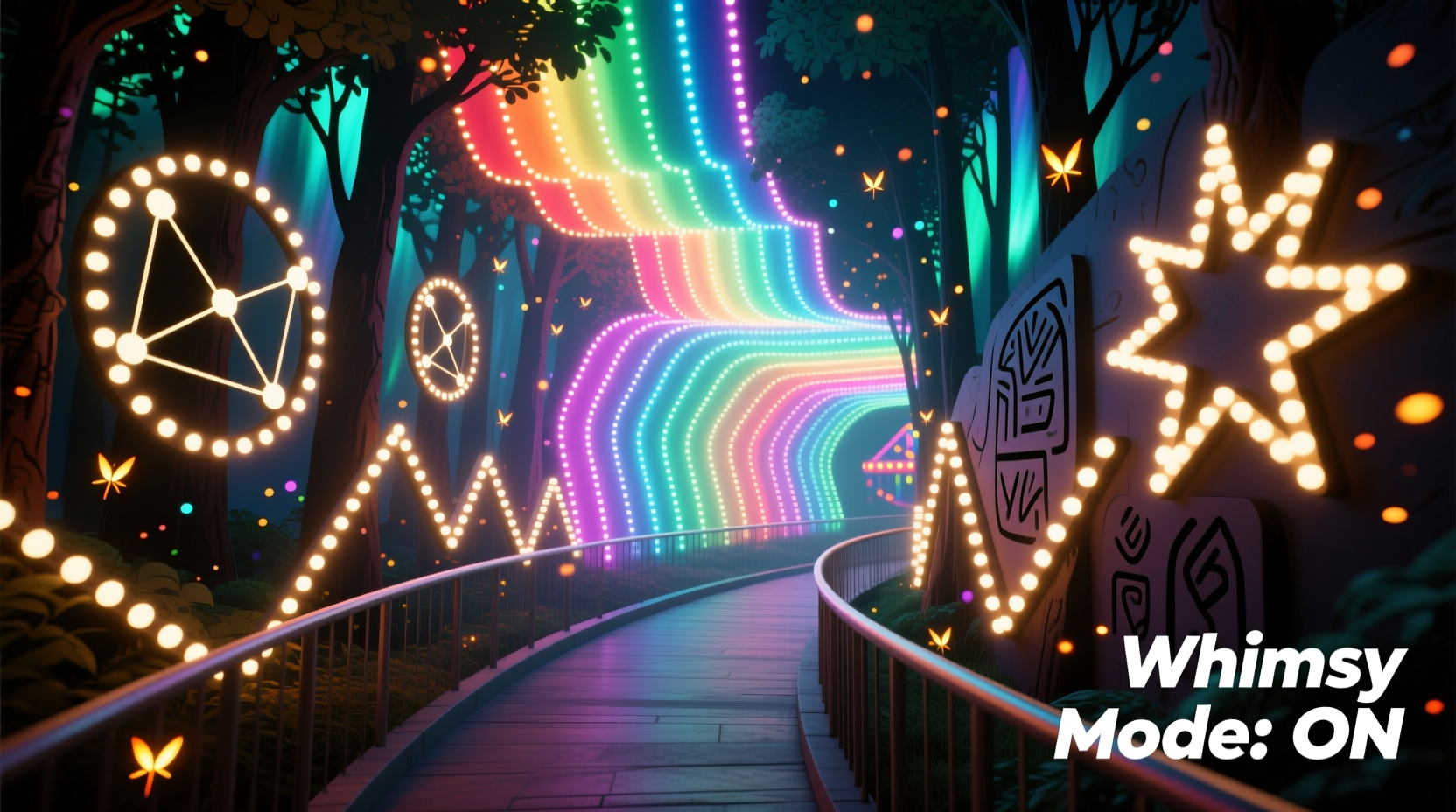
Before comparing technologies, it’s essential to define what makes light feel whimsical. Whimsy emerges from subtle unpredictability, gentle rhythm, narrative suggestion, and emotional resonance—not randomness or chaos. A flickering candle feels whimsical; a strobing LED strip does not. A light sequence that mimics dandelion seeds drifting upward feels whimsical; a rigid, metronomic chase does not—unless deliberately softened with easing, variation, and pause. Interior designer and lighting consultant Lena Torres explains this distinction clearly:
“Whimsy lives in the micro-gestures: the 0.3-second delay between two adjacent bulbs lighting, the slight asymmetry in a ‘twinkling’ effect, the way a pattern breathes rather than pulses. Fixed patterns can achieve this—but only if they’re thoughtfully designed. Programmable systems give you the tools to build it, but they don’t guarantee it. The magic is in the intention behind the motion.” — Lena Torres, Principal, Lumina Studio, specializing in experiential lighting for hospitality and public art
In practice, whimsy thrives on three pillars: variation (no two moments identical), tempo (slower than instinctive reaction, often 0.5–3 seconds per cycle), and organic reference (light that echoes natural phenomena—breezes, growth, reflection, or flight). Both fixed and programmable lights engage these pillars differently—and that difference shapes their expressive range.
Fixed Pattern Lights: Simplicity with Intentional Charm
Fixed pattern lights embed behavior directly into the hardware. Think of classic incandescent mini-lights wired for “chase,” “twinkle,” or “slow fade”—or modern LED strings with built-in IC chips that run a single, non-editable sequence. Their strength lies in consistency, reliability, and ease of use. No app, no sync issues, no firmware updates. Plug in, and the whimsy begins immediately.
But not all fixed patterns are created equal. Low-end versions often rely on monotonous, high-frequency twinkle (3–5 times per second) that reads as frantic—not fanciful. High-quality fixed-pattern lights, however, are engineered for nuance: soft ramp-up/down curves, randomized start points across strands, and multi-layered effects (e.g., a base glow with intermittent “starburst” highlights). These are curated by lighting designers and tested for emotional impact—not just technical function.
A well-chosen fixed pattern can deliver profound whimsy precisely because it *doesn’t require input*. It removes decision fatigue and invites passive enjoyment—the kind you experience watching fireflies from a porch swing. Its limitation isn’t charm; it’s adaptability. You cannot slow the chase for a meditative garden path, nor accelerate it for a lively party backdrop. You get one story—and it must fit your setting perfectly.
Programmable Lights: Precision, Possibility, and the Peril of Over-Engineering
Programmable lights—typically addressable LEDs like WS2812B (NeoPixel), SK6812, or proprietary smart systems (Philips Hue Play, Nanoleaf Shapes)—allow granular control over every pixel: color, brightness, timing, and sequencing. With software (Light-O-Rama, xLights, or mobile apps), users build custom animations, sync to music, or trigger effects via sensors.
This capability unlocks unprecedented whimsy potential. Imagine lights that mimic falling cherry blossoms—each “petal” a single LED descending at a unique speed and fade rate. Or a string of lights along a staircase that “grows” upward like climbing ivy, with subtle green-to-gold transitions. Or ambient wall lighting that shifts hue and intensity to mirror the sky outside—softening at twilight, deepening at midnight. These aren’t gimmicks; they’re emotionally intelligent lighting narratives.
Yet, programmability introduces friction. Setting up a smooth, non-distracting animation requires understanding timing curves, easing functions, and color theory. A poorly programmed “twinkle” can feel jarring—a series of sharp, disconnected blinks instead of a gentle, overlapping shimmer. As lighting engineer Rajiv Mehta notes:
“The most whimsical programmable installations I’ve seen share one trait: restraint. They use 3% of the system’s capability to achieve 90% of the emotional impact. Over-programming—adding too many layers, too much speed, too many colors—kills whimsy. It becomes visual noise.” — Rajiv Mehta, Lead Engineer, Aurora Labs, developer of open-source lighting protocols
So while programmable lights offer infinite possibility, their whimsy quotient depends entirely on the creator’s discipline—not just their technical skill.
Comparing Whimsy Potential: A Practical Decision Matrix
Choosing between fixed and programmable isn’t about “which is better,” but “which serves your specific context best.” The table below compares key dimensions—not just technical specs, but experiential outcomes relevant to whimsy:
| Factor | Fixed Pattern Lights | Programmable Lights |
|---|---|---|
| Whimsy Consistency | High—once selected, delivers the same emotional tone reliably, day after day | Variable—depends entirely on programming quality and maintenance; can degrade if settings are lost or overwritten |
| Installation Effort | Low—plug-and-play; ideal for renters, temporary displays, or quick seasonal setups | Moderate to high—requires controller setup, power management, software configuration, and often network integration |
| Context Adaptability | Low—designed for one environment; moving it to a new space may break the illusion (e.g., a “water ripple” effect on a straight fence) | High—you can reprogram for scale, orientation, or mood (e.g., slow & dreamy for a nursery, playful & bouncy for a kids’ room) |
| Long-Term Whimsy Evolution | Static—the effect remains unchanged year after year unless replaced | Evolving—you can refresh the display annually with new animations, keeping the experience novel and personally resonant |
| Risk of Whimsy Failure | Low—failure mode is usually “off” or “solid on”; rarely “distracting” | Medium—glitches, sync errors, or poorly tuned effects can create visual stress instead of delight |
Real-World Example: The Porch Light Transformation
Consider Maya Chen, a graphic designer in Portland who wanted to transform her modest front porch into a “whimsical welcome” for neighbors and passersby—without overwhelming her small space or requiring daily attention.
Her first attempt used inexpensive programmable strip lights. She downloaded a popular “firefly” animation online. It blinked rapidly, with harsh on/off transitions and identical timing across all LEDs. Neighbors described it as “nervous” and “like a faulty security light.” Discouraged, Maya switched to a premium fixed-pattern string labeled “Gentle Firefly Glow.” It featured staggered, low-intensity pulses with organic decay—each bulb fading out over 1.2 seconds, with random delays between activations. She draped it along her railing and added a simple timer.
The result? A soft, breathing presence—warm amber dots appearing and dissolving like actual insects at dusk. Passersby paused. Children pointed. Local news featured her porch in a “Small Joys” segment. Crucially, Maya didn’t need to adjust it once. The whimsy was baked in—not built.
Later, she added a programmable accent: a single, narrow strip under her eaves, programmed to very slowly shift from pale gold to soft lavender over 90 minutes at sunset—mirroring the sky. This wasn’t competing with the fixed lights; it was complementing them. The fixed pattern provided the soulful, consistent heartbeat; the programmable element added quiet, evolving texture. Together, they achieved layered whimsy neither could alone.
Your Whimsy Action Plan: A 5-Step Guide
Whether you’re decorating a balcony, a shopfront, or a child’s bedroom, follow this sequence to maximize authentic whimsy—regardless of your light choice:
- Observe your space’s natural rhythm. Spend 10 minutes at dusk noting ambient light, movement (wind, foot traffic), and existing textures. Whimsy enhances—not overrides—this context.
- Define the feeling, not the effect. Instead of “I want twinkling,” ask: “Do I want calm? Curiosity? Nostalgia? Playfulness?” Then match technology to intent.
- Start fixed, then layer programmable. Use fixed-pattern lights for your primary whimsy anchor (e.g., railing, doorway frame). Reserve programmable elements for subtle, secondary accents (e.g., under-shelf glow, ceiling starfield).
- Test timing at human scale. Set animations to run at half-speed during testing. If it still feels rushed, slow it further. True whimsy breathes—never gasps.
- Commit to one palette. Whimsy thrives in harmony. Choose 2–3 closely related hues (e.g., warm white + amber + soft peach) or a single hue with varying saturation. Avoid rainbow sequences unless narratively justified (e.g., a candy-themed party).
FAQ: Addressing Common Whimsy Dilemmas
Can fixed pattern lights ever feel “custom” or personal?
Yes—through curation and composition. Combining multiple fixed-pattern strings (e.g., a “gentle fade” strand with a “slow pulse” strand) creates emergent complexity. Layering them at different depths (near/far, high/low) or using diffusers (fabric sleeves, frosted glass) adds organic softness. Personalization comes from *how* you arrange and combine them—not how you program them.
Is it worth learning programming just for whimsy?
Only if you value evolution over ease. If you love experimenting, enjoy tinkering, or plan multi-year displays, yes—tools like xLights have intuitive drag-and-drop interfaces for basic effects. But if your priority is reliability, simplicity, and immediate joy, invest in premium fixed-pattern lights instead. Time saved is whimsy preserved.
Do programmable lights consume more energy when creating whimsical effects?
Not significantly—if programmed wisely. A gentle fade uses less power than full-brightness static white. However, rapid color cycling or maximum brightness across all pixels *does* increase draw. For whimsy, prioritize lower brightness (60–70% max) and longer transitions—both save energy and enhance emotional impact.
Conclusion: Whimsy Is a Choice, Not a Feature
Programmable lights promise infinite creativity. Fixed pattern lights promise effortless grace. But whimsy—the tender, joyful spark that makes people smile without knowing why—isn’t embedded in either technology. It resides in the intention behind the choice, the patience in the timing, and the humility to let light breathe. A $12 fixed-pattern string, placed with care and observed at the right moment, can evoke more wonder than a $300 programmable system running a chaotic, over-designed animation. The most whimsical displays don’t shout—they whisper, linger, and invite return visits. They remember that light, at its most magical, doesn’t command attention. It earns it, softly.
Your next step isn’t to buy new lights—it’s to watch how light already moves in your space. Notice where shadows pool, where reflections catch, where time seems to slow. Then choose the tool—not the flashiest, not the most complex—but the one that helps you echo that quiet, human rhythm. Start small. Try one strand. Observe the response—not just from others, but from yourself. Does it make you pause? Smile? Feel lighter? If yes, you’ve found your whimsy. Share what worked for you in the comments below—we’re building a library of real, human-tested light magic, one gentle pulse at a time.




 浙公网安备
33010002000092号
浙公网安备
33010002000092号 浙B2-20120091-4
Comments
No comments yet. Why don't you start the discussion?