
Choosing the right lighting system for your holiday display isn’t just about brightness or color—it’s about how much expressive control you want over your home’s festive identity. Fixed-sequence lights offer simplicity and reliability, while programmable systems unlock dynamic storytelling through light: synchronized music, custom animations, seasonal transitions, and responsive effects. Yet many homeowners hesitate—not because they lack vision, but because they’re uncertain where to invest time, money, and effort for meaningful returns. This isn’t a binary choice between “basic” and “fancy.” It’s a strategic decision rooted in your goals, technical comfort, long-term plans, and how deeply you value creative autonomy.
What Defines Fixed-Sequence Lights?
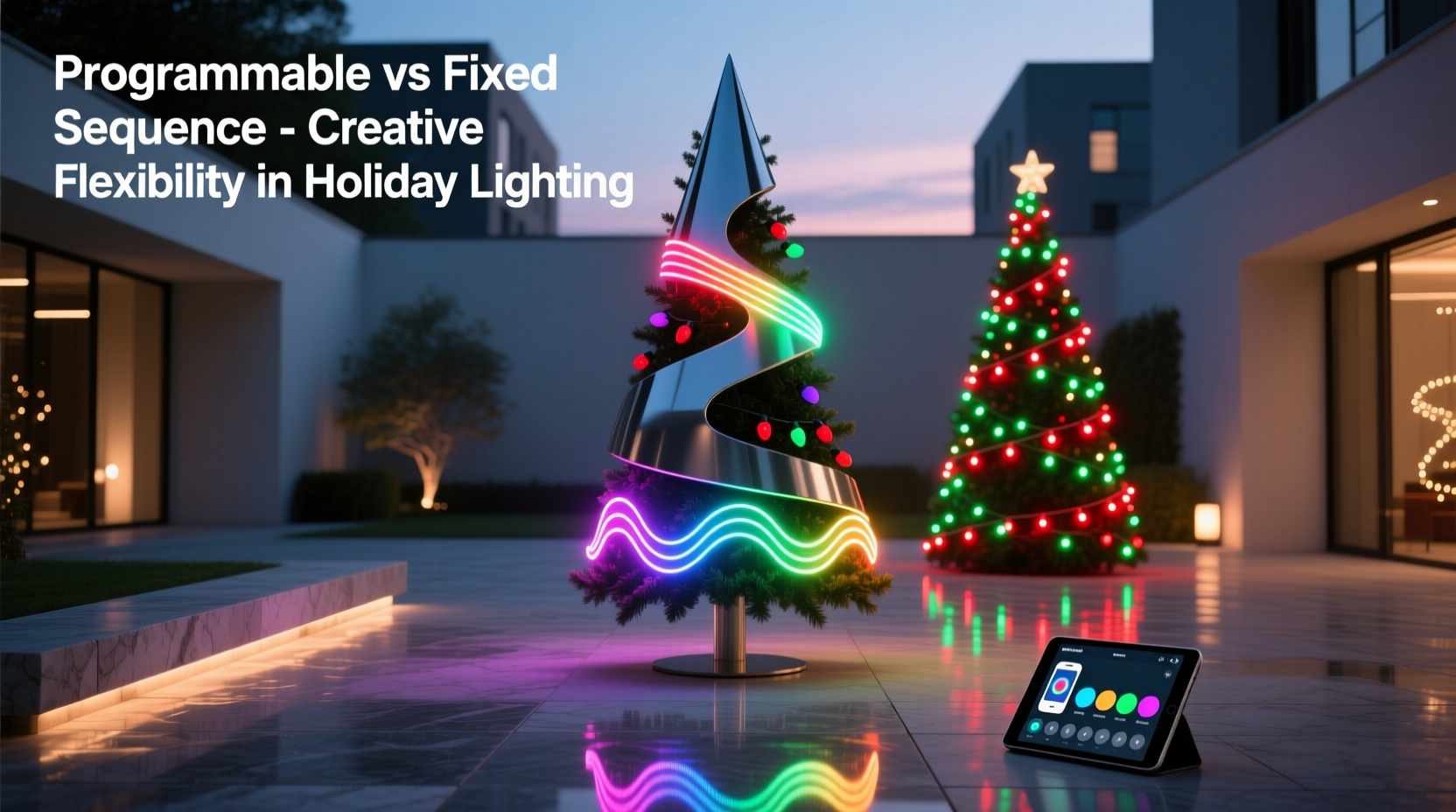
Fixed-sequence lights—often called “chasing,” “twinkling,” or “pre-programmed” strings—contain built-in microcontrollers that cycle through a set number of effects (e.g., steady-on, slow fade, chase, blink, random twinkle) without external input. These patterns are hardwired into the controller chip and cannot be altered, renamed, or reordered. Most operate via simple plug-and-play controllers with physical buttons or dials; some integrate with basic remotes. They’re commonly found in incandescent mini-lights, LED net lights, icicle strands, and pre-lit wreaths and trees.
While often marketed as “smart” due to their automatic motion, fixed-sequence lights lack true intelligence: no app interface, no scheduling, no synchronization capability, and no ability to layer effects or respond to environmental triggers. Their strength lies in predictability—not adaptability.
How Programmable Systems Deliver Creative Control
Programmable lights—whether pixel-based RGB LEDs, DMX-controlled strips, or Wi-Fi-enabled smart bulbs—rely on external software to define every aspect of behavior: color per bulb, timing, transition speed, intensity, and sequencing logic. Platforms like xLights, Light-O-Rama, or even consumer-grade apps (Philips Hue, Nanoleaf, Twinkly) let users design custom shows frame-by-frame—or generate them algorithmically using music analysis tools.
This level of granularity enables precise artistic expression: a snowfall effect cascading down eaves at 3-second intervals, a warm-to-cool gradient sweeping across porch columns at sunset, or a synchronized “Jingle Bells” routine where roofline lights pulse in time with bass notes while window frames shimmer in counter-rhythm. More importantly, programmability supports iteration. You can test a new pattern on one strand, refine timing based on real-world visibility, then deploy it across your entire display—all without rewiring.
Crucially, programmability extends beyond aesthetics. It enables responsiveness: lights that brighten when motion is detected, dim at midnight automatically, or shift to amber-only mode during neighborhood “dark sky” hours. These aren’t gimmicks—they’re functional adaptations grounded in community awareness and energy mindfulness.
Key Differences: A Practical Comparison
| Feature | Fixed-Sequence Lights | Programmable Lights |
|---|---|---|
| Pattern Customization | None. Limited to factory presets (typically 6–12 modes) | Full control: create, save, and schedule unlimited original patterns |
| Per-Bulb Addressability | No. Entire string behaves uniformly | Yes. Individual pixels or segments can display unique colors and behaviors |
| Music Synchronization | No native support; requires third-party hardware hacks (unreliable) | Native support via audio analysis tools and real-time waveform mapping |
| Setup Time (Annual) | Under 30 minutes for typical residential layout | 2–8 hours initially; drops to 30–90 minutes after first year with saved profiles |
| Average Cost per Foot (LED) | $0.15–$0.35 | $1.20–$4.50 (higher for high-density pixels or commercial-grade controllers) |
| Troubleshooting Complexity | Low: if it doesn’t work, replace controller or strand | Moderate: requires understanding of networks, firmware updates, and signal timing |
| Lifespan & Upgrade Path | 5–7 years; no firmware or feature upgrades possible | 8–12+ years; firmware updates add new effects, protocols, and integrations |
Real-World Application: The Thompson Family Display
The Thompsons in Portland, Oregon, installed their first holiday light display in 2018—a modest fixed-sequence setup on their front porch and garage. For three years, they enjoyed reliable twinkles and chases but felt limited when neighbors began adding musical shows. In 2022, they upgraded to a programmable system: 240 feet of WS2811 pixel string lights, two Falcon F16v3 controllers, and xLights software.
They didn’t start with complexity. Their first custom show was a 90-second loop: white lights warming to amber at dusk, followed by a gentle “breathing” pulse across the roofline. By Thanksgiving, they’d added a 4-minute synchronized version of “Carol of the Bells,” using free audio-reactive templates from the xLights community library. What made the difference wasn’t just spectacle—it was ownership. When their youngest daughter asked for “purple snowflakes” on the bay window, they spent 22 minutes building and testing the effect. No waiting for a new product release. No compromise.
By December 2023, their display drew over 1,200 visitors—including local school groups studying light physics and rhythm. The Thompsons now volunteer at a neighborhood workshop teaching beginners how to build simple programmable sequences. As Sarah Thompson told The Oregonian: “We didn’t buy lights. We bought a canvas—and learned how to paint with light.”
Expert Insight: Beyond Aesthetics
“Programmability transforms lighting from decoration into communication. A fixed sequence says ‘It’s Christmas.’ A well-designed programmable show says ‘This is *our* Christmas—thoughtful, joyful, and uniquely ours.’ That distinction matters more than ever as people seek authenticity over automation.” — Dr. Lena Cho, Lighting Anthropologist, University of Illinois Chicago
Dr. Cho’s research reveals that neighborhoods with mixed lighting approaches—some homes using fixed-sequence, others programmable—report higher collective satisfaction. Why? Because variety creates visual rhythm. A street where every home runs identical chase patterns feels monotonous; one where each display reflects individual taste fosters connection. Programmable systems don’t require technical mastery to contribute meaningfully. Even selecting and scheduling three pre-made community patterns—each with distinct pacing and mood—demonstrates intentionality that fixed systems simply cannot replicate.
Your Decision Framework: 5 Actionable Steps
Don’t choose based on price alone—or hype. Align your lighting strategy with your values and habits using this step-by-step framework:
- Assess Your Annual Commitment: Will you install, test, and maintain lights for 45+ minutes each November? If consistently under 20 minutes, fixed-sequence likely fits better.
- Define Your Creative Threshold: List three specific effects you’d love to see (e.g., “snow falling only on the roof,” “lights matching my doorbell chime,” “transitioning from red/green to blue/silver on New Year’s Eve”). If all three require per-bulb control, programmable is necessary.
- Evaluate Your Tech Environment: Do you have stable 2.4 GHz Wi-Fi coverage outdoors? Is your router less than 5 years old? Can you run Ethernet to a garage or shed for controller placement? Programmable systems thrive on connectivity—not convenience.
- Calculate Total Cost of Ownership: Add not just purchase price, but estimated time investment (setup, troubleshooting, updates), electricity usage (programmable LEDs often draw 20–30% less power at equivalent brightness), and replacement frequency. Fixed-sequence may cost less upfront—but programmable systems last longer and retain resale value.
- Test Before You Invest: Borrow a programmable strand from a friend or rent a starter kit for one weekend. Build one simple animation (e.g., a rainbow wave). If the process feels intuitive—or at least learnable—you’ve cleared the biggest barrier.
Frequently Asked Questions
Can I mix fixed-sequence and programmable lights in one display?
Yes—with caveats. Fixed-sequence strands operate independently and cannot sync timing or color with programmable elements. You’ll need separate power sources and controllers. Visually, contrast works well: use programmable lights for focal points (roofline, tree top) and fixed-sequence for background areas (shrubbery, railings). Just ensure voltage compatibility and avoid overloading circuits.
Do programmable lights require constant internet access?
No. Once programmed and uploaded to the controller (via SD card, USB, or local network), most systems run autonomously—even during outages. Internet is only needed for remote updates, cloud-based scheduling, or voice assistant integration. For reliability-focused users, offline operation is standard, not optional.
Are programmable lights harder to repair if a bulb fails?
It depends on the type. Analog RGB strips (e.g., 12V DC) often fail entirely if one pixel shorts. Digital pixel strings (e.g., WS2811/WS2812B) are designed with breakaway points—so a single dead bulb rarely affects downstream lights. Replacement bulbs cost $0.10–$0.30 and snap in with minimal soldering. Fixed-sequence strings, by contrast, frequently use series-wired incandescents where one dead bulb kills the whole strand—making repairs slower and less predictable.
Creative Flexibility Isn’t Luxury—It’s Intentionality
When you choose programmable lights, you’re not buying more features. You’re investing in agency—the ability to evolve your display alongside your family’s changing traditions, your home’s architectural updates, or your community’s growing expectations. You’re choosing to express warmth, humor, reverence, or quiet reflection—not through static symbols, but through light that breathes, listens, and responds. Fixed-sequence lights serve admirably when consistency, speed, and simplicity are paramount. But for those who view holiday lighting as an extension of personal narrative—as a seasonal act of curation and care—programmability isn’t the future. It’s the present, fully realized.
Start small. Pick one section of your home—a doorway, a staircase railing, a single tree—and give yourself permission to experiment. There’s no “final” version. Every December offers another chance to refine, simplify, or surprise. Your lights don’t need to dazzle the block. They just need to feel unmistakably yours.




 浙公网安备
33010002000092号
浙公网安备
33010002000092号 浙B2-20120091-4
Comments
No comments yet. Why don't you start the discussion?