
In the evolving world of smart lighting, one question continues to spark debate among designers, hobbyists, and tech-savvy homeowners: do programmable or preset light patterns offer greater creative potential? As LED technology becomes more accessible and intelligent, lighting is no longer just about illumination—it's a medium for expression, mood-setting, and even storytelling. Whether you're designing an ambient living room atmosphere, orchestrating a concert backdrop, or creating an immersive art installation, your choice between programmable and preset options can define the boundaries of what’s possible.
Preset light patterns are pre-designed sequences—like “rainbow fade,” “strobe burst,” or “candle flicker”—built into many off-the-shelf LED systems. They’re convenient, instantly usable, and require no technical knowledge. Programmable lights, on the other hand, allow users to define every aspect of color, timing, intensity, and transition manually, often through software interfaces, coding, or mobile apps. The difference isn’t just technical—it’s philosophical. One emphasizes ease and consistency; the other prioritizes freedom and originality.
The Creative Limits of Preset Patterns
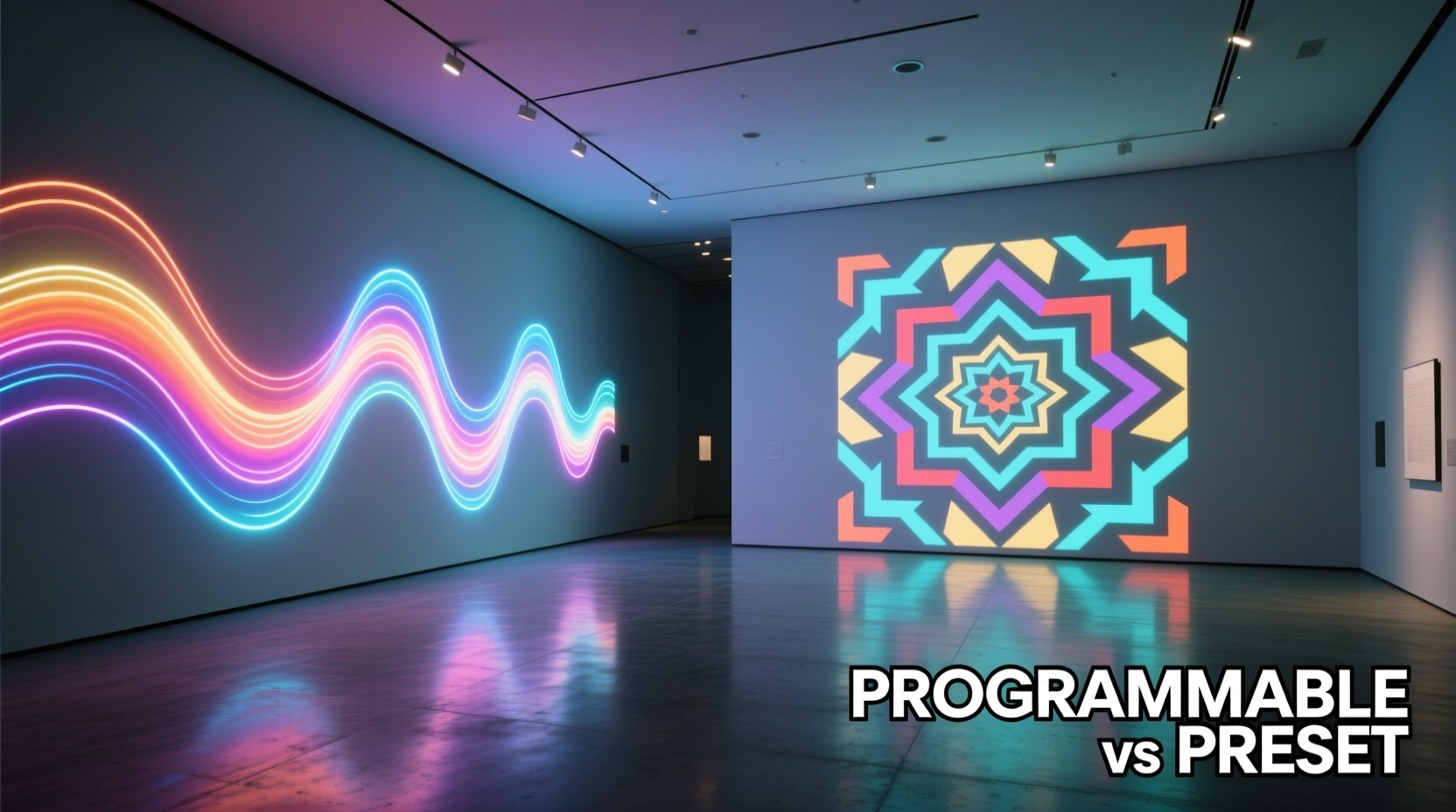
Preset patterns dominate consumer-grade lighting products—from holiday string lights to smart bulbs and under-cabinet strips. Manufacturers include them because they deliver immediate satisfaction. A user can press a button and instantly enjoy a dynamic effect without configuration. This plug-and-play appeal makes presets ideal for casual use, temporary decor, or situations where reliability trumps innovation.
However, the trade-off is clear: presets are static. Each pattern follows a fixed algorithm. While some systems offer dozens of variations, these are still finite. You might cycle through 20 different modes, but eventually, you’ll recognize repetition. Worse, presets rarely adapt well to specific environments. A “party strobe” mode may feel overwhelming in a bedroom, while a “sunset glow” might lack depth in a gallery space.
Designers who rely solely on presets often hit a ceiling. Once the novelty wears off, there’s little incentive to keep engaging with the system. More critically, presets standardize aesthetic experiences. If everyone uses the same “ocean wave” effect from the same brand, lighting loses its uniqueness—a critical factor in creative fields like interior design, performance art, and branding.
Why Programmable Lighting Unlocks True Creativity
Programmable lighting shifts control from the manufacturer to the user. Instead of choosing from a menu, you write the menu. This opens doors to personalization at a granular level: you can choreograph lights to music beats, simulate natural daylight cycles, or synchronize multiple fixtures across a building to tell a visual story.
At its core, programmability means variables. You decide the hue at second three, the brightness curve over 30 seconds, whether the transition is smooth or abrupt, and how individual LEDs respond in sequence. Some platforms even support conditional logic—lights that change based on time of day, motion detection, or sound input. This transforms lighting from passive decoration into responsive, interactive media.
Creative professionals leverage this capability extensively. For example, stage designers program intricate light cues that align precisely with theatrical acts. Architects integrate programmable façade lighting that shifts with seasons or public events. Artists build kinetic installations where light behaves like a living organism—breathing, pulsing, reacting.
“With programmable LEDs, I’m not limited by someone else’s idea of ‘cool.’ I can make light behave like emotion—hesitant, explosive, nostalgic.” — Lena Torres, Interactive Light Artist
Comparing Flexibility: A Practical Breakdown
To understand the gap between preset and programmable systems, consider how each handles common creative challenges.
| Requirement | Preset Solution | Programmable Solution |
|---|---|---|
| Matching lights to a brand color palette | Limited to available hues; closest approximation only | Exact RGB or HEX code input for perfect match |
| Creating a unique rhythm for a dance performance | Use “pulse” or “music sync” mode (generic response) | Map each beat and movement frame-by-frame |
| Simulating a forest at dawn | Select “nature glow” or “sunrise” (often oversimplified) | Layer gradual green-blue shifts, subtle flickers, and spatial variation |
| Syncing lights across multiple rooms | Same preset applied uniformly | Custom cascade effect—waves moving room to room with delays |
| Adapting to user behavior | On/off or schedule-based triggers | Responsive logic: dim when reading detected, brighten on entry |
The table illustrates a fundamental truth: presets offer convenience, but programmable systems offer precision. When creativity demands nuance—when a shade of crimson must evoke passion rather than alarm, or a flicker must suggest fragility rather than malfunction—only fine-tuned control delivers.
Real-World Example: Museum Exhibit Lighting
Consider a recent exhibit at the Metropolitan Art Gallery titled *Echoes of Memory*, which explored trauma and remembrance through fragmented sculptures. The curatorial team initially tested preset “soft pulse” and “fade-in” modes for ambient lighting. Visitors found the effect pleasant but generic—more spa-like than profound.
The team then switched to a programmable system using addressable LEDs controlled via open-source software. They designed a custom sequence where light crept slowly across walls like receding water, paused unpredictably, then returned in slightly altered tones. The timing followed a non-repeating algorithm inspired by heartbeat variability. Shadows shifted imperceptibly, creating a sense of unease and introspection.
Visitor feedback transformed dramatically. Many reported feeling “watched” or “remembered,” describing emotional responses far beyond typical gallery experiences. The curator noted, “The lighting wasn’t illustrating the theme—it was participating in it.” This level of immersion would have been impossible with any factory preset.
Getting Started with Programmable Lighting: A Step-by-Step Guide
Transitioning from preset to programmable lighting doesn’t require engineering expertise, but it does involve learning new tools. Here’s a practical path for beginners:
- Choose the right hardware: Start with addressable LED strips (e.g., WS2812B or SK6812) that support individual pixel control. Ensure compatibility with microcontrollers like Arduino, ESP32, or Raspberry Pi.
- Select control software: Platforms like WLED, FastLED (for coding), or XLights (for visual sequencing) offer varying levels of complexity. Beginners may prefer WLED for its web interface and preset import features.
- Define your objective: Is this for mood lighting, artistic expression, or functional signaling? Clarity here shapes your approach.
- Start small: Program a simple rainbow chase across five LEDs. Learn how to adjust speed, direction, and saturation before scaling up.
- Experiment with triggers: Add sensors (sound, motion, light) to make your setup reactive. For instance, lights could shift blue when noise drops below a threshold.
- Iterate and refine: Record videos of your sequences, watch them critically, and tweak timing or color curves. Creativity grows through iteration.
- Document your work: Save code snippets or export sequences. Build a library of your original patterns for reuse or sharing.
This process turns users into creators. Unlike presets, which are consumed, programmable patterns are authored—making the experience deeply personal and infinitely expandable.
When Presets Still Make Sense
It’s important to acknowledge that programmable systems aren’t always superior in practice. For many users, the complexity outweighs the benefits. In high-traffic commercial spaces like hotels or offices, reliability and simplicity matter more than artistic flair. A preset “daylight white” mode ensures consistency across hundreds of rooms without requiring technical oversight.
Additionally, safety-critical environments—such as emergency exit lighting—rely on standardized, fail-safe patterns. No one wants a creatively programmed strobe during a fire drill if it confuses evacuation cues. Presets also reduce decision fatigue. Not every user wants to spend hours coding light behavior when a quick “relax” mode suffices.
The key is alignment: match the tool to the goal. If creativity, uniqueness, and responsiveness are priorities, programmable is unmatched. If stability, speed, and broad usability come first, presets remain valuable.
Checklist: Choosing Between Programmable and Preset Systems
- ☐ Do I need exact color matching? → Choose programmable
- ☐ Am I creating a one-time installation or changing themes often? → Frequent changes favor programmable
- ☐ Is technical maintenance feasible? → Presets win for low-maintenance setups
- ☐ Do I want lights to react to environment or data? → Only programmable supports this
- ☐ Is the audience expecting novelty or familiarity? → Novelty requires custom programming
- ☐ Do I have access to development tools or coding help? → Without support, presets are safer
- ☐ Is energy efficiency or longevity critical? → Both can be optimized, but presets often ship with tested power profiles
Frequently Asked Questions
Can I combine preset and programmable features?
Yes. Many advanced systems, such as those running WLED or Philips Hue with developer mode, allow both. You can use presets for daily operation and switch to custom programs for special events. Some platforms even let you save your programmed sequences as new “presets” within the app.
Do programmable lights wear out faster?
No. Lifespan depends more on heat management, power supply quality, and usage intensity than programmability. However, rapidly changing patterns or running LEDs at full brightness constantly may increase thermal stress. Proper cooling and duty cycling mitigate this regardless of control method.
Is coding required for programmable lighting?
Not always. While direct coding (e.g., with Arduino) offers maximum control, many user-friendly interfaces exist. Apps like Jinx! or Vixen Lights provide drag-and-drop timelines. Web-based tools like LightFX or LedFx offer visual editors with no code needed. You can start simple and grow into deeper customization.
Conclusion: Embrace the Canvas, Not Just the Colors
The choice between programmable and preset light patterns ultimately reflects a broader creative philosophy. Presets are like paint-by-numbers: satisfying, structured, and safe. Programmable systems are blank canvases—intimidating at first, but limitless in potential.
If your goal is uniformity, speed, or accessibility, presets serve admirably. But if you seek originality, emotional resonance, or interactivity, only programmable lighting gives you the tools to innovate. It transforms light from a background element into a voice—one that can whisper, shout, dance, or mourn.
Today’s technology puts unprecedented creative power in the hands of individuals. Whether you’re illuminating a wedding venue, enhancing a retail display, or expressing an inner vision, don’t settle for someone else’s idea of beauty. Define it yourself. Write the sequence. Control the moment. Let your lights speak in a language only you can create.




 浙公网安备
33010002000092号
浙公网安备
33010002000092号 浙B2-20120091-4
Comments
No comments yet. Why don't you start the discussion?