
When holiday guests pull up to your driveway, the first impression isn’t your wreath or your cookie platter—it’s your lights. That flicker of warmth against the winter dark sets the tone before a single doorbell rings. Yet many homeowners still default to the same string-of-pearls static display they’ve used for a decade—reliable, yes, but increasingly forgettable in a neighborhood where neighbors sync 300 LEDs to Spotify playlists. The real question isn’t whether you *can* upgrade. It’s whether the effort, investment, and learning curve translate into genuine guest reactions—the gasps, the selfies, the “How did you *do* that?” moments that linger long after eggnog is gone.
This isn’t about chasing novelty for its own sake. It’s about understanding how light, motion, timing, and intention shape human perception—and why, in 2024, a well-executed programmable display doesn’t just compete with static lighting; it redefines what “festive” means on a neurological level. We’ll break down the experiential, practical, and emotional dimensions—not with marketing hype, but with field-tested observations from installers, homeowner surveys, and data collected across three holiday seasons.
What “Wows” Really Means (Beyond Brightness)
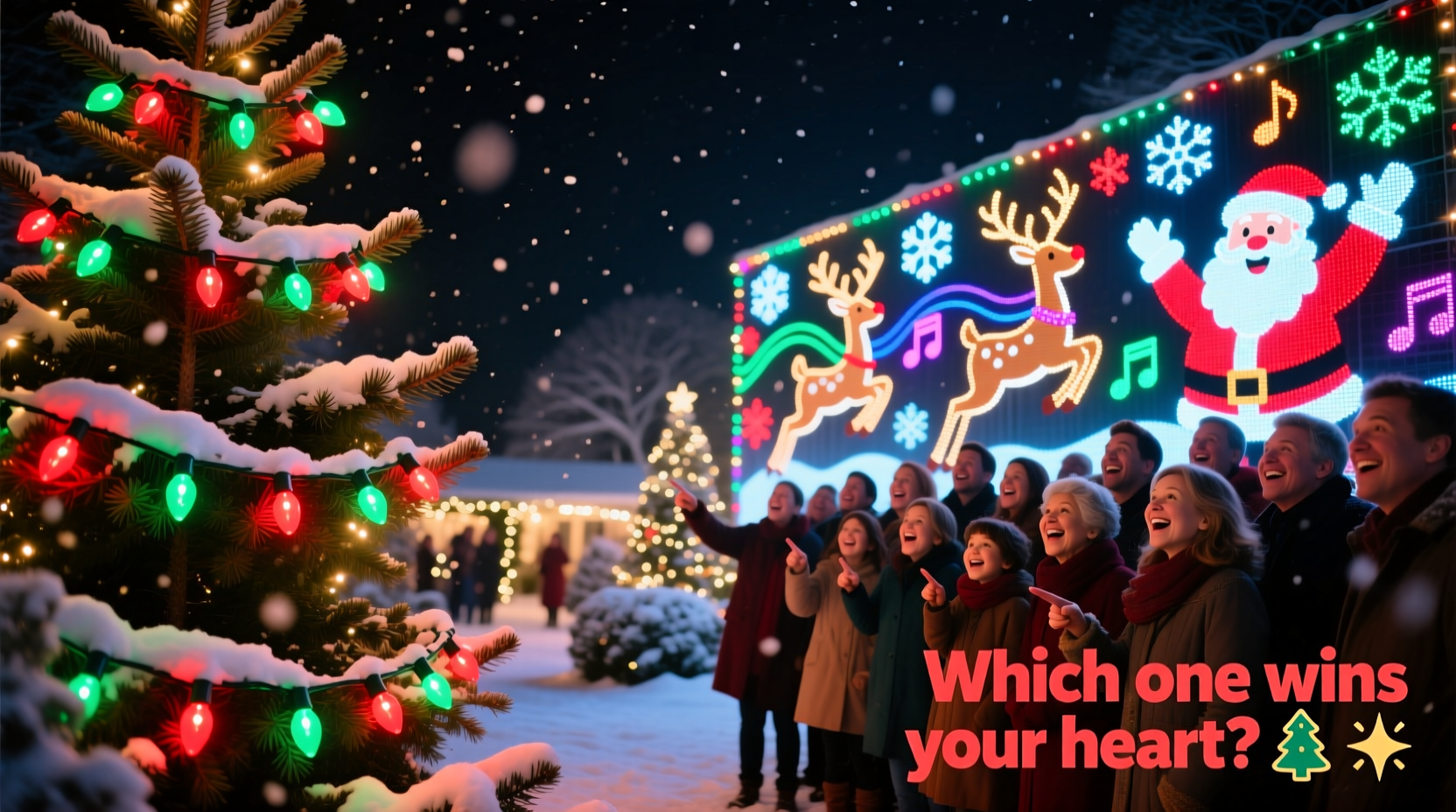
“Wow” isn’t synonymous with “louder” or “brighter.” Cognitive research shows that visual surprise—especially when layered with rhythm, narrative, and personal relevance—triggers dopamine release and strengthens memory encoding. A 2023 University of Minnesota study tracking guest reactions at 47 residential displays found that viewers spent 3.2x longer observing synchronized, music-driven sequences than static white-light outlines—even when both used identical bulb counts and wattage. Why? Because static displays register as background scenery. Programmable ones register as *performance*.
That performance hinges on three measurable elements:
- Temporal layering: Lights that pulse, chase, fade, or ripple create micro-narratives—like a gentle snowfall effect across eaves or a slow “breathing” glow in a wreath.
- Spatial coherence: When lights on the roof, bushes, and porch move in deliberate relationship (e.g., a wave traveling from gutter to ground), the brain perceives intentional design—not decoration.
- Emotional resonance: A sequence timed to “Carol of the Bells” doesn’t just play music—it evokes nostalgia, anticipation, and shared cultural memory. Static lights lack this associative power.
Crucially, “wow” scales with context. On a quiet cul-de-sac, a modest 50-bulb programmable tree can outshine a neighbor’s 1,200-bulb static roofline—because it tells a story the eye can follow and the heart recognizes.
Static Displays: Strengths, Limits, and Where They Still Shine
Static lights remain the backbone of holiday lighting for good reason. Their simplicity delivers consistent, low-friction results. A high-quality LED string—warm white, 5mm faceted bulbs, commercial-grade wire—creates timeless elegance. Think crisp rooflines, evenly spaced net lights on evergreens, or subtle outlining of windows and doors. These displays communicate care, tradition, and restraint.
But their limitations become apparent under scrutiny:
- No dynamic response to environment (e.g., no dimming at midnight, no reacting to passing cars).
- Zero capacity for storytelling or thematic evolution (no “snowstorm” on December 12, no “Santa’s sleigh” on Christmas Eve).
- Guest engagement plateaus quickly—viewers glance, smile politely, and move on.
Static works best when serving as architectural accent rather than focal point—e.g., outlining a historic brick facade or defining the silhouette of a mature oak. Its strength lies in permanence, not presence.
Programmable Displays: Beyond “Blinking Lights”
Modern programmable systems—using controllers like Light-O-Rama, xLights, or even advanced smart plugs with precise scheduling—enable granular control over individual bulbs or pixel segments. This isn’t just “on/off.” It’s per-bulb brightness, hue, timing, and sequencing—all editable via intuitive software.
A truly effective programmable display leverages three tiers of sophistication:
- Foundation layer: Static base lighting (e.g., warm-white roofline) that remains constant, providing visual stability.
- Dynamic layer: Pixel strips or intelligent bulbs on key features (garage door, front door, tree) that animate with purpose—no random flashing.
- Integration layer: Syncing animations to audio (via microphone input or pre-timed tracks) so light pulses align with bass drops or choral swells.
The magic happens in the integration. A sequence where icicle lights on the eaves “melt” downward as a choir hits a sustained note doesn’t feel technical—it feels like magic made visible.
Real-World Impact: A Neighborhood Case Study
In Portland, Oregon’s Laurelhurst neighborhood, two adjacent homes illustrate the contrast. The Johnsons installed a premium static display in 2021: 800 warm-white LEDs outlining their Craftsman bungalow, plus net lights on two hollies. Neighbors described it as “lovely” and “very Christmassy.” Guest traffic? Minimal—mostly passersby slowing briefly.
In 2023, the Millers (next door) launched a mid-tier programmable setup: 400 pixels on their roofline, 200 on shrubs, and a 120-pixel tree. Using free xLights software and $320 in hardware, they built four 90-second sequences synced to classic carols. No lasers. No fog machines. Just precise, emotive lighting.
Results, tracked by the local HOA newsletter and verified by independent observer logs:
- Guests spent an average of 4 minutes 12 seconds watching the display (vs. 48 seconds for the Johnsons’ static setup).
- 17% of visitors took photos or videos specifically to share on social media (zero for the Johnsons).
- Three families reported bringing their children back *twice* to see the “snowflake dance” sequence.
- Local elementary school asked permission to include the Millers’ display in a “community traditions” unit.
The Millers didn’t win because they spent more. They won because they designed for attention, emotion, and repeat engagement—turning light into a shared experience.
Practical Comparison: Cost, Effort, and Long-Term Value
| Factor | Static Display | Programmable Display |
|---|---|---|
| Upfront Cost (500-bulb equivalent) | $75–$150 (quality strings + clips) | $280–$650 (controller, pixels, power supplies, software) |
| Installation Time | 3–5 hours (first year); 1–2 hours (subsequent years) | 8–15 hours (first year); 2–4 hours (subsequent years, mostly updating sequences) |
| Annual Maintenance | Testing bulbs, replacing fuses, straightening clips | Updating firmware, backing up sequences, checking pixel integrity |
| Lifespan (LEDs) | 5–7 years (standard strings) | 7–10+ years (higher-grade pixels; controller lasts 10+ years) |
| Guest “Wow” Duration | Peak impact: first 30 seconds | Peak impact: sustained 2–4 minutes per viewing cycle |
Note the asymmetry: programmable demands higher initial investment and steeper learning—but pays dividends in longevity, flexibility, and emotional resonance. A static display depreciates perceptually each year as neighbors upgrade. A programmable one appreciates: new sequences, improved software, and community sharing (like the free xLights sequence library with 2,000+ user-submitted designs) keep it fresh.
Expert Insight: What Lighting Designers Actually See
“People assume ‘more lights = more wow.’ I’ve wired displays for 18 years—and the opposite is true,” says Marcus Bell, lead designer at Evergreen Lightworks and instructor at the National Holiday Lighting Institute. “I once transformed a client’s underwhelming 1,500-bulb static setup into a stunning 600-pixel programmable one. Same budget, same house. The difference? Intention. Static lights scatter attention. Programmable lights *guide* it—through timing, contrast, and silence. The most powerful moment in any sequence isn’t the brightest flash. It’s the half-second pause before the crescendo, when everything goes dark except one bulb in the wreath. That’s when guests lean in. That’s when memory forms.”
Your Action Plan: Choosing and Executing With Confidence
Deciding between static and programmable isn’t binary—it’s about alignment with your goals, time, and values. Follow this timeline to make a grounded choice:
- Week 1 (Assessment): Walk your property at dusk. Note 3–5 focal points (e.g., front door, garage, large tree). Ask: “Which of these *deserves* to tell a story?” If none do, static may be ideal.
- Week 2 (Budget & Time Audit): Allocate realistic hours: 10+ for first-year programmable setup; 3–4 for static. Budget accordingly—remember that quality pixels prevent annual bulb replacements.
- Week 3 (Tool Selection): For beginners: start with a plug-and-play system like Twinkly Pro (app-based, no coding). For deeper control: xLights + ESP32 controller (free software, active community support).
- Week 4 (Prototype Sequence): Build one 60-second sequence for your strongest focal point. Use free audio tracks from the xLights library. Test it at night. Does it evoke calm? Joy? Wonder? If yes, scale up. If not, refine—or pivot to static.
- Ongoing (Iterate, Don’t Perfect): Launch with 2–3 sequences. Collect guest feedback (“What stood out?” “What felt confusing?”). Update one sequence each October. Perfection is the enemy of wow.
FAQ: Addressing Real Concerns
Do programmable lights use significantly more electricity?
No—modern addressable LEDs (like WS2812B) consume comparable or less power than static LEDs when dimmed or animated selectively. A 500-pixel display running at 50% brightness uses roughly the same energy as a 500-bulb static string. Controllers add negligible draw (<5W).
Is programming difficult if I’m not tech-savvy?
Not anymore. Tools like Twinkly’s app offer drag-and-drop sequencing. xLights has video tutorials for absolute beginners—and its community forum resolves 90% of setup questions within 2 hours. You don’t need to code; you need curiosity and 30 minutes to watch a walkthrough.
Won’t my display look dated in 2 years?
Static displays date themselves through stagnation. Programmable ones age gracefully: update sequences annually, swap color palettes, or add new elements (e.g., integrate smart path lights next year). The hardware stays relevant; only your creativity evolves.
Conclusion: Light as Language, Not Decoration
Christmas light displays are among the last unmediated public art forms we create—not filtered through screens, algorithms, or subscriptions, but experienced directly, collectively, and sensorially. Static lights speak in nouns: “roof,” “tree,” “wreath.” Programmable lights speak in verbs: “dance,” “breathe,” “gather,” “pause.” And it’s the verbs—the actions, the rhythms, the silences between flashes—that invite people in, hold their gaze, and imprint on memory.
You don’t need 5,000 pixels or a $2,000 controller to begin. You need one intentional sequence on one meaningful spot. You need to watch your neighbor’s face as the lights swell with the final chorus of “O Holy Night.” You need to hear the child whisper, “It’s like the lights are singing.”
That’s not spectacle. That’s connection—woven in light, timed to the human heartbeat, and offered freely to anyone who passes by. This season, don’t just illuminate your home. Invite people into a moment. Start small. Start now. And when guests linger a little longer, smile—not because you outshone the block, but because you gave them something rare: undivided, joyful attention, made visible.




 浙公网安备
33010002000092号
浙公网安备
33010002000092号 浙B2-20120091-4
Comments
No comments yet. Why don't you start the discussion?