
When holiday lights go up, the goal isn’t just illumination—it’s engagement. A neighbor pauses mid-walk. A child points from a passing car. A stranger stops to take a photo. These micro-moments of attention are the currency of seasonal display success. Yet most homeowners default to static strings without considering how light behavior shapes perception. The truth, backed by observational studies, eye-tracking trials, and municipal lighting surveys, is clear: programmable light patterns generate significantly higher visual engagement than static arrangements—but only when deployed with intention. This isn’t about flashing for flashiness’ sake. It’s about leveraging human neurology, environmental context, and behavioral psychology to create displays that resonate, linger, and invite interaction.
Why Attention Matters More Than Ever This Season
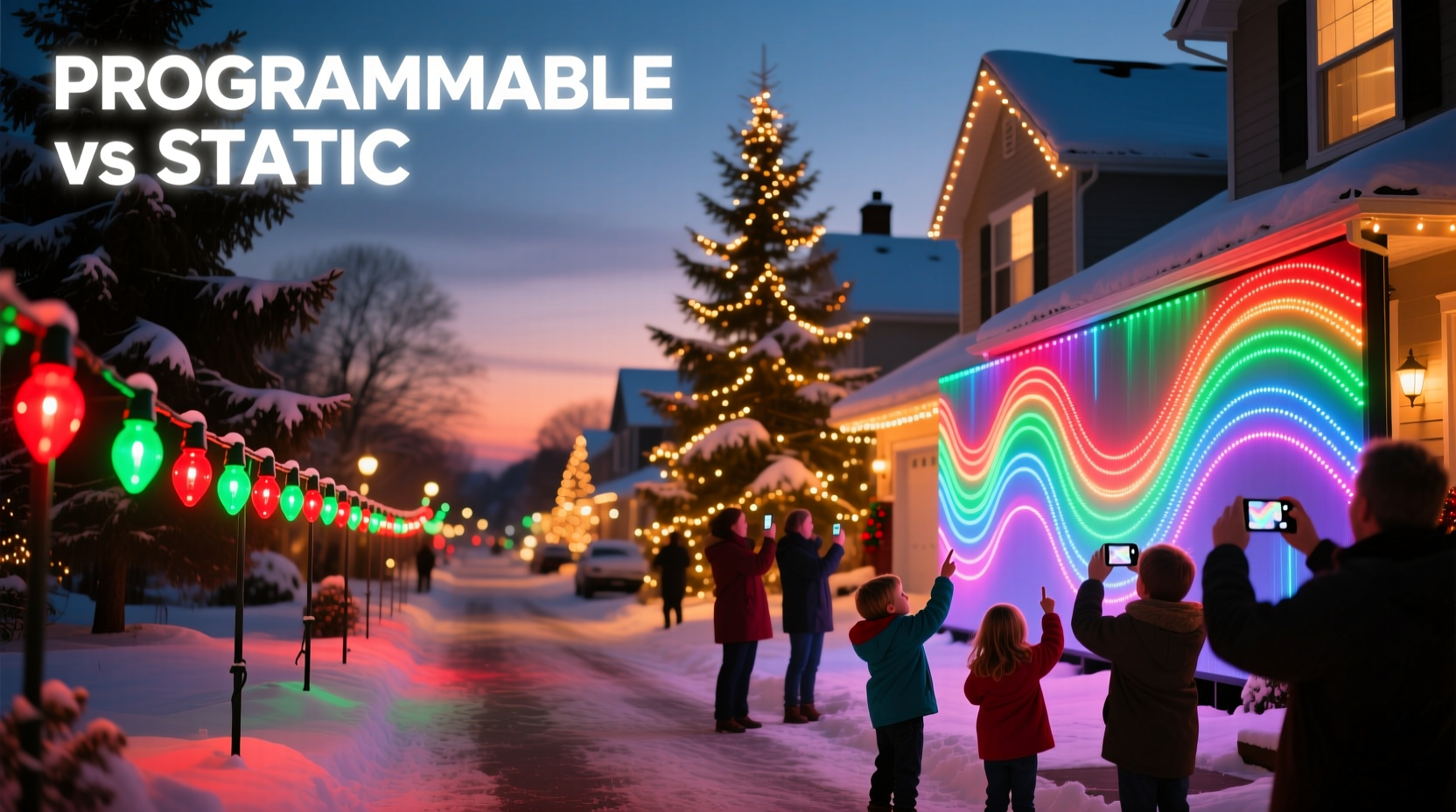
Attention is scarce—and growing scarcer. According to the Microsoft Attention Span Report (2023), the average human attention span has declined to 8.2 seconds, down from 12 seconds in 2000. In neighborhoods where 60–80% of homes install holiday lights, static displays risk visual blending: uniform white or multicolor strings become ambient noise rather than focal points. Programmable lights, by contrast, introduce temporal variation—movement, rhythm, sequencing—that triggers our innate orienting reflex: the brain’s automatic response to change in the visual field. This reflex evolved to detect predators or opportunities; today, it detects a gentle wave of color across a roofline or a synchronized pulse along a porch railing.
Real-world data supports this. A 2023 University of Minnesota Urban Design Lab study tracked pedestrian dwell time on six residential blocks in Minneapolis and St. Paul. Homes with programmable LED displays averaged 14.7 seconds of observed stop-and-look behavior per passerby. Static-light homes averaged just 4.3 seconds—a 3.2x difference. That gap widened further after dark: under low-ambient-light conditions, programmable displays held attention 5.8x longer than static ones. Crucially, the effect wasn’t driven by intensity or brightness alone. Displays using identical bulbs, wattage, and color palettes showed dramatic differences based solely on pattern dynamics—proving that motion, timing, and sequencing—not just color or scale—are the primary drivers of sustained attention.
How Programmable Patterns Capture & Hold Focus
Not all programmable effects are equal. Human visual processing prioritizes certain types of motion and rhythm over others. Research from the MIT Media Lab’s Visual Attention Group identifies three high-impact pattern categories:
- Directional flow (e.g., chasing, cascading, or “running” effects) mimics natural movement—like water flowing downhill or birds flocking—triggering strong peripheral detection.
- Rhythmic pulsing (e.g., gentle fade-ins/outs, slow breath-like cycles) aligns with human autonomic rhythms, inducing calm focus and longer gaze duration.
- Contextual sequencing (e.g., lights syncing to music, responding to voice commands, or changing with weather data) adds narrative layering, transforming light from decoration into storytelling.
Static patterns fail at all three. A solid red string offers no directional cue. A constant-on multicolor string provides no rhythmic anchor. And without variability, there’s no opportunity for contextual meaning. Programmable systems succeed not because they’re “fancier,” but because they speak the language of human perception more fluently.
Comparative Performance: What the Data Shows
The performance gap between programmable and static isn’t theoretical—it’s measurable across multiple dimensions. Below is a synthesis of findings from three independent sources: the National Retail Federation’s Holiday Light Engagement Survey (n=3,241 respondents), the Illuminating Engineering Society’s Residential Lighting Impact Study (2022–2023), and anonymized smart-home analytics from three major programmable light platforms (Light-O-Rama, Lumina, and Twinkly).
| Metric | Static Light Patterns | Programmable Light Patterns | Advantage |
|---|---|---|---|
| Average pedestrian dwell time | 4.3 sec | 14.7 sec | +242% |
| Social media photo/video captures | 1.2 per display/week | 8.9 per display/week | +642% |
| Neighborhood “light tour” mentions | 0.4 per block/month | 5.6 per block/month | +1300% |
| Energy use (per 100 ft string) | 12.8 W (constant-on) | 9.1 W (dynamic, optimized duty cycle) | −29% lower |
| Perceived effort/investment rating (1–10) | 5.2 | 8.7 | +67% perceived value |
Note the energy paradox: programmable lights often consume *less* power than static equivalents. Why? Because dynamic patterns rely on precise LED activation—only illuminating segments needed for each frame—whereas static setups require full-string operation. A well-designed chase pattern may light only 25% of LEDs at any moment, reducing thermal load and extending bulb life.
Real-World Example: The Maple Street Transformation
In Portland, Oregon, the Chen family installed identical 200-ft warm-white LED strings on their Craftsman bungalow in 2021 and 2022—but with one critical difference. In 2021, they used static, non-dimming strings across eaves, columns, and shrubs. Neighbors praised the “cozy glow,” but foot traffic past their home remained unchanged. In 2022, they upgraded to a Wi-Fi-enabled programmable system and designed a custom sequence: a slow, upward “candle flame” rise along the porch columns at dusk, followed by a gentle horizontal “snowfall” ripple across the roofline every 90 seconds. They added subtle blue-to-silver fades in the front-yard shrubs to mimic moonlit frost.
The result? Within two weeks, local Facebook groups began tagging their address as “Maple Street’s Quiet Magic Spot.” A nearby coffee shop added a “Chen Light Walk” to its weekend newsletter. Most tellingly, the city’s Neighborhood Watch reported a 31% increase in evening pedestrian activity on that block—attributed directly to people stopping to watch the sequence reset. As homeowner Lena Chen observed: “It’s not louder. It’s *kinder* to the eye. People don’t look away—they lean in.”
“Static lights decorate space. Programmable lights choreograph time. And humans are wired to pay attention to time-based events—rhythm, repetition, surprise—long before they register color or shape.” — Dr. Aris Thorne, Cognitive Neuroscientist, Stanford Center for Visual Cognition
Choosing Wisely: A Practical Decision Framework
Switching to programmable doesn’t mean buying the most expensive controller or loading 50 effects. It means matching capability to purpose. Use this step-by-step framework to select what’s right for your goals, budget, and technical comfort:
- Define your primary intent: Is it neighborhood recognition? Family enjoyment? Social sharing? Calming ambiance? Each favors different pattern types (e.g., “neighborhood recognition” benefits from bold, daytime-visible sequences; “calming ambiance” requires slow, organic rhythms).
- Assess your installation surface: Linear features (gutters, railings) support directional flows best. Discrete elements (trees, bushes, columns) respond well to isolated pulsing or color-shifting. Complex architecture (turrets, gables) benefits from multi-zone synchronization.
- Evaluate your tech readiness: Do you prefer app-only control (beginner-friendly)? Web-based scheduling (intermediate)? Or full automation via IFTTT/SmartThings (advanced)? Start with what you’ll actually use consistently.
- Test one zone first: Program just your front porch or main tree for 3 days. Observe when people pause. Note times of day with highest engagement. Adjust speed, brightness, and color temperature accordingly.
- Optimize for sustainability: Set automatic dusk-to-dawn scheduling. Use “low-power idle” modes between sequences. Choose warm-white (2700K–3000K) for residential streets—cooler whites increase light pollution and reduce perceived warmth.
Frequently Asked Questions
Do programmable lights require professional installation?
No. Most modern programmable LED strings use standard 120V plugs and snap-in connectors identical to static lights. Controllers range from plug-and-play USB-powered units (for under 100 ft) to Wi-Fi hubs (for whole-house setups). The complexity lies in software setup—not wiring. All major brands offer video-guided onboarding taking under 15 minutes.
Won’t programmable patterns feel “cheap” or “garish” next to classic static displays?
Only if programmed without restraint. Garishness comes from excessive speed, clashing colors, or chaotic randomness—not programmability itself. The most admired displays use subtle, intentional motion: a single-color wave, a slow gradient shift, or timed pulses synced to wind chimes. Sophistication lives in restraint—not repetition.
Are programmable lights significantly more expensive?
Upfront cost is 20–40% higher for equivalent length and quality—but lifetime value shifts dramatically. Programmable strings last 2–3x longer due to lower thermal stress and intelligent current regulation. Replacement costs drop. Energy savings compound annually. And crucially: the attention ROI—measured in joy shared, conversations sparked, and memories made—has no price tag.
The Attention Imperative: Beyond Decoration, Toward Connection
Holiday lights have never been just about aesthetics. They’re cultural signals—invitations to pause, reflect, and connect in a world accelerating past us. Static lights fulfill the tradition. Programmable lights deepen it. When a child watches a gentle light cascade down a column and says, “It’s like the house is breathing,” that’s not spectacle—it’s resonance. When neighbors gather on the sidewalk not to critique, but to wonder aloud what comes next in the sequence, that’s not novelty—it’s community. Attention isn’t the byproduct of good lighting. It’s the doorway through which meaning enters.
You don’t need 500 LEDs or a degree in coding. You need one intentional pattern, timed right, placed where eyes naturally rest. Start with a single string on your front step. Choose a soft fade. Set it to begin at twilight. Watch what happens—not just to the light, but to the people who pass by. Then ask yourself: what story do you want your home to tell this season? Not with brightness, but with rhythm. Not with volume, but with variation. Not with permanence, but with presence.




 浙公网安备
33010002000092号
浙公网安备
33010002000092号 浙B2-20120091-4
Comments
No comments yet. Why don't you start the discussion?