
When it comes to decorating for the holidays, few elements carry as much visual impact as Christmas lights. From delicate string lights outlining rooftops to bold displays that dance in sync with music, lighting transforms homes into seasonal spectacles. But not all Christmas lights are created equal. At the heart of many decoration decisions lies a key question: should you choose programmable or static pattern lights? The answer depends on what you value most—ease of use or creative freedom. While both types illuminate your space, they differ significantly in functionality, customization, and long-term adaptability.
Understanding these differences is essential for homeowners, decorators, and holiday enthusiasts who want to maximize their display without overcomplicating setup. This article breaks down the core distinctions between programmable and static pattern lights, evaluates their strengths, and ultimately answers which option provides greater versatility for different kinds of users.
What Are Static Pattern Christmas Lights?
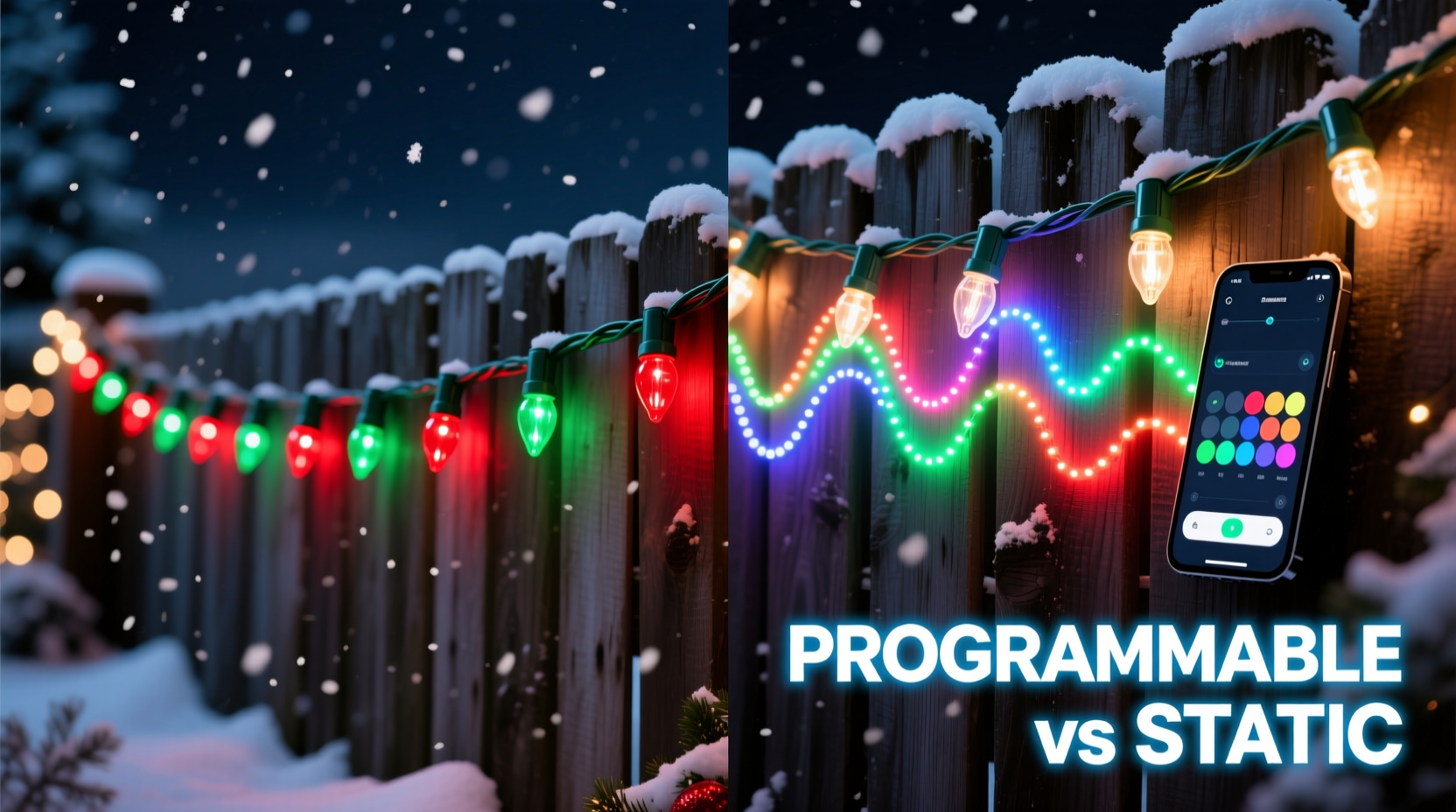
Static pattern Christmas lights come pre-programmed with one or more fixed lighting effects. These might include steady-on, twinkling, fading, chasing, or slow-glow sequences. Once manufactured, the patterns cannot be altered by the user. You plug them in, and they run through their built-in routines automatically. Some models offer a switch to toggle between available patterns, but the variations remain limited and predetermined.
These lights are widely available at retail stores and online marketplaces due to their simplicity and affordability. They require no technical knowledge to operate—just hang, plug in, and enjoy. Because of this ease of use, static lights are popular among casual decorators or those looking for a quick seasonal upgrade without investing time in configuration.
However, the convenience comes at a cost: rigidity. Once you’ve chosen a set, you’re locked into its factory settings. There's no way to adjust timing, synchronize with music, or create custom sequences. For someone who enjoys evolving their display year after year, this lack of flexibility can become limiting.
How Do Programmable Christmas Lights Work?
Programmable Christmas lights take holiday illumination to a new level by allowing users to customize every aspect of the light show. These systems typically rely on microcontroller-based technology—most commonly using platforms like Wi-Fi-enabled controllers (e.g., Twinkly, Light-O-Rama) or addressable LEDs such as WS2812B (commonly known as NeoPixels). Each individual bulb or segment can be controlled independently, enabling complex animations, color transitions, and synchronization with sound.
Users interact with programmable lights via smartphone apps, desktop software, or even voice assistants. Through intuitive interfaces, they can design sequences from scratch, import pre-made effects, or sync lights to music in real time. Advanced setups can integrate multiple strands across large properties, creating coordinated light shows visible from blocks away.
“With programmable lights, you’re not just decorating—you’re choreographing an experience.” — Daniel Reeves, Smart Lighting Designer and Holiday Display Consultant
The learning curve is steeper than with static lights, but the payoff is unmatched creative control. Whether you want a gentle wave effect across your roofline or a full-blown synchronized performance to Mariah Carey’s “All I Want for Christmas Is You,” programmable lights make it possible.
Comparing Versatility: Key Factors
Versatility isn’t just about how many colors a light can produce—it encompasses adaptability, scalability, longevity, and ease of reuse. Below is a detailed comparison across critical dimensions.
| Feature | Static Pattern Lights | Programmable Lights |
|---|---|---|
| Pattern Customization | Limited to pre-set modes; no user input | Fully customizable sequences via app/software |
| Color Options | Single-color or multi-color sets with fixed combinations | Millions of colors per bulb; dynamic mixing possible |
| Synchronization | No audio sync capability | Full music synchronization with beat detection |
| Setup Complexity | Plug-and-play; minimal effort required | Requires initial setup, network connection, calibration |
| Reusability Across Seasons | Same look every year unless replaced | Display can evolve annually with new programs |
| Scalability | Difficult to coordinate multiple strands | Supports large-scale, multi-zone installations |
| Price Range (per 50-light strand) | $8–$15 | $25–$60+ |
The data clearly shows that programmable lights outperform static ones in nearly every category related to versatility. While they demand higher upfront investment and technical engagement, they offer long-term value through repeated reinvention.
Real-World Example: A Suburban Home Transformation
Consider the case of the Martinez family in Portland, Oregon. In 2020, they used basic static multicolor lights around their eaves and porch railings—a typical suburban holiday look. Their display was pleasant but unremarkable, drawing little attention beyond the immediate neighborhood.
In 2021, they invested in a programmable LED system with Wi-Fi control. Using a mobile app, they designed a sequence where red and green lights pulsed outward from the center of the house like ripples. They added a snowfall effect during quieter songs and ramped up intensity during upbeat tracks. By connecting their system to a small outdoor speaker, they created a mini drive-through light show that attracted families from nearby streets.
Each subsequent year, they refined the display—adding new zones, integrating motion triggers, and even scheduling daily changes. What started as a simple upgrade became a community tradition. The same hardware remained, but the presentation evolved dramatically thanks to programmability.
This example illustrates a fundamental truth: static lights provide a snapshot; programmable lights enable a living, changing display.
When Static Lights Make Sense
Despite the advantages of programmable systems, static lights still have a place in modern holiday decorating. They are best suited for specific scenarios:
- Rental properties: Tenants may prefer non-permanent, easy-to-remove decorations.
- Small spaces: Apartments or townhomes where elaborate displays aren't practical.
- Minimalist aesthetics: Those seeking subtle ambiance rather than spectacle.
- Budget constraints: Families wanting festive touches without high initial costs.
- Occasional use: Seasonal cabins or vacation homes used infrequently.
For these users, the predictability and reliability of static lights outweigh the need for advanced features. However, even in these cases, hybrid approaches can enhance overall appeal without requiring full-scale automation.
Step-by-Step Guide to Getting Started with Programmable Lights
If you're ready to explore the world of customizable lighting, follow this practical guide to begin confidently:
- Assess Your Display Area: Measure rooflines, trees, walkways, and other surfaces where lights will go. Note power outlet locations.
- Determine Scale: Decide whether you want a single accent feature (e.g., a lit tree) or a whole-property setup. Start small if new to programming.
- Choose a System: Select a reputable brand like Twinkly, Luminara, or DIY options using Arduino/Raspberry Pi with addressable strips.
- Purchase Components: Buy sufficient lengths of lights, compatible controllers, extension cords rated for outdoor use, and mounting clips.
- Install Hardware: Secure lights using gutter hooks or adhesive mounts. Avoid stapling, which damages wires.
- Connect and Configure: Power the system and connect via app. Follow calibration prompts to map light positions digitally.
- Create Your First Sequence: Use preset templates or build a simple fade/wave effect. Test playback outdoors.
- Add Music Sync (Optional): Upload a holiday track and let the software detect beats, or manually align cues.
- Schedule On/Off Times: Set timers to conserve energy and extend bulb life. <10> Store Properly Off-Season: Label cords, coil neatly, and keep controllers in protective cases.
With each season, expand your skills—add sensors, integrate smart home systems, or participate in local light show events.
Common Misconceptions About Programmable Lights
Several myths deter potential users from adopting programmable systems:
- “They’re too complicated.” Modern apps are designed for consumers, not engineers. Drag-and-drop interfaces simplify creation.
- “They won’t last as long.” Quality programmable LEDs often exceed 30,000 hours of use—longer than many static sets.
- “I need coding skills.” No programming knowledge is required for most consumer-grade products.
- “They’re only for pros.” Thousands of homeowners run impressive displays with beginner kits.
Education and trial runs dispel these concerns quickly. Many brands offer free trial periods or demo videos to help users get comfortable.
FAQ
Can I mix programmable and static lights on the same circuit?
Yes, as long as voltage requirements are compatible and total load doesn’t exceed breaker capacity. However, they cannot be synchronized unless using a master controller with relay outputs.
Do programmable lights use more electricity?
Not necessarily. LED-based programmable lights are energy-efficient. Actual consumption depends on brightness settings and duration. Running all bulbs at full white uses more power than dimmed or animated modes.
Are programmable lights weatherproof?
Most outdoor-rated programmable lights have IP44 or higher protection, meaning they resist splashing water and dust. Always check manufacturer specifications before installation in wet climates.
Checklist: Choosing the Right Option for You
Use this checklist to determine which type aligns with your goals:
- ☐ Do you want to change your display design each year? → Lean toward programmable
- ☐ Is budget under $50 for lighting? → Static may be better
- ☐ Do you enjoy tech projects or smart home integration? → Programmable fits well
- ☐ Will children or guests help operate the system? → Static is simpler for shared control
- ☐ Do you host holiday gatherings or attract visitors? → Programmable enhances experience
- ☐ Are you decorating a temporary space? → Static reduces setup complexity
- ☐ Do you plan to keep lights for 5+ years? → Programmable offers better long-term ROI
Final Verdict: Which Offers More Versatility?
While both types serve important roles, programmable Christmas lights undeniably offer far greater versatility. They allow for endless creativity, adapt to changing preferences, support technological integration, and deliver unique experiences year after year. Unlike static lights, which present a fixed aesthetic, programmable systems grow with you—offering new possibilities with each update.
That said, versatility must align with purpose. For someone who values simplicity and speed, static lights remain a valid choice. But for anyone interested in personal expression, community engagement, or evolving holiday traditions, programmable lights unlock doors that static sets simply cannot open.
“The most memorable holiday displays aren’t the brightest—they’re the ones that tell a story. Programmable lights give you the vocabulary to speak in light.” — Lena Peterson, Public Art Curator and Festival Director
Conclusion
The decision between programmable and static pattern Christmas lights ultimately hinges on how you define versatility. If it means ease and consistency, static lights win. But if versatility means freedom to innovate, personalize, and inspire, then programmable lights are the clear leader.
Whether you're illuminating a city balcony or a sprawling suburban estate, consider starting small with a programmable strand. Experiment with colors, test a music sync, and see how it changes your holiday experience. The joy of creation often becomes as meaningful as the final display.




 浙公网安备
33010002000092号
浙公网安备
33010002000092号 浙B2-20120091-4
Comments
No comments yet. Why don't you start the discussion?