
Choosing the right controller for your holiday lighting isn’t just about convenience—it’s about shaping the experience. A flickering porch display, synchronized roofline animations, or subtle ambient glow at dusk all depend on how precisely you can command timing, sequencing, intensity, and responsiveness. Timer-based controllers have anchored seasonal displays for decades: simple, predictable, and low-maintenance. Programmable controllers—often Wi-Fi–enabled, app-driven, and compatible with smart home ecosystems—promise granular command over every pixel and pulse. But does technical sophistication always translate to better control? Or do legacy timers still hold ground where simplicity, durability, and predictability matter most? This article cuts through marketing claims to examine real-world functionality, installation realities, scalability limits, and long-term adaptability—so you invest in a system that aligns with your goals, not just your budget.
What “Control” Really Means in Holiday Lighting
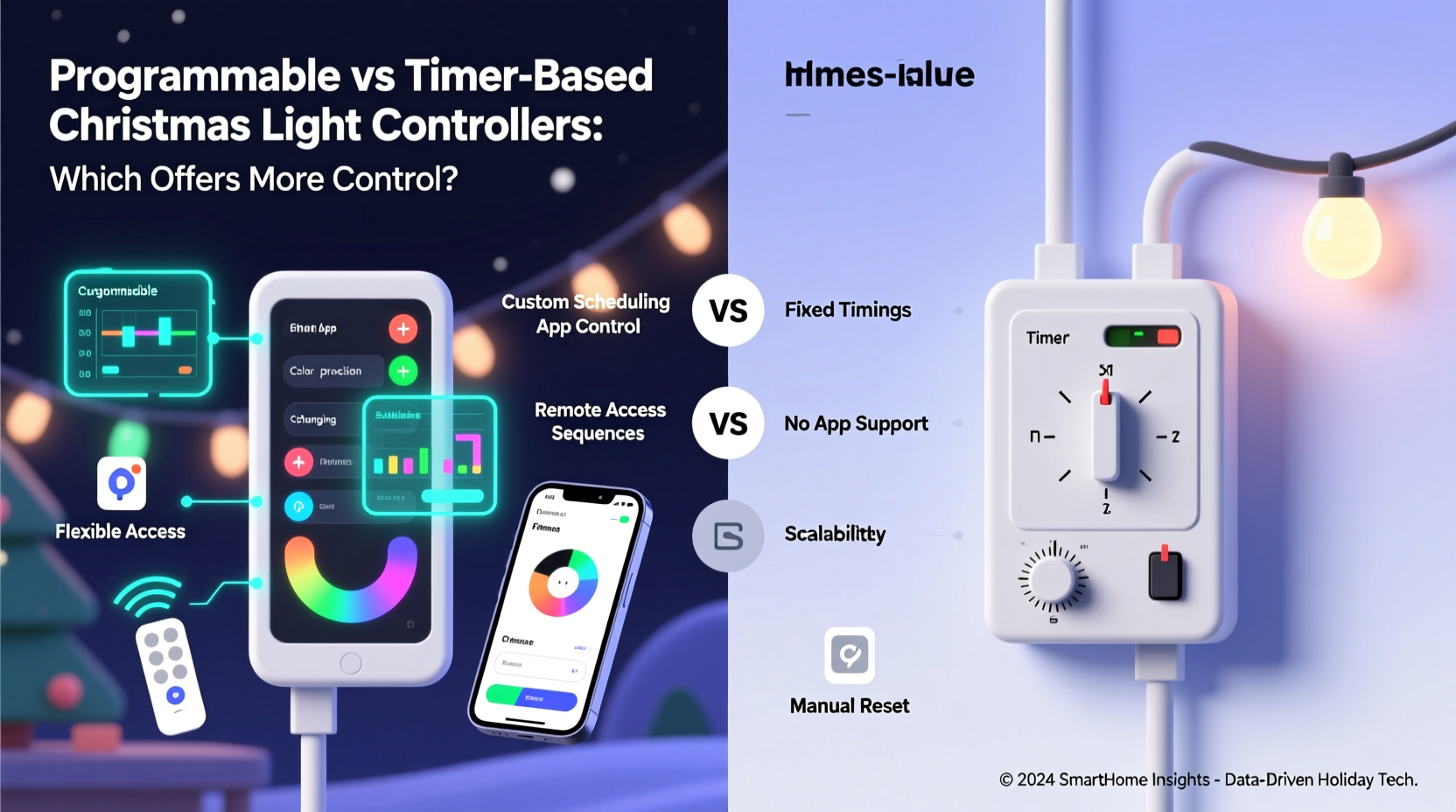
Before comparing devices, it’s essential to define what “more control” actually entails—not just in theory, but in daily use. Control includes five interlocking dimensions:
- Temporal precision: Can you schedule lights to turn on at 4:58 p.m. on December 17—and only then—not just “at dusk”?
- Behavioral granularity: Can you dim Channel 3 by 12% between 8:00–9:30 p.m., while running a chase pattern on Channel 1 only on weekends?
- Adaptability: Can the system adjust automatically to shifting sunset times across November–January—or respond to weather data (e.g., dim during heavy rain)?
- Integration depth: Does it accept voice commands, trigger from motion sensors, or sync with music via microphone input or audio analysis?
- Recovery & resilience: If power flickers or the network drops, does the controller retain settings, resume schedules, or revert safely without manual reprogramming?
Timer-based units typically deliver strong temporal consistency and high resilience—but minimal behavioral or adaptive capability. Programmable systems excel at granularity and integration, yet often sacrifice reliability when dependent on cloud services, firmware updates, or unstable home networks. The “more control” question hinges less on feature lists and more on which dimensions matter most for your setup, environment, and tolerance for troubleshooting.
How Timer-Based Controllers Work—and Where They Excel
Timer-based controllers operate using mechanical or digital clock circuits paired with pre-set modes (e.g., “on for 6 hours,” “twinkle for 2 hours, then steady”). Most plug into standard outlets, accept basic incandescent or LED string inputs, and require no app, account, or internet connection. Their strength lies in operational integrity: no software to crash, no servers to go offline, no passwords to reset.
Modern digital timers—like the GE Enbrighten or Woods 59026—add useful refinements: sunrise/sunset tracking via built-in photodiodes, weekly scheduling, and multiple on/off cycles per day. Still, they lack dynamic response. For example, if a winter storm pushes sunset 18 minutes earlier than predicted, the timer won’t compensate unless manually adjusted. It also cannot differentiate between a weekday and a holiday—unless you’ve physically programmed separate days weeks in advance.
How Programmable Controllers Deliver True Customization
Programmable controllers—such as the Light-O-Rama CTB16PC, Falcon F16v3, or newer smart options like the Nanoleaf Shapes + Matter-compatible controllers—use microprocessors, onboard memory, and often real-time operating systems. They allow users to build sequences frame-by-frame, assign custom effects per channel, embed audio waveforms, and execute logic-based triggers.
Unlike timers, these units don’t just answer “when?”—they answer “how, why, and under what conditions?” You can program a sequence that runs only when temperature falls below 32°F *and* motion is detected near the front walkway. You can fade warm-white LEDs gradually over 90 seconds at midnight while triggering a soft blue pulse on pathway markers. You can export/import sequences between seasons, share them in online communities, or even generate animations using AI-assisted tools like xLights’ Auto-Sequence feature.
Crucially, programmability extends beyond aesthetics. Advanced units support DMX512, E1.31 (sACN), and Art-Net protocols—enabling synchronization across dozens of controllers, professional-grade pixel strips, and stage lighting gear. This interoperability transforms residential displays into scalable, production-grade installations.
“Timers tell time. Programmable controllers interpret context. The difference becomes undeniable when you want your lights to breathe—not just blink.” — Derek Lin, Lighting Designer & Co-Founder, HolidayLightingLab.com
Side-by-Side Comparison: Key Decision Factors
The table below compares critical attributes across both controller types—not as abstract specs, but as practical implications for installers, homeowners, and hobbyists.
| Feature | Timer-Based Controllers | Programmable Controllers |
|---|---|---|
| Setup Time | Under 5 minutes: plug in, set time, done. | 30–120+ minutes: install software, configure hardware IDs, calibrate channels, test sequences. |
| Learning Curve | None. Ideal for first-time users or elderly homeowners. | Moderate to steep. Requires understanding of sequencing logic, timing resolution, and protocol basics. |
| Remote Adjustments | None. Physical access required for any change. | Yes—via smartphone app, web dashboard, or voice assistant (if supported). |
| Power Resilience | Excellent. Retains settings through outages; resumes instantly. | Varies. Many store sequences locally—but cloud-dependent features fail without internet. |
| Expandability | Limited. Typically one or two outputs; adding zones requires multiple units. | High. Supports daisy-chaining, multi-controller networks, and hundreds of controllable channels. |
| Long-Term Cost | Low upfront ($15–$45); zero recurring costs. | Higher initial investment ($80–$300+); some require paid software upgrades or cloud subscriptions. |
Real-World Example: The Suburban Family’s Evolving Display
In Maplewood, MN, the Chen family began with a single $22 digital timer controlling three strands on their front porch. For five years, it worked flawlessly—until their twins asked, “Can the lights dance to ‘Jingle Bell Rock’?” That question launched a six-month journey: researching controllers, learning xLights software, upgrading to 150-pixel RGB nodes, and installing a Falcon F16v3 with Ethernet backbone. Their first programmable season featured a 4-minute synchronized show triggered nightly at 6:00 p.m.—but also included unexpected benefits. When a late-November snowstorm knocked out their Wi-Fi for 36 hours, the F16v3 ran its local schedule uninterrupted. When their daughter designed a custom animation for her school’s holiday fair, they exported it as a .lms file and loaded it onto the controller in under 90 seconds. And when they added solar-powered path lights the following year, they integrated them via a smart relay—triggered only when the main display was active. What began as a quest for “more control” became infrastructure for creativity, resilience, and intergenerational engagement.
Which Controller Is Right for You? A Practical Checklist
Answer these questions honestly to determine your optimal path:
- ✅ Do you prefer plug-and-play operation with zero software or network dependencies?
- ✅ Is your display limited to 3–5 strands, unchanged year after year?
- ✅ Do you value absolute reliability over visual variety?
- ✅ Are you comfortable adjusting settings only in person—and only once per season?
- ✅ Do you plan to expand beyond basic strings (e.g., pixels, arches, matrices) within the next 2–3 years?
- ✅ Do you want to sync lights to music, voice commands, or environmental triggers?
- ✅ Are you willing to invest 2–5 hours annually to learn, update, and maintain software?
- ✅ Do you host frequent outdoor gatherings where lighting ambiance shifts by event type (e.g., quiet dinner vs. New Year’s Eve party)?
If you answered “yes” to three or more of the first five items, a premium timer-based controller is likely sufficient—and possibly wiser. If you answered “yes” to three or more of the last five, programmability delivers tangible, lasting advantages.
FAQ
Can I combine timer and programmable controllers in one display?
Yes—and it’s often strategic. Use a timer to manage power delivery to a programmable controller (e.g., turning the entire system on at dusk), while letting the programmable unit handle sequencing, effects, and channel-level control. This adds a layer of failsafe: if the programmable unit freezes, the timer still ensures lights activate at least once per day.
Do programmable controllers work with non-smart bulbs and traditional mini-lights?
Most do—but with caveats. Basic programmable relays (like Light-O-Rama’s SC series) switch standard AC loads cleanly. However, older incandescent mini-lights draw high inrush current, which can damage sensitive solid-state relays over time. Always verify controller specifications for maximum load type (resistive vs. inductive) and peak amperage. When in doubt, use mechanical relay modules rated for lighting loads.
Are there security risks with Wi-Fi–enabled programmable controllers?
Potentially—especially with budget brands using default passwords, unencrypted firmware updates, or hardcoded cloud APIs. Prioritize controllers supporting local-only operation (no mandatory cloud account), WPA3 encryption, and regular, transparent security patches. Avoid units that require third-party cloud services for basic on/off functionality.
Conclusion: Control Isn’t About Complexity—It’s About Intention
“More control” doesn’t mean stacking features until your controller resembles an air traffic control panel. It means having exactly the authority you need—no more, no less—to express your vision, honor your time, and respect your environment. A timer-based controller grants sovereignty over time: dependable, silent, and unwavering. A programmable controller grants sovereignty over expression: responsive, evolving, and deeply personal. Neither is objectively superior. The right choice emerges from honest reflection on your priorities—not the flashiest spec sheet or the lowest price tag.
If your goal is warmth, consistency, and ease, invest in a well-reviewed digital timer and spend those saved hours stringing lights with loved ones. If your goal is storytelling through light—where each blink carries meaning, each fade reflects mood, and each season builds on the last—then embrace the learning curve. The most powerful controllers aren’t the ones with the most buttons. They’re the ones that disappear into the background, leaving only wonder in their wake.




 浙公网安备
33010002000092号
浙公网安备
33010002000092号 浙B2-20120091-4
Comments
No comments yet. Why don't you start the discussion?