
As the holiday season approaches, one of the most visible—and joyful—traditions is decorating with Christmas lights. But today’s options go far beyond simply plugging in a string and flipping a switch. With the rise of smart home technology, programmable LED lights now promise dazzling animations, voice control, and app-based scheduling. Meanwhile, traditional timer-based lights remain a reliable, low-cost favorite for many households.
The question isn’t just about brightness or color—it’s about value. Are programmable lights worth the investment, or are they an example of smart lighting overkill? To answer that, we need to compare functionality, ease of use, cost, energy efficiency, and long-term practicality. The best choice depends not on trends, but on how you plan to use your lights and what kind of experience you want to create.
Understanding the Core Differences
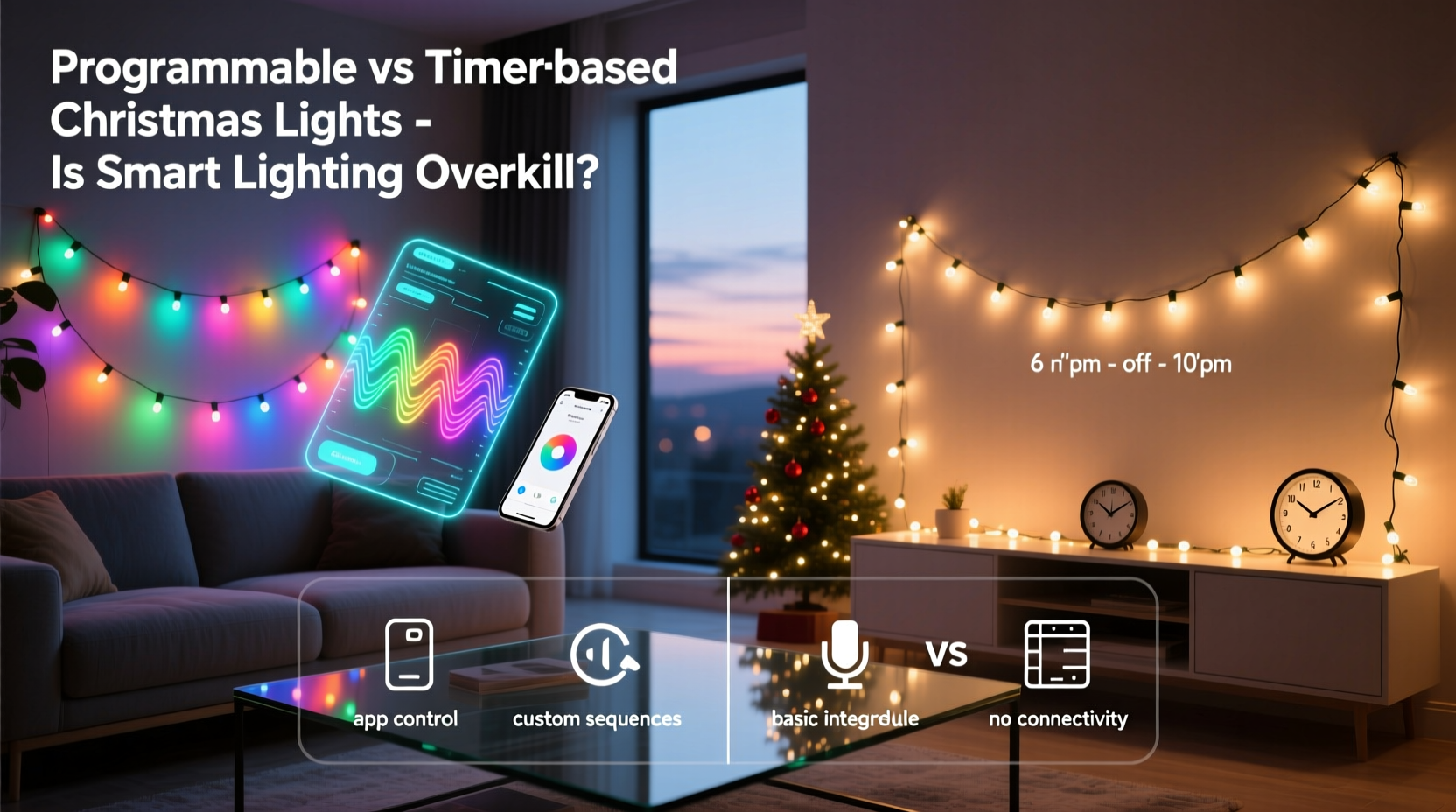
At first glance, both programmable and timer-based lights turn on and off automatically. But their capabilities diverge sharply from there.
Timer-based lights operate on a fixed schedule. You set a start and end time—say, 5 PM to 10 PM—and the lights follow that routine every day until you change it. These timers can be built into the light strand, attached via a plug-in module, or controlled through a simple wall switch. They’re mechanical or digital, often requiring manual adjustment when daylight saving time shifts or seasonal hours change.
Programmable (smart) lights, by contrast, connect to Wi-Fi or Bluetooth and allow granular control via smartphone apps. You can create dynamic light shows, fade effects, music synchronization, color transitions, and custom schedules that vary by day of the week. Some integrate with voice assistants like Alexa or Google Assistant, enabling hands-free control. These systems often support multiple zones, letting you control different parts of your display independently.
The difference is similar to comparing a flip phone to a smartphone—one gets the job done, the other opens up new possibilities.
Cost and Setup: Practical Considerations
Price is often the deciding factor. Timer-based lights are significantly cheaper. A standard 100-light string with a built-in timer can cost as little as $8–$12. Plug-in outlet timers run $5–$15 and work with any standard light set. There’s no learning curve, no app setup, and minimal maintenance.
Smart lights, however, come at a premium. A single strand of programmable RGB LEDs with Wi-Fi capability starts around $25 and can exceed $50 for longer, higher-density sets. For a full yard display, costs can quickly reach hundreds of dollars. Add in the need for a stable Wi-Fi signal outdoors, potential hub requirements (for certain brands), and possible subscription fees for advanced cloud features, and the complexity grows.
Setup is another hurdle. Smart lights require downloading apps, connecting to networks, naming devices, and sometimes troubleshooting sync issues. Outdoor installations may suffer from weak signals unless you have strong exterior coverage. In contrast, timer-based systems are plug-and-play. Set the clock once, check it monthly, and you’re done.
“Many consumers overestimate how much they’ll use smart features. For basic holiday lighting, simplicity often wins.” — David Lin, Home Automation Analyst at TechHome Insights
Feature Comparison: What Can Each System Do?
| Feature | Timer-Based Lights | Programmable Smart Lights |
|---|---|---|
| On/Off Scheduling | ✅ Yes (fixed daily schedule) | ✅ Yes (customizable per day/time) |
| Color Changing | ❌ No (unless pre-set multi-color) | ✅ Yes (millions of colors, gradients) |
| Light Effects | ❌ Limited (twinkle mode only) | ✅ Yes (pulse, fade, chase, strobe) |
| Remote Control | ❌ No | ✅ Yes (via app or voice) |
| Music Sync | ❌ No | ✅ Yes (ambient sound or live audio) |
| Energy Efficiency | ✅ High (LEDs with simple circuitry) | ✅ High (but higher standby draw) |
| Installation Complexity | 🟢 Low | 🔴 High |
| Avg. Cost per Strand (100 lights) | $8–$15 | $25–$50+ |
The table reveals a clear trade-off: convenience and affordability versus flexibility and spectacle. If you enjoy crafting elaborate displays or hosting neighborhood light tours, programmable lights offer creative freedom. But if your goal is a warm, consistent glow without hassle, timer-based systems deliver reliably.
Real-World Example: Two Homes, Two Approaches
Consider two neighbors on the same block: Maria and James.
Maria loves the holidays. Every year, she spends weekends installing layered lighting across her roofline, trees, and walkway. She uses programmable RGB strips synced to holiday music playlists. Her display changes themes weekly—candy cane stripes in early December, snowfall effects near Christmas Eve, and a New Year’s countdown animation. She controls everything from her phone, even turning on the lights remotely for surprise visits. For Maria, smart lighting isn’t overkill—it’s central to her tradition.
James, meanwhile, hangs one string of warm white lights along his porch railing. He sets a plug-in timer to match local sunset times and forgets about it until January. He doesn’t want flashing patterns or app notifications. His lights serve safety and cheer, not performance. When he tried smart lights last year, he found the setup frustrating and rarely used more than the basic on/off function.
Their experiences highlight a key insight: the value of smart lighting depends entirely on usage intent. For enthusiasts, it’s empowering. For minimalists, it’s excess.
When Smart Lighting Makes Sense (And When It Doesn’t)
Smart lights shine in specific scenarios:
- You host annual holiday events and want a memorable display.
- You live in a community with lighting competitions or charity drives.
- You enjoy DIY tech projects and integrating lights with other smart home devices.
- You travel during the holidays and want to control lights remotely for security or ambiance.
- You have children or family members who love interactive elements like music-synced lights.
But for many, these benefits are irrelevant. If you:
- Only decorate one area of your home
- Prefer classic white or steady-color lights
- Don’t want to troubleshoot connectivity issues
- Are on a tight budget
- Value simplicity over customization
—then programmable lights may indeed be overkill. The added cost, setup time, and maintenance outweigh the marginal gains.
Step-by-Step: Choosing the Right System for Your Needs
- Assess your display size and location. Are you lighting a single window or an entire house? Larger displays benefit more from zoning and remote control.
- Determine your desired effect. Do you want static lighting, gentle twinkles, or animated sequences? Only smart lights support complex effects.
- Evaluate your tech comfort level. Are you comfortable managing apps, firmware updates, and network connections? If not, stick with timers.
- Calculate total cost. Multiply the price per strand by the number you’ll need. Include controllers, extension cords, and surge protectors.
- Check Wi-Fi coverage. Walk around your property with your phone to see where the signal drops. Poor outdoor coverage will limit smart light reliability.
- Decide on control preferences. Would you rather adjust settings manually each month, or automate everything from your couch?
- Test one option first. Buy a single smart strand or timer module to evaluate performance before scaling up.
Expert Insight: Balancing Innovation and Practicality
“The danger with smart holiday products is assuming more features equal better results. Often, the emotional impact comes from consistency and warmth—not flashing rainbows. Technology should enhance tradition, not replace it.” — Dr. Lena Peterson, Consumer Behavior Researcher at HolidayTech Lab
This perspective underscores a broader truth: holiday lighting is as much about atmosphere as it is about technology. A softly lit wreath with a simple timer can evoke more nostalgia than a high-tech laser show. The best lighting solution aligns with your values, not just your gadget budget.
FAQ: Common Questions Answered
Can I mix timer-based and programmable lights?
Yes, absolutely. Many homeowners use smart lights for focal points (e.g., tree or signage) and timer-based strings for background areas. Just ensure they’re on compatible power sources and circuits.
Do smart lights use more electricity?
The LEDs themselves are equally efficient. However, smart controllers and Wi-Fi modules consume a small amount of standby power—even when lights are off. Over a month, this might add $1–$3 to your bill depending on the number of strands.
Are programmable lights harder to store?
Slightly. They often have delicate controllers, soldered nodes, or rigid segments that require careful coiling. Use labeled bins and avoid tight bends to prevent wire damage. Timer-based lights, being simpler, are generally more durable in storage.
Checklist: Choose Your Lighting Type
- ☐ I know how many strands I need
- ☐ I’ve checked my outdoor Wi-Fi strength (if going smart)
- ☐ I understand the total cost for my preferred option
- ☐ I’ve decided on color scheme and lighting effects
- ☐ I’m comfortable with app setup or prefer plug-and-play
- ☐ I have a secure place to store lights after the season
- ☐ I’ve tested one strand before buying in bulk
Conclusion: Smart Lighting—Enhancement or Excess?
The debate between programmable and timer-based Christmas lights isn’t about which is objectively better—it’s about fit. Programmable lights offer remarkable capabilities, but those features only matter if you’ll use them. For hobbyists, tech lovers, and festive entertainers, smart lighting unlocks creativity and convenience. For everyone else, a well-placed timer does the job quietly and effectively.
There’s no shame in choosing simplicity. In fact, it’s often the wiser choice. The spirit of the holidays lies in warmth, connection, and tradition—not in how many app notifications you receive when your reindeer lights turn on.
Before upgrading to smart lights, ask yourself: Will this enhance my experience, or just complicate it? If the answer leans toward complication, you may be facing true overkill. But if you light up at the thought of choreographing a light show to \"Jingle Bell Rock,\" then embrace the tech. Just make sure it serves joy, not just novelty.




 浙公网安备
33010002000092号
浙公网安备
33010002000092号 浙B2-20120091-4
Comments
No comments yet. Why don't you start the discussion?