
Home illumination—especially for holidays, events, or permanent architectural enhancement—has evolved dramatically. Once limited to strings of incandescent bulbs and basic floodlights, homeowners now face a meaningful choice: invest in traditional physical lighting systems or adopt projection mapping technology to transform their façade into a dynamic, programmable canvas. But “cool tech” doesn’t always translate to smarter investment. This comparison cuts past marketing hype and examines what truly matters: upfront cost, installation labor, maintenance burden, longevity, energy use, weather resilience, and creative flexibility. We’ve aggregated real project data, consulted lighting designers and AV integrators, and analyzed five-year operational patterns across residential applications to deliver an unvarnished, practical breakdown.
Upfront Cost Breakdown: What You Actually Pay
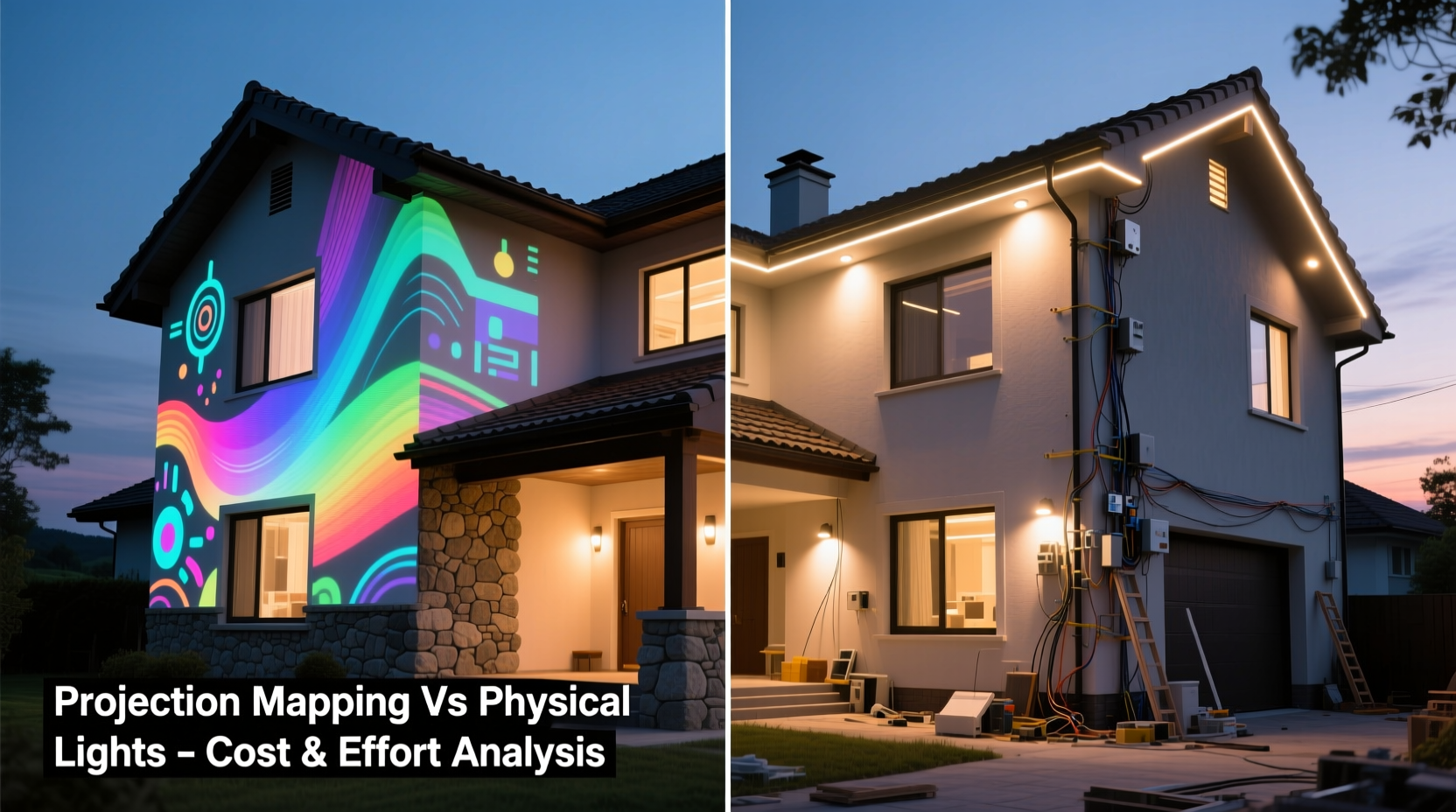
Initial investment is often the first filter—and where misconceptions take root. Projection mapping is frequently assumed to be prohibitively expensive. In reality, entry-level residential projection setups start lower than many expect—but hidden costs quickly accumulate. Physical lighting, by contrast, has predictable pricing tiers but scales steeply with complexity and quality.
| Component | Projection Mapping (Residential Grade) | Physical LED Lighting (Architectural Grade) |
|---|---|---|
| Core Equipment | $2,400–$6,800 (laser phosphor projector, media server, mounting hardware, lens kit) | $1,200–$5,500 (LED strip modules, linear fixtures, color-changing nodes, power supplies, controllers) |
| Design & Content Creation | $800–$3,500 (custom animation, 3D model calibration, timing sync) | $0–$1,200 (optional design consultation; most systems use preset modes or simple apps) |
| Installation Labor | $1,600–$4,200 (rigging, focus calibration, ambient light mitigation, network setup) | $900–$3,000 (wiring, conduit, transformer placement, fixture mounting, circuit balancing) |
| Permits & Electrical Upgrades | Rarely required (low-voltage signal + standard outlet) | Frequently required ($300–$1,800 for new circuits, GFCI upgrades, city sign-off) |
| Total Estimated Range | $4,800–$14,500 | $3,000–$11,500 |
Note: These figures reflect mid-tier, weather-rated gear—not consumer-grade projectors or bargain-bin LED strips. A $799 “outdoor projector” lacks the lumen output, sealed optics, or thermal management needed for reliable nighttime façade work and will fail within 12 months under sustained use. Likewise, sub-$10/meter LED strips degrade visibly after one season and lack IP66+ ratings for rain exposure.
Labor & Installation: Time, Skill, and Site Constraints
Installation isn’t just about hours logged—it’s about specialized knowledge, access logistics, and environmental tolerance. Physical lighting demands electrical expertise, structural anchoring, and meticulous wire management. Projection mapping requires optical precision, ambient light control, and digital infrastructure integration.
A typical 2,500 sq ft two-story home illustrates the divergence:
- Physical lighting: Requires trenching or surface-mount conduit runs (up to 200 linear feet), installing 30–50 fixtures across eaves, soffits, columns, and gables, balancing loads across 3–4 circuits, and programming sequences via app or DMX console. Skilled electricians average 3–5 days on-site.
- Projection mapping: Needs secure mounting points (roof peak, garage beam, or ground pole), precise projector alignment using survey-grade laser levels and photometric software, ambient light assessment (measuring dusk-to-dawn lux levels), and multi-point keystone correction. Calibration alone takes 8–12 hours. AV integrators report 4–6 days, with 40% of time spent troubleshooting reflective surfaces (windows, metal gutters) and stray light bleed.
Crucially, physical lighting is modular: you can install porch lights today and add gable accents next month. Projection mapping is inherently holistic—you must map the *entire* intended surface area at once. Adding a second projector later introduces complex blending, latency synchronization, and color-matching challenges.
Maintenance, Durability, and Real-World Reliability
Long-term ownership cost separates theoretical appeal from practical viability. Physical LEDs have matured into industrial-grade components with proven lifespans. Projectors remain electromechanical devices operating at thermal extremes—especially when mounted outdoors or in unventilated enclosures.
“Projection mapping on residential façades delivers unmatched visual impact—but it trades off reliability. I’ve seen clients spend $5k on gear only to replace the projector lamp twice in 18 months because they skipped the $1,200 outdoor-rated enclosure. Physical LEDs? Install them right once, and they’ll run 50,000 hours with zero intervention.” — Rafael Torres, AV Integration Director, Lumina Collective
Here’s how they compare over five years:
- Physical LED systems: No moving parts. Rated for -25°C to +60°C operation. IP67-rated fixtures withstand hail, salt spray, and freeze-thaw cycles. Minimal maintenance: occasional lens cleaning (every 6–12 months) and firmware updates (via app). Failure rate: ~1.2% per year (mostly due to voltage spikes or improper grounding).
- Projection mapping: Laser phosphor projectors last 20,000–30,000 hours—but only if ambient temperature stays below 35°C and humidity remains under 70%. Outdoor mounting without climate-controlled housing cuts lifespan by 40–60%. Filters require quarterly cleaning; optics fog or scratch in high-pollen or coastal environments. Failure rate: 8–12% annually (lamp degradation, fan failure, lens condensation, software crashes).
Energy consumption also diverges significantly. A premium 8,000-lumen projector draws 550–750W continuously. A full-house LED system—50 fixtures averaging 12W each—draws just 600W total, but operates at 20–30% duty cycle during animations, dropping effective draw to 120–180W. Over 100 nights/year, that’s ~180 kWh saved versus projection.
Creative Flexibility and Environmental Limitations
This is where projection mapping shines—and where its limitations become decisive. Projection transforms static architecture into a living surface: water effects ripple across brick, constellations swirl over shingles, or animated characters walk across windows. Physical lights excel at accent, wash, and rhythm—but cannot replicate texture, motion, or narrative.
Yet environment imposes hard boundaries:
- Daylight performance: Projection is strictly nocturnal. Even high-lumen projectors wash out completely at dusk until full darkness (typically 45–60 minutes post-sunset). Physical LEDs operate identically at noon or midnight.
- Surface dependency: Projection requires matte, light-colored, non-reflective surfaces. Dark brick, stucco with heavy texture, or homes with >40% window area produce uneven brightness, hotspots, or ghosting. Physical LEDs perform identically on any surface—they illuminate *from* the structure, not *onto* it.
- Weather interference: Rain, fog, or heavy dew scatters projected light, creating diffuse halos and color bleeding. Wind-induced vibration blurs animation. Physical LEDs are unaffected by precipitation and only require wind-rated mounts for coastal zones.
One homeowner in Portland, Oregon, installed a $9,200 projection system for holiday displays. For three weeks in December, it delivered stunning snowfall animations across their cedar-shingle façade. But during January’s persistent drizzle, the system produced inconsistent, low-contrast imagery—so much so that neighbors mistook it for malfunctioning security lighting. By February, condensation inside the projector housing triggered automatic shutdowns. They retrofitted with architectural LEDs the following fall—spending $6,800—and now run synchronized, weatherproof animations nightly from October through March.
Step-by-Step Decision Framework: Which Path Fits Your Home?
Don’t choose based on novelty or neighbor envy. Use this field-tested sequence to determine the optimal solution for your specific context:
- Assess your façade: Take photos at noon and 8 p.m. on a clear day. If >30% of the surface is glass, dark stone, or highly textured material, projection efficiency drops below 60%. Physical lighting becomes the pragmatic default.
- Map ambient light sources: Walk your property at night. Streetlights, security floods, or neighboring LEDs within 50 feet create competing illumination that degrades projection contrast. If ambient lux exceeds 5 at the target surface, projection requires costly supplemental blackening (e.g., custom baffles) or is inadvisable.
- Define your usage pattern: Will you use it seasonally (e.g., Halloween/Christmas only) or year-round (architectural accent, entertainment)? Projection rarely justifies year-round operation due to wear and energy cost. Physical LEDs thrive in continuous-use scenarios.
- Evaluate access and mounting: Can you securely mount a projector 15–25 feet from the façade with line-of-sight to all key areas? No roof access, no stable ground plane, or overhead wires eliminate projection as a viable option.
- Calculate your 5-year TCO: Add equipment, labor, content, permits, electricity (at $0.14/kWh), and estimated replacement parts. Projection’s higher failure rate and shorter component life mean its 5-year cost often exceeds physical lighting—even with identical upfronts.
FAQ
Can I combine projection mapping and physical lights?
Yes—and it’s increasingly common. Designers use physical LEDs for consistent base illumination (e.g., outlining rooflines or pillars) while projecting dynamic content onto flat, light-colored wall sections. This hybrid approach reduces projector workload (lower lumen requirements), extends lamp life, and adds dimensional depth. Just ensure both systems share a unified timeline controller (e.g., MadMapper + Art-Net bridge) to avoid desynchronization.
Do I need a professional to install either system?
For physical lighting: Yes, if wiring into your home’s electrical panel or running new circuits. Low-voltage LED kits (12V/24V) with plug-in transformers can be DIY-installed—but improper grounding or undersized wire causes flicker, premature failure, or fire risk. For projection mapping: Strongly advised. Consumer projectors lack the thermal management, lens shift, and sealed optics for outdoor use. Misalignment or inadequate weather sealing leads to rapid degradation and voided warranties.
How long does custom projection content take to develop?
Simple geometric animations (pulsing waves, color sweeps) take 3–5 days. Photorealistic scenes with physics-based movement (e.g., falling leaves interacting with window frames) require 2–4 weeks—including 3D scanning, surface texturing, and iterative on-site testing. Rush jobs compromise fidelity and increase rework time.
Conclusion
Projection mapping on a house is a powerful visual tool—not a universal upgrade. It excels where narrative, transformation, and temporary spectacle matter most: seasonal celebrations, special events, or artistic installations on ideal surfaces. Physical LED lighting wins where reliability, longevity, weather resilience, and year-round usability are non-negotiable. The true cost isn’t just monetary—it’s measured in downtime, recalibration hours, unexpected replacements, and compromised aesthetics when conditions aren’t perfect. Choose projection when your home’s architecture and environment align with its technical demands. Choose physical lighting when you prioritize peace of mind, lower lifetime cost, and effortless operation—night after night, season after season.




 浙公网安备
33010002000092号
浙公网安备
33010002000092号 浙B2-20120091-4
Comments
No comments yet. Why don't you start the discussion?