
Depth perception in architectural lighting isn’t about brightness—it’s about how the human visual system interprets spatial relationships through contrast, shadow, texture, and dimensional cues. When illuminating a façade—whether for a holiday display, an art installation, or permanent ambient enhancement—the choice between projection mapping and traditional physical lighting fundamentally alters how viewers perceive volume, mass, and relief. One method manipulates light as information; the other treats light as material. Neither is universally superior—but their effectiveness in creating authentic depth depends on context, scale, surface integrity, viewer distance, and intent. This article dissects that distinction with precision, drawing from real-world installations, optical principles, and professional practice—not marketing claims.
How Depth Is Perceived (Not Just “Created”)
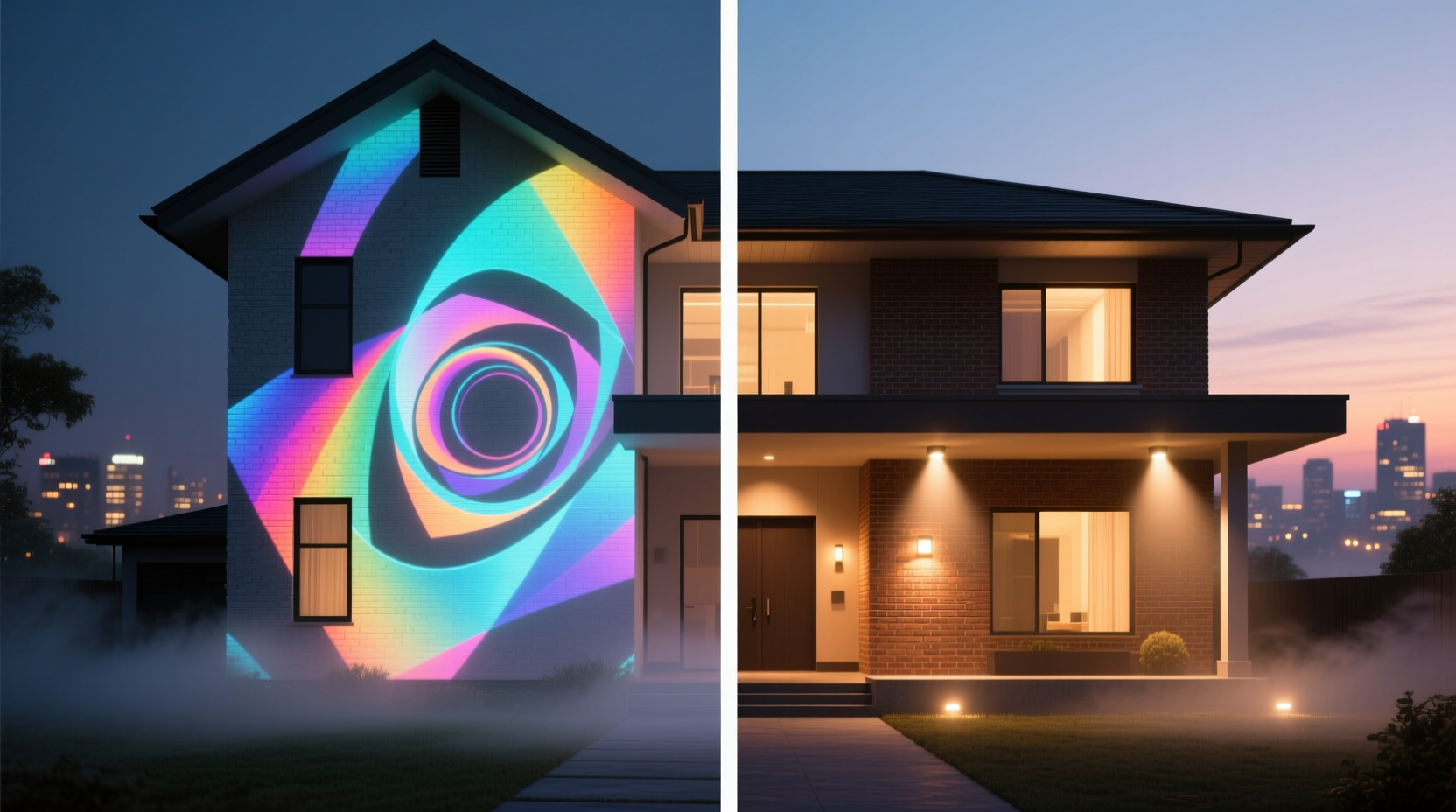
Before comparing tools, it’s essential to clarify what “depth” means in this context. In visual perception, depth is not generated by light alone—it emerges from the interplay of three elements: relative luminance gradients, cast shadow fidelity, and surface texture modulation. A flat wall lit evenly appears two-dimensional, regardless of wattage. But introduce subtle, directional illumination that accentuates brick mortar joints, reveals the curve of a cornice, or throws a crisp shadow from a balcony railing—and the brain instantly reconstructs three-dimensionality.
Physical lights achieve this by projecting light vectors that interact directly with topography: a narrow-beam LED grazing a stucco wall highlights ridges and recesses; uplighting a column creates graduated falloff that signals cylindrical form; cross-lighting from opposing angles yields stereoscopic contrast. Projection mapping, by contrast, simulates these effects digitally—overlaying pre-rendered gradients, shadows, and textures onto the surface via calibrated projectors. It doesn’t illuminate geometry; it *depicts* geometry.
Projection Mapping: Strengths, Limitations, and Depth Illusion
Projection mapping excels where physical access is impossible, surfaces are irregular or fragile, or dynamic storytelling is required. Its depth effect relies entirely on perceptual trickery—leveraging high-fidelity photogrammetry, precise edge blending, and real-time warping to align virtual shadows and highlights with physical contours. When executed flawlessly on a clean, matte, static façade viewed from a fixed vantage point, it can produce startlingly convincing volumetric illusions—especially for curved or sculptural architecture.
But depth illusion collapses under scrutiny. Move laterally just 2 meters, and parallax shifts expose the flatness beneath the image. At night, ambient light washes out contrast; at dawn, backlighting bleaches gradients. More critically, projection cannot cast *real* shadows onto adjacent surfaces—no overhang casts a true shadow on the sidewalk, no balcony rail interrupts light on the wall below. The absence of occlusion breaks visual continuity, triggering subconscious skepticism. As lighting designer Rafael Díaz observes: “A mapped ‘shadow’ may look correct on screen—but it doesn’t block light elsewhere. That inconsistency is what our peripheral vision detects first.”
“True depth requires light to behave like physics—not like pixels. Projection gives you the image of depth; physical lighting gives you its cause.” — Rafael Díaz, Principal Lighting Designer, Luminous Studio Barcelona
Physical Lighting: Depth Through Light Physics
Traditional architectural lighting builds depth through immutable optical laws. Grazing light reveals surface micro-topography. Wall washing delivers even vertical gradation that reinforces height and plane separation. Uplighting emphasizes verticality and mass; downlighting defines horizontal layers and thresholds. Crucially, physical fixtures generate real occlusion—shadows fall where geometry dictates, interacting dynamically with changing sun angles, weather, and viewer position.
This fidelity scales robustly. A well-designed scheme using IP66-rated LED modules embedded in soffits or mounted on ground stakes maintains depth perception across seasons, weather conditions, and viewing distances from 5 to 50 meters. It also integrates seamlessly with daylight: warm-white uplights at dusk enhance perceived warmth and solidity; cooler 4000K wall washers at midnight increase spatial clarity without glare.
Where physical lighting falters is flexibility. Retrofitting adjustable optics into historic masonry is labor-intensive. Reconfiguring beam angles for seasonal displays requires manual intervention or expensive motorized fixtures. And achieving seamless coverage across non-planar surfaces—like undulating tile roofs or ornate wrought-iron balconies—demands meticulous fixture placement and custom shielding.
Direct Comparison: Depth Performance Matrix
| Criterion | Projection Mapping | Physical Lights |
|---|---|---|
| Perceived Depth at Fixed Vantage Point | ★★★★☆ (Excellent with calibration; relies on viewer compliance) | ★★★☆☆ (Good; depends on fixture type and placement) |
| Depth Consistency Across Viewing Angles | ★☆☆☆☆ (Rapid degradation beyond ±5° off-axis) | ★★★★★ (Maintains volumetric cues across wide field of view) |
| Real Shadow Casting & Occlusion | None (simulated only) | ★★★★★ (physically accurate, dynamic, responsive) |
| Surface Texture Enhancement | ★★★☆☆ (Can simulate texture but obscures actual grain) | ★★★★★ (Grazing/washing reveals true mortar, stone grain, wood grain) |
| Long-Term Depth Stability | ★★☆☆☆ (Degrades with projector lamp decay, dust accumulation, misalignment) | ★★★★☆ (Stable for 50,000+ hours; minimal drift) |
| Weather & Ambient Light Resilience | ★★☆☆☆ (Washed out by rain, fog, moonlight, or street glow) | ★★★★☆ (IP66+ rated fixtures perform reliably in all conditions) |
Mini Case Study: The 1892 Brownstone Facade, Brooklyn
A heritage preservation group sought to highlight the intricate terra cotta ornamentation on a landmark brownstone without drilling into historic masonry. Two proposals were evaluated: a short-throw laser projector system ($28,000) and a discreet physical lighting scheme using micro-grazing LEDs ($32,000).
The projection solution delivered stunning results during the inaugural evening event—viewers stood at the designated “sweet spot” on the sidewalk, captivated by animated highlights tracing floral motifs and simulated depth in recessed panels. But within 48 hours, maintenance staff reported issues: dew condensed on the projector lens overnight, blurring morning previews; passing buses vibrated the mounting bracket, requiring daily recalibration; and neighbors complained about stray blue light spilling into bedroom windows.
The physical alternative used 14 custom-fitted 7W LED grazers, each less than 4 cm deep, mounted inside existing window wells and roof gutters—no masonry penetration. Beam angles were tuned to graze vertically oriented terra cotta ribs while avoiding spill. Within one week, the façade revealed previously unseen depth: mortar joints gained 3mm visual relief; the curvature of archivolts became tactile; and the layered projection of cornice brackets read as stacked mass rather than flat relief. Crucially, depth held whether viewed from the fire escape, the opposite sidewalk, or a passing car. After six months, the physical system required zero adjustment; the projector had undergone three realignments and one lamp replacement.
When to Choose Which (A Practical Decision Framework)
Selecting between projection and physical lighting isn’t about budget or novelty—it’s about matching technique to depth objectives. Use this step-by-step framework:
- Define your primary depth goal: Is it to reveal inherent architectural texture (choose physical), or to add narrative dimensionality (e.g., “making a wall appear to breathe” — choose projection)?
- Map the critical viewing zones: If >70% of viewers occupy a single corridor (e.g., festival entry path), projection is viable. If views come from multiple elevations (sidewalk, upper floors, adjacent buildings), physical lighting is mandatory.
- Assess surface stability: Does the façade shift seasonally (wood expansion), vibrate (near train lines), or accumulate grime rapidly (industrial zone)? Physical lights tolerate this; projection requires stable, clean geometry.
- Evaluate occlusion needs: Will depth be perceived in relation to surrounding elements—trees, benches, sidewalks? If yes, real shadows are non-negotiable. Projection cannot fulfill this.
- Calculate lifecycle commitment: Projection demands quarterly recalibration, annual lamp/panel service, and software updates. Physical systems need only biannual cleaning and driver checks. Choose based on available maintenance capacity—not just upfront cost.
Expert Tips for Maximizing Depth With Either Method
- For projection mapping: Use dual-projector stereo alignment instead of single-unit warping—this introduces micro-parallax that enhances volumetric believability at the primary viewing zone.
- For physical lighting: Layer at least two light types—e.g., a grazing layer for texture + a gentle wall wash for overall form definition. Avoid monochromatic schemes; subtle CCT variation (e.g., 2700K grazers + 3000K wash) adds chromatic depth cues.
- Always measure: Use a lux meter at multiple points across the façade—not just center. Depth perception correlates strongly with luminance ratio (max: min). Aim for 10:1 to 15:1 for residential-scale depth; 20:1 for civic-scale monumentality.
- Test before commit: Rent equipment and conduct full-scale mock-ups at dusk. Record video from key vantage points. Playback reveals depth failures invisible to the naked eye in real time.
FAQ
Can projection mapping create deeper depth than physical lights on highly textured surfaces?
No—on surfaces with pronounced relief (rough stone, deep brickwork, carved wood), physical grazing or raking light reveals true micro-shadowing that projection cannot replicate. Mapped “texture” sits optically on the surface plane; physical light penetrates crevices, generating genuine occlusion gradients.
Do colored physical lights reduce perceived depth compared to white light?
Only if poorly selected. Saturated colors compress luminance range and distort material perception. However, carefully calibrated warm whites (2700–3000K) with high CRI (>90) enhance depth by preserving tonal nuance and shadow richness. Avoid cool whites above 4500K on residential façades—they flatten form through excessive contrast and clinical sterility.
Is hybrid use ever advisable—projection plus physical lighting?
Yes—when used intentionally. Example: physical uplights establish base depth and real shadows on ground-level features (columns, steps), while projection adds time-based, non-physical depth layers (e.g., rippling water effect on a flat wall plane). The physical layer grounds the illusion; the projection extends it narratively. Critical rule: never let projection attempt to “fix” poor physical lighting—layer, don’t compensate.
Conclusion
Depth isn’t added—it’s uncovered. Projection mapping overlays an interpretation of depth, elegant and evocative within strict boundaries. Physical lighting excavates depth from the building itself, revealing what was always there in stone, brick, and shadow. Neither technique is obsolete, nor universally dominant. The most compelling façade experiences emerge when designers stop asking “which creates better depth?” and begin asking “what kind of depth does this building—and its people—need right now?” That question shifts focus from technology to intention, from spectacle to substance. Whether you’re specifying lights for a century-old townhouse or designing an immersive holiday experience, remember: the deepest impressions aren’t made with the brightest light, but with the most honest light—one that respects geometry, honors materiality, and invites the eye to travel not just across a surface, but into space itself.




 浙公网安备
33010002000092号
浙公网安备
33010002000092号 浙B2-20120091-4
Comments
No comments yet. Why don't you start the discussion?