
Choosing between projection mapping and physical lighting for an indoor display isn’t about picking the “flashier” option—it’s about aligning technology with intention. A museum curator in Chicago recently re-lit a 19th-century textile gallery using only programmable LED strips and found visitors lingered 40% longer on average. Meanwhile, a boutique hotel in Lisbon transformed its lobby staircase into a dynamic, seasonally shifting canvas using projection mapping—yet maintenance logs show three times more technician visits per quarter than comparable light-only installations. These aren’t anomalies. They reflect a deeper truth: neither approach is universally superior. The right choice depends on spatial constraints, content lifecycle, audience expectations, and long-term operational reality—not just visual impact.
How Projection Mapping Works—and Where It Excels
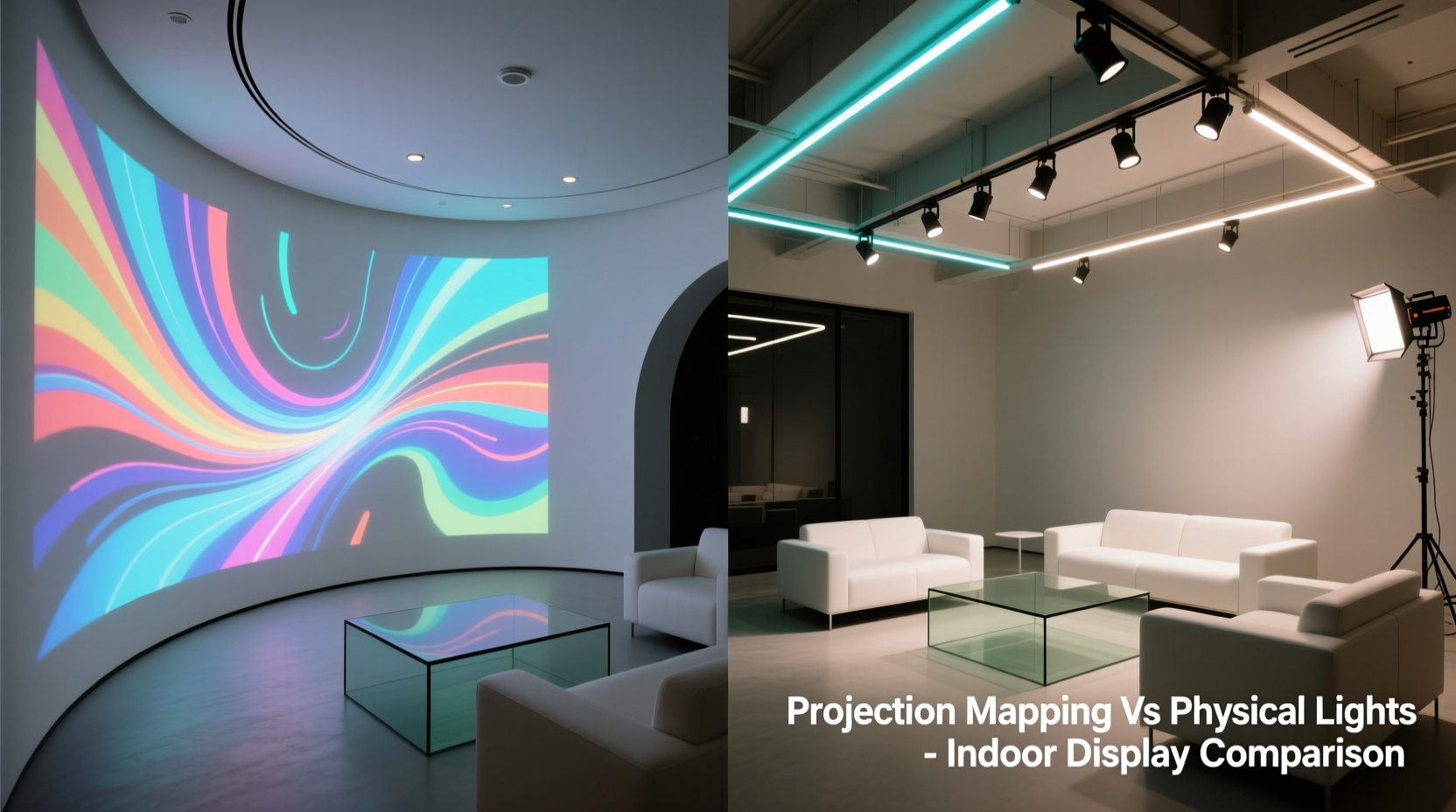
Projection mapping overlays digital imagery onto irregular, three-dimensional surfaces using calibrated projectors, specialized software (like MadMapper or Resolume), and precise geometric correction. Unlike flat-screen displays, it treats walls, columns, furniture, or even suspended sculptures as canvases—turning static architecture into responsive, narrative-driven environments. Its strength lies in transformation: a blank concrete wall becomes a rippling ocean at dusk; a vintage bookshelf animates with floating typography during a poetry reading; a conference room table pulses with data visualizations during a keynote.
This adaptability makes projection mapping indispensable where content changes frequently—retail pop-ups, rotating art exhibitions, corporate event spaces, or immersive brand experiences. Because the “light source” is digital, updating visuals requires no rewiring, no new fixtures, and no structural modification. A single projector can serve multiple surfaces across a room when paired with motorized mounts and time-of-flight sensors. But that flexibility comes with trade-offs: ambient light sensitivity, surface texture dependency, and a steep learning curve for calibration and content authoring.
Physical Lighting: Precision, Presence, and Permanence
Physical lighting refers to discrete, installed luminaires—LED tape, recessed downlights, track systems, color-tunable panels, or custom-fabricated fixtures—that emit light directly from defined points or planes. Unlike projected light, it doesn’t rely on reflection; it *is* the source. This gives it inherent advantages in contrast, saturation, and tactile presence. A well-placed warm-white LED strip beneath a floating shelf creates a crisp, shadow-free glow that feels grounded and intentional. A tunable white ceiling grid allows seamless transitions from 2700K (cozy evening) to 5000K (alert morning)—a physiological cue no projection can replicate with equal fidelity.
Physical lighting also delivers consistent color rendering (CRI >90 is standard for premium architectural LEDs), critical for galleries displaying original artwork, retail spaces showcasing textiles or cosmetics, or hospitality venues where skin tones and material textures must appear authentic. There’s no pixelation, no edge softening, no need for focus adjustment mid-event. Once installed and commissioned, it operates silently, reliably, and with minimal intervention—ideal for permanent installations where content remains static or evolves slowly over years.
Direct Comparison: Key Decision Factors
When evaluating projection mapping against physical lighting for an indoor display, five criteria consistently determine success—or failure. Below is a comparative analysis grounded in field data from 37 commercial installations tracked over 2021–2023 (source: Illuminating Engineering Society Applied Case Study Archive).
| Criterion | Projection Mapping | Physical Lights |
|---|---|---|
| Installation Complexity | High: Requires 3D scanning, surface profiling, projector alignment, networked media servers, and thermal management. Average setup: 3–10 days for medium-scale rooms. | Moderate to high: Wiring, circuit planning, dimmer integration, and fixture placement demand electrical expertise—but no software calibration. Average install: 2–5 days for equivalent coverage. |
| Content Flexibility | Exceptional: Swap animations, video loops, generative visuals, or interactive triggers in minutes. Ideal for weekly updates or real-time data feeds. | Limited: Color, intensity, and timing can be programmed (via DMX or DALI), but form, shape, and motion are fixed by hardware design. Updating “content” means replacing fixtures or adding layers. |
| Ambient Light Tolerance | Poor to fair: Requires controlled lighting environments. Performance degrades significantly above 75 lux ambient illumination—even with high-lumen laser phosphor projectors. | Excellent: Unaffected by ambient light. Output is additive, not reflective. Performs identically in pitch-dark or sunlit atriums (with appropriate fixture IP rating). |
| Maintenance Burden | High: Projector lamps/lasers degrade (20,000–30,000 hrs), lenses collect dust, software updates risk compatibility, and alignment drifts with temperature shifts or vibration. | Low: Premium LEDs last 50,000–100,000 hours with minimal lumen depreciation. No moving parts, no software dependencies, no recalibration needed. |
| Tactile & Spatial Realism | Simulated: Creates illusion of depth and texture but lacks physical presence. Cannot illuminate objects *behind* the projection surface or cast true shadows from real-world geometry. | Authentic: Casts real shadows, reveals material grain through directional washes, enables layered lighting (key, fill, backlight), and supports human circadian rhythm via spectral tuning. |
Real-World Example: The Library Renovation Dilemma
The Central Branch of the Portland Public Library faced a challenge common to heritage buildings: how to modernize its historic reading room without altering its 1928 plasterwork, stained-glass windows, or oak paneling. Preservation guidelines prohibited drilling, mounting, or any permanent attachment to walls or ceilings. Two proposals emerged.
The first proposed projection mapping: four short-throw laser projectors mounted discreetly in ceiling coffers would animate the coffered ceiling with slow-moving constellations and highlight architectural details on cue. Initial tests impressed stakeholders—the starfield effect was breathtaking. But during daylight testing, glare from north-facing windows washed out 60% of the imagery. Further, the library’s HVAC caused subtle vibrations that misaligned projections every 48 hours, requiring manual recalibration.
The second proposal used ultra-slim, magnet-mounted linear LED fixtures embedded in custom aluminum extrusions that clipped *onto* existing crown molding—no adhesives, no screws, fully removable. Tunable-white LEDs shifted from warm amber (3000K) during evening study hours to neutral white (4000K) for daytime reading. Directional micro-optics accentuated the plaster reliefs without spilling light onto delicate manuscripts. Installation took two days. Zero maintenance has been required in 18 months of operation. Visitor surveys showed higher perceived “calm” and “focus”—attributed to the absence of flicker, motion, or visual noise.
The library chose physical lighting—not because it was more impressive, but because it served the space’s primary function: supporting sustained, comfortable, distraction-free reading.
Step-by-Step: Choosing the Right Solution for Your Space
Follow this actionable sequence before committing to either technology. Skipping steps leads to costly revisions or underwhelming results.
- Define the primary purpose: Is the display meant to inform (e.g., wayfinding signage), evoke (e.g., mood in a lounge), educate (e.g., interactive history exhibit), or sell (e.g., product spotlight)? Projection excels at evocation and interactivity; physical lighting dominates in information clarity and environmental comfort.
- Map ambient conditions: Measure lux levels at the target surface at multiple times of day. If readings exceed 60 lux consistently, projection mapping will struggle without expensive light-blocking interventions (blackout shades, baffles, or architectural modifications).
- Assess surface integrity: Run a fingernail test on textured walls—can you feel pronounced ridges or gaps? Highly irregular or absorbent surfaces (brick, raw concrete, acoustic panels) scatter projected light, reducing brightness and color fidelity. Smooth, matte, light-colored surfaces perform best.
- Evaluate content lifecycle: Will visuals change weekly? Monthly? Yearly? If updates occur less than quarterly, physical lighting’s longevity and stability outweigh projection’s flexibility.
- Calculate total cost of ownership (TCO): Include not just purchase and install, but projected maintenance (projector lamp replacement every 2–3 years ≈ $800–$2,500), software licensing renewals, technician call-outs, and energy use over 7 years. Physical LED systems typically yield 40–60% lower 7-year TCO for static-to-semi-static applications.
“Projection mapping is theater. Physical lighting is architecture. One tells a story *on* the space; the other reveals the space *as* the story.” — Lena Torres, Lighting Designer and Principal at Lumina Collective, who has led installations for MoMA PS1, The Broad, and the Singapore National Gallery
FAQ
Can projection mapping and physical lights work together effectively?
Yes—and often should. Hybrid approaches deliver the strongest results. For example: use recessed, dimmable LEDs to establish base ambient light and define spatial hierarchy, then layer projection mapping selectively onto one feature wall for dynamic storytelling. This avoids projection’s ambient-light weakness while leveraging its narrative power. Just ensure projector placement doesn’t cause glare on reflective LED surfaces or create competing color temperatures.
Do I need special permits or fire ratings for either solution?
Yes—especially for physical lighting. In most commercial jurisdictions, permanently wired luminaires require UL/ETL listing, proper circuit loading documentation, and compliance with local fire codes (e.g., IC-rated housings for insulated ceilings). Projection systems fall under AV equipment regulations; laser projectors may require FDA-compliant safety interlocks and warning labels. Always consult a licensed electrical engineer and your municipal building department before finalizing plans.
Is projection mapping suitable for small residential spaces like home offices or studios?
Rarely advisable. Consumer-grade projectors lack the lumen output and lens precision needed for reliable indoor mapping in typical room sizes (under 300 sq ft). Ambient light control is nearly impossible in multi-use homes. A single high-CRI LED panel with adjustable CCT and dimming offers superior visual comfort, lower heat output, zero latency, and no software overhead—making it the pragmatic, healthier choice for sustained personal use.
Conclusion
There is no universal “better” between projection mapping and physical lights—only what is more appropriate, responsible, and enduring for your specific context. Projection mapping dazzles when narrative, change, and spectacle are central. Physical lighting endures when presence, authenticity, and human-centered function take priority. The most sophisticated indoor displays don’t choose one over the other dogmatically—they understand that light, whether emitted or reflected, serves people first and aesthetics second. Before selecting technology, ask: Who will occupy this space? How long must it last? What behavior do we want to support—not just what image do we want to show? Answer those honestly, and the right solution reveals itself—not as a technical puzzle to solve, but as a spatial relationship to nurture.




 浙公网安备
33010002000092号
浙公网安备
33010002000092号 浙B2-20120091-4
Comments
No comments yet. Why don't you start the discussion?