
Transforming the atmosphere of a room is no longer limited to repainting walls or rearranging furniture. With advancements in lighting and digital technology, two powerful tools have emerged as frontrunners in spatial transformation: projection mapping and physical lighting. While both can radically alter perception, mood, and aesthetic, they do so through fundamentally different mechanisms. The question isn’t just about brightness or color—it’s about depth, narrative, and immersion. When it comes to dramatic impact, one method may outshine the other depending on context, budget, and desired outcome.
The Nature of Transformation: Illusion vs Illumination
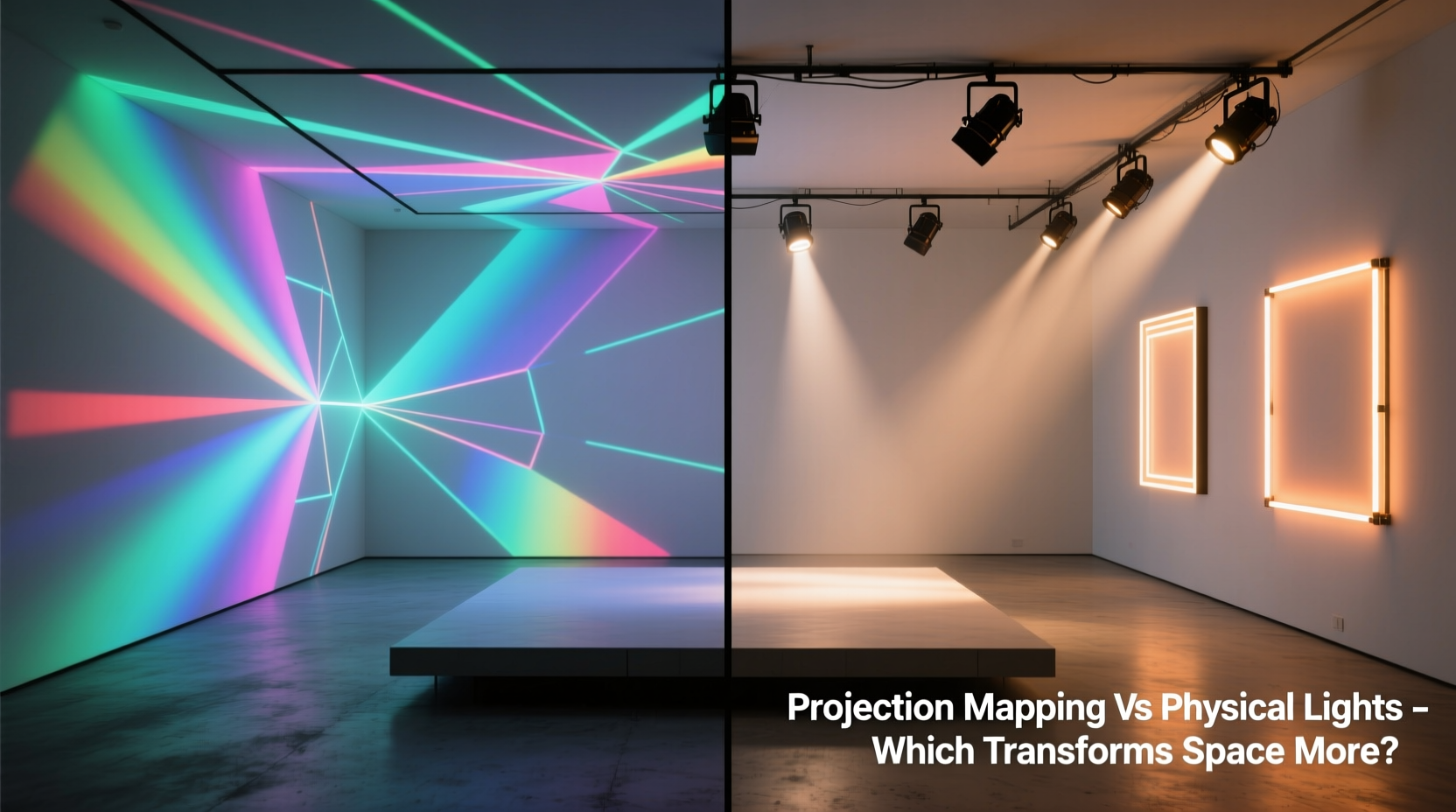
At its core, the difference between projection mapping and physical lighting lies in how they interact with space. Physical lights—such as LED strips, spotlights, chandeliers, or smart bulbs—alter a room by casting light onto surfaces. They work with existing architecture, enhancing textures, defining zones, and setting ambiance through hue, intensity, and placement.
In contrast, projection mapping doesn’t just illuminate—it redefines. By projecting precisely calibrated images, animations, or patterns onto three-dimensional surfaces, it creates optical illusions that can make flat walls appear textured, static objects seem to move, or entire rooms feel like alternate realities. It overlays new geometry onto real-world structures, effectively rewriting the visual language of a space without altering a single physical element.
“Projection mapping turns architecture into a canvas. It doesn’t decorate space—it reinvents it.” — Lena Petrov, Immersive Experience Designer
This fundamental distinction means that while physical lighting enhances what already exists, projection mapping can negate reality altogether. For sheer transformative power, especially in short-term installations or events, projection often wins by offering not just change, but metamorphosis.
Comparative Impact: Depth, Movement, and Emotional Resonance
Dramatic transformation isn’t solely about visual spectacle; it’s about emotional engagement. A dimmed room with warm ambient lighting might feel cozy, but a wall that appears to crack open and reveal a galaxy within evokes awe. Here’s where projection mapping pulls ahead in terms of visceral impact.
Physical lighting systems are excellent for consistent moods—romantic, energetic, calming—but their effects are largely static unless automated through complex programming. Even dynamic RGB setups follow predictable gradients or preset scenes. Projection mapping, however, introduces motion, storytelling, and interactivity. A staircase can appear to flow like water. A ceiling can simulate a thunderstorm. These aren’t subtle shifts—they’re full sensory overhauls.
Consider an art gallery opening. Using only physical lights, curators might spotlight each piece with focused beams. But with projection mapping, the walls themselves could become part of the exhibit—shifting colors, animating frames, even reacting to visitor movement. The experience becomes participatory, not passive. This level of engagement is difficult, if not impossible, to achieve with conventional lighting alone.
Technical Comparison: Setup, Flexibility, and Limitations
Despite its advantages, projection mapping isn’t universally superior. It comes with technical constraints that physical lighting typically avoids. Below is a breakdown of key factors influencing real-world usability.
| Factor | Projection Mapping | Physical Lights |
|---|---|---|
| Installation Complexity | High – requires surface calibration, masking, alignment | Low to medium – plug-and-play or simple wiring |
| Surface Dependency | Critical – works best on light-colored, non-reflective surfaces | Minimal – effective on any surface |
| Ambient Light Tolerance | Poor – requires dark or low-light environments | High – performs well in daylight and bright spaces |
| Content Flexibility | Very high – change visuals instantly via software | Moderate – limited to color, intensity, pattern changes |
| Lifespan & Maintenance | Moderate – projectors require bulb/diode maintenance | High – LEDs last 25,000–50,000 hours with minimal upkeep |
| Cost (Initial) | High – quality projectors and software add up | Low to moderate – scalable based on needs |
While projection mapping offers unparalleled flexibility in content, it demands controlled environments. Sunlit living rooms or glossy tiles can severely degrade image quality. Physical lights, meanwhile, function reliably across conditions. For permanent or everyday use—such as home theaters, restaurants, or offices—physical lighting remains the practical choice.
Real-World Example: Transforming a Hotel Lobby
In 2023, the Aurora Grand Hotel in Toronto sought to revitalize its aging lobby for a luxury rebrand. Two proposals were considered: one using advanced architectural lighting, the other employing large-scale projection mapping.
The lighting proposal included recessed floor uplights, programmable ceiling coves, and backlit marble panels. It promised elegance and sophistication—ideal for a high-end guest experience. The projection plan, however, involved mapping the entire 30-foot ceiling dome with evolving celestial themes: dawn skies in the morning, starfields at night, and seasonal auroras during special events.
The hotel chose projection mapping. Within days of launch, guest social media posts surged by 78%. Visitors described the space as “magical” and “otherworldly.” Staff reported guests lingering longer, taking photos, and asking about the technology. While the lighting design was technically flawless, it didn’t generate the same emotional response or viral attention.
This case illustrates a key truth: when the goal is dramatic transformation—not just improvement—projection mapping has a unique ability to captivate and surprise.
When Physical Lighting Excels
That said, physical lighting dominates in scenarios requiring reliability, subtlety, or integration into daily life. Consider residential interiors. A homeowner might use tunable white LEDs to shift from energizing blue-white in the morning to warm amber in the evening, supporting circadian rhythms. This kind of seamless, functional adaptation is beyond the scope of most projection systems.
Additionally, physical lights contribute to safety and usability. Stairwell lighting, kitchen task lighting, or bathroom vanity fixtures serve essential roles that projection cannot fulfill. No amount of animated vines on a wall replaces the need for adequate illumination to prevent accidents.
- Physical lighting provides consistent, functional brightness.
- It integrates naturally into architectural design.
- It supports health and productivity through circadian tuning.
- It operates efficiently over long periods with minimal energy use.
In environments where drama must coexist with utility—homes, offices, hospitals—physical lighting is not just preferable; it’s necessary.
Step-by-Step Guide: Choosing the Right Tool for Your Space
Deciding between projection mapping and physical lights depends on your goals, resources, and environment. Follow this sequence to make an informed decision:
- Define the purpose: Is the transformation meant to be functional, decorative, or experiential?
- Assess the environment: Evaluate ambient light levels, surface colors, and room geometry.
- Determine duration: Is this a temporary event or a permanent installation?
- Set a budget: Include equipment, software, labor, and maintenance costs.
- Test both options: Run small-scale demos—project a sample animation, install a mock lighting scheme.
- Evaluate audience impact: Gather feedback on emotional response and perceived value.
- Choose or combine: Select the best fit—or integrate both for layered effects.
This process ensures that your choice aligns with both practical needs and creative ambitions.
Expert Insight: The Future of Spatial Design
As technology evolves, the line between projection and lighting continues to blur. New hybrid systems now embed micro-projectors into light fixtures, allowing dynamic content to be cast alongside ambient illumination. Others use laser-based projection for higher brightness and precision in lit environments.
“We’re moving toward intelligent environments where light doesn’t just shine—it communicates, adapts, and tells stories.” — Dr. Rajiv Mehta, Director of Interactive Environments Lab, MIT
Future rooms may use AI-driven sensors to adjust both projected content and physical lighting in real time, responding to occupancy, time of day, or even emotional cues. In such ecosystems, neither tool will dominate—their synergy will define the next generation of spatial transformation.
Frequently Asked Questions
Can projection mapping work in a brightly lit room?
Generally, no. Most consumer and mid-range projectors struggle in ambient light. High-lumen laser projectors (8,000+ lumens) can perform better, but even then, contrast and color fidelity suffer. For well-lit spaces, physical lighting or transparent OLED displays are more effective.
Is projection mapping expensive to maintain?
Yes, relatively. Projector lamps last 1,500–4,000 hours and can cost $200–$500 to replace. LED-based projectors last longer (up to 20,000 hours) but come with higher upfront costs. Physical LED systems, by comparison, often exceed 30,000 hours with no consumables.
Can I use both projection and physical lights together?
Absolutely—and you should. Combining both creates depth. Use physical lights to highlight architectural features and ensure visibility, while projection adds narrative layers. For example, a restaurant might use warm pendant lights for dining comfort while projecting animated foliage onto side walls for ambiance.
Action Plan: How to Get Started
If you're ready to explore dramatic room transformation, begin with clarity and experimentation.
- ✅ Identify the primary goal: mood, function, or spectacle?
- ✅ Measure your space and note surface types and light conditions.
- ✅ Research projector specs (lumens, resolution, throw ratio) or lighting types (CCT, CRI, beam angle).
- ✅ Create a short demo: use a rented projector or smart bulb kit to test effects.
- ✅ Consult a professional if planning large-scale or permanent installations.
- ✅ Document results and gather feedback before scaling up.
Conclusion
So, which transforms a room more dramatically—projection mapping or physical lights? The answer hinges on intent. For deep, narrative-driven, visually stunning transformations that defy reality, projection mapping takes the crown. It turns walls into windows, floors into oceans, and ceilings into skies. But for enduring, functional, and seamlessly integrated change, physical lighting remains unmatched.
The most dramatic spaces don’t choose one over the other—they harness both. Light shapes perception; projection reshapes it. Together, they offer a complete toolkit for reimagining any environment. Whether you’re designing a home, hosting an event, or reinventing a public space, consider not just how to light it—but how to transform it entirely.




 浙公网安备
33010002000092号
浙公网安备
33010002000092号 浙B2-20120091-4
Comments
No comments yet. Why don't you start the discussion?