
Transforming a room from ordinary to extraordinary has become an art form in interior design, event production, and experiential marketing. Two powerful tools dominate this space: projection mapping and physical lighting. While both can alter the mood, perception, and function of a space, they operate on fundamentally different principles. One manipulates light as information, the other as presence. Choosing between them isn't just about brightness or color—it's about intent, impact, and immersion.
The question isn’t whether either technology works, but which one delivers a more dramatic transformation under specific conditions. A well-placed chandelier changes ambiance; a precisely calibrated projection can make walls breathe. Understanding when and why each excels reveals not just technical differences, but creative philosophy.
The Nature of Transformation: Defining \"Dramatic\"
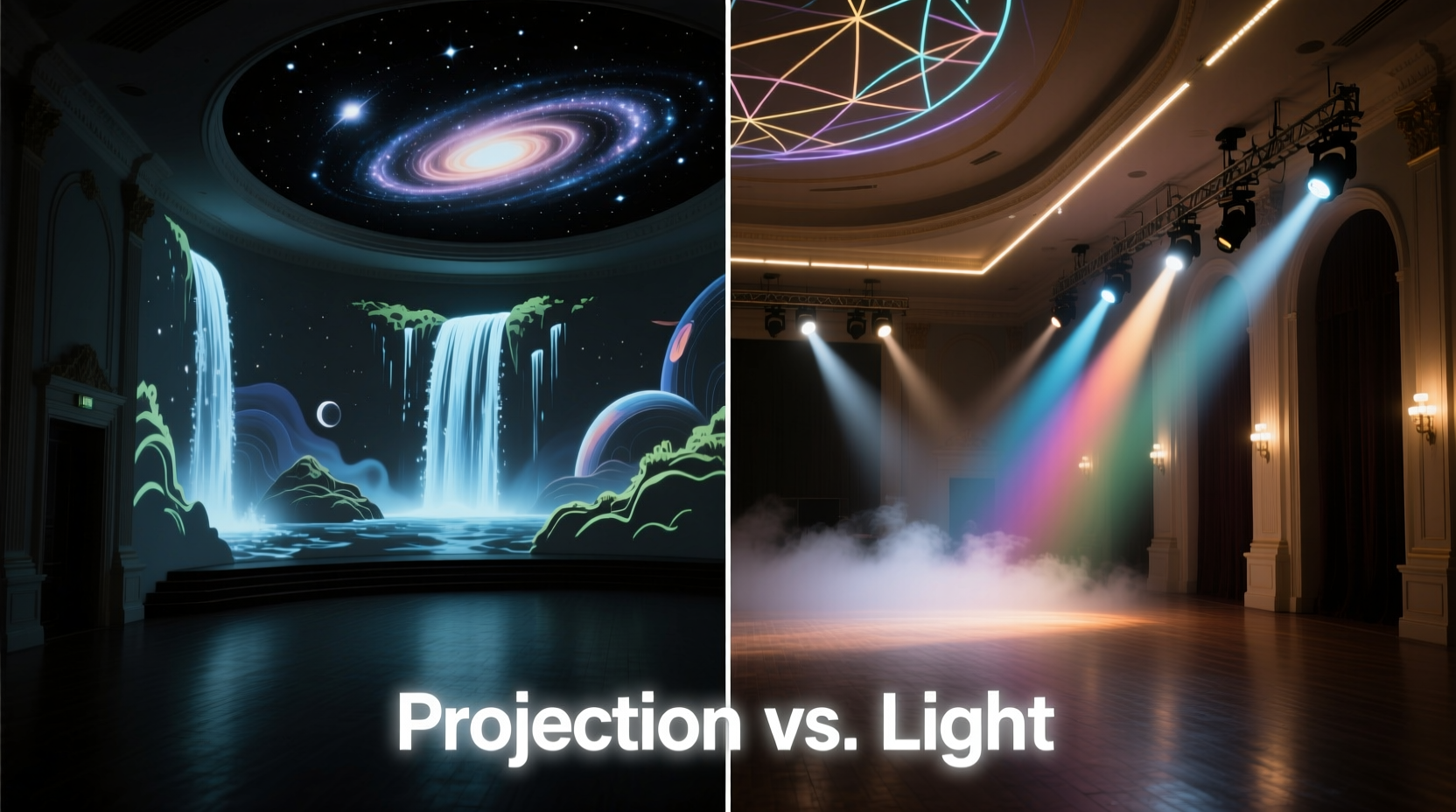
Before comparing technologies, it’s essential to define what “dramatic transformation” means in spatial terms. It goes beyond aesthetic appeal. A dramatic change alters:
- Perception of space — making small rooms feel expansive or flat surfaces appear three-dimensional.
- Emotional response — evoking awe, nostalgia, tension, or wonder.
- Functionality — repurposing a room temporarily (e.g., turning a conference hall into an underwater dreamscape).
- Temporal dynamics — introducing movement, narrative, or interactivity that evolves over time.
Physical lighting modifies atmosphere through intensity, hue, direction, and shadow. It enhances architecture but rarely redefines it. Projection mapping, by contrast, overlays dynamic visuals directly onto surfaces, effectively redrawing reality. This distinction becomes critical when evaluating dramatic impact.
“Lighting sets the tone. Projection tells the story.” — Lena Torres, Immersive Experience Designer at Atmosfera Labs
How Physical Lighting Transforms Rooms
Physical lighting—LED strips, spotlights, ambient fixtures, intelligent moving heads—has long been the backbone of environmental transformation. Its strengths lie in consistency, reliability, and integration with architectural elements.
In residential spaces, layered lighting (ambient, task, accent) can redefine how a room is used and perceived. A dimmed warm glow creates intimacy; cool white task lighting sharpens focus. In commercial or event environments, dynamic RGB systems allow color shifts synchronized to music or mood, producing visceral reactions.
However, physical lights are limited by hardware placement and surface neutrality. They illuminate but do not inherently project imagery. To create patterns or scenes, gobos (stencils placed in front of lights) or complex rigging are required—adding cost and reducing flexibility.
Pros and Cons of Physical Lighting
| Advantage | Description |
|---|---|
| Persistent Ambiance | Provides continuous, reliable illumination ideal for long-term installations. |
| High Brightness | Superior lumen output ensures visibility even in large or bright spaces. |
| Architectural Integration | Can be embedded into ceilings, floors, or furniture for seamless design. |
| Low Latency Control | Instant response to DMX or wireless signals enables precise timing. |
| Limitation | Description |
| Static Imagery | Cannot display complex moving visuals without additional optics or projectors. |
| Fixed Installation | Relocation or reconfiguration often requires rewiring or structural changes. |
| Limited Narrative Potential | Conveys mood rather than story or data-driven content. |
The Power of Projection Mapping
Projection mapping uses software to warp and align projected images onto irregular surfaces—walls, furniture, staircases—turning static objects into dynamic canvases. Unlike standard projection, it accounts for depth and geometry, creating illusions of movement, texture, and transformation.
A blank wall becomes a cascading waterfall. A staircase morphs into a field of blooming flowers. These effects rely on 3D surface scanning, edge blending across multiple projectors, and real-time rendering engines like TouchDesigner or Notch. The result is not just visual enhancement, but perceptual deception.
This technology shines in temporary installations: art exhibitions, product launches, weddings, theater sets. Because it’s non-invasive, it leaves no permanent trace—ideal for historic buildings or rented venues.
“I once mapped a 17th-century library to look like it was being consumed by digital vines. Guests reached out to touch the ‘growing’ tendrils. That’s the power of illusion.” — Marcus Reed, Projection Artist
Key Advantages of Projection Mapping
- Surface Agnosticism: Works on curved, textured, or uneven surfaces where physical lights would fail to create coherent imagery.
- Narrative Depth: Can tell stories through animated sequences, text, or interactive triggers.
- Rapid Reconfiguration: Change the entire environment in minutes via software updates—no rewiring needed.
- Immersive Illusion: Creates depth, motion, and impossible physics (e.g., melting walls, floating objects).
Yet, projection mapping demands ideal conditions: low ambient light, high-lumen projectors, and careful calibration. Sunlit rooms or reflective surfaces can wash out effects, diminishing impact.
Comparative Analysis: When Each Technology Excels
The choice between projection mapping and physical lights depends on context, budget, duration, and desired effect. Below is a scenario-based comparison:
| Scenario | Best Choice | Reason |
|---|---|---|
| Wedding Reception (Ballroom) | Projection Mapping | Transforms plain walls into enchanted forests or starry skies with minimal setup. |
| Home Theater Ambient Lighting | Physical Lights | Consistent backlighting improves viewing comfort without distraction. |
| Museum Exhibit (Temporary) | Projection Mapping | Animates artifacts or walls with historical narratives without altering structures. |
| Restaurant Mood Lighting | Physical Lights | Warm, adjustable fixtures enhance dining experience sustainably over years. |
| Product Launch (Brand Activation) | Projection Mapping | Dramatic reveal of a car emerging from a wall creates viral moments. |
| Office Workspace | Physical Lights | Daylight-simulating panels support productivity and circadian rhythms. |
Projection mapping wins in scenarios demanding surprise, storytelling, or radical visual overhaul. Physical lighting prevails where stability, longevity, and subtlety matter most.
Mini Case Study: Transforming a Historic Ballroom
A luxury hotel in Vienna sought to revitalize its 19th-century ballroom for a modern gala. The space had ornate plasterwork but outdated chandeliers and poor acoustics. The client wanted drama without damaging heritage features.
The team opted for hybrid design: physical LED uplighting to gently highlight architectural details, combined with four high-lumen laser projectors for floor-to-ceiling mapping. Over 90 minutes, the room cycled through themes—Austro-Hungarian opulence, alpine auroras, digital baroque patterns.
Guests reported feeling “transported,” with many unaware the projections weren’t permanent installations. The physical lights provided grounding realism; the projections delivered spectacle. Together, they achieved a transformation neither could alone.
Step-by-Step Guide to Choosing Your Approach
Follow this decision framework to determine the right tool for your space:
- Define the Goal: Are you enhancing mood (physical lights) or creating illusion (projection)?
- Assess the Environment: Measure ambient light, surface texture, and room size. Darker, matte spaces favor projection.
- Estimate Duration: Long-term installations benefit from durable physical systems. Short events lean toward flexible projection.
- Budget Constraints: High-end projectors and media servers cost more upfront. Physical lighting may require costly installation but less content creation.
- Content Needs: Do you need video, animation, interactivity? If yes, projection mapping is likely necessary.
- Test On-Site: Always conduct a mockup. Project a test image; measure lux levels for lighting. Adjust based on real-world performance.
Hybrid Solutions: The Best of Both Worlds
The most dramatic transformations often combine both technologies. Physical lights shape volume and depth; projections add narrative layers. For example:
- Uplighting a column while projecting climbing ivy gives both realism and fantasy.
- Using LED strips along the baseboard to ground a scene while overhead projectors simulate falling snow.
- Synchronizing color-changing bulbs with mapped animations to reinforce transitions (e.g., lights dim as a digital sunset unfolds).
This synergy amplifies impact. The brain perceives consistent lighting cues as “real,” making projected illusions more believable. The result is deeper immersion.
Frequently Asked Questions
Can projection mapping work in a brightly lit room?
Generally, no. High ambient light washes out projected images. For daytime use, consider rear-projection screens or extremely high-lumen projectors (15,000+ lumens), though these are expensive and may still struggle. Controlling light is key to success.
Is physical lighting more energy-efficient than projection mapping?
Yes, typically. Modern LED fixtures consume far less power than high-output projectors and generate less heat. A single 10,000-lumen projector can use 1,000 watts, while equivalent ambient lighting might use 150 watts. For permanent installations, efficiency favors physical lights.
Do I need special surfaces for projection mapping?
Not necessarily, but results vary. Matte, neutral-colored surfaces work best. Glossy or dark walls absorb or reflect light poorly. However, advanced software can compensate somewhat by adjusting brightness and color balance per zone.
Conclusion: Dramatic Transformation Depends on Intent
So, which transforms rooms more dramatically—projection mapping or physical lights? The answer lies in purpose. If the goal is enduring elegance, functional adaptability, and subtle emotional influence, physical lighting is unmatched. But if the aim is astonishment, narrative immersion, and visual reinvention, projection mapping holds the crown.
Neither is universally superior. The most compelling spaces today leverage both: using light as structure and projection as story. As technology converges—smart LEDs integrated with AR, projectors with AI-driven warping—the line will blur further. Yet the core principle remains: transformation begins not with tools, but with vision.




 浙公网安备
33010002000092号
浙公网安备
33010002000092号 浙B2-20120091-4
Comments
No comments yet. Why don't you start the discussion?