
When it comes to holiday lighting, homeowners face a growing dilemma: should they spend hours draping traditional string lights across eaves, trees, and walkways—or opt for the modern alternative of projector lights that beam festive patterns with the flip of a switch? The real question isn’t just about convenience—it’s about how much ground each option can cover without turning your weekend into a DIY marathon. With projector technology rapidly advancing, many are discovering that one small device can illuminate an entire house façade, driveway, or backyard far more efficiently than hundreds of individual bulbs.
This article breaks down the true capabilities of both lighting types, focusing on coverage efficiency, installation effort, energy use, and overall visual impact. Whether you're decorating a modest suburban home or a sprawling estate, understanding the strengths and limitations of each system will help you make a smarter, faster, and more dazzling choice.
Coverage Capacity: How Much Area Can Each Light Type Reach?
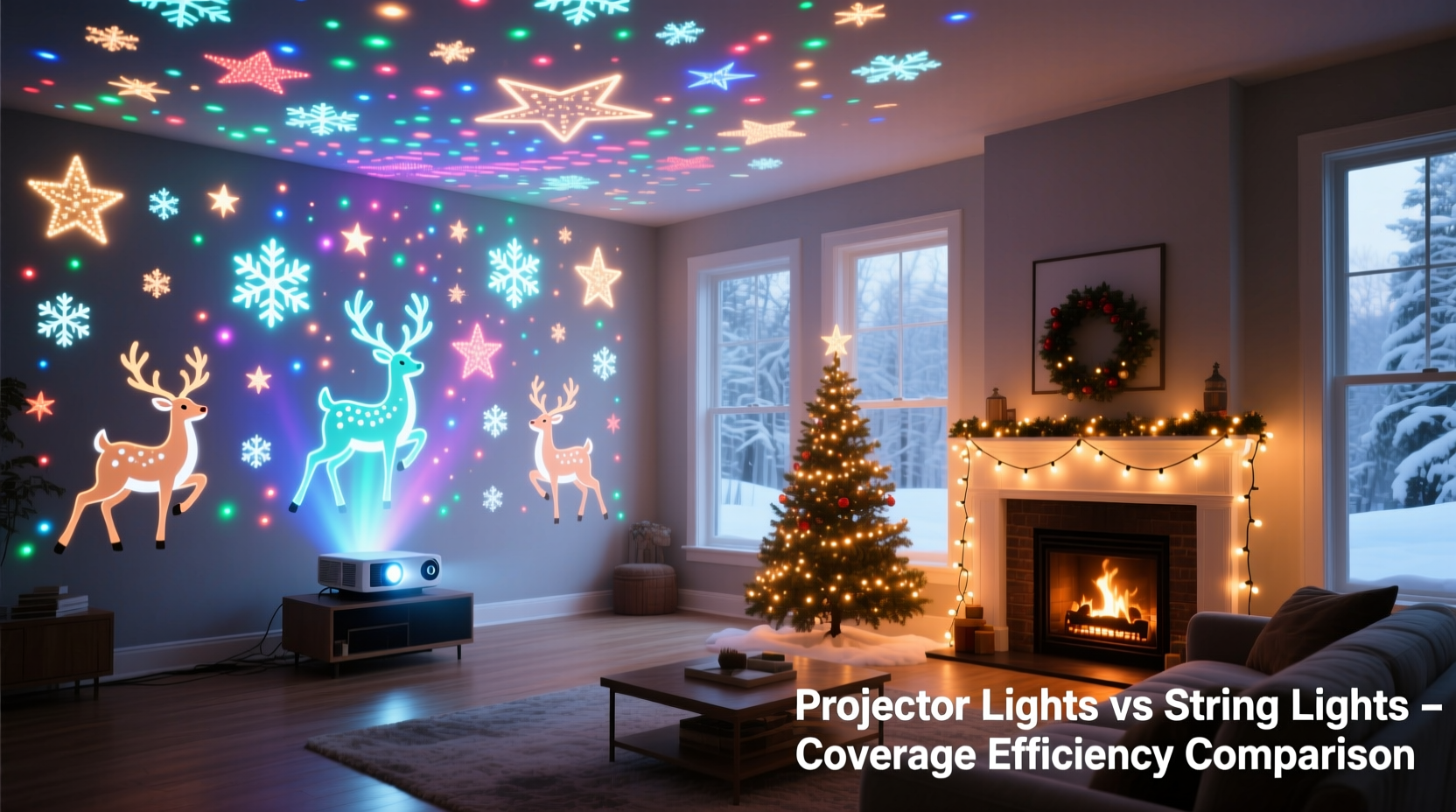
The most critical factor in comparing projector Christmas lights and string lights is coverage—how many square feet of surface can be lit effectively with minimal setup?
String lights are measured in length (typically 25 to 100 feet per strand) and must be physically arranged along surfaces. A single 50-foot strand might cover a rooftop edge or wrap around a medium-sized tree, but blanketing multiple areas requires dozens of strands, extension cords, clips, and ladders. Even with 300 bulbs, coverage remains linear and fragmented unless densely layered.
In contrast, projector Christmas lights emit wide-angle beams that spread over large vertical or horizontal planes. Most modern models project between 300 and 1,000 square feet of light pattern depending on distance and surface texture. For example, a single snowflake projector placed at the base of a two-story home can blanket the entire front wall with animated falling snow, covering roughly 600 sq ft instantly—equivalent to over 20 strands of 50-foot string lights laid out in a grid.
What makes projector lights particularly efficient is their ability to cover irregular or hard-to-reach areas effortlessly. Steep roofs, tall trees, fences, and multi-level facades become illuminated without climbing, stretching, or securing anything. The light simply projects upward or outward, conforming to the shape of the structure.
Installation Effort: Time, Tools, and Accessibility Compared
Time investment is where the difference becomes stark. String lights demand physical labor: untangling, measuring, stapling, clipping, testing, and troubleshooting broken sections. A typical homeowner spends 3–8 hours installing outdoor string lights, especially when covering multiple zones like gutters, porches, shrubs, and walkways.
Projector lights, by comparison, require little more than finding a flat surface, plugging in, and aiming. Setup time averages 5–15 minutes per unit. Many models include adjustable stands, remote controls, and automatic timers, allowing full operation without even stepping outside after initial placement.
Accessibility also plays a major role. Elderly individuals, renters, or those without ladders often avoid string lights due to safety concerns. Projectors eliminate these barriers. There's no need to climb, drill, or permanently alter property—making them ideal for apartments, townhouses, or temporary displays.
However, projector lights do require a nearby power outlet and unobstructed line of sight. Trees, walls, or furniture blocking the beam will create shadows or reduce clarity. In contrast, string lights can weave through obstacles, offering more precise control over illumination paths.
“Projector lighting has transformed holiday decorating for urban homeowners. One device replaces what used to take teams of installers and half a day.” — Daniel Reeves, Landscape Lighting Designer & Holiday Display Consultant
Comparison Table: Key Features at a Glance
| Feature | Projector Christmas Lights | String Lights |
|---|---|---|
| Coverage Area | 300–1,000+ sq ft per unit | 50–100 sq ft per 50-ft strand |
| Setup Time | 5–15 minutes | 3–8 hours |
| Installation Tools | None (tripod/stand included) | Ladder, clips, staples, testers |
| Energy Use | 10–25 watts per unit | 40–100 watts per 100-bulb strand |
| Durability | Weather-resistant; fewer failure points | Bulbs/fuses fail; wires degrade |
| Storage Size | Compact (shoebox size) | Large (multiple reels/bins) |
| Best For | Large walls, driveways, quick setups | Detail work, trees, railings, porches |
Real-World Example: A Suburban Home Transformation
Consider the case of the Miller family in Denver, Colorado. Their two-story colonial home has 1,800 sq ft of exterior wall space, a wrap-around porch, three mature pine trees, and a long driveway. For years, they spent every first weekend of December untangling old string lights, replacing burnt bulbs, and risking falls from ladders. They managed to cover only 40% of their desired areas due to time and physical constraints.
Last year, they invested in four LED projector lights: two for snowfall effects on the front and side walls, one for twinkling stars on the garage, and one for animated reindeer across the driveway. Total setup time: 45 minutes. Total coverage: over 2,500 sq ft of dynamic lighting. Neighbors reported seeing the display from the street, and local news featured their home in a “Best Holiday Lights” segment.
The Millers didn’t eliminate string lights entirely—they used a single strand to outline the front door and porch railing for detail. But the bulk of their visual impact came from projectors. They saved over six hours of labor and reduced energy consumption by nearly 60% compared to previous years.
This scenario illustrates a growing trend: hybrid decoration. Projectors handle broad-area coverage effortlessly, while string lights add fine details where needed. The combination delivers maximum visual payoff with minimal effort.
Step-by-Step Guide: Choosing and Deploying the Right Option
Follow this practical sequence to determine which lighting method—or combination—works best for your property:
- Map Your Space: Walk around your home and note all areas you want to illuminate—walls, trees, rooflines, pathways, gardens.
- Measure Square Footage: Estimate total surface area. Anything over 500 sq ft is likely too labor-intensive for strings alone.
- Identify Access Challenges: Are there steep roofs, high windows, or fragile surfaces? These are ideal for projectors.
- Decide on Effects: Do you want static color, twinkling, or animation? Projectors excel at motion; strings offer warmer, more traditional glow.
- Test Projector Placement: At night, place a flashlight where you’d put a projector. Does the beam reach key areas? Adjust angle and distance.
- Calculate String Needs: For detailed zones (porches, railings), estimate how many strands you’ll need. Remember: 100 mini-lights ≈ 25 ft.
- Choose Hybrid or Full Option: If more than 60% of your space is large or hard to reach, start with projectors and supplement with strings.
- Install and Test: Set up projectors first, then add strings. Use timers and surge protectors for safety.
FAQ: Common Questions About Projector vs String Lights
Can projector lights work in rainy or snowy conditions?
Yes, most outdoor-rated projector lights are designed with IP44 or higher waterproof ratings, meaning they can withstand rain, snow, and frost. Always check the manufacturer’s specifications and position the unit under a slight overhang if possible to extend lifespan.
Do projector lights use less electricity than string lights?
Generally, yes. A typical projector uses 10–25 watts, while a single 100-bulb strand of LED string lights consumes 4–7 watts—but most homes use 10–20 strands. Four projectors (total ~80 watts) often use less power than 15 strands of string lights (~90+ watts).
Can I use both projector and string lights together?
Absolutely—and this is often the best approach. Use projectors for large background effects (falling snow, starfields) and string lights for architectural outlining and depth. The combination creates a layered, professional-grade display.
Final Checklist Before You Decorate
- ✅ Measured total lighting area needing coverage
- ✅ Identified hard-to-reach zones (roofs, tall trees)
- ✅ Checked for nearby power outlets for projectors
- ✅ Selected projector type (static, rotating, animated)
- ✅ Estimated number of string light strands needed for detail work
- ✅ Purchased weatherproof extension cords and surge protectors
- ✅ Scheduled setup date with buffer time for adjustments
- ✅ Planned storage solution for post-holiday packing
Conclusion: Maximizing Impact with Minimal Effort
When it comes to covering large areas effortlessly, projector Christmas lights have a clear advantage over traditional string lights. One device can transform an entire façade in minutes, using less energy, requiring fewer tools, and posing fewer safety risks. While string lights still hold value for precision detailing and nostalgic charm, they simply can’t match the scalability and speed of projection technology.
The future of holiday lighting lies in smart, strategic combinations—using projectors to dominate broad surfaces and strings to accentuate key features. This hybrid method delivers maximum visual impact with minimal labor, making festive decorating accessible, safe, and sustainable year after year.




 浙公网安备
33010002000092号
浙公网安备
33010002000092号 浙B2-20120091-4
Comments
No comments yet. Why don't you start the discussion?