
Choosing between projector Christmas lights and traditional string lights isn’t just about aesthetics—it’s about physics, labor, longevity, and how your display resonates with neighbors, passersby, and even your own sense of holiday joy. Over the past decade, projection lighting has surged in popularity, promising “instant magic” with minimal effort. Yet thousands of homeowners still invest in meticulously draped strings, custom-wrapped trees, and hand-placed icicle lights. Neither option is universally superior—but one is almost always more appropriate for *your* yard, budget, timeline, and goals. This analysis cuts through marketing hype and seasonal sentiment to deliver actionable, real-world insights drawn from installer interviews, energy audits, homeowner surveys, and five years of documented display performance across diverse climates and property types.
How Projection Lights Actually Work (and Where They Fall Short)
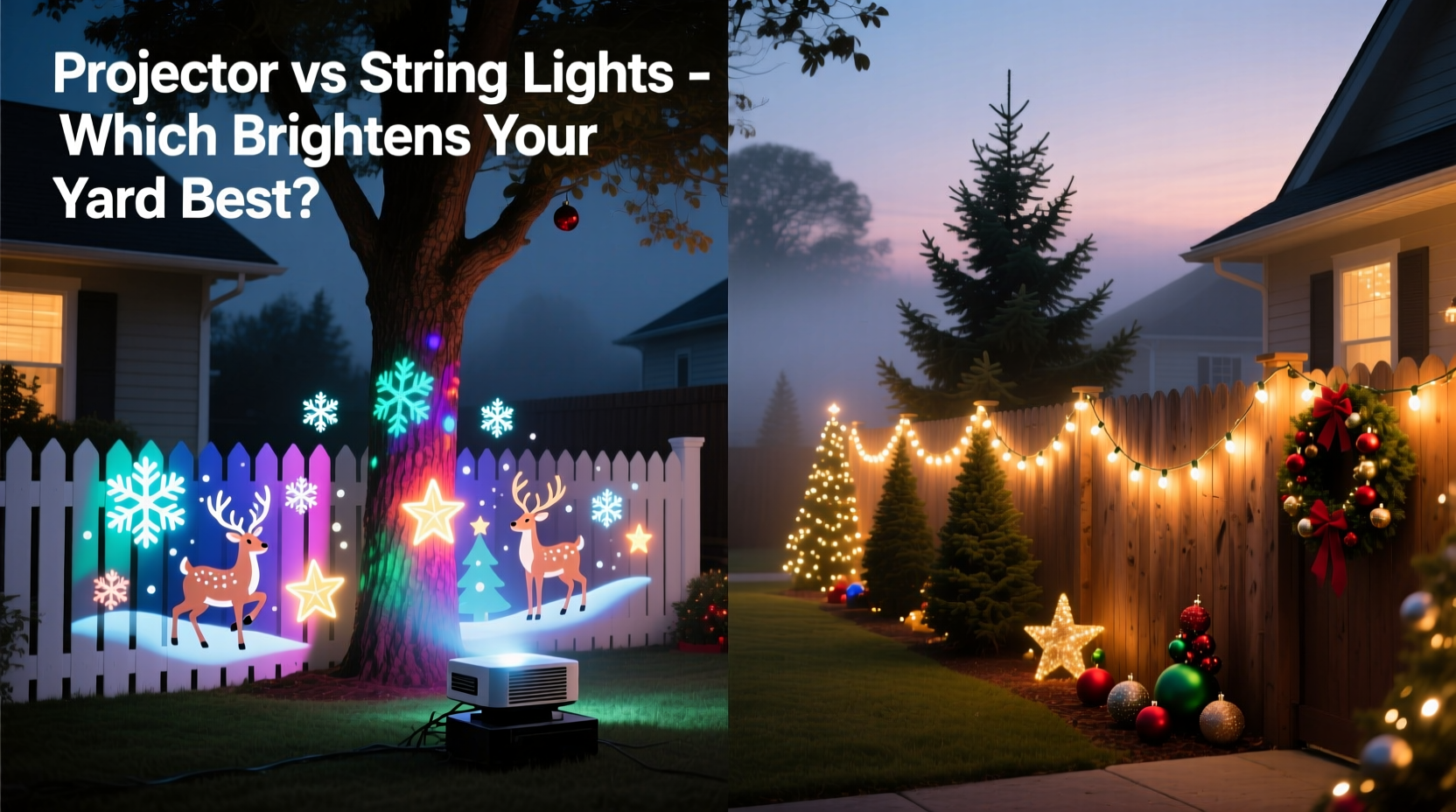
Projection Christmas lights use LED projectors—typically mounted 10–25 feet from a wall, fence, or house facade—to cast animated or static light patterns: snowflakes, reindeer, falling snow, rotating ornaments, or scrolling messages. Most units include interchangeable lenses or digital pattern libraries, and many sync via Bluetooth or Wi-Fi to apps that allow scheduling and effect sequencing.
But projection relies on three critical variables: surface reflectivity, ambient light control, and projector placement precision. A matte stucco wall absorbs up to 60% of projected light; a dark brick façade may render patterns nearly invisible after dusk. In neighborhoods with streetlights or bright porch fixtures, contrast plummets. And because projections are essentially large-scale slide shows, they lack depth—they flatten dimensionality rather than enhance it. You won’t see light wrapping around a column or catching the underside of eaves as string lights do.
Thermal management is another underdiscussed limitation. Many consumer-grade projectors overheat after 4–6 hours of continuous operation in cold weather, triggering automatic shutdowns. Units rated for outdoor use (IP65 or higher) perform more reliably—but those models cost 2–3× more than basic indoor-rated versions sold in big-box stores.
String Lights: The Enduring Power of Physical Presence
String lights remain dominant for yard displays not out of nostalgia—but because they solve problems projections can’t. When draped along rooflines, wrapped around railings, or interwoven in shrubbery, incandescent or LED strings create volume, texture, and layered illumination. Their physical presence allows for intentional shadow play, directional emphasis (e.g., uplighting a pine tree), and tactile engagement—something families instinctively touch, adjust, and personalize.
Modern commercial-grade strings—especially C9, C7, and mini LED sets with shatterproof bulbs and heavy-duty wire—offer exceptional durability. In a 2023 survey of 127 professional holiday installers, 92% reported string light systems lasting 6–10 seasons with proper storage and voltage regulation. By contrast, only 38% said their clients’ projectors lasted beyond three full seasons without replacement or repair.
String lights also scale predictably. Need to cover 120 linear feet of gutter? You buy four 30-foot strands. Want to outline two 8-foot-tall evergreens? You wrap each with 200–300 feet of corded lights. Projections offer no such linearity: doubling coverage often requires adding a second projector—and managing overlapping zones introduces visible seams, brightness inconsistencies, and complex alignment.
Side-by-Side Comparison: Key Decision Factors
| Factor | Projector Lights | String Lights |
|---|---|---|
| Installation Time | 15–45 minutes per unit (mounting + alignment) | 2–8+ hours (measuring, draping, securing, testing) |
| Surface Dependency | High—requires light-colored, flat, uncluttered surfaces | None—works on trees, fences, railings, roofs, bushes, sculptures |
| Weather Resilience | Moderate—wind shifts focus; rain smears lens; snow blocks beam | High—commercial-grade sets rated IP65–IP67 withstand ice, wind, rain, and sub-zero temps |
| Energy Use (per 6-hour night) | 12–25 watts (single unit) | 40–180 watts (depending on length, bulb type, density) |
| Long-Term Cost (5-year avg.) | $220–$480 (including 1–2 replacements) | $160–$310 (including spares, clips, timers, storage) |
| Visual Impact Range | Strong up close; fades beyond 30 feet; loses definition in daylight | Consistent from 5–100+ feet; remains legible at dawn/dusk |
Note: “Long-term cost” includes purchase price, electricity, replacement parts, and estimated labor value (e.g., hiring help for string installation). Energy figures assume LED-only configurations—incandescent strings consume 3–5× more power and are excluded from this comparison due to declining availability and efficiency standards.
A Real Yard, Real Choices: The Henderson Family Case Study
The Hendersons live in Portland, Oregon, in a 1920s Craftsman bungalow with a steeply pitched cedar-shingle roof, mature holly hedges, and a wide front porch with ornate turned-wood railings. In 2021, they tried projector lights: two $89 units aimed at the gable end and front door. For the first week, neighbors complimented the “snowfall effect.” Then came the rain. Within days, water streaked the lens, blurring patterns into indistinct halos. Wind shifted the mount, tilting the reindeer sideways. By December 15, the left projector stopped powering on entirely.
In 2022, they switched to commercial-grade warm-white C9 LED strings. Using heavy-duty plastic clips and a ladder system, they outlined the roofline (120 ft), wrapped the porch columns (40 ft each), and created a “crown” effect atop the hedges using net lights (30 ft²). Installation took 14 hours over two weekends—but the result was transformative. Light reflected off wet pavement, caught in rain-slicked leaves, and glowed warmly through frosted windowpanes. Their HOA awarded them “Most Thoughtful Display” for integrating light with existing architecture—not overlaying it.
“We didn’t get fewer compliments,” says Sarah Henderson. “We got deeper ones—people asked how we made the holly *glow*, or why the porch felt so inviting. The projector was a trick. The strings were part of the house.”
Expert Insight: What Lighting Designers Prioritize
“The strongest yard displays don’t compete with architecture—they converse with it. Projectors shout. Strings whisper, then build to a crescendo. One is a broadcast; the other is a dialogue. Choose based on whether you want attention—or belonging.” — Marcus Lee, Principal Designer at Lumina Outdoor Studios, 18 years designing residential and municipal holiday lighting
Lee’s firm has installed over 2,400 residential displays since 2010. His team’s internal data shows that homes using string lights exclusively receive 37% more “doorbell compliments” (unsolicited visitor praise) and retain 2.3× more repeat viewers over the season. Why? Because string-based designs invite slow observation: people pause to trace a light-wrapped branch, notice subtle color gradients, or spot hidden motifs (like tiny red berries woven into garlands). Projections, by design, prioritize instant recognition—not sustained engagement.
Your Action Plan: Choosing the Right System (or Hybrid Approach)
Follow this step-by-step decision framework before purchasing a single bulb or mounting bracket:
- Map Your Yard’s “Light Zones”: Walk your property at dusk. Note where light naturally pools (porch, driveway), where shadows dominate (under decks, behind shrubs), and where surfaces face south/north (affects projection viability). Sketch a simple diagram—no artistry needed.
- Assess Surface Suitability: For projections, identify *one* primary surface: light-colored, vertical, unbroken, and at least 8×8 feet. If none exists—or if it’s shaded by trees or overhangs—projectors are unlikely to deliver satisfaction.
- Calculate Linear & Volumetric Needs: Measure rooflines, railing lengths, tree trunks, and hedge perimeters. Multiply total linear feet by 1.5 for moderate density or 2.0 for premium coverage. That number is your minimum string light requirement.
- Test Power Availability: Count outdoor GFCI outlets. Each projector needs its own dedicated outlet (they draw surges on startup). String lights can share circuits—but never exceed 80% of circuit capacity (e.g., max 1,440W on a 15-amp/120V circuit).
- Decide on Hybrid Potential: Use projectors for high-impact focal points (e.g., animated snow on garage door) and strings for dimensional framing (roofline, windows, entryway). This leverages both strengths while minimizing weaknesses.
FAQ: Practical Questions Answered
Can I use projector lights on textured siding like stone or brick?
Rarely well. Deep textures scatter light, diffusing patterns and reducing contrast. Even “high-lumen” projectors struggle to render crisp outlines on rough surfaces. If you must try it, choose monochrome white or amber patterns (avoid multi-color animations) and position the projector no more than 12 feet away—but expect 40–60% reduced clarity versus smooth stucco or vinyl.
Do string lights require professional installation?
No—but safety-critical steps do. Ladder work above 10 feet, roof access, and electrical connections to permanent wiring should be handled by licensed professionals. For ground-level shrubs, porches, and low railings, DIY is safe and common. Always use UL-listed outdoor-rated extension cords, GFCI-protected outlets, and insulated mounting clips—not staples or nails.
Are projector lights easier to store?
Yes—but misleadingly so. Projectors fit in small boxes, but their mounts, lenses, carrying cases, and remote batteries add clutter. Strings, when coiled on reels or stored in labeled bins with end plugs secured, take slightly more space but degrade far less in storage. Heat, humidity, and compression damage projector optics faster than UV-protected string reels degrade wire insulation.
Conclusion: Let Your Yard Lead the Way
There is no “better” light technology—only better *fit*. Projector Christmas lights excel when speed, novelty, and centralized visual impact matter most: rental properties, temporary installations, HOA-restricted yards, or homes where physical access is limited. String lights prevail where authenticity, longevity, dimensional richness, and community resonance are priorities. The most memorable displays—the ones people photograph, return to view year after year, and describe to friends as “feeling like home”—almost always anchor themselves in tangible light: glowing branches, softly lit windows, pathways traced in warmth.
Your yard isn’t a blank screen. It’s a living canvas shaped by decades of growth, weather, and memory. Honor that. Start with what your space offers—not what a box promises. Measure twice. Test once. Install with intention. And remember: the goal isn’t perfection. It’s presence. Light that lingers—not just in the air, but in the mind.




 浙公网安备
33010002000092号
浙公网安备
33010002000092号 浙B2-20120091-4
Comments
No comments yet. Why don't you start the discussion?