
Lighting your yard isn’t just about visibility—it’s about atmosphere, safety, and expression. Whether you're preparing for a holiday celebration, enhancing curb appeal, or creating an inviting outdoor space for gatherings, choosing the right lighting system matters. In recent years, projector lights have emerged as a modern alternative to traditional string lights, promising quicker setup and broader coverage. But when it comes down to real-world performance—especially ease of use—which one truly wins? This article dives deep into both options, comparing installation, coverage, maintenance, cost, and overall effectiveness to help you make an informed decision.
How Traditional String Lights Work in Outdoor Spaces
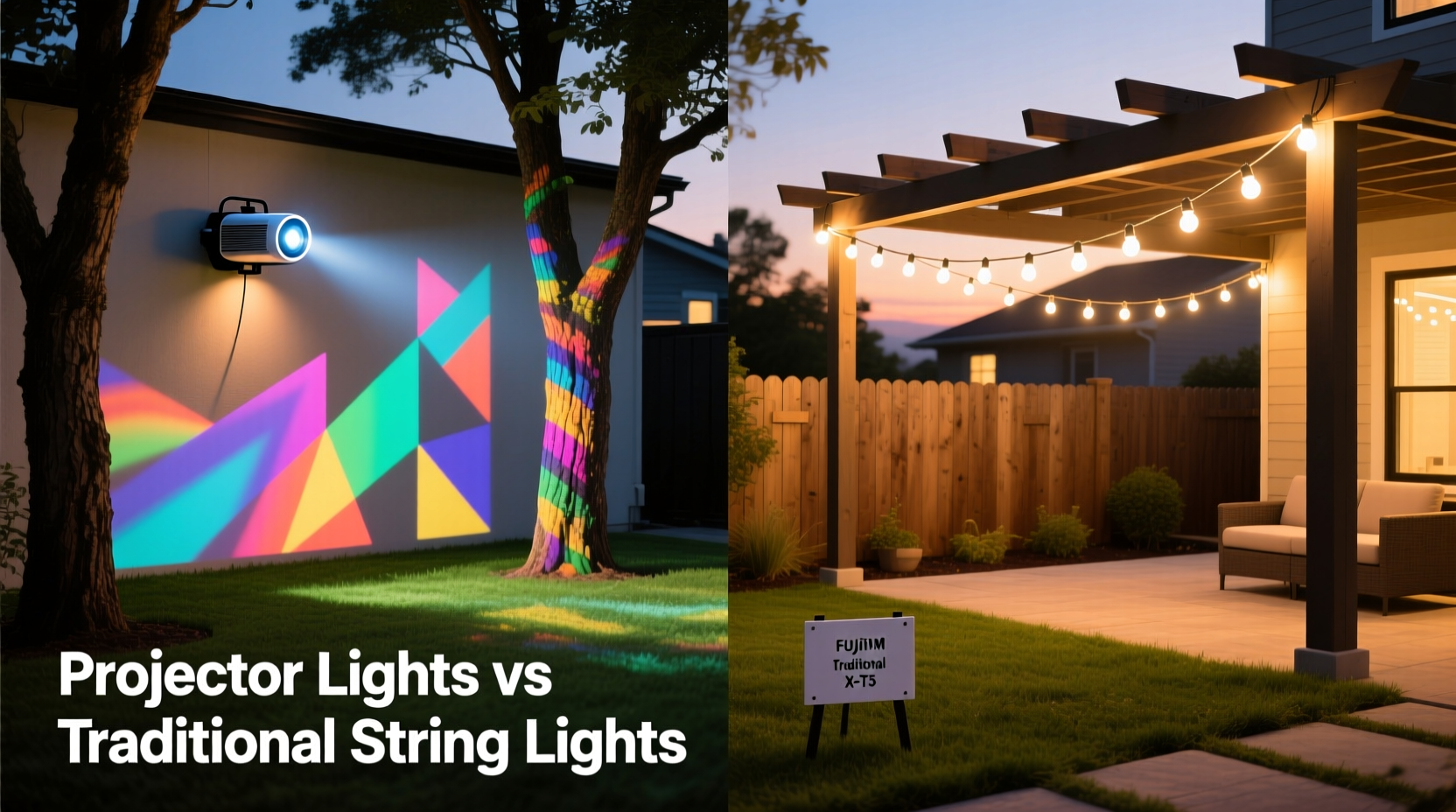
String lights—also known as fairy lights, patio lights, or holiday lights—have been a staple in outdoor decor for decades. They consist of a series of small bulbs connected by a long electrical wire, often powered by an outlet or solar panel. Available in incandescent, LED, and smart variants, they offer flexibility in design and placement.
Typically, users drape these lights across fences, wrap them around trees, hang them from eaves, or suspend them between poles using hooks or wires. The charm lies in their warm glow and customizable patterns. However, this customization comes at a cost: time and effort. Installing string lights is inherently labor-intensive. Each bulb must be positioned deliberately, and the wiring must be secured safely to prevent tripping hazards or weather damage.
For example, lighting a 30-foot backyard fence with standard 25-light strands may require four to six separate strings, each needing individual hanging, testing, and adjustment. If one section fails, troubleshooting can mean checking multiple connections, fuses, or individual bulbs—especially with older incandescent models.
The Rise of Projector Lights: A New Approach to Yard Illumination
Projector lights represent a shift toward efficiency in outdoor lighting. Instead of placing individual bulbs throughout the yard, these devices project hundreds—or even thousands—of light points from a single unit. Mounted on a stake or wall bracket, they use internal LED arrays and rotating lenses to scatter pinpoint lights across lawns, walls, or trees, mimicking the look of scattered stars or snowfall.
Most projector lights are designed for plug-and-play operation. Simply place the unit in the desired location, aim it at the target surface (like a house facade or tree line), and turn it on. Many models include remote controls, timers, and multiple lighting effects such as twinkling, falling snow, or color-changing modes. Some advanced versions even sync with music or respond to motion.
Because they rely on projection rather than physical distribution, projector lights drastically reduce setup time. One device can cover up to 800 square feet, depending on model and distance. This makes them ideal for renters, busy homeowners, or anyone who wants dramatic visual impact without hours of manual labor.
“Projector lights are changing how people think about seasonal décor. They deliver instant ambiance with minimal effort.” — Marcus Tran, Outdoor Lighting Designer
Comparative Analysis: Installation, Coverage, and Maintenance
To determine which option “lights up your yard easier,” we need to evaluate key factors: setup speed, area coverage, durability, energy use, and adaptability.
| Feature | Traditional String Lights | Projector Lights |
|---|---|---|
| Installation Time | 30–90+ minutes (depending on size) | 5–10 minutes |
| Coverage Area | Limited to linear paths (e.g., fences, railings) | Broad field (up to 800 sq ft per unit) |
| Setup Complexity | High (requires planning, measuring, securing) | Low (place, aim, power on) |
| Maintenance Needs | Moderate to high (bulb replacement, rewiring) | Low (clean lens occasionally) |
| Weather Resistance | Varies; many are not fully sealed | Generally high (IP65-rated models common) |
| Storage Size | Bulky (coiled wires, fragile bulbs) | Compact (single housing unit) |
| Energy Efficiency | Good (LED versions) | Excellent (low-wattage LEDs) |
| Flexibility in Design | High (custom layouts possible) | Moderate (preset patterns only) |
The data clearly shows that projector lights outperform string lights in terms of speed and simplicity. For someone looking to illuminate a yard quickly—especially during short winter daylight hours or last-minute events—projectors offer unmatched convenience. On the other hand, string lights allow greater artistic control. You can shape them into spirals, frames, or layered curtains of light, making them better suited for permanent installations or themed displays.
Real-World Example: Holiday Setup at Two Neighboring Homes
Consider two neighbors, both preparing their homes for Christmas. Sarah opts for traditional string lights. She spends three evenings untangling old strands, replacing burnt-out bulbs, measuring distances, and installing clips along gutters and trees. Her final display includes 1,200 LED bulbs spread across 12 strands. It looks impressive but took nearly five hours total.
Across the street, James uses two projector lights—one aimed at his front lawn, another at the side of his garage. He places each unit on a ground stake, adjusts the angle, sets the timer via remote, and powers them on. Within seven minutes, his entire exterior glows with a dynamic starfield effect. Both homes achieve festive atmospheres, but James accomplished his with less than 10% of the labor.
This scenario reflects a growing trend: consumers prioritizing time savings over granular control. While Sarah’s setup may win a neighborhood contest for detail, James enjoys more free time—and likely repeats the process year after year with confidence.
Step-by-Step: How to Light Your Yard in Under 15 Minutes Using Projector Lights
If ease is your priority, here’s how to get started with projector lights:
- Choose the right model: Look for weatherproof (IP65 or higher), multi-effect projectors with remote control and timer functions.
- Select placement spots: Identify open areas where the projector can face upward toward walls, trees, or roofs. Avoid obstructions like shrubs or low-hanging branches.
- Check power access: Ensure outdoor outlets are nearby or use a heavy-duty extension cord rated for outdoor use.
- Stake or mount the unit: Insert the included stake into soft ground or use brackets for hard surfaces. Adjust tilt until the desired coverage is achieved.
- Test and adjust: Turn on the projector, select your preferred mode (e.g., steady glow, twinkle), and fine-tune the angle if needed.
- Set automation: Program the timer to turn lights on at dusk and off at bedtime for hands-free operation.
- Secure cords: Use cord covers or stakes to keep wires flat and safe from foot traffic or mowing.
With this process, even large yards can be lit uniformly in under 15 minutes. Compare that to the average 2–4 hours required for comparable string light coverage, and the efficiency gap becomes undeniable.
When Traditional String Lights Still Make Sense
Despite the advantages of projector lights, string lights remain relevant in specific situations. Their strength lies in precision and permanence. For instance:
- You want to highlight architectural features like archways or pergolas.
- Your yard has irregular shapes that don’t reflect projected light well.
- You prefer a constant, non-moving glow rather than animated effects.
- You’re building a semi-permanent outdoor lounge or dining area.
In commercial settings—such as restaurants with patios or wedding venues—string lights are often part of the brand identity. Their soft, continuous illumination creates intimacy that projections can’t replicate. Additionally, because they emit light directly along their length, they provide functional lighting for pathways or seating zones, whereas projectors are primarily decorative.
Moreover, some homeowners find the ritual of hanging lights nostalgic or therapeutic. There’s emotional value in the tradition, especially during holidays. Projector lights may save time, but they don’t offer the same tactile connection to seasonal preparation.
Frequently Asked Questions
Can projector lights work in rainy climates?
Yes, most quality projector lights are built with weather-resistant housings (typically IP65 rated), meaning they can withstand rain, snow, and dust. Always verify the manufacturer’s specifications before purchasing for year-round outdoor use.
Do string lights use more electricity than projector lights?
It depends on the model. A full set of 500 LED string lights might consume 25–40 watts, while a typical projector light uses 10–20 watts. So, projectors are generally more energy-efficient, especially when covering large areas.
Can I use both types together?
Absolutely. Many homeowners combine projector lights for broad background illumination and string lights for accent features. This hybrid approach balances speed and aesthetics, offering both drama and detail.
Final Verdict: Which Option Lights Up Your Yard Easier?
When judged purely on ease, projector lights are the clear winner. They require less time, fewer tools, and minimal technical knowledge to install. One device replaces dozens of bulbs and hundreds of feet of wire. They’re portable, reusable, and adaptable to different seasons and occasions. For temporary displays, renters, or those with limited mobility, they represent a significant upgrade in accessibility.
That said, “easier” doesn’t always mean “better for every situation.” Traditional string lights still reign supreme when customization, warmth, and functional lighting are priorities. They offer a level of craftsmanship and continuity that projectors can’t match.
The best choice depends on your goals. If your main objective is to light up your yard quickly and consistently—with minimal hassle—projector lights are the smarter, more efficient solution. But if you value handmade charm and detailed design, string lights will continue to earn their place.
“Technology should serve convenience without sacrificing beauty. The future of outdoor lighting isn’t one or the other—it’s knowing when to use each.” — Lena Patel, Landscape Lighting Consultant
Take Action Today
Don’t let outdated methods keep you from enjoying your outdoor space. Evaluate your yard’s layout, your available time, and your aesthetic goals. Try a single projector light this season—you might be surprised at how much impact a small device can deliver. Or, if you’re committed to string lights, invest in modular, pre-lit systems that simplify storage and reinstallation.




 浙公网安备
33010002000092号
浙公网安备
33010002000092号 浙B2-20120091-4
Comments
No comments yet. Why don't you start the discussion?