
Living in a rental apartment with stringent decoration policies—no nails, no paint, no permanent fixtures—can make creating a warm, personalized space feel like navigating a minefield. Landlords often prohibit wall-mounted sconces, ceiling fans with integrated lights, or even adhesive-backed LED strips if they risk residue or surface damage. Yet light is foundational to atmosphere: it shapes mood, defines function, and signals intention. When your options are limited to non-invasive, reversible solutions, two contenders rise above the rest: portable smart projectors and low-profile string lights. Neither requires drilling, painting, or structural modification—but their suitability hinges on more than just “no holes.” It depends on your ceiling height, outlet access, daily routines, aesthetic goals, and how much you value flexibility versus consistency. This isn’t about choosing prettier lights—it’s about selecting the right tool for your specific constraints, lifestyle, and long-term tenancy.
Why Decor Restrictions Matter More Than You Think
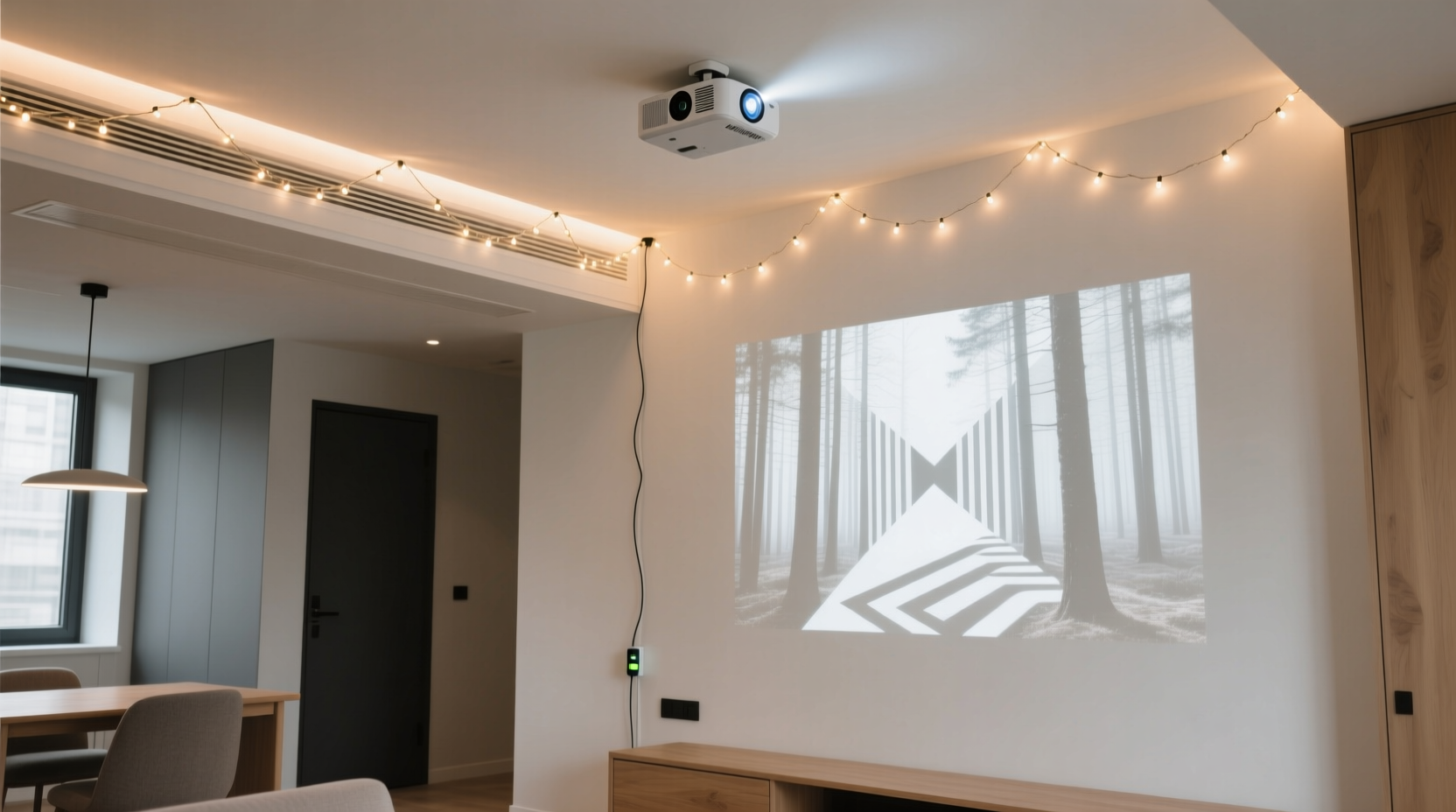
Strict decoration rules aren’t arbitrary—they reflect real legal and financial stakes. Most leases define “alterations” broadly: anything that changes the property’s condition beyond normal wear and tear may trigger restoration clauses. That includes adhesive hooks that peel paint, command strips that lift drywall texture, or even embedded cable channels routed behind baseboards. A 2023 National Multifamily Housing Council (NMHC) survey found that 68% of property managers cited “lighting modifications” as a top-three violation category during move-out inspections—often because tenants misjudge what qualifies as “temporary.” String lights seem harmless until the wire snags on a doorframe and pulls off crown molding. A projector seems safe until its heat vent blocks an HVAC register or its remote sensor interferes with building-wide Wi-Fi. Understanding the *why* behind the rules helps you advocate intelligently—not just comply passively.
Projectors: The Flexible, Functional, but Often Overlooked Option
Smart projectors—especially compact, short-throw models under 2 lbs—are increasingly viable as ambient lighting tools. Unlike traditional home theater units, modern LED-based projectors (e.g., Anker Nebula Capsule 3, XGIMI MoGo Pro) offer built-in Android TV, 360° keystone correction, and auto-focus—all while operating silently and generating minimal heat. Used intentionally, they don’t just replace screens; they transform walls and ceilings into dynamic light canvases.
Their advantages for restricted apartments are structural: no mounting hardware, no wiring across floors, no visible infrastructure. Projectors sit on a shelf, desk, or even a stack of books—and when not in use, they vanish into a drawer. They deliver variable color temperature (2700K–6500K), adjustable brightness (100–500 ANSI lumens), and programmable schedules. You can cast a soft amber wash over your bedroom wall at night, project a starfield onto the ceiling for sleep, or display rotating nature scenes in your living area without touching a single surface.
But projectors demand environmental awareness. They require a clean, light-colored surface (white or light gray walls work best), minimal ambient light for optimal effect, and at least 6 feet of unobstructed projection distance. In studios or walk-through layouts, placement can be tricky—especially if furniture must remain movable. And while most models run on standard USB-C power, cord management still matters: a dangling 10-foot cable taped to baseboard violates many “no adhesives” clauses.
String Lights: The Familiar Choice—With Hidden Limitations
String lights—particularly battery-operated, micro-LED varieties—are widely assumed to be “lease-safe.” And they often are… until they’re not. Their appeal is undeniable: low cost, instant ambiance, and effortless installation. But compliance hinges entirely on execution—not product type. Many renters mistakenly assume “battery-powered = automatically approved,” overlooking three critical factors: attachment method, heat generation, and visual impact.
Adhesive-backed clips, tension rods across windows, or draped wires over curtain rods may seem temporary, yet they frequently violate lease terms prohibiting “affixing objects to walls, doors, or fixtures.” Even removable tape can leave residue on painted drywall, especially in older buildings with brittle latex paint. Further, incandescent or older LED strings generate noticeable heat—enough to warp plastic window frames or discolor curtains over time. And while subtle twinkle lights suit a cozy reading nook, dense clusters of warm-white bulbs along a kitchen backsplash can read as “commercial signage” to overly cautious property managers.
| Feature | Smart Projector (e.g., XGIMI MoGo Pro) | Battery String Lights (e.g., Govee 200-Bulb Micro-LED) |
|---|---|---|
| Installation Time | Under 2 minutes (place + power on) | 15–45 minutes (measuring, attaching, testing) |
| Surface Contact Required? | No—projects onto existing surfaces | Yes—requires clips, tape, or hooks |
| Movement Flexibility | High—reposition anytime; no trace left | Low—relocation risks residue or damage |
| Ambient Light Control | Full spectrum, dimmable, color-shifting | Limited to preset modes; rarely dimmable below 30% |
| Move-Out Readiness | Zero cleanup; device packs in 30 seconds | Risk of paint lifting, texture damage, or adhesive residue |
Real-World Scenario: Maya’s Studio Apartment Dilemma
Maya lives in a 450-square-foot studio in Chicago’s Logan Square—a historic building with iron-clad lease terms forbidding any wall penetration or adhesive use. Her unit has 9-foot ceilings, one north-facing window, and beige textured walls. She wanted warmth in her sleeping zone without sacrificing her minimalist aesthetic.
She first tried string lights: battery-powered copper wire lights with tiny clear clips. Within two weeks, she noticed faint peeling near the top edge of her closet door frame where a clip had been affixed. Her property manager issued a formal notice citing “unauthorized surface modification.” Discouraged, Maya switched to a $299 XGIMI MoGo Pro. She placed it on a floating shelf 7 feet from her bed wall, projecting a slow-pulsing gradient of deep indigo to soft lavender. No attachments. No cords crossing the floor. She used its built-in timer to fade out after 90 minutes—mimicking natural dusk. At move-out, she simply unplugged and packed it. Her security deposit was returned in full. As she told a local tenant advocacy group: “I thought string lights were the ‘safe’ choice. Turns out the safest choice was the one that touched nothing at all.”
Expert Insight: What Lighting Designers Actually Recommend
“Landlord restrictions force creativity—not compromise. Projectors are underutilized in residential rentals because people think of them as ‘for movies.’ But ambient projection is the ultimate non-invasive lighting strategy: zero contact, infinite customization, and total reversibility. String lights win on nostalgia and simplicity, but only if installed with zero-surface methods—like magnetic strips on steel-framed doors or gravity-based stands. Anything involving adhesion is a liability waiting to happen.” — Lena Torres, Interior Lighting Consultant & Author of Rent-Ready Illumination
Actionable Decision Framework: Which Solution Fits Your Space?
Don’t choose based on preference alone. Use this step-by-step evaluation to determine the optimal path for your apartment:
- Assess Surface Integrity: Run your hand over walls, trim, and doors. If paint feels chalky, cracks easily, or lifts with gentle pressure, avoid *any* adhesive—even “removable” tape. Projectors become the default safe choice.
- Map Power Access Points: Count accessible outlets within 6 feet of your target zones. If outlets are scarce or behind furniture, prioritize battery-powered string lights *only if* you can route cords cleanly using floor-level raceways (check lease for “cord cover” allowances) or use rechargeable projectors with 3+ hour battery life.
- Define Primary Function: Is light needed for task (reading, cooking), ambiance (dining, winding down), or both? Projectors excel at large-area ambiance and mood-setting; string lights better serve focused zones (above a desk, around a mirror) when mounted without adhesives.
- Test Visual Scale: Measure your largest open wall. If it’s under 60 inches wide and heavily textured, projector images will blur or pixelate. String lights may render more cohesively here—provided you use ultra-thin, matte-finish wires and diffuse bulb covers.
- Evaluate Long-Term Tenure: Planning to stay >12 months? Invest in a projector—it pays for itself in avoided damage fees and repeated replacement costs. Under 6 months? Prioritize low-risk string lights with magnetic or clamp-based mounting (e.g., lights designed for bookshelves or metal headboards).
Frequently Asked Questions
Can I use string lights on my ceiling if I attach them to a removable tension rod instead of the ceiling itself?
Yes—*if* the rod is freestanding (not wedged into crown molding or attached to light fixtures) and doesn’t require wall anchors. Tension rods designed for shower curtains or closet systems are generally acceptable, provided they don’t compress or scuff trim. Always confirm with your property manager in writing before installation.
Do projectors cause glare or disturb neighbors through windows?
Not with proper setup. Modern smart projectors emit directional light—no beam spills sideways or upward unless misaligned. Mount the projector facing inward, not toward windows. For added safety, use the projector’s “eco mode” (reducing brightness by 30%) and enable automatic ambient light sensing so it dims when room light increases. No neighbor has ever filed a complaint about a properly configured projector—unlike string lights, whose flicker or blue tones can sometimes be visible through thin curtains.
What’s the most landlord-friendly string light alternative if I absolutely need linear accent lighting?
Opt for “plug-and-play” linear LED strips housed in rigid aluminum channels with pre-installed end caps—mounted using heavy-duty, non-adhesive C-clamps to existing furniture (e.g., underside of a floating desk, inside a bookshelf frame). These produce uniform, shadow-free light, generate negligible heat, and leave zero residue. Brands like Luminoodle and Govee offer clamp-ready kits specifically marketed for rental use.
Conclusion: Choose Intention, Not Convenience
Your apartment’s lighting shouldn’t be a compromise between aesthetics and compliance—it should be a deliberate expression of how you inhabit space responsibly. Projectors offer unprecedented freedom: transforming blank walls into evolving backdrops without altering a single surface. String lights provide intimacy and tradition—but only when deployed with surgical attention to attachment ethics and thermal safety. Neither is universally superior. The right choice emerges from honest assessment of your walls, your lease, your habits, and your willingness to rethink what “lighting” means. Stop asking, “What can I get away with?” Start asking, “What lets me live well—today, next month, and at move-out?” That shift in framing turns constraint into clarity. Your space deserves light that honors both your humanity and your tenancy agreement. Pick the tool that does both—then use it with purpose.




 浙公网安备
33010002000092号
浙公网安备
33010002000092号 浙B2-20120091-4
Comments
No comments yet. Why don't you start the discussion?