
When it comes to setting up an entertainment hub in the bedroom, the choice between a traditional TV and a projector isn’t just about screen size—it’s about lifestyle, space, lighting, and long-term usability. Many are drawn to the cinematic allure of a projector: massive images, immersive viewing, and a theater-like ambiance. But does that dream translate into daily practicality? Or does a sleek, reliable TV still win when it comes to convenience and consistency?
This comparison goes beyond specs and price tags. It’s about how each option fits into real-world routines—late-night scrolling, weekend movie binges, morning news checks, or even using the screen for work or fitness videos. Let’s dissect both technologies through the lens of bedroom-specific needs.
Image Size and Immersion: The Projector’s Big Advantage
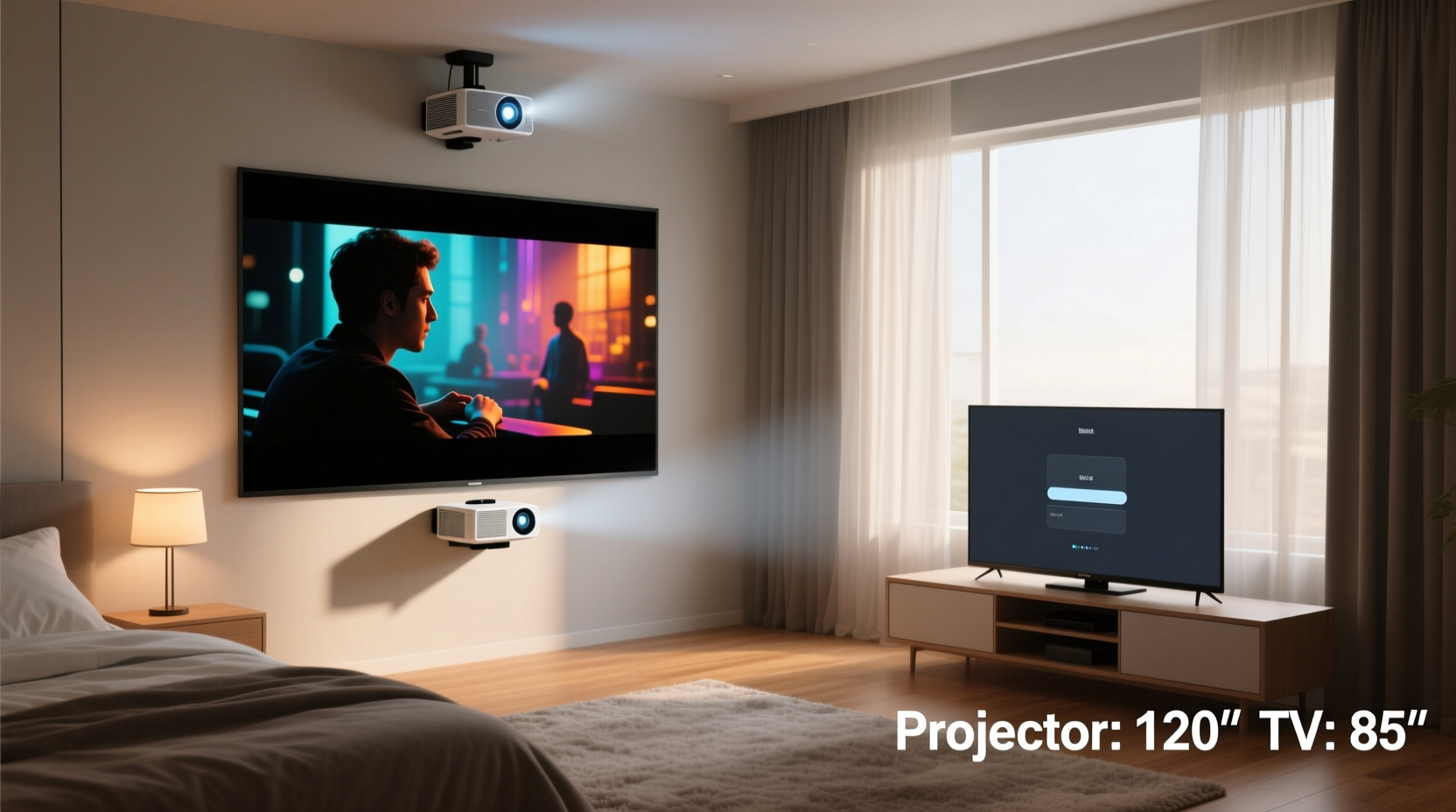
The most obvious benefit of a projector is scale. While even high-end TVs max out around 85 inches, projectors can easily deliver 100-inch+ images without breaking the bank. In a bedroom, especially one with limited floor space, this allows for a dramatic visual upgrade without sacrificing square footage.
Projectors thrive in dark environments. With no ambient light bleeding from the screen itself, black levels can appear deeper, and contrast more pronounced—especially with modern laser or LED models. When properly calibrated, a good projector in a darkened bedroom can rival high-end OLEDs in cinematic quality.
However, image size isn’t always an advantage. A 120-inch screen in a small bedroom might feel overwhelming during casual daytime use. Watching YouTube clips or checking the weather on a giant wall can be excessive and impractical. Plus, focusing and aligning the image requires precision. Keystone correction helps, but overuse degrades quality.
Light Sensitivity and Ambient Conditions
One of the biggest hurdles for bedroom projectors is light control. Unlike TVs, which emit their own bright light, projectors reflect light onto a surface. This makes them highly sensitive to ambient illumination. Even moderate room lighting—morning sun, bedside lamps, or hallway glow—can wash out the image.
Most bedrooms aren’t designed like home theaters. Curtains may not fully block sunlight, and many people prefer some ambient lighting at night. This reality limits projector usability outside of true dark-room conditions. High-brightness projectors (2,500+ lumens) help, but they come with trade-offs: increased fan noise, higher power consumption, and often lower contrast.
In contrast, modern TVs—especially OLED and QLED models—are engineered for varied lighting. They maintain clarity and color accuracy whether the room is pitch black or brightly lit. For viewers who use their bedroom screen during early mornings or with lights on, a TV remains the more consistent performer.
“Projectors deliver unmatched immersion in controlled lighting, but they’re unforgiving in mixed-light environments.” — David Lin, Home Theater Consultant
Installation, Space, and Setup Practicality
Setting up a projector is inherently more complex than mounting a TV. It involves precise placement—either ceiling-mounted or shelf-based—with attention to throw ratio, screen alignment, and cable management. You may also need a dedicated screen, which adds cost and takes up wall space.
For renters or those in compact apartments, drilling into ceilings or walls may not be feasible. Even placing a projector on a dresser requires careful leveling and clearance behind the bed. Any movement—bumping the unit or adjusting furniture—can misalign the image, requiring recalibration.
TVs, on the other hand, offer plug-and-play simplicity. Wall-mounting or using a stand takes minutes. Once set, the display stays stable. Inputs are centralized, remote controls are intuitive, and smart platforms (like Google TV or Roku) integrate seamlessly.
Yet, projectors do save floor and wall space in one key way: they don’t occupy vertical real estate. If your bedroom has low ceilings or cluttered walls, projecting onto the ceiling itself (for reclined viewing) can be a clever workaround—though focus and distortion become bigger challenges.
Projector vs TV: Key Differences at a Glance
| Feature | Projector | TV |
|---|---|---|
| Max Screen Size | 100–300 inches | Up to 85 inches (consumer models) |
| Light Sensitivity | High – requires dark room | Low – performs well in all lighting |
| Installation Complexity | High – alignment, cabling, mounting | Low – plug and play |
| Lifespan (Lamp/LED) | 2,000–10,000 hours | 50,000+ hours |
| Avg. Cost (100\"+ equivalent) | $800–$2,500+ | $1,500–$4,000+ |
| Noise Level | Noticeable fan noise | Silent operation |
| Daily Usability | Moderate – best for intentional viewing | High – ready anytime |
Long-Term Costs and Maintenance
While projectors can offer large-screen experiences at lower upfront costs than premium TVs, their long-term expenses add up. Traditional lamp-based models require bulb replacements every 2,000 to 5,000 hours—at a cost of $100–$300 per bulb. Even LED and laser projectors, which last longer (up to 20,000 hours), aren’t immune to dust accumulation, filter cleaning, and eventual internal wear.
TVs, particularly modern flat panels, are largely maintenance-free. No consumables, no moving parts, no regular servicing. Their lifespan typically exceeds 7–10 years with minimal degradation. Repair costs can be high if the panel fails, but failures are relatively rare compared to projector components.
Additionally, projector brightness diminishes over time. What starts as a vibrant 3,000-lumen image may degrade to 1,500 lumens after a few years, significantly affecting picture quality—especially in less-than-ideal lighting.
Real-Life Use Case: The Hybrid Bedroom Setup
Consider Sarah, a 34-year-old graphic designer living in a 500-square-foot urban apartment. Her bedroom doubles as a relaxation and occasional workspace. She wanted a cinematic experience but also needed functionality for morning news, video calls, and quick browsing.
She initially installed a 1080p HD projector with a pull-down screen. The weekend movie nights were stunning—deep blacks, expansive image, full immersion. But she quickly noticed drawbacks: the projector took 30 seconds to warm up, the fan was audible during quiet scenes, and daytime use was nearly impossible due to street-facing windows.
After three months, she added a 43-inch OLED TV mounted on a swivel arm above her dresser. Now, she uses the TV for daily tasks and the projector only on weekends. While this hybrid approach works, it required double the investment, extra cables, and remote confusion.
Sarah’s experience highlights a common reality: projectors excel in dedicated viewing scenarios but fall short as all-in-one bedroom displays. For those seeking both versatility and spectacle, a dual setup may be ideal—but it’s not the most practical or economical path for everyone.
Step-by-Step: How to Decide What’s Right for Your Bedroom
Choosing between a projector and a TV shouldn’t be based on hype or isolated specs. Follow this decision framework tailored to bedroom use:
- Assess your room’s lighting. Can you fully blackout the space? Do you often watch with lights on? If not, a TV is likely the better fit.
- Measure available space. Ensure adequate throw distance for a projector. Small rooms may limit screen size or require ultra-short-throw models (which cost more).
- Define your primary use. Is it movies and gaming (favoring projectors), or mixed use including news, apps, and daytime viewing (favoring TVs)?
- Check noise tolerance. Listen to sample videos of projector fan noise. If you’re a light sleeper, even “quiet” models may disturb you.
- Calculate total cost. Include screen, mounting, cables, potential bulb replacements, and audio (both usually need external speakers).
- Test before committing. If possible, rent or demo a projector in your actual environment before purchasing.
FAQ: Common Questions About Bedroom Projectors
Can I use a projector on the ceiling for lying in bed?
Yes, many people mount projectors upside-down on the ceiling and project onto a wall or retractable screen. Just ensure the model supports ceiling mounting and has vertical lens shift to adjust the image without keystone distortion.
Do I need a special screen, or can I project on a white wall?
You can use a flat white wall in a pinch, but a dedicated screen improves contrast, color accuracy, and uniformity. For bedrooms, consider a fixed-frame or motorized screen if space allows.
Are smart projectors a viable alternative to a TV?
Some projectors now come with Android TV or built-in streaming apps, reducing the need for external boxes. However, interface responsiveness is often slower than on modern TVs, and app selection may be limited. They’re improving, but not yet on par.
Final Verdict: Is a Projector Practical for a Bedroom?
The answer depends on your expectations. If you prioritize cinematic quality and are willing to adapt your environment—blackout curtains, scheduled viewing, careful setup—a projector can transform your bedroom into a personal theater. It’s a compelling option for film lovers, gamers, or those craving a larger-than-life experience.
But if you value convenience, reliability, and multi-purpose use, a TV remains the more practical choice. It works instantly, performs consistently in any lighting, and integrates smoothly into daily life. Modern mid-range TVs offer excellent picture quality, smart features, and sleek designs that suit bedroom aesthetics.
In essence: projectors offer experience; TVs offer utility. One excels in moments of immersion; the other in everyday usability.
“For most people, a bedroom is a multi-functional space. That’s why reliability and flexibility often outweigh raw spectacle.” — Lena Park, Interior Tech Designer
Conclusion: Make the Choice That Fits Your Life
Don’t let marketing or viral TikTok setups dictate your decision. A bedroom projector isn’t inherently superior—it’s a specialized tool. Its practicality hinges on your habits, room layout, and willingness to manage its limitations.
If you’re captivated by the idea, start small. Try an affordable portable projector to test the waters. See how it feels after a week of real use. Compare it side-by-side with your current screen. You might discover that the magic fades once the novelty wears off—or that it enhances your evenings in ways you hadn’t imagined.
Either way, the best setup is the one you’ll actually use, enjoy, and keep maintained. Whether it’s a glowing rectangle on the wall or a sprawling image on the ceiling, your bedroom should serve you—not the other way around.




 浙公网安备
33010002000092号
浙公网安备
33010002000092号 浙B2-20120091-4
Comments
No comments yet. Why don't you start the discussion?